
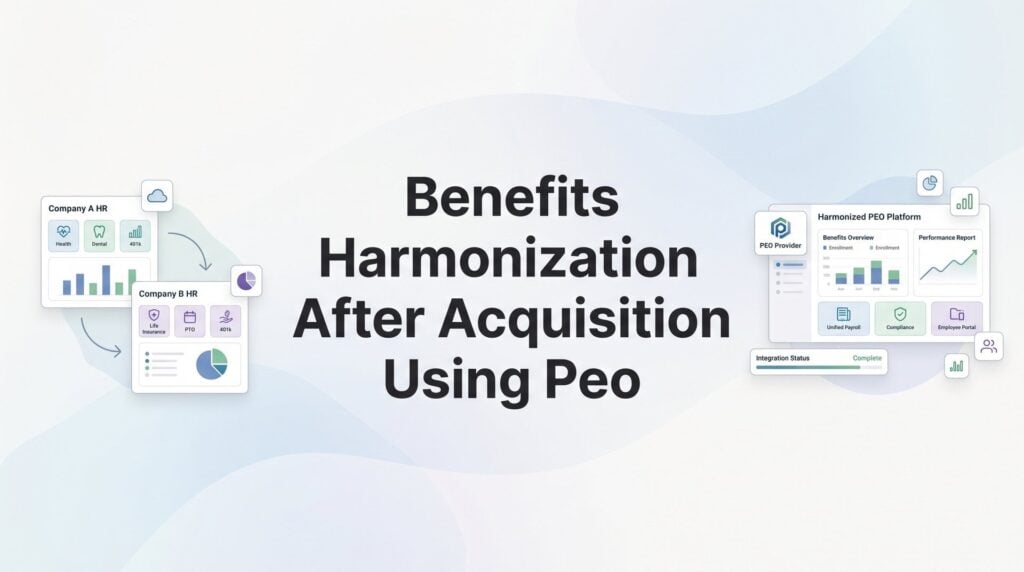
You just closed an acquisition. Congratulations. Now comes the part nobody warned you about in the deal memo: two workforces, two sets of benefits packages, and a room full of employees who are already comparing notes.
Benefits harmonization is consistently one of the messiest parts of post-acquisition integration. It’s not the most glamorous problem, but it’s often the most urgent. Within weeks of a deal closing, acquired employees start asking questions. What happens to their health plan? Does the retirement match change? Will they lose PTO they’ve already accrued? The longer those questions go unanswered, the faster your best people start updating their resumes.
A PEO can be a genuinely useful tool here. It can consolidate two separate benefits structures under one roof quickly, handle the compliance complexity that comes with combining workforces, and buy you time to figure out the long-term HR strategy. But it’s not a universal fix, and using one in the wrong scenario can create new problems while solving old ones. This guide is for the operator or HR leader who already understands the basics of how PEOs work and wants to think clearly about whether this approach makes sense for their specific acquisition situation.
Why Benefits Become the First Fire After an Acquisition
The first 90 days after a deal closes are when retention risk is highest. Acquired employees are already uncertain about their future. Benefits gaps — real or perceived — accelerate that uncertainty into action.
It doesn’t take much. If the acquired company had a generous health plan with low deductibles and the acquiring company’s plan has higher out-of-pocket costs, employees notice immediately. If the retirement match drops, they notice. If PTO policies are less flexible, they notice. And in a small company where everyone talks to everyone, these comparisons happen fast.
The compliance picture is equally complicated. When you acquire a company, you inherit its obligations. COBRA administration for employees who leave during the transition becomes your responsibility. If the acquired company had its own ERISA-governed retirement plan, you’ll need legal counsel to decide whether to merge it, terminate it, or maintain it separately — each option carrying different timelines and notice requirements. State-specific continuation coverage laws may apply differently depending on where the acquired employees are located, adding another layer if the acquisition crosses state lines.
There’s also the ACA employer mandate threshold to consider. If either company was below 50 full-time equivalent employees before the deal and the combined entity crosses that line, you’ve just become an Applicable Large Employer. That means new reporting requirements, minimum coverage standards, and affordability thresholds that didn’t apply before. Most acquirers don’t budget for this shift.
On top of all that, there’s the sheer administrative weight of it. You’re reconciling multiple carriers, potentially different plan years, different eligibility waiting periods, different enrollment systems, and different broker relationships — all while trying to make sure nobody has a coverage gap during the transition. It’s a lot to manage even if you have a dedicated HR team. For smaller companies that don’t, it can become genuinely unmanageable without outside help.
This is the context in which a PEO starts looking attractive. Not because it’s the only solution, but because speed and simplicity matter a lot in this window. Understanding how a post-acquisition integration plan works can help you prepare before the deal even closes.
What a PEO Actually Does During Benefits Harmonization
The core value a PEO brings to this scenario is consolidation. Instead of maintaining two separate employer-sponsored benefits programs with separate carrier agreements, separate plan documents, and separate compliance obligations, a PEO moves both workforces onto a single master plan that the PEO sponsors.
That last part matters more than it might seem. Because the PEO operates under a co-employment model, it becomes the plan sponsor for benefits purposes. That simplifies the legal complexity of merging two employer-sponsored plans considerably. You’re not technically merging two plans — you’re transitioning employees from their existing plans onto the PEO’s plan. That’s a cleaner process from an ERISA standpoint, though you’ll still want legal review of any retirement plan obligations from the acquired company.
Health, dental, vision, life insurance, and often retirement plans all get consolidated under the PEO’s umbrella. The PEO handles carrier negotiations, plan administration, and the ongoing compliance layer: ACA reporting, COBRA administration for departing employees, and state-specific requirements that may have changed now that your workforce spans different geographies. For a deeper look at what this actually covers, see our guide on PEO benefits administration.
Timing is one of the strongest arguments for this approach. A PEO can typically onboard an acquired workforce within 30 to 60 days if the transition is well-organized. That’s fast enough to bridge the gap before coverage lapses become a problem. Without a PEO, you’re often looking at waiting for a plan renewal window, negotiating with carriers to add a new group mid-year, or using short-term coverage solutions that are expensive and unsatisfying for employees.
The PEO also takes on the enrollment logistics: setting up the acquired employees in the enrollment system, communicating plan options, managing the paperwork, and handling ongoing payroll integration for benefits deductions. For a lean HR team managing an integration while also trying to run the business, that operational lift matters.
One thing to be clear about: the PEO doesn’t eliminate the need for employee communication. That part still falls on you. Employees need to understand what’s changing, what’s staying the same, and what the timeline looks like. A PEO can provide templates and support, but the relationship communication is yours to manage.
The Cost Math: PEO Harmonization vs. Doing It Yourself
The DIY path is more expensive than most people expect upfront. Benefits harmonization without a PEO typically requires a benefits consultant to audit both plans and design a transition strategy, legal counsel to review ERISA obligations and plan document requirements, and often a temporary broker arrangement to manage the acquired company’s coverage until you can consolidate. Add in the staff time required to manage the transition and you’re looking at a meaningful first-year cost even before you factor in any premium increases.
A PEO bundles most of that into its service fees. You’re paying one entity to handle plan administration, compliance, enrollment, and carrier management. For companies where the combined headcount is under 150 employees, that bundled model often pencils out favorably compared to assembling the same capability piece by piece. Running a thorough acquisition cost modeling exercise before committing is the best way to validate this.
There’s also the purchasing power angle. PEOs aggregate employees across their entire client base, which gives them leverage with carriers that a 75-person or 100-person company simply doesn’t have on its own. That can translate into better plan rates or richer benefits at comparable cost. It’s not guaranteed, and you should ask any PEO you’re evaluating to show you actual plan comparisons rather than taking this claim on faith. But for smaller combined entities, it’s a real potential advantage.
That said, there are cost traps worth watching. Some PEOs charge migration or onboarding fees for adding an acquired workforce mid-contract. Some impose waiting periods before the acquired employees can access certain benefits, which may force you to maintain the old plan longer than you planned. Multi-year contract lock-ins are common, and in an acquisition scenario where headcount and strategy can shift quickly, that reduced flexibility has real cost implications.
A few questions worth asking any PEO before you sign:
Migration fees: Is there a separate charge to onboard the acquired group, and how is it structured? Flat fee or per-employee?
Waiting periods: Will acquired employees face any waiting period before they’re eligible for the PEO’s health plan? If so, how do you bridge that gap?
Headcount fluctuation: If you reduce headcount during integration — which happens — how does the PEO handle that in terms of pricing and minimums?
Exit terms: If the combined entity grows past the point where a PEO makes sense, what does it cost to transition off? This matters more in acquisition scenarios than in typical PEO engagements.
Running a real cost comparison before committing is worth the effort. The numbers will tell you more than any general guidance can.
Where This Approach Breaks Down
A PEO is a good solution for a specific set of scenarios. It’s not universally the right answer, and there are situations where using one for benefits harmonization creates more friction than it resolves.
The clearest limitation is plan complexity. If the acquired company’s employees had highly specialized benefits — union-negotiated plans, industry-specific retirement structures, executive deferred compensation arrangements — a standard PEO master plan likely can’t replicate what they had. That’s a benefits downgrade, regardless of how the plan compares on paper. Employees who feel like they lost something in the acquisition will remember it, and retention risk goes up, not down.
Headcount is the other major factor. The cost advantage of PEO pooled benefits erodes as the combined entity gets larger. The rough threshold that comes up most often in practice is somewhere around 150 to 200 employees. Above that, a direct-to-carrier strategy with a dedicated benefits broker and an in-house HR team often becomes more cost-effective. Understanding the differences between a PEO vs benefits broker model can help you decide which path fits your situation. If your acquisition pushes you past that range, you may be using a PEO as a short-term bridge rather than a long-term solution — which is fine, but it should be intentional and priced accordingly.
There’s also a cultural dimension that’s easy to underestimate. Some companies build their employer brand around benefits flexibility: multiple plan tiers, HSA options, voluntary benefits, pet insurance, whatever their workforce values. A hybrid benefits strategy can sometimes address this by blending PEO coverage with supplemental options. Moving those employees onto a one-size-fits-all PEO plan can feel like a step backward even if the core health coverage is comparable. The loss of optionality matters to some employees more than the plan details themselves.
None of this means a PEO is the wrong choice. It means the decision requires an honest assessment of what the acquired workforce actually had, what they value, and whether the PEO’s plan portfolio is flexible enough to approximate it. The best PEOs for acquisition scenarios offer multiple plan tiers and some degree of customization. The ones that don’t are better suited to straightforward situations.
A Realistic Timeline for PEO-Led Benefits Harmonization
One of the most useful things you can do before a deal closes is start the benefits audit early. The more you know about the acquired company’s plan obligations before day one, the faster you can move.
Pre-close (30-60 days before): Pull together the full benefits picture for both companies. Plan documents, carrier contracts, renewal dates, employee census data, outstanding claims obligations, and any contractual commitments the acquired company made to employees around benefits. This is also when you should be talking to PEO candidates if you’re considering that route — getting a preliminary assessment of what onboarding would look like and what the timeline would be.
Days 1-30 post-close: Move quickly on communication. Acquired employees need to know what’s happening with their benefits, even if the full transition isn’t complete yet. Ambiguity is what drives people to leave. If you’re using a PEO, this is the active onboarding window: employee data into the PEO’s system, bridge coverage arrangements for anyone who needs them, enrollment materials distributed, and payroll integration started. Don’t let this window slip.
Days 31-90: Full harmonization should be largely complete by the end of this window. Both workforces on a single benefits platform, unified enrollment portal, consolidated payroll reporting. This is also when you run a deliberate pulse check with the acquired workforce. What questions are still unanswered? Where is there frustration? Early feedback is much easier to address than resentment that’s had three months to build. Comparing your internal HR costs vs PEO expenses at this stage helps confirm you’re on the right track financially.
Ninety days is an aggressive but achievable timeline with a PEO that has genuine M&A integration experience. Without one, the same process often stretches to six months or longer, particularly if you’re waiting for plan renewal windows or negotiating new carrier agreements from scratch.
Choosing the Right PEO for Post-Acquisition Integration
Not every PEO is built for this. General-purpose PEOs that primarily serve stable small businesses may not have the systems, staffing, or experience to handle an acquisition-driven onboarding with the speed and precision the scenario requires. It’s worth asking directly.
Specifically, ask about M&A integration experience. How many acquisition-driven onboardings have they handled in the past two years? Do they have a dedicated transition team or does your account just get absorbed into a standard onboarding queue? Can they handle multi-state workforces if the acquired company operates in different geographies than you do? State-specific compliance requirements vary enough that a PEO with limited multi-state experience can create problems rather than solve them. Resources on using a PEO during acquisition integration can help you frame the right questions.
Plan flexibility is the other critical evaluation point. Ask to see the actual plan options available within the PEO’s master plan. How many health plan tiers are there? Are there HSA-compatible options? What does the retirement plan look like? The more the PEO can approximate what both workforces had before, the smoother the transition will be. A PEO that offers a single health plan with no variation is a poor fit for an acquisition scenario where you’re trying to minimize perceived benefits downgrades.
Contract terms deserve extra scrutiny here. Look specifically for:
Mid-year enrollment flexibility: Can the acquired group enroll outside of a standard open enrollment window? If not, you have a timing problem.
Headcount fluctuation provisions: Acquisitions often involve some workforce reduction. Make sure the contract doesn’t penalize you for dropping below a headcount minimum during integration.
Exit provisions: What does it cost and how long does it take to transition off the PEO if the combined entity outgrows the model? This should be clearly defined before you sign, not negotiated under pressure later.
The PEO market has enough variation in how these terms are structured that comparing providers side-by-side with real contract details matters. Headline fees are rarely the full picture.
The Bottom Line on PEO-Led Benefits Harmonization
Benefits harmonization after an acquisition is a time-bounded problem. It’s not permanent infrastructure — it’s a transition challenge with a defined window and a clear finish line. A PEO can be an excellent way to get both workforces under one benefits roof quickly, maintain compliance during the transition, and free up your HR team to focus on the cultural and operational integration work that also needs to happen.
But it’s the right tool for a specific range of situations: combined headcount under 150, no highly specialized plan obligations, a workforce that will accept a consolidated plan structure, and a PEO partner with genuine M&A experience. Outside those parameters, the tradeoffs start to outweigh the benefits.
The decision should be driven by real numbers, not assumptions. What does the PEO’s plan actually cost compared to maintaining separate plans or negotiating a new direct-to-carrier arrangement? What are the contract terms if things change? What does the acquired workforce actually have today, and how does the PEO’s plan compare?
Running that comparison with actual provider data is the only way to know if you’re making a sound decision or just taking the path of least resistance. Don’t auto-renew. Make an informed, confident decision. The right PEO for a post-acquisition scenario looks different from the right PEO for a stable 40-person company, and the details in the contract terms and plan options are where that difference shows up.
