
A California HR director or CFO usually starts looking at a PEO after the same pattern repeats for a few quarters. Payroll is running, but every pay period feels fragile. Benefits keep eating more budget than expected. Managers need help with employee issues. Compliance questions pile up faster than the internal team can answer them. The business isn't looking for theory. It's looking for relief without creating a different kind of risk.
That's where many PEO conversations go sideways. The sales pitch tends to focus on convenience, buying power, and outsourced support. Those things matter. But a PEO in California should be evaluated less like a software subscription and more like a long-term operating model decision. The right provider can reduce administrative drag and improve process discipline. The wrong one can leave the client with the same legal exposure, weaker visibility into costs, and a painful renewal.
Table of Contents
- Is a PEO the Right Move for Your California Business
- What a PEO Actually Does in California
- Navigating California's Unique Compliance Landscape
- The True Cost and Financial Impact of a California PEO
- How to Evaluate and Compare PEO Providers
- Decoding the PEO Service Agreement
- A 7-Step Checklist for Your PEO Decision
Is a PEO the Right Move for Your California Business
California creates a different operating burden than most states. It's not just large. It's structurally complex. The state remains the most populous in the country, with about 39.5 million residents in July 2025, and no single racial or ethnic group forms a majority. About 40% of residents are Latino, 34% white, 16% Asian American or Pacific Islander, and 6% Black, according to the Public Policy Institute of California's population analysis.
That scale matters in day-to-day HR operations. Employers aren't dealing with a simple single-state workforce. They're often managing multilingual communication, varied employee expectations, location-specific practices, and a regulatory environment that gets more complicated as the company grows. For businesses hiring across multiple California markets, a PEO can function less like outsourced admin and more like infrastructure.
A good test is this: what problem is the company trying to solve?
If the issue is only payroll processing, a PEO may be too much. If the issue is broader, such as benefits administration, HR support, onboarding discipline, workers' compensation coordination, and compliance process management, the model becomes more compelling. The most useful framing isn't “Should the company outsource HR?” It's “Which employment functions need a stronger operating system?”
Practical rule: A PEO makes the most sense when the business needs process control across payroll, benefits, compliance, and risk, not just help with one isolated task.
For many California employers, the trade-off sits between building internal capability and renting it. Building gives more control. Renting can create speed. But renting only works if the client understands where responsibility ends and where it doesn't.
That's why buyers should weigh the pros and cons of using a PEO before comparing vendors. The decision comes first. The provider list comes second.
What a PEO Actually Does in California
Most buyers hear “co-employment” and still don't get a clear picture of what they're paying for. In practice, the value of a PEO in California usually sits in four operating pillars.
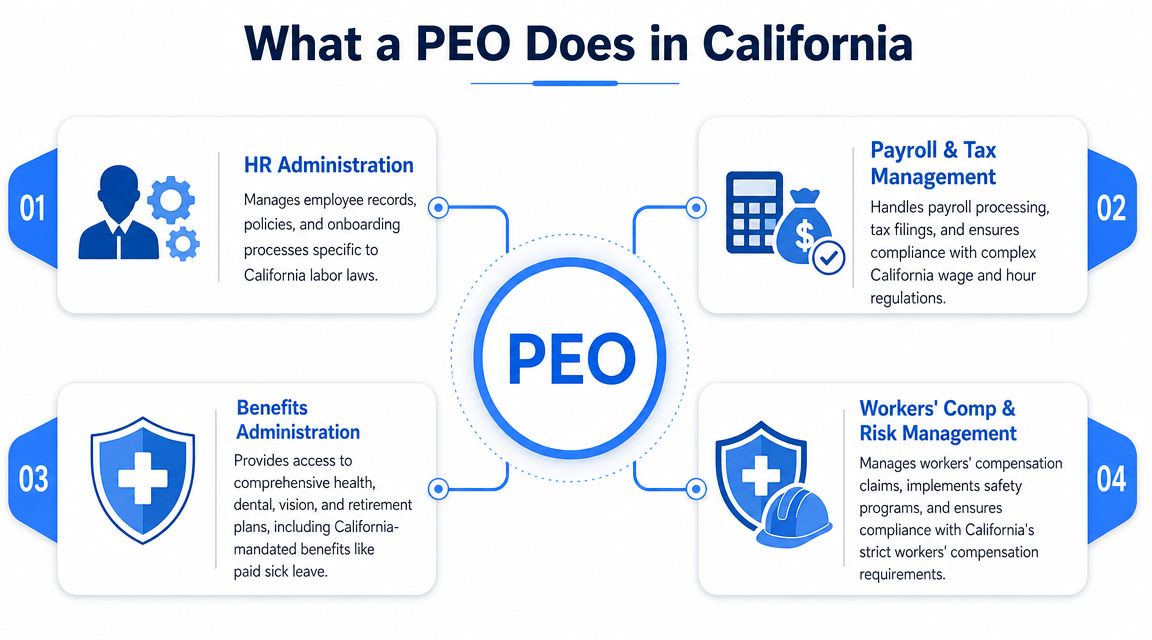
The four operating pillars
Payroll and tax administration is usually the first pillar. That includes payroll processing, tax filings, wage statement support, onboarding records, and the repeatable mechanics that keep a pay cycle clean. In California, that work has to stand up to a more exacting environment than many employers expect. Small process defects can become expensive disputes.
Benefits administration is the second pillar. Here, PEOs often win attention because they can package medical, dental, vision, retirement, and leave administration into one model. For smaller employers especially, that can simplify enrollment, deductions, carrier coordination, and employee service. The key question isn't whether a plan looks good in a proposal. It's whether the network, contribution structure, and renewal behavior still work a year later.
Workers' compensation and risk support is the third pillar. A PEO may place employees under a master workers' comp structure and coordinate claims administration, reporting, and safety support. When this area is handled well, the client gets cleaner workflows and fewer handoffs between payroll, HR, and insurance parties. When it's handled poorly, the client often finds out only after a claim, audit, or cancellation issue appears.
HR administration and compliance support is the fourth. This covers employee handbooks, onboarding, policy updates, manager guidance, required training coordination, and help desk support for routine employee issues. In California, this support matters because the volume of state-specific questions is high and the operational tolerance for error is low.
A more detailed breakdown of these service layers appears in this guide on what a PEO does.
What the client still owns
The common misunderstanding is that these pillars transfer accountability. They don't. They transfer execution on selected tasks and process support around them.
The client still runs the business. It still hires, terminates, manages performance, sets compensation strategy, and makes judgment calls on difficult employee situations. Even where the PEO handles the workflow, the client still needs reporting visibility, approval controls, and enough internal ownership to spot a problem early.
The strongest PEO relationships work like a disciplined operating partnership. The weakest ones turn into a black box where the client assumes someone else is watching the details.
That distinction matters more in California than in lower-complexity states. A PEO can absorb admin. It can't absorb leadership responsibility.
Navigating California's Unique Compliance Landscape
A California company can run payroll on time for months, use a reputable PEO, and still end up paying for a wage claim, a leave dispute, or a workers' comp mess that started with one bad handoff. I see this when founders assume the PEO took over compliance, while managers keep making day-to-day decisions that create the exposure.
California is hard on loose operating discipline. The risk is not just the volume of rules. It is the gap between what the PEO contract says it will support and what your company still has to get right in scheduling, pay practices, documentation, supervisor training, and claim reporting.
Where California employers still get exposed
The companies that struggle are rarely missing a handbook. More often, they have a process problem. The written policy looks fine, but the field practice does not match it.
Common failure points include:
- Wage and hour execution: Meal periods, rest periods, overtime calculations, timekeeping edits, split-shift issues, and final pay timing still rise or fall on manager behavior and payroll controls. For many employers, tightening California wage and hour compliance processes does more to reduce claims than adding another layer of outsourced HR support.
- Leave coordination: California leave administration breaks down when policy language, payroll coding, benefit deductions, and manager communication are handled by different people without one clear owner.
- Classification and recordkeeping: Exempt status decisions, job descriptions, reimbursement practices, and personnel file maintenance need periodic review. A clean implementation does not protect a company if roles drift over time.
- Safety and claims handling: A PEO may place coverage and help manage claims, but delayed reporting, poor return-to-work coordination, or weak communication with the carrier still hit the client in real dollars.
These are operating risks, not just legal theories.
Pay data reporting shows where the line is
Pay data reporting is a useful stress test because it forces a company to find out who owns the data, who validates it, and who signs off when something does not tie out. California requires covered employers to file annual reports with establishment detail, job categories, pay bands, hours worked, and remote-worker information, as noted earlier in this guide.
That reporting burden exposes a recurring problem in PEO relationships. The provider may assemble the file, but the client still needs to reconcile headcount, worker categories, location assignments, and payroll coding before submission. If those records do not line up, filing through a vendor does not remove the employer's exposure.
I advise clients to treat this as a dry run for broader compliance control. If the company cannot trace one report from HRIS to payroll to final certification, it probably has other blind spots too.
Residual liability is where the real decision gets made
California's Department of Industrial Relations states this plainly in its state's PEO guidance from the Department of Industrial Relations. Hiring a PEO does not release the employer from liability. The client still has to confirm workers' compensation coverage, understand cancellation terms, and read the agreement closely enough to know where the provider's responsibility stops.
That point gets softened in sales conversations because it complicates the pitch. It should not be softened in your evaluation.
A disciplined PEO can reduce administrative errors and improve consistency. It can also give smaller California employers access to better systems and more specialized support than they could build internally. The trade-off is that a weak service team, a vague contract, or poor internal ownership can leave the company paying PEO fees while still carrying much of the same downside risk.
For legal teams and executives reviewing co-employment risk, this overview of employer defense for California businesses gives useful context on joint-employer liability issues that can survive outsourcing arrangements.
Decision lens: Ask every provider to walk through three failure scenarios in writing. A late payroll tax filing. A workers' comp lapse or claim dispute. A wage-and-hour claim tied to timekeeping or final pay. Then identify what the PEO covers, what your company still owes, and how fast you would know there is a problem.
The True Cost and Financial Impact of a California PEO
PEO pricing often looks simple until the second year. Buyers focus on the admin fee, compare a few proposals, and assume the cheapest first-year quote is the lowest-cost option. That's where mistakes start.
What the invoice includes and what it doesn't
A PEO invoice usually blends several categories together. The visible line items may include the administrative fee, payroll-related costs, benefit costs, workers' comp charges, and implementation-related items. Some proposals are transparent. Others bury real cost drivers inside bundled language that makes apples-to-apples comparison difficult.
That's why finance teams should separate the decision into two questions:
| Cost area | What to examine |
|---|---|
| Admin pricing | Whether the fee is easy to audit, fixed or variable, and subject to later adjustment |
| Benefits economics | Carrier quality, plan design, employee contribution flexibility, and renewal mechanics |
| Workers' comp structure | How classification, claims handling, and policy administration work in practice |
| Transition costs | Implementation fees, onboarding workload, parallel payroll effort, and exit friction |
The mistake isn't paying for a PEO. The mistake is evaluating only the visible fee while ignoring the total operating model. A provider with a cleaner service model, better benefits fit, and fewer contract traps can be cheaper over time even if the opening quote looks higher.
This resource on how much a PEO costs is useful when building that broader comparison.
Renewal economics matter more than launch pricing
The harder financial question is what happens after the honeymoon period. Businesses should explicitly ask about benefits renewal rates because some providers may increase costs unexpectedly after the first year, as noted in this discussion of California PEO renewal considerations.
That doesn't mean every renewal is abusive. It means the buyer needs to model total cost over multiple renewals, not just implementation. In California, where employers already carry a dense mix of payroll, benefits, and workers' comp expenses, that distinction matters.
A practical review should include:
- Rate protection: Is there any lock on the admin fee, or can it move quickly at renewal?
- Benefits methodology: How are increases communicated, and how much detail will the client receive before open enrollment decisions are due?
- Implementation recovery: If year-one pricing is aggressive, is the provider making that back later through renewal increases or extra service fees?
- Exit cost: What happens if the economics no longer work and the company needs to move off the platform?
A cheap first year can be the most expensive proposal in the room if the contract allows quiet inflation later.
Finance leaders should build a simple multi-year model, then stress-test it. The goal isn't to predict every future cost. It's to avoid being surprised by the parts of the deal the proposal barely mentioned.
How to Evaluate and Compare PEO Providers
Most PEO demos are polished enough to make mediocre providers sound interchangeable. They aren't. The differences show up in service structure, benefits fit, platform usability, and California-specific competence.
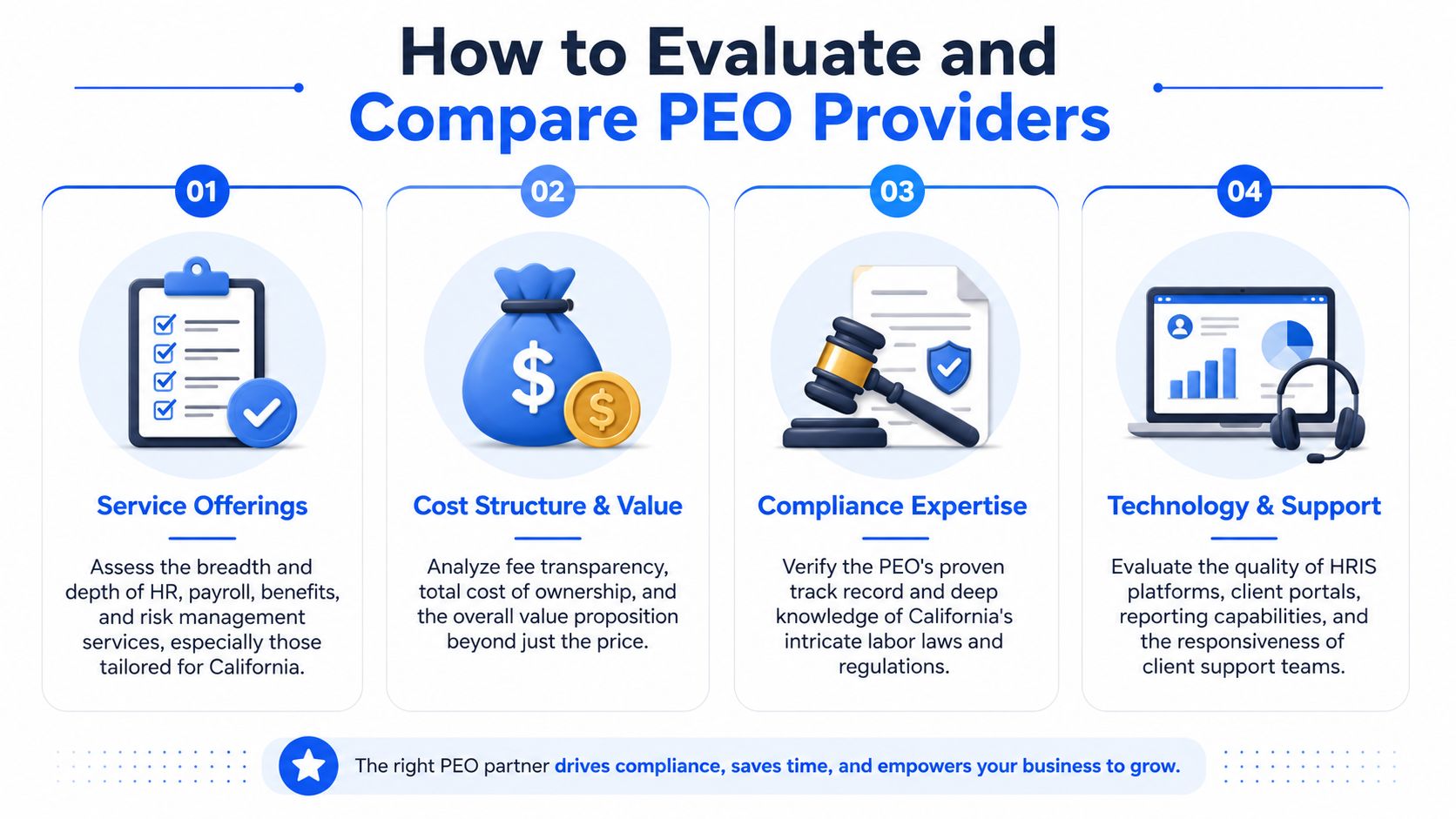
Use a scorecard instead of a demo impression
A side-by-side scorecard works better than open-ended impressions. The company should score each provider against the same criteria and force trade-offs into view.
Service model comes first. Some PEOs assign a dedicated contact structure. Others route most issues through pooled support. Neither model is automatically wrong. A smaller employer with straightforward needs may be fine with centralized support. A business with frequent employee relations issues, messy leave administration, or multiple California locations usually needs named contacts and sharper escalation paths.
Benefits quality deserves its own lane. Buyers often compare premiums and ignore the actual employee experience. Carrier networks, plan design, enrollment support, and contribution flexibility all affect retention and internal friction. If employees can't use the network they expect, the plan savings won't feel like savings.
Technology platform should be tested by the people who will operate it. Payroll admins, HR staff, managers, and employees all touch different parts of the system. A platform that demos well can still create daily frustration if approvals, reporting, or onboarding workflows are clumsy.
California expertise is the final filter. A provider may be strong nationally and still weak on California execution. The issue isn't whether the salesperson knows California terminology. The issue is whether service staff can handle real questions about wage and hour workflow, leave coordination, employee documentation, and claims process without improvising.
One practical option in this comparison phase is PEO Metrics, which reviews providers side by side based on pricing, benefits, contract terms, service model, compliance support, and fit. That kind of structured comparison is usually more useful than collecting a stack of proposals and hoping the differences become obvious on their own.
Questions that expose the gaps fast
Instead of asking broad questions, ask operational ones.
- Ask about support ownership: Who handles payroll issues, benefits escalations, and HR policy questions once the account is live?
- Ask for California examples: How does the provider handle manager questions that involve wage timing, leave coding, or employee classification?
- Ask about implementation strain: What work stays with the client during onboarding, and what typically creates delays?
- Ask about reporting: Can the platform give finance and HR clean visibility into payroll detail, benefits costs, and employee status data without manual workarounds?
A useful comparison format looks like this:
| Evaluation area | Strong answer | Weak answer |
|---|---|---|
| Support | Named team, clear escalation, service continuity | Generic queue, unclear ownership |
| Benefits | Clear carrier and plan detail, transparent renewal process | Broad claims, little renewal clarity |
| Technology | Easy workflows, usable reporting, admin visibility | Attractive demo, weak day-to-day functionality |
| California fit | Operational depth and confident answers | Generic national language |
The buyer should leave every finalist meeting with fewer assumptions, not more.
Decoding the PEO Service Agreement
The service agreement is the least-read document in many PEO deals and the most important one. In California, that matters even more because the state doesn't have a separate PEO licensing regime. PEOs are governed through broader labor, tax, and insurance laws, which makes the language on liability, workers' comp, and tax administration unusually important, as explained in this overview of California PEO regulation.
The contract matters more in California
When there's no standalone state licensing screen, the contract becomes a major source of protection. It defines who does what, how obligations are allocated, what happens when something goes wrong, and how expensive it is to leave.
That means contract review shouldn't be delegated entirely to legal with no input from HR and finance. Legal will look at liability and indemnification. HR will spot workflow assumptions that don't match reality. Finance will notice fee mechanics, renewal language, and termination exposure.
Clauses worth pushing on
Some terms deserve more negotiation attention than buyers usually give them.
- Termination language: Notice periods, early exit charges, and post-termination obligations can turn a provider switch into a costly project.
- Liability allocation: If payroll taxes, claims handling, or compliance tasks are mishandled, the agreement should make responsibilities clear.
- Automatic increases: Vague renewal language can create pricing movement that the sales process barely mentioned.
- Service expectations: If response times and support roles matter, they should be defined rather than assumed.
- Data and transition support: The client should know how employee and payroll data will be delivered if the relationship ends.
A contract review checklist helps keep those issues organized. This PEO master service agreement checklist is a practical starting point for that review.
Contract risk usually hides in ordinary-looking clauses. The expensive problems often come from terms the buyer assumed were “standard.”
The stronger move is to negotiate before implementation urgency takes over. Once the launch calendar is set, bargaining power diminishes.
A 7-Step Checklist for Your PEO Decision
A California company usually feels pressure to make this decision when payroll is messy, benefits costs are rising, or HR support is thin. That is often the worst time to buy. A rushed PEO selection can solve this quarter's pain and lock in next year's pricing, service gaps, and exit costs.
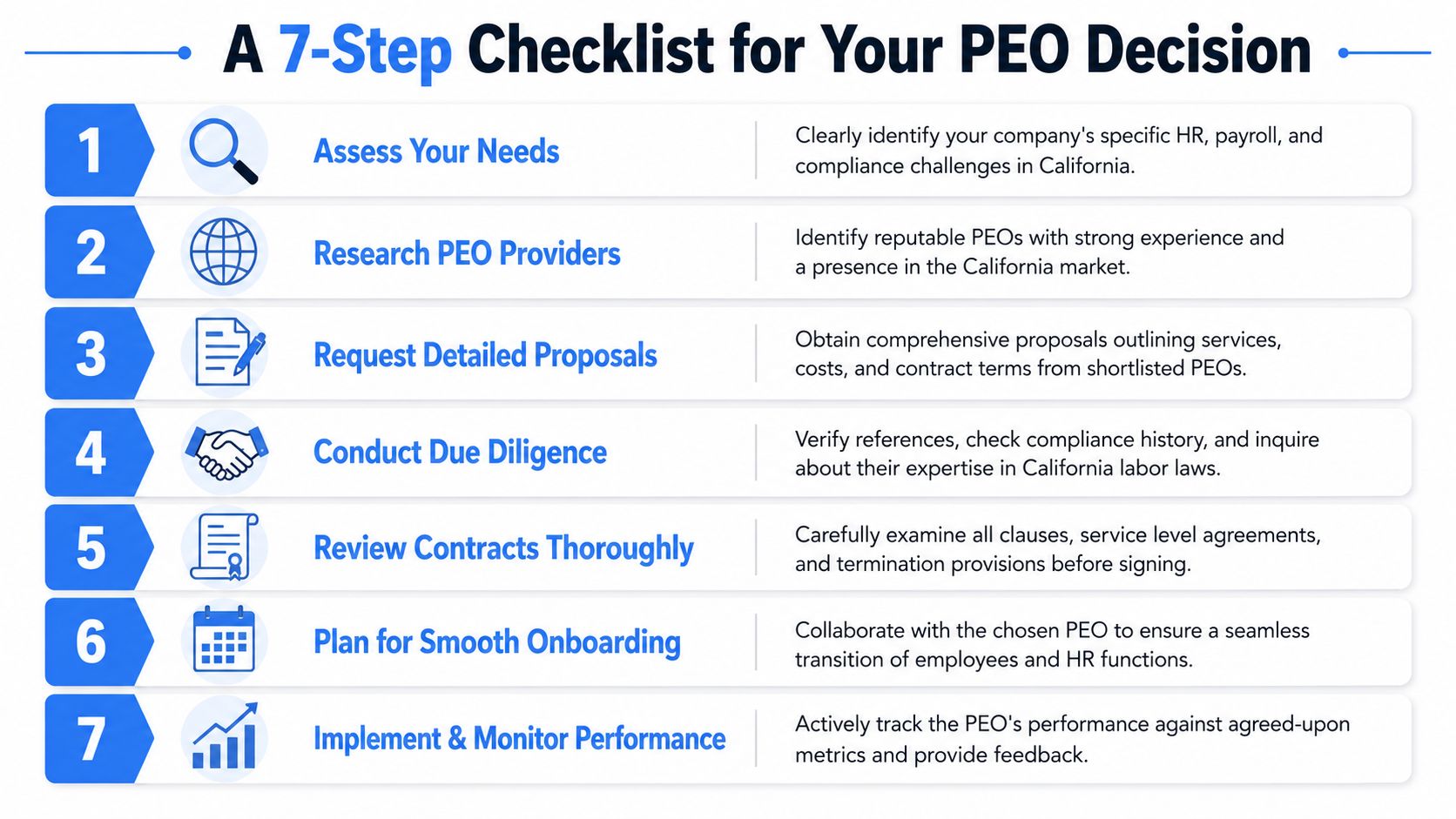
A practical decision sequence
Define the problem you are actually trying to fix. Separate payroll execution problems from benefits strategy, HR capacity, and compliance process weaknesses. A PEO can help with all four, but not equally well, and not at the same price.
Build a real baseline cost. Include current vendor fees, internal HR and finance time, leadership involvement in escalations, compliance cleanup work, and the cost of service failures. Buyers who compare only the quoted admin fee miss the full economic trade-off.
Shortlist providers that match your operating profile. Headcount matters, but so do multi-state hiring plans, workers' compensation mix, leave complexity, and the level of manager support your team expects. A provider that looks efficient at 40 employees can become expensive or operationally clumsy at 120.
Run demos using your own scenarios. Use a new-hire setup, an off-cycle payroll, a California leave request, a benefits enrollment correction, and a reporting request from finance. Generic demos hide handoffs and exception handling. Those are the places where service teams either save time or create more work.
Test residual compliance ownership. Ask the provider to spell out what they do, what they assist with, and what still sits with your company. In California, that line matters. Employers often assume the PEO has "covered compliance" when the client still owns final review, approvals, policy decisions, and data accuracy for certain filings, as noted earlier.
Model first-year and renewal-year cost. Compare per-employee fees, benefit funding assumptions, payroll tax treatment, workers' compensation structure, implementation charges, and any minimums. Then ask how pricing changes at renewal. The launch discount gets attention. The second-year economics drive the longer-term result.
Assign owners before go-live. Name the internal decision-maker for payroll, benefits, employee relations, compliance review, and vendor escalation. A PEO relationship works better when responsibilities are explicit and reviewed on a set cadence after implementation.
Keep the evaluation team cross-functional. HR sees process fit. Finance sees fee mechanics and billing drift. Legal sees allocation of responsibility. Operations sees where service delays affect managers and employees.
If proposals are hard to compare, PEO Metrics can help leadership teams evaluate providers side by side, benchmark total cost, and identify the trade-offs that matter before signing.
