
Auto dealerships don’t have simple workforces. Under one roof you’ve got commission-based salespeople, F&I managers, service technicians with real physical risk exposure, lot attendants, detailers, parts staff, and back-office admin — each with different pay structures, different workers’ comp classifications, and different compliance considerations. Choosing between a PEO and a standalone payroll company in that environment isn’t a minor vendor swap. It’s a decision that affects your insurance costs, your liability exposure, your ability to offer competitive benefits, and how much HR administrative work lands on your desk every week.
This guide covers the tools that can help you think through that decision clearly. But first, a quick framing of what actually separates these two options in a dealership context — because the generic “PEO vs payroll” comparison misses most of what matters here.
What the PEO vs Payroll Decision Actually Looks Like for Dealerships
A standalone payroll company handles wage processing, tax filings, direct deposit, and basic reporting. That’s useful. But it doesn’t touch workers’ comp class code management, it doesn’t share HR liability, it doesn’t offer group health benefits, and it provides no compliance guidance when your F&I manager’s draw structure runs into a wage and hour question.
A PEO enters a co-employment relationship with your dealership. You retain day-to-day control; the PEO becomes the employer of record for tax and benefits purposes. That structure gives you access to the PEO’s master workers’ comp policy, large-group health insurance rates, and HR compliance infrastructure — all of which matter more in a dealership than in most other business types.
The workers’ comp angle alone is worth understanding carefully. Service technicians and lot staff carry meaningfully higher risk classifications than your clerical or sales staff. Managing those class codes under a PEO’s master policy works differently than a standalone commercial policy, and the cost difference can be significant depending on your department mix. This is one of the primary financial levers in the decision — and it’s one most payroll-only comparisons completely ignore.
Sales department turnover is another dealership-specific factor. High turnover increases onboarding and offboarding administrative burden, complicates unemployment insurance exposure, and creates ongoing payroll complexity that a PEO’s HR infrastructure is genuinely built to absorb. A payroll company processes the transactions. It doesn’t reduce the friction around them.
One nuance worth flagging on PEO pricing: most PEOs price either as a percentage of gross payroll or as a flat per-employee-per-month fee. For dealerships with commission-heavy salespeople, percentage-of-payroll pricing can get expensive during strong sales months. PEPM pricing tends to be more predictable in that environment. It’s a dealership-specific wrinkle that rarely comes up in generic PEO evaluations.
Payroll-only can still be the right answer — particularly for very small single-location dealers under 15-20 employees with minimal service department exposure and existing HR support. But the comparison only works when you model all costs together: payroll processing fees, separate insurance broker costs, workers’ comp premiums, and the value of your own time spent managing compliance questions. The tools below help you do that analysis honestly.
1. PEO Metrics
Best for: Dealerships that want unbiased, side-by-side PEO comparisons with real pricing data before committing.
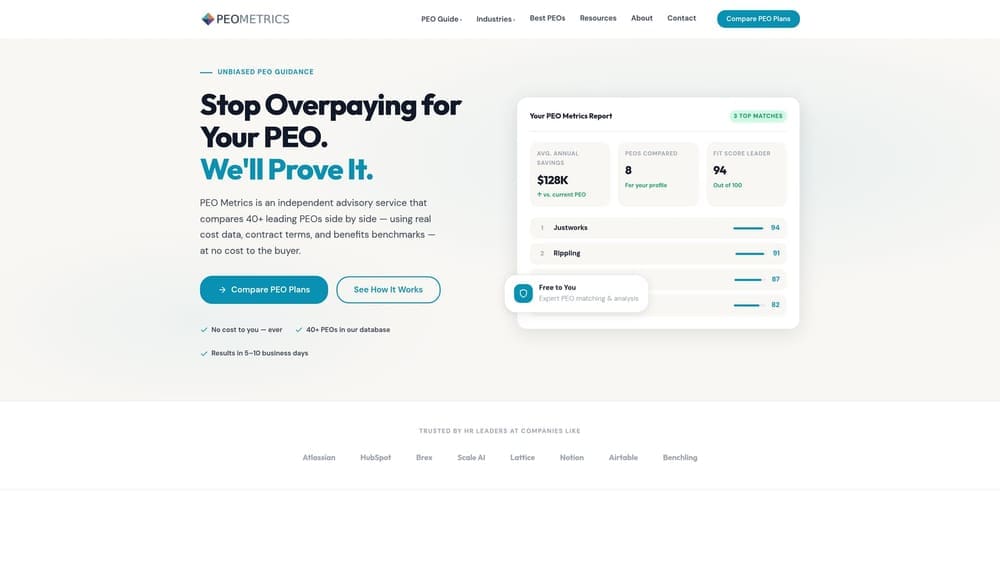
PEO Metrics is an independent PEO comparison service built for businesses that want a clear picture of their options without being sold to by the vendors they’re evaluating.
Where This Tool Shines
Most businesses encounter PEOs through the PEOs themselves — sales reps, broker referrals, or lead-gen marketplaces where providers pay for placement. PEO Metrics operates differently. It’s designed to give you an honest side-by-side view of what different providers actually cost and what they actually offer, with guidance that accounts for your specific workforce profile rather than defaulting to a generic pitch.
For dealerships, that specificity matters. The workers’ comp class code complexity, the commission pay structures, the potential multi-state exposure for larger dealer groups — these factors change which PEOs are actually a good fit and which are priced in ways that will hurt you. PEO Metrics can help identify providers with automotive industry experience and model the total cost of a PEO arrangement against a payroll-only alternative, so you’re comparing apples to apples rather than guessing.
Key Features
Side-by-Side Provider Comparisons: Actual pricing data across multiple PEO providers, not just feature checklists or star ratings.
Unbiased Guidance: No vendor commissions driving the recommendations. The analysis isn’t shaped by who’s paying for placement.
Industry-Specific Filtering: Helps identify PEOs with documented experience in automotive or similarly complex workforce environments.
Total Cost Modeling: Evaluates full PEO cost against payroll-only alternatives, accounting for benefits, workers’ comp, and HR administration — not just the processing fee.
Consultative Approach: Accounts for workforce complexity and risk profile rather than treating every business as the same size and structure.
Best For
Dealerships actively evaluating PEO options for the first time, or those coming up on a renewal and wondering whether they’re overpaying. Also useful for multi-location dealer groups trying to consolidate vendors without making a blind commitment to a single provider.
Pricing
Contact PEO Metrics directly for pricing details. Given the consultative nature of the service, it’s worth a conversation before assuming it’s out of range.
2. Peocompare
Best for: Initial market orientation when you’re just starting to map the PEO landscape.
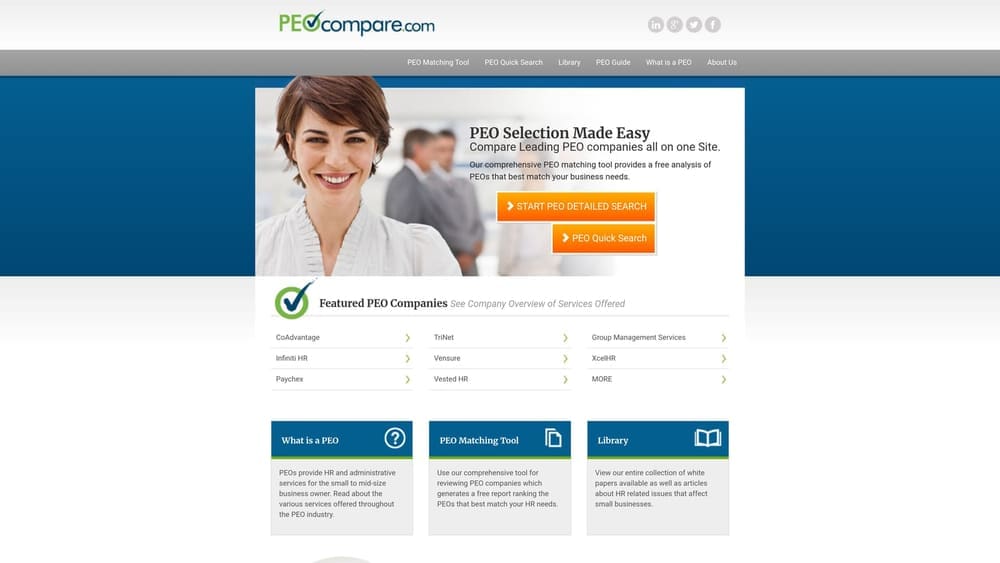
Peocompare is a free platform that lets businesses review multiple PEO providers side-by-side and get a basic sense of what’s available in their region.
Where This Tool Shines
If you’re early in the process and you don’t yet have a clear sense of how many PEO providers operate in your area or what they generally offer, Peocompare gives you a starting point without requiring you to hand over your contact information to a sales team. It’s useful for building a preliminary list of providers to investigate more seriously.
The depth of information is limited compared to a consultative service, so it’s best treated as a first pass rather than a final comparison. For a dealership with meaningful workers’ comp complexity or multi-state exposure, you’ll outgrow what’s available here fairly quickly — but as an orientation tool, it does the job.
Key Features
Comparison Interface: Review multiple PEO providers in a structured side-by-side format without having to contact each one individually.
Regional Filtering: Narrow results by geographic availability, which matters for dealer groups with location-specific coverage needs.
Basic Provider Profiles: Feature summaries and general service descriptions to help you understand what each provider broadly offers.
Best For
Business owners or HR managers who are new to the PEO evaluation process and need a low-friction starting point before moving into more detailed analysis. Less suited for dealerships with complex workforce structures that require deeper cost modeling.
Pricing
Free to use.
3. HR Guide
Best for: Building foundational knowledge about PEOs and HR compliance before talking to vendors.
HR Guide is a free HR reference resource covering employer fundamentals, PEO concepts, and compliance basics in plain language.
Where This Tool Shines
Walking into a PEO evaluation without understanding what co-employment actually means, or what a master workers’ comp policy involves, puts you at a disadvantage in every vendor conversation. HR Guide helps close that knowledge gap before you start taking sales calls. It’s not a comparison engine — it’s reference material that makes you a more informed buyer.
For dealership owners or office managers who handle HR without a dedicated HR background, this kind of foundational reading can be genuinely useful. Understanding the difference between what a PEO handles and what a payroll company handles — in plain terms — makes every subsequent conversation more productive and harder to spin.
Key Features
PEO Fundamentals: Clear explanations of how PEOs work, what co-employment means in practice, and what employers retain control over.
Compliance Reference Material: Employer-focused content on HR compliance basics, useful for understanding what you’re responsible for regardless of which vendor you use.
Educational Baseline: Helps business owners build enough working knowledge to evaluate vendor claims critically rather than accepting them at face value.
Best For
Dealership owners or HR generalists who are new to the PEO conversation and want to build a solid knowledge foundation before engaging vendors. Not a substitute for actual comparison or cost modeling, but a useful prerequisite.
Pricing
Free resource.
Making the Call: Which Option Fits Your Dealership
The honest answer is that it depends on your dealership’s size, department mix, and how much HR complexity you’re actually carrying. A small single-point dealer with a minimal service department and an existing insurance broker relationship may find that payroll-only plus a separate commercial workers’ comp policy costs less in total than a PEO. That math can work — but only if you’ve actually done the math.
For dealerships with active service departments, meaningful turnover in the sales department, or multi-state operations, the PEO value proposition gets considerably stronger. The workers’ comp class code pooling, the large-group benefits access for retaining skilled technicians, and the compliance infrastructure for commission-based pay structures are all areas where a PEO earns its fee in ways a payroll company simply cannot.
Of the tools above, HR Guide is where you start if you need to build foundational knowledge. Peocompare is useful for an early market scan. But if you’re at the point of actually making a decision — or evaluating whether your current arrangement is costing you more than it should — PEO Metrics is the resource built for that work. The side-by-side cost modeling and unbiased guidance are particularly valuable in a dealership context where the variables are genuinely complex.
Before you sign that PEO renewal, make sure you’re not leaving money on the table. Many dealerships overpay because of bundled fees, hidden administrative markups, and contracts designed to limit flexibility. A clear, side-by-side breakdown of pricing, services, and contract terms changes that. Don’t auto-renew. Make an informed, confident decision.
Before you sign that PEO renewal, make sure you’re not leaving money on the table.
Many businesses unknowingly overpay because of bundled fees, hidden administrative markups, and contracts designed to limit flexibility. We give you a clear, side-by-side breakdown of pricing, services, and contract terms—so you can see exactly what you’re paying for and choose the option that truly fits your business.
