

New York employers face some of the country’s most complex payroll and compliance rules, from NYC’s paid safe/sick leave add-ons to state-specific workers’ comp requirements, which makes PEO selection higher stakes than in many other states. A PEO enters a co-employment arrangement with your business, taking on shared responsibility for payroll tax filing, benefits administration, and workers’ comp, which is different from an ASO (administrative services only, no co-employment) or an EOR (employer of record, used when you don’t have a legal entity in the state at all). This list focuses on providers with a genuine New York presence or client base, selected for service model, industry fit, and how transparently they price and structure contracts, rather than generic marketing claims. For a broader look at how provider strengths vary across the country, see our state-by-state guide to PEO services by region.
Quick Comparison
- PEO Metrics: best for employers who already have PEO quotes and want an independent read before signing; quote-based; the only option here that reviews other providers’ proposals instead of selling its own PEO service.
- Justworks: best for early-stage tech and startup employers who want self-service software; quote-based; flat per-employee pricing tiers instead of percentage-of-payroll billing.
- TriNet: best for mid-sized employers in a defined industry vertical; quote-based; packages benefits benchmarking by sector.
- Insperity: best for companies wanting high-touch HR guidance; quote-based; assigns a dedicated HR service team per account.
- ADP TotalSource: best for employers with multi-state or complex payroll tax needs; quote-based; built directly on ADP’s payroll and tax infrastructure.
- Prestige Employee Administrators: best for New York tri-state area employers; quote-based; headquartered in Melville, NY with a regionally concentrated client base.
- Engage PEO: best for mid-sized employers in higher-risk industries; quote-based; bundles dedicated risk management and safety consulting.
- Rippling PEO: best for growing companies wanting HR and IT unified; quote-based; combines PEO services with IT device and app provisioning on one platform.
1. PEO Metrics
PEO Metrics is not a PEO. It’s an independent comparison and advisory service built for New York employers who are already sitting on one or more PEO proposals and need help figuring out what those numbers actually mean. Rather than pitching its own payroll or benefits platform, it reviews the quotes you already have and lays out fee structure, contract terms, and service scope side by side.
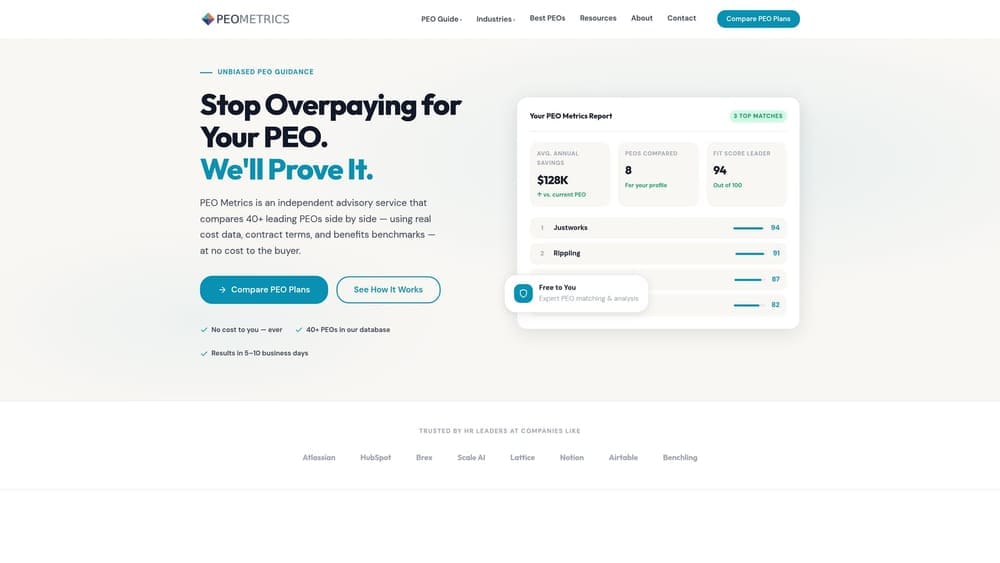
That positioning is the main thing that separates it from every other entry on this list. Every other provider here is trying to win your business directly, which means their sales materials are, understandably, built to highlight strengths and downplay trade-offs. PEO Metrics has no PEO of its own to sell, so its role is to help you read between the lines of markup structures, administrative fees, and renewal terms that can otherwise be hard to compare across providers using different pricing models.
- Puts multiple PEO quotes and contract terms into a single side-by-side comparison so you’re not toggling between PDFs.
- Flags where markup or administrative fees may be embedded in a proposal rather than itemized clearly.
- Maintains a neutral position across providers rather than representing one vendor’s interests.
It works alongside whatever quotes you’re already collecting, so there’s no platform migration or integration to manage on your end. Setup is a conversation, not a software rollout. It doesn’t run payroll, administer benefits, or handle workers’ comp claims itself, since it isn’t a PEO, so it’s a complement to your PEO search rather than a replacement for one.
Pricing is quote-based, and it’s worth noting upfront that PEO Metrics may receive placement fees from vendors it discusses, which is common in the comparison-service space and doesn’t preclude an honest, side-by-side breakdown of what each option actually costs.
Best for: Employers who already have PEO quotes in hand and want an outside read before signing.
2. Justworks
Justworks is a New York City-based PEO built around a self-service software platform, popular with startups and small tech companies that want HR, payroll, and benefits handled without a heavy consulting relationship attached.
The distinguishing feature is pricing structure. Justworks uses flat per-employee monthly pricing tiers rather than charging a percentage of payroll, which is the more common model among larger PEOs. For a company with a few higher earners on staff, that flat-fee approach can be easier to budget against and easier to compare across providers than a percentage-based fee that scales with salary levels.
- Charges flat per-employee monthly rates instead of a percentage of total payroll, simplifying budget forecasting.
- Provides self-service tools for running payroll, enrolling in benefits, and handling basic compliance tasks without waiting on a rep.
- Operates out of New York City with a client base weighted toward tech and startup employers, giving it built-in familiarity with NYC-specific requirements.
Justworks connects with common accounting and expense management tools through an API and app marketplace, and it’s designed to be run day-to-day by a founder or small internal HR/ops person rather than requiring a dedicated HR department. Setup leans self-directed, in keeping with the platform’s software-first identity.
The trade-off is depth of service. Larger companies wanting a dedicated HR business partner, hands-on benefits negotiation, or more complex compliance consulting may find the self-service model thinner than what a higher-touch PEO offers.
Starting price is quote-based.
Best for: Early-stage tech and startup employers who prefer self-service software over high-touch HR consulting.
3. TriNet
TriNet packages its PEO offering by industry vertical, including technology, financial services, and nonprofit, with benefits benchmarked against each sector rather than offered as a one-size-fits-all bundle.
Where it fits for New York employers
TriNet has an established New York client presence and administers workers’ comp coverage for New York-based employees, which matters given the state’s specific requirements around coverage and claims handling. For a company competing for talent within a specific industry, seeing benefits benchmarked against sector peers rather than generic averages can be more useful when setting compensation packages.
- Groups its PEO service into industry-specific packages, so benefits and plan design reflect what similar companies in your sector actually offer.
- Maintains national scale with an established presence among New York employers.
- Administers workers’ comp coverage for employees based in New York.
Trade-offs
TriNet’s platform and tiered packaging are built with mid-sized organizations in mind, and the structure can feel heavier than necessary for a company with fewer than 10 employees that doesn’t need sector-level benchmarking. Integrations run through TriNet’s own payroll and HRIS platform, with connections to third-party benefits and time-tracking tools.
Pricing is quote-based.
Best for: Mid-sized employers in a defined industry vertical who want sector-specific benefits benchmarking.
4. Insperity
The main thing to know about Insperity before anything else: it assigns each client a dedicated HR service team, rather than routing support through a shared call center or rotating rep pool. For employers who’ve been burned by inconsistent service at a previous PEO, that structural difference is often the deciding factor.
Insperity has a long operating history in the PEO industry, and its service model reflects an older, more relationship-driven approach to HR outsourcing compared with the software-first platforms newer entrants like Justworks or Rippling PEO have built.
- Assigns a consistent, dedicated HR service team to each client account instead of a shared support queue.
- Offers optional add-on services including recruiting support and performance management tools.
- Brings decades of operating history in the PEO space, which can matter for employers weighing provider stability.
Because of that higher-touch model, Insperity’s HR platform and payroll system typically get run in partnership with your assigned team rather than purely self-service, which suits companies that want a hands-on relationship. Integrations extend to optional recruiting and performance management modules on top of the core HR and payroll platform.
The trade-off is flexibility on price. A more consultative service model generally comes with less room to negotiate down to a bare-bones package, which can matter for lean-budget employers who only need basic payroll and compliance support.
Pricing is quote-based.
Best for: Companies that want consistent, high-touch HR guidance beyond basic payroll and benefits administration.
5. ADP TotalSource
ADP TotalSource is built on ADP’s own payroll and tax processing infrastructure, which is the practical advantage for any New York employer also managing payroll obligations in other states.
Multi-state payroll tax handling is one of the more error-prone parts of running a growing business, and ADP’s infrastructure for it predates its PEO offering by decades. TotalSource inherits that backbone directly, along with optional access to ADP’s broader HR technology ecosystem as add-on modules if you need talent management or advanced time-tracking down the line.
- Runs on ADP’s core payroll and tax filing infrastructure, built for handling multi-state tax obligations.
- Gives access to ADP’s wider HR technology ecosystem as optional add-ons rather than a forced bundle.
- Connects to ADP’s time tracking and talent modules within the same HCM ecosystem.
Day-to-day administration typically sits with an internal HR or payroll administrator working within ADP’s platform, supported by ADP account representatives. Setup involves migrating payroll history and employee data into ADP’s system, a process that’s fairly standardized given how many companies ADP has onboarded.
That standardization cuts both ways. Some employers report a more uniform service experience with less room for contract customization compared with smaller, more regionally concentrated PEOs, which is worth weighing if you want a provider willing to negotiate terms specific to your business.
Pricing is quote-based.
Best for: Employers with multi-state or complex payroll tax situations who value infrastructure over customization.
6. Prestige Employee Administrators
Prestige Employee Administrators is headquartered in Melville, New York, and its client base is concentrated in the New York tri-state area, which sets it apart from every nationally headquartered provider on this list.
For an employer whose entire workforce sits in New York, New Jersey, and Connecticut, that regional concentration can translate into staff who deal with New York-specific compliance questions, like paid sick/safe leave rules or state-specific workers’ comp requirements, on a routine basis rather than as one jurisdiction among fifty.
- Headquartered in Melville, New York, with operations built around the regional market.
- Concentrates its client base in the New York tri-state region rather than spreading thin across the country.
- Bundles payroll, benefits, and workers’ comp administration into a single PEO agreement.
Prestige runs on a standard payroll and benefits administration platform, managed day-to-day by an internal HR contact working with a Prestige account team. Setup follows the typical PEO onboarding process of transferring payroll and benefits records into the new system.
The limitation is scale. Prestige’s national footprint is smaller than TriNet’s or ADP TotalSource’s, which matters if you’re planning to expand operations outside the Northeast and want a single PEO relationship that can follow you there.
Pricing is quote-based.
Best for: New York and tri-state area employers who want a provider concentrated in their region.
7. Engage PEO
Engage PEO serves mid-sized employers with a modular service structure, letting you choose which HR functions to outsource rather than accepting an all-or-nothing bundle.
The feature that stands out here is dedicated risk management and workplace safety consulting built into the service, which goes beyond the standard workers’ comp administration most PEOs offer. For employers in construction, manufacturing, healthcare, or other higher-risk industries, that safety consulting can factor directly into workers’ comp experience ratings over time.
- Structures its service modularly, so you can outsource payroll and benefits without necessarily handing over every HR function.
- Provides dedicated risk management and workplace safety consulting alongside standard workers’ comp administration.
- Focuses its account base on mid-sized employers rather than trying to serve every company size equally well.
Engage runs on a standard payroll, benefits, and HRIS platform, typically managed by an internal HR lead working alongside an Engage account team. Onboarding follows a fairly conventional PEO setup process.
Its main limitation for a New York search specifically is brand recognition. Engage has less name recognition in the New York market compared with nationally headquartered competitors like ADP TotalSource or TriNet, so you may need to do more independent diligence on service quality and client references before signing.
Pricing is quote-based.
Best for: Mid-sized employers in higher-risk industries who want built-in safety consulting alongside HR outsourcing.
8. Rippling PEO
What makes Rippling PEO different from the rest of this list has less to do with HR service and more to do with software architecture. Rippling built its PEO on top of a broader platform that also handles IT device management and app provisioning, so onboarding a new hire can trigger payroll setup, benefits enrollment, and laptop/software access all from the same workflow.
For a company managing a distributed or hybrid workforce, that consolidation removes a layer of manual coordination between HR and IT that most PEOs simply don’t touch.
- Unifies payroll, benefits, and PEO services into a single HRIS rather than separate systems that need to be reconciled.
- Manages IT device provisioning and app access from the same platform used for HR and payroll.
- Automates workflows so that HR changes, like a termination, can also trigger system access changes automatically.
Rippling’s native integrations extend across its own IT, finance, and app management modules, which is part of the draw but also part of the commitment: getting the full value out of Rippling PEO generally means adopting its broader software suite, not just the PEO layer. Setup and day-to-day administration are usually handled by an internal HR or IT-adjacent operations person, given the platform’s technical breadth.
That breadth is also the limitation. A smaller employer that just needs payroll, benefits, and workers’ comp handled may find the IT and app management features more than they need, and paying for platform capability they won’t use.
Pricing is quote-based.
Best for: Growing companies that want HR, payroll, and IT workflows consolidated on one platform.
Matching the Right Provider to Your Situation
If you’re an early-stage tech company or startup, Justworks and Rippling PEO are the two worth a closer look, with the choice largely coming down to whether you want lean, flat-fee software or a platform that also handles IT provisioning. Larger or industry-specific employers tend to fit better with TriNet, for sector-benchmarked benefits, or Insperity, for a dedicated HR team and a longer track record. If multi-state payroll tax complexity is your main headache, ADP TotalSource’s infrastructure is built for exactly that problem. And if your workforce is concentrated in New York and the tri-state area, Prestige’s regional focus is worth weighing against the bigger national names.
Whichever direction you’re leaning, it’s worth getting an independent read on the actual quote before you sign anything, since PEO pricing structures vary enough between percentage-of-payroll and flat-fee models that side-by-side comparisons aren’t always apples to apples.
Before you sign that PEO renewal, make sure you’re not leaving money on the table. Many businesses unknowingly overpay because of bundled fees, hidden administrative markups, and contracts designed to limit flexibility. We give you a clear, side-by-side breakdown of pricing, services, and contract terms, so you can see exactly what you’re paying for and choose the option that truly fits your business.
