

At around 50 employees, most companies sit in an awkward spot for PEO pricing. You’re too big for the smallest-group rate cards but not big enough to negotiate like a 500-person employer, so the difference between providers shows up fast in your renewal quote. This list covers PEOs with a real track record serving companies in the 20-100 employee range, chosen for benefits scale, HR support depth, and how well their platform fits a growing but still lean HR team. A quick note on terms: a PEO enters a co-employment arrangement and shares liability for employment law compliance, an ASO (administrative services only) handles payroll and HR tasks without that shared liability, and an EOR (employer of record) lets you hire workers without setting up a local legal entity. Mixing these up is one of the most common mistakes we see companies make when comparing quotes.
Quick Comparison
- PEO Metrics: best for HR leaders who want quote comparisons before committing; pricing available on the website; the only entry here that compares other PEOs rather than being one.
- TriNet: best for industry-specific companies; quote-based; builds plan packages around specific sectors instead of one generic offering.
- Insperity: best for companies wanting a consistent HR contact; quote-based; assigns a named HR generalist to the account.
- Justworks: best for companies wanting pricing before a sales call; published tiered pricing on its website; the only provider on this list with public rate tiers.
- Rippling PEO: best for companies wanting PEO bundled with IT and device management; quote-based; PEO delivered as one module inside a broader platform.
- ADP TotalSource: best for multi-state workforces; quote-based; runs on ADP’s national payroll and tax infrastructure.
- Paychex PEO: best for companies wanting local service reps with national scale; quote-based; flexible scope on which HR functions to outsource.
- Sequoia One: best for venture-backed companies competing on benefits; quote-based; built around total rewards strategy rather than baseline compliance.
1. PEO Metrics
PEO Metrics is a PEO comparison and advisory service, not a PEO itself. It exists for the moment you’re staring at three or four quotes with different fee structures, different benefit networks, and different contract terms, trying to figure out which one actually costs less once you account for everything bundled into the price.
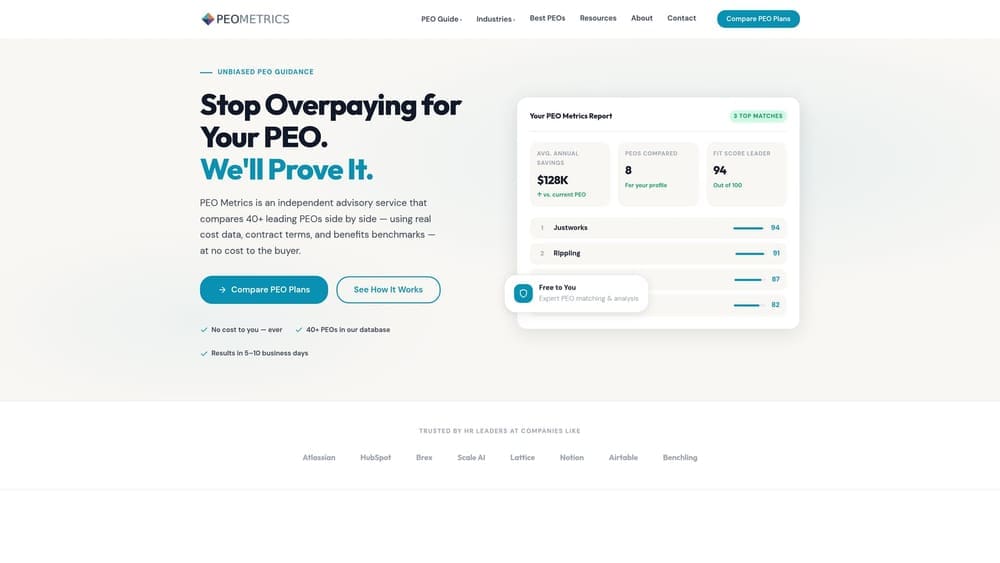
What sets it apart from every other entry on this list is that it isn’t selling you HR administration. It’s giving you a structured way to line up multiple PEO quotes side by side using pricing and service-level data, rather than relying on whatever a single sales rep presents. That distinction matters most right around the 50-employee mark, where fee structures diverge the most between providers.
- Compares PEO pricing structures and benefits offerings across multiple providers at once, so you’re not evaluating one quote in isolation.
- Tailors guidance to your specific headcount and state footprint, since compliance obligations and benefit-pool access shift with both.
- Runs on independent research rather than a single vendor’s sales materials, which matters when providers structure fees differently on purpose.
It works alongside any PEO you’re already evaluating and isn’t tied to a specific payroll platform or carrier. Setup is light: you bring your current situation and target providers, and the comparison work happens from there.
The limitation is straightforward: PEO Metrics doesn’t run payroll or administer benefits itself. It’s a decision-support layer you use before you sign with a PEO, not a replacement for one. Pricing details are available on the website.
Best for: HR leaders who want quote comparisons before committing to a specific PEO.
2. TriNet
TriNet builds its PEO plans around specific industries, with dedicated packages for sectors like technology, nonprofit, and financial services. For a 50-employee company in one of those verticals, that can mean benefits and compliance guidance shaped around the risks and norms of your industry rather than a one-size-fits-all plan.
The industry packaging is what separates TriNet from the more generalized PEOs on this list. Instead of building a benefits plan from scratch, you’re plugged into a package already tuned to your sector’s typical needs.
- Offers plan packages built specifically around industries like tech, nonprofit, and finance.
- Gives access to large-group benefits purchasing power that a standalone 50-person company usually can’t get on its own.
- Provides HR compliance support and employee handbook resources to reduce the burden on an internal HR team.
- Handles payroll and tax administration as part of the core service.
TriNet integrates with common accounting and time-tracking tools, though you should verify the current integration list on its site since these change. Setup typically involves a dedicated onboarding process, and day-to-day administration is usually shared between your internal HR contact and a TriNet service team.
The tradeoff is flexibility. If you already have a benefits broker relationship you want to keep, or want a highly custom plan design, TriNet’s industry-packaged approach gives you less room to negotiate than some smaller or more configurable PEOs.
Best for: Industry-specific companies wanting benefits and HR support tailored to their sector.
3. Insperity
Insperity is one of the longer-established names in the PEO space, and its model centers on assigning a dedicated HR generalist to each client account rather than routing support through a ticket queue.
That named-contact model is the clearest differentiator here. For a 50-employee company without a large internal HR function, having one person who knows your account and answers the phone can matter more than a slick app.
- Assigns a dedicated HR generalist to your account for ongoing support.
- Offers retirement plan and wellness program options beyond baseline benefits.
- Provides performance management and training resources for growing teams.
- Supports multi-state payroll for companies with employees in more than one state.
Insperity’s current integration list should be verified on its site, as it varies by module. Day-to-day, your assigned HR generalist becomes the primary point of contact, which reduces the coordination burden on your internal team but also means onboarding tends to take longer, especially if you don’t already have established HR processes and documentation in place.
Companies that want a fast, fully self-service setup may find Insperity’s onboarding pace and process-heavy approach a mismatch. Pricing is quote-based; check the provider’s site for current figures as of 2026.
Best for: Companies wanting a consistent, named HR contact rather than ticket-based support.
4. Justworks
Pricing transparency is the reason Justworks shows up on more shortlists than its size alone would suggest. Where most PEOs require a sales call to get a number, Justworks has historically published tiered pricing plans directly on its website, which you should confirm are current before assuming they apply to your headcount.
What makes it different
The published-pricing model is the standout feature. It lets an HR leader do rough budget math before ever talking to a sales rep, which is rare in this industry and useful when you’re building a board-level cost comparison.
- Publishes tiered pricing plans so you can estimate costs before a sales conversation.
- Runs payroll and benefits administration through a self-service platform designed for smaller HR teams.
- Provides compliance support for employers with workers spread across multiple states.
- Offers 24/7 support access rather than limiting help to business hours.
Fit and limitations
Justworks integrates with QuickBooks, Xero, and other common accounting tools, though you should verify the current integration list since these are updated periodically. Setup leans self-service, meaning your internal HR or finance lead typically manages the platform directly rather than working through a large dedicated account team.
The tradeoff for that simplicity is fewer industry-specific plan variations than a provider like TriNet or Insperity offers. If your company needs a highly tailored benefits design for a specific sector, Justworks’ more standardized tiers may feel limiting.
Best for: Companies that want transparent, published pricing before talking to sales.
5. Rippling PEO
Rippling PEO is the PEO layer inside Rippling’s broader HR, IT, and finance platform. Rather than being a standalone PEO product, it’s one module that sits alongside device management, app provisioning, and finance tools the company already sells.
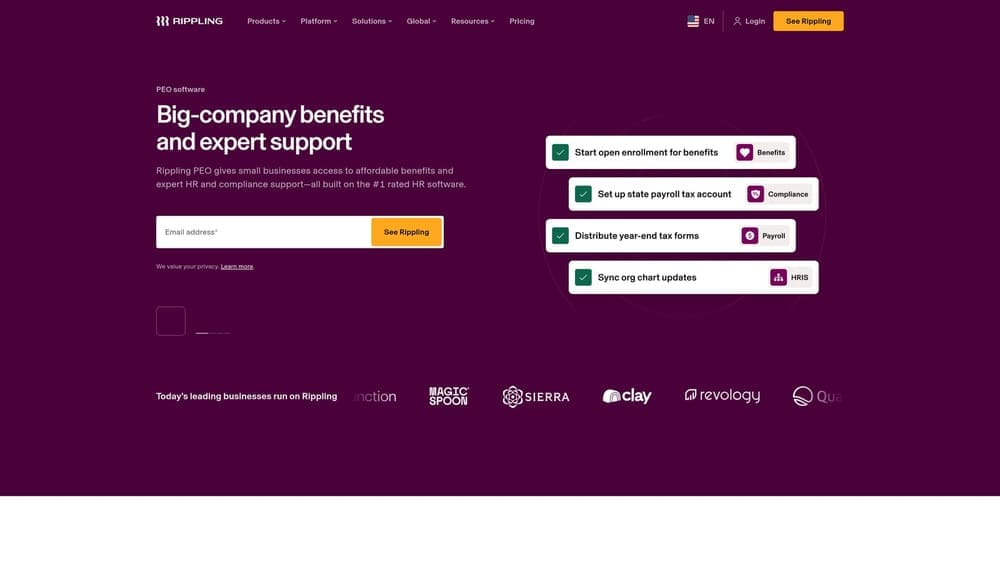
That integration is the whole pitch. Other PEOs on this list connect to outside tools; Rippling builds the PEO functions natively into a system that also manages laptops, software licenses, and expense workflows.
- Delivers PEO services natively inside Rippling’s own HRIS, IT, and finance modules.
- Automates onboarding workflows that tie new-hire paperwork directly to payroll and benefits enrollment.
- Adds global payroll options for companies with employees outside the U.S.
- Includes a custom workflow builder for HR processes specific to your company.
Because the PEO is built into Rippling’s platform, integrations are native rather than bolted on, which simplifies setup if you’re starting fresh. Your internal HR or IT lead typically manages the system directly, since the platform is designed for hands-on administration rather than heavy vendor hand-holding.
The catch is that the value proposition depends on wanting Rippling’s broader platform, not just the PEO piece. If you only need payroll and benefits administration and have no interest in consolidating IT and finance tools into the same system, you’re paying for capability you won’t use. Pricing is quote-based; verify current figures on the provider’s site.
Best for: Companies wanting PEO services bundled with a unified HR and IT management system.
6. ADP TotalSource
ADP TotalSource is ADP’s PEO offering, and its main advantage is riding on top of ADP’s national payroll and tax filing infrastructure, which is among the most established in the industry.
For a 50-employee company with workers spread across several states, that infrastructure is the differentiator. Multi-state tax filing and compliance tracking are areas where scale genuinely helps, and ADP has built that scale over decades.
- Runs on ADP’s national payroll and tax filing systems, reducing multi-state compliance risk.
- Provides HR analytics and reporting dashboards for tracking workforce trends.
- Supports compliance across multiple states as headcount and locations grow.
- Gives access to ADP’s broader HR technology suite beyond the core PEO service.
ADP’s own payroll and HCM ecosystem is the natural integration point; check the current third-party integration list on its site, since it changes. Administration is typically shared between your internal HR lead and an ADP service team, with the platform itself handling much of the compliance tracking in the background.
The size that makes ADP strong on compliance infrastructure can also make service feel less personal at the 50-employee mark, where you’re a smaller account relative to ADP’s largest clients. Companies that want a close, high-touch relationship may find the experience more standardized than they’d like. Pricing is quote-based; verify current figures on the provider’s site as of 2026.
Best for: Companies with employees spread across many states that want deep compliance infrastructure.
7. Paychex PEO
Paychex PEO has a long operating history in the industry and takes a flexible approach to scope: you choose which HR functions to hand off and which to keep running in-house.
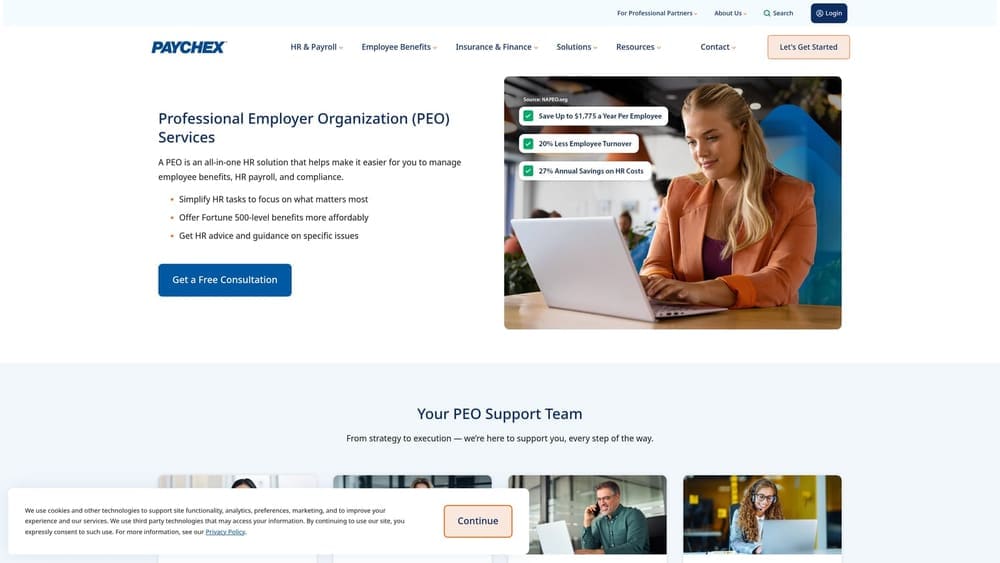
That flexibility, paired with a local service representative model, is what separates Paychex from more platform-centric competitors. You get national scale on the back end but a local point of contact on the front end.
- Lets you choose the scope of outsourced HR functions rather than an all-or-nothing package.
- Provides local service representatives alongside national-scale infrastructure.
- Covers payroll, tax administration, and workers’ compensation support.
- Draws on decades of operating history in the PEO industry.
Verify Paychex’s current integration list on its site, since it’s updated as the platform evolves. Day-to-day management typically involves your internal HR contact working alongside a local Paychex representative rather than a purely self-service dashboard.
If you’re looking for a modern, fully digital-first experience, Paychex’s model can feel more traditional than newer platform-centric PEOs like Justworks or Rippling. The service quality often depends heavily on your local representative, which is a tradeoff worth weighing. Pricing is quote-based; verify current figures on the provider’s site as of 2026.
Best for: Companies that want an established provider with local service reps over a fully self-service platform.
8. Sequoia One
Sequoia One takes a different angle than most PEOs on this list: it’s built for venture-backed and mid-market companies competing hard for talent, and its focus is total rewards strategy rather than baseline payroll and compliance.
Where other providers lead with compliance infrastructure or price transparency, Sequoia One leads with benefits design aimed at competitive talent markets, typically tech and professional services.
- Offers total rewards and benefits strategy consulting, not just plan administration.
- Designs benefits plans meant to compete for talent in tight labor markets.
- Handles HR compliance and payroll administration as part of the broader package.
- Focuses specifically on venture-backed tech and professional services clients.
Verify Sequoia One’s current integration list directly with the provider, as this varies by client setup. Because the offering centers on strategic benefits consulting, day-to-day administration often involves closer collaboration between your HR leader and Sequoia’s advisory team than a purely transactional PEO relationship.
The limitation is cost-focus mismatch. If your priority is the lowest possible per-employee fee rather than benefits richness, Sequoia One’s model is built around a different set of priorities and likely isn’t the right fit. Pricing is quote-based; verify current figures on the provider’s site as of 2026.
Best for: Venture-backed or professional services companies competing for talent on benefits quality.
Matching the Right Provider to Your Situation
If your team is spread across several states, ADP TotalSource and Insperity both bring the compliance depth that matters most once payroll tax filings and employment law start varying by location. If you’re already invested in a broader HR and IT tech stack, Rippling PEO’s native integration is worth a closer look before you add a separate PEO on top of tools you already run. Companies competing hard for talent, particularly venture-backed tech and professional services firms, will find Sequoia One’s total rewards focus more relevant than a baseline compliance package. And if transparent pricing matters most before you even pick up the phone, Justworks remains the one provider here with published tiers.
None of these are universally “best.” Fee structures, benefit-pool access, and service models vary enough at the 50-employee mark that the right choice depends on your state footprint, your existing tech stack, and whether you’re optimizing for cost or for benefits competitiveness.
Before you sign that PEO renewal, make sure you’re not leaving money on the table. Many businesses unknowingly overpay because of bundled fees, hidden administrative markups, and contracts designed to limit flexibility. PEO Metrics gives you a clear, side-by-side breakdown of pricing, services, and contract terms, so you can see exactly what you’re paying for and choose the option that truly fits your business. Don’t auto-renew. Make an informed, confident decision.
