
Dumpster rental is a deceptively high-risk business to insure and staff. You’ve got drivers operating heavy equipment, workers handling contaminated materials, seasonal demand swings, and DOT compliance layered on top of standard HR obligations. That combination makes choosing the right PEO more consequential than it is for most industries. The wrong one will misclassify your workers’ comp codes, underestimate your risk profile, or lock you into a contract that doesn’t flex with your haul volume.
This guide covers the best PEO comparison resources available for dumpster rental operators, ranked by how well they handle the industry-specific variables that actually matter: workers’ comp structuring, high-hazard class codes, equipment-related liability, and pricing transparency. If you want to understand the fundamentals first, start with our guide on what a PEO does before diving in.
Why Dumpster Rental Operators Need Industry-Specific PEO Guidance
Most PEO comparison processes are built around generic business profiles: headcount, payroll size, state, and industry category. That works fine for a software company or a staffing agency. It doesn’t work well for a dumpster rental operation.
Here’s what makes your situation different from most small businesses evaluating PEOs.
Workers’ comp class code complexity: Your workforce likely spans multiple classifications. Roll-off truck drivers typically fall under a freight or trucking code. Laborers handling containers and debris often fall under a waste or sanitation code. Office and dispatch staff fall under something else entirely. Many PEOs default to a single blanket code, which can either overcharge you significantly or misrepresent your actual risk profile to the carrier. Class code structuring under a PEO master policy is one of the most meaningful cost levers available to operators in your industry, and most generic comparison tools don’t surface it.
DOT compliance exposure: If you’re running commercial vehicles over 26,001 lbs GVWR, you’re operating under FMCSA jurisdiction. That means driver qualification files, drug and alcohol testing programs, and hours-of-service records. Not all PEOs have the infrastructure to support DOT-regulated fleets in a co-employment context. This is a genuine differentiator that matters when you’re evaluating providers, and it rarely comes up in standard PEO sales conversations.
Seasonal headcount volatility: Dumpster rental demand often spikes during construction season and drops in winter months, particularly in northern markets. PEOs that charge flat per-employee fees handle this very differently than those charging a percentage of payroll. You need to understand how headcount fluctuation affects your billing cycle and whether minimum employee thresholds apply before you sign anything.
Assigned risk pool exposure: Smaller operators, especially those with prior claims or newer businesses, often end up in the assigned risk pool for workers’ comp. A PEO master policy can be a legitimate path out of the assigned risk pool, but only if the PEO is willing to underwrite your specific risk. Not all are. This is a real decision factor that separates providers who can actually help you from those who will decline or exclude your highest-risk classifications.
Coverage boundaries around equipment: PEOs provide workers’ comp and HR services. They do not cover commercial auto or equipment liability. Operators sometimes assume co-employment extends to vehicle-related incidents. It doesn’t. A good PEO evaluation process should clarify exactly where coverage begins and ends so you’re not caught short when a claim comes in.
With that context in place, here are the tools worth using when you’re evaluating PEO options for your operation.
1. PEO Metrics
Best for: Dumpster rental operators who want unbiased, data-driven provider comparisons before entering negotiations.
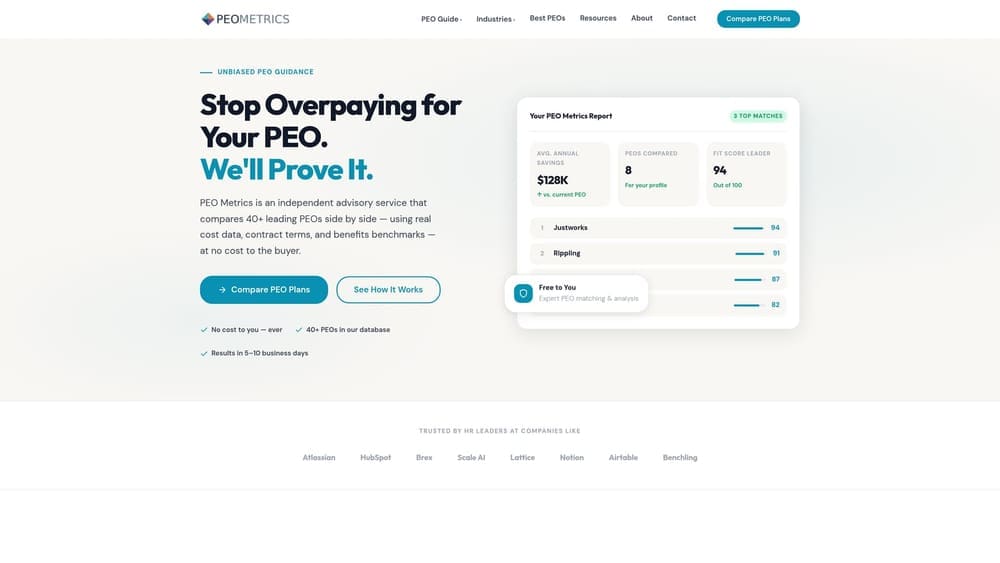
PEO Metrics is a PEO comparison service built around pricing transparency and side-by-side provider analysis, with a specific focus on helping businesses avoid overpaying — particularly in high-risk industries where class code treatment and fee structures vary significantly between providers.
Where This Tool Shines
For dumpster rental operators, the most valuable thing PEO Metrics does is surface how different providers handle high-hazard workers’ comp classifications. That’s not information you’ll get from a standard sales call, and it’s exactly the variable that determines whether a PEO deal actually saves you money or costs you more than your current arrangement.
The comparison model is also built to be unbiased. PEO Metrics doesn’t operate on a referral commission structure tied to which provider you ultimately choose. That matters because most PEO brokers and aggregators have financial incentives to steer you toward specific providers regardless of fit. When you’re evaluating something as consequential as your workers’ comp program and co-employment structure, you want analysis that isn’t compromised by those incentives.
Key Features
Side-by-side provider comparisons: Detailed pricing metrics across multiple PEO providers so you can see cost structure differences before you’re in a vendor conversation.
Unbiased guidance model: Not tied to provider referral commissions, which keeps the analysis independent of which provider you ultimately select.
Workers’ comp class code visibility: Surfaces how providers handle high-hazard classifications, which is directly relevant to roll-off truck drivers and waste handling laborers.
Pre-negotiation cost structure clarity: Helps operators understand what they should be paying before entering negotiations, reducing the information asymmetry that typically favors PEO providers.
Field-based workforce relevance: Built with depth for industries like waste hauling where generic comparison tools fall short.
Best For
Dumpster rental operators who are actively evaluating PEO options and want to compare providers on industry-relevant variables before committing to a contract. Particularly useful for operators who’ve had a bad experience with a previous PEO, are currently in the assigned risk pool, or suspect they’re overpaying on their current arrangement.
Pricing
Free to use. PEO Metrics operates as a comparison service rather than a transactional marketplace, so there’s no cost to access the comparison tool.
2. PEOcompare
Best for: Operators in early-stage evaluation who want broad market visibility across multiple PEO providers quickly.
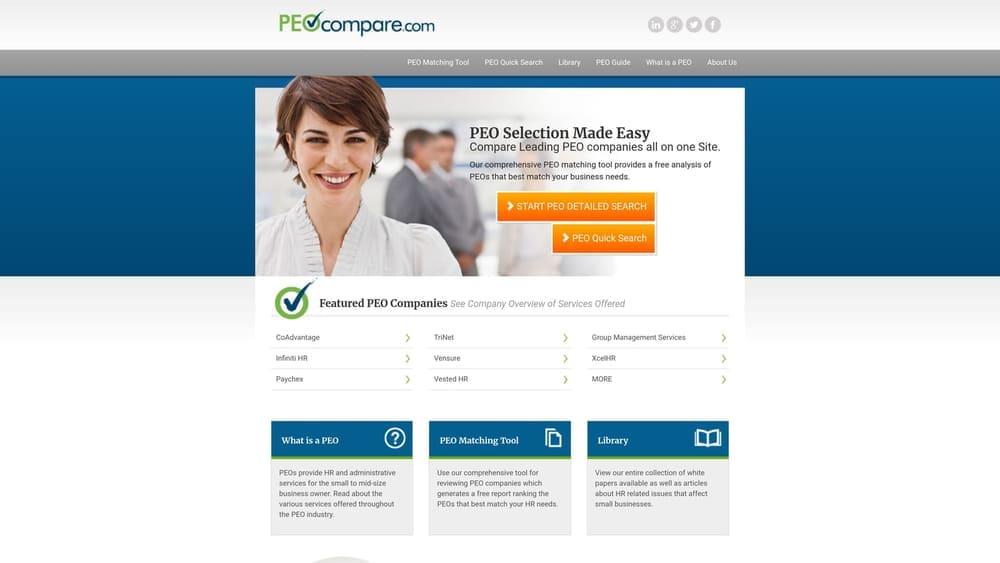
PEOcompare is a PEO marketplace and quote aggregation platform that connects businesses with multiple PEO providers based on a submitted business profile, allowing early-stage comparison across a broad set of vendors in a single submission.
Where This Tool Shines
If you’re a dumpster rental operator who doesn’t yet know which PEOs even serve your industry or your state, PEOcompare is a reasonable starting point. The submit-once, receive-multiple-quotes model gives you market-wide visibility without requiring you to initiate separate conversations with a dozen different providers. That breadth has real value when you’re still mapping the landscape.
The tradeoff is depth. PEOcompare operates as a lead generation model, which means providers are paying to be in the network and receive your information. The quotes you receive will reflect what each provider wants to show you at the top of the funnel, not necessarily how they’ll actually handle your workers’ comp classifications or whether they can support a DOT-regulated fleet. Treat it as a first filter, not a final answer.
Key Features
Single-submission profile: Submit your business information once and receive quotes from multiple PEO providers without separate outreach to each.
Broad provider network: Connects operators with a wide range of PEO vendors, useful for understanding which providers are active in your market.
Early-stage evaluation utility: Helps operators who are new to PEO evaluation understand the range of options before doing deeper due diligence.
Market-wide visibility: Surfaces providers you might not have encountered through direct research or referrals.
Best For
Dumpster rental operators who are in the earliest stage of PEO evaluation and want to understand which providers serve their industry before committing time to deeper analysis. Less useful once you’re past initial market mapping and ready to evaluate providers on industry-specific variables like class code treatment or DOT compliance support.
Pricing
Free to use. PEOcompare operates on a lead generation model, meaning providers pay to access the submitted business profiles rather than charging the operator.
3. HR Guide
Best for: Operators who want to understand PEO mechanics and co-employment fundamentals before engaging vendors directly.
HR Guide is an HR information resource covering PEO mechanics, co-employment fundamentals, compliance topics, and HR management guidance, useful as an educational foundation before you start talking to providers.

Where This Tool Shines
HR Guide isn’t a comparison tool or a quote platform. It’s reference material. For dumpster rental operators who are newer to the PEO space or who’ve had a confusing experience with co-employment language in a contract, it provides useful editorial depth on what a PEO actually is, how co-employment works legally, and what HR compliance obligations look like for field-based workforces.
The practical value here is in entering vendor conversations better prepared. If you understand what a master workers’ comp policy is, what co-employment means for your liability exposure, and what questions to ask about class code treatment, you’re less likely to get sold a program that doesn’t fit your operation. HR Guide helps close that knowledge gap before you’re sitting across from a PEO sales rep.
Key Features
Co-employment editorial depth: Covers the legal and operational mechanics of co-employment in plain language, useful for operators unfamiliar with how PEO agreements actually work.
HR compliance reference material: Guidance on compliance topics relevant to field-based workforces, including areas that intersect with hourly, blue-collar employment.
Pre-engagement education: Helps operators understand what they’re agreeing to before signing a PEO contract, reducing the risk of misaligned expectations.
HR terminology context: Useful reference for understanding the language used in PEO agreements and compliance documentation.
Best For
Dumpster rental operators who are new to PEOs and want to build foundational knowledge before engaging providers. Also useful as a reference resource when reviewing contract language or evaluating whether a PEO’s proposed structure aligns with standard co-employment practice. Less useful as a decision-making tool once you’re ready to compare specific providers on pricing and class code treatment.
Pricing
Free editorial resource. No transactional component.
Questions to Ask Any PEO Before You Sign
The tools above help you find and evaluate PEO options. But the actual decision happens in vendor conversations, and most PEO sales processes are designed to move you toward a signature before you’ve asked the right questions. Here are the ones that matter most for dumpster rental operators.
How will you classify my roll-off truck drivers? Get the specific class code in writing. If the answer is vague or they default to a single blanket code for all employees, that’s a red flag. Misclassification in either direction costs you money.
Do you support DOT-regulated fleets? Ask specifically whether they have experience with FMCSA compliance requirements in a co-employment context. Driver qualification files, drug testing programs, and hours-of-service records need to be managed correctly. Not all PEOs have infrastructure for this.
How does billing work when I add or drop employees mid-quarter? Seasonal headcount volatility is the norm in dumpster rental. Understand exactly how your PEO fee adjusts when you scale up for construction season and scale back in winter. Ask whether minimum employee thresholds apply.
Will your master policy cover operators currently in the assigned risk pool? If you’re in the assigned risk pool, this is the most important question on the list. Some PEOs will exclude your highest-risk classifications or decline entirely. Know before you invest time in the process.
What does your coverage not include? Commercial auto, equipment liability, and vehicle-related incidents are not covered under a PEO arrangement. Make sure you understand exactly where their coverage ends and where your separate commercial policies need to pick up.
Making the Right Call for Your Operation
Three resources, three different roles in the evaluation process. Here’s how to think about using them.
If you’re in early-stage evaluation and don’t yet know which PEOs serve your market, PEOcompare gives you broad visibility quickly. It’s a reasonable first filter, not a final answer.
If you’re newer to PEOs and want to understand co-employment mechanics before talking to vendors, HR Guide fills that knowledge gap. Go in educated so you don’t get sold a program that doesn’t fit.
If you’re ready to compare providers on the variables that actually matter for a dumpster rental operation, PEO Metrics is where that analysis lives. Class code treatment, pricing structure, and unbiased side-by-side comparisons are exactly what you need before you’re in a negotiation.
The stakes are real here. A misclassified workers’ comp program, a contract with no flexibility for seasonal headcount swings, or a PEO that can’t support your DOT obligations aren’t just inconveniences. They’re expensive problems that take time to unwind.
Before you sign that PEO renewal, make sure you’re not leaving money on the table. Many operators unknowingly overpay because of bundled fees, hidden administrative markups, and contracts designed to limit flexibility. Don’t auto-renew. Make an informed, confident decision.
Before you sign that PEO renewal, make sure you’re not leaving money on the table.
Many businesses unknowingly overpay because of bundled fees, hidden administrative markups, and contracts designed to limit flexibility. We give you a clear, side-by-side breakdown of pricing, services, and contract terms—so you can see exactly what you’re paying for and choose the option that truly fits your business.
