
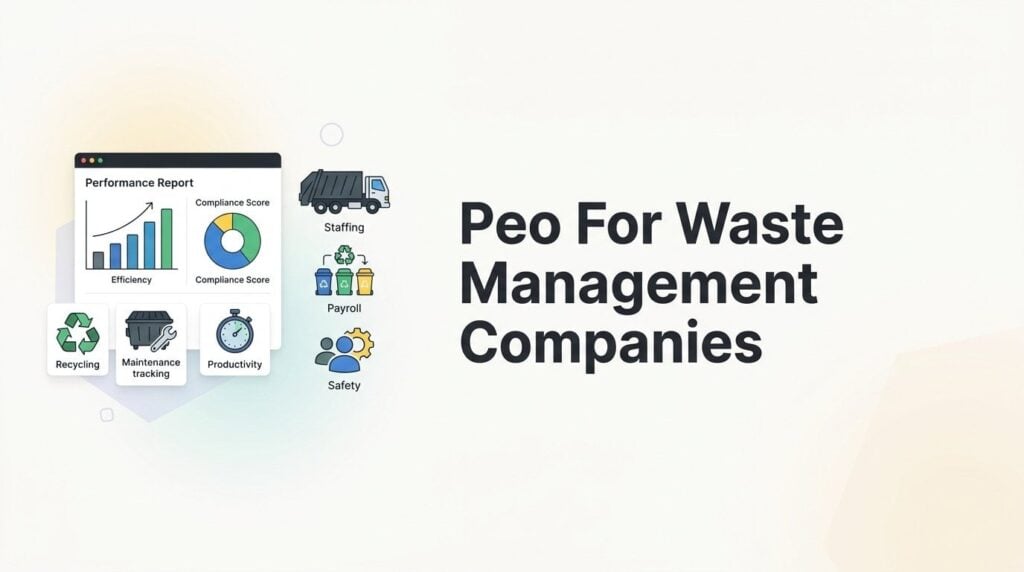
Waste management is one of the harder industries to place with a PEO. You’ve got route drivers, residential collectors, diesel mechanics, dispatchers, and sometimes hazmat handlers all under one roof — each with different workers’ comp class codes, exposure profiles, and regulatory requirements. Most general PEOs either price you out of the market or simply aren’t equipped to handle that complexity.
The right PEO for a waste hauler or environmental services company needs to go beyond payroll processing. It needs to understand OSHA exposure, DOT compliance intersections, high-mod workers’ comp programs, and the operational reality of a workforce that’s almost never behind a desk. Finding that fit without wasting months on sales calls is the challenge.
Here are the top tools and platforms for evaluating and selecting a PEO that’s actually built for the realities of waste management.
What Makes PEO Selection Different for Waste Management
Before jumping into the tools, it’s worth being direct about why this industry requires a different approach than most PEO searches.
Waste management operations typically involve multiple high-risk workers’ comp class codes running simultaneously. Refuse collection workers, commercial drivers, diesel mechanics, and hazmat handlers each carry elevated base rates. Many PEOs using master policies either decline these accounts outright or apply significant surcharges that eliminate the financial case for going with a PEO in the first place.
Then there’s the DOT compliance layer. If you’re running commercial vehicles over 26,001 lbs, you’re subject to FMCSA regulations including driver qualification files, drug and alcohol testing programs under 49 CFR Part 382, hours of service records, and vehicle inspection logs. A PEO that doesn’t understand how these HR-adjacent requirements work won’t solve your compliance gaps — it’ll just create new ones.
Your Experience Modification Rate (EMR) matters more here than in most industries. Many PEO master policies have EMR thresholds — often around 1.0 to 1.25 — above which they simply won’t accept new accounts. If your company has a history of workers’ comp claims and a higher EMR, you may need a standalone policy or specialty market rather than a PEO. That’s a critical “when PEO doesn’t fit” scenario that generic comparison content almost never addresses.
The workforce segmentation complexity is real too. Different comp codes, different benefit eligibility rules, different compliance requirements — all within the same company. PEOs built for homogeneous white-collar workforces often struggle here. The tools below help you cut through that complexity and find providers that have actually placed companies like yours.
1. PEO Metrics
Best for: Waste management companies that want unbiased, side-by-side PEO comparisons before committing to a provider.
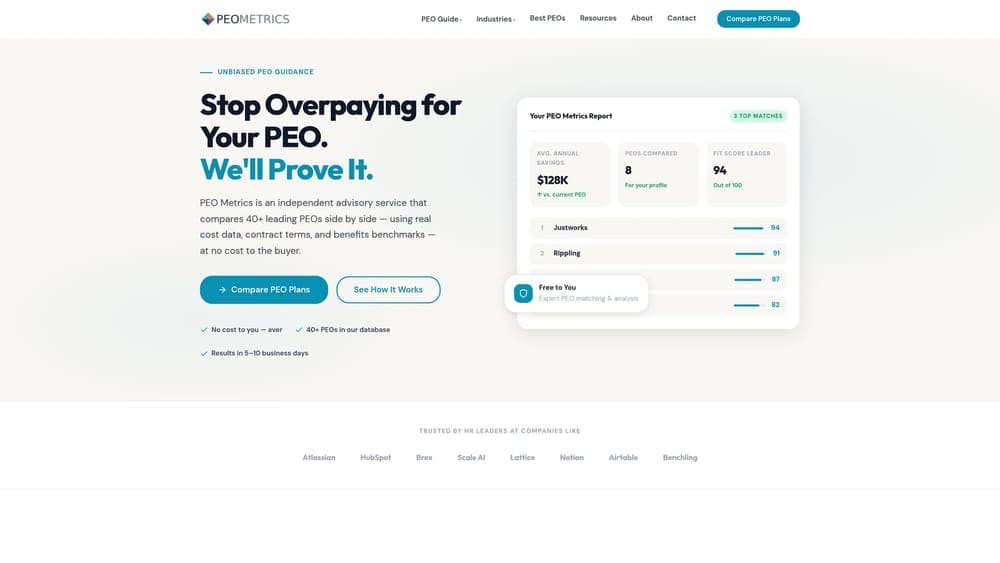
PEO Metrics is a PEO comparison platform that helps businesses evaluate providers using detailed pricing data, workers’ comp handling, and industry-specific metrics — without the sales pressure of going directly to a PEO.
Where This Tool Shines
For waste management companies, the biggest risk in a PEO search is getting locked into a provider that looked competitive on headline pricing but didn’t account for your specific risk profile. PEO Metrics addresses this by surfacing the comparison data that actually matters for high-risk industries — not just admin fee percentages, but how different providers handle workers’ comp for elevated-risk class codes and what their actual cost modeling looks like for your headcount and payroll mix.
The platform is unaffiliated with any single PEO provider, which matters a lot in this space. Most broker or matchmaking services have financial relationships with the PEOs they recommend. That creates obvious conflicts when the right answer for your company might be a provider that doesn’t pay referral fees. An independent comparison layer removes that distortion.
Key Features
Side-by-side provider comparisons: Detailed pricing breakdowns across multiple PEO providers, structured so you can compare apples to apples rather than decoding each provider’s custom proposal format.
Workers’ comp and benefit cost analysis: Comparison data organized by industry and risk profile, which is especially relevant for waste management operations with multiple class codes and elevated exposure.
Industry experience identification: Helps surface which PEOs have actual experience placing high-risk industries like waste management, rather than discovering post-contract that your account is outside their comfort zone.
Transparent cost modeling: Designed to identify where bundled fees and administrative markups are inflating total cost — a common issue in PEO contracts that aren’t reviewed carefully.
No sales pressure structure: The comparison process is designed to give you information before you engage directly with any provider, so you’re not starting every conversation from a position of information disadvantage.
Best For
Waste management operators who want to understand the real competitive landscape before signing anything. Particularly useful if you’re approaching a renewal and want to know whether your current pricing is still competitive, or if you’re shopping for the first time and don’t know which PEOs are even worth talking to for your risk profile.
Pricing
Free comparison service. No cost to use the platform.
2. PEOcompare
Best for: Businesses that want to generate multiple PEO quotes simultaneously through a marketplace model.
PEOcompare is a PEO marketplace that aggregates provider options and allows businesses to compare services across multiple vendors in a structured format.
Where This Tool Shines
PEOcompare’s value is in breadth. The marketplace model connects you with multiple providers at once, which can be useful early in the evaluation process when you’re trying to understand which PEOs are even willing to quote a waste management account. For an industry where many providers decline or heavily surcharge, getting a broad initial read on who’s competitive is a reasonable first step.
The structured comparison interface helps organize provider information in a way that’s easier to evaluate than reviewing individual proposals in isolation. If you’re new to PEO evaluation and want a starting point, the marketplace format gives you something to work with quickly.
Key Features
Marketplace model: Connects businesses with multiple PEO providers through a single intake process rather than requiring separate outreach to each provider.
Structured comparison interface: Organizes provider options in a format designed for side-by-side evaluation rather than raw proposal review.
Broad provider network: Access to providers across multiple industries, which increases the chance of surfacing options that serve waste management and environmental services.
Simultaneous quote requests: Submit your information once and receive responses from multiple providers, reducing the time spent on initial outreach.
Best For
Waste management companies at the early stages of a PEO search who want to quickly identify which providers are willing to engage with their industry and risk profile. Less useful for deep cost modeling or workers’ comp-specific analysis.
Pricing
Free to use as a comparison and matching service.
3. HR Guide
Best for: Smaller waste management operations without dedicated HR staff that need both compliance education and PEO matching support.
HR Guide is an HR resource and PEO guidance platform that combines educational content with provider matching support.
Where This Tool Shines
HR Guide is useful in a specific scenario: you’re running a smaller waste operation, you don’t have a dedicated HR person, and you’re not entirely sure what you should even be asking a PEO. The platform’s combination of educational content and provider guidance helps fill that knowledge gap before you enter a sales process where the PEO rep knows far more than you do about the contract terms.
For waste management companies with basic workforce management questions — how PEOs handle multi-code payroll, what compliance obligations transfer to the PEO versus stay with you, how benefit administration works — the educational layer has practical value. It’s not a deep-dive comparison tool, but it can help a smaller operator get oriented before making a major decision.
Key Features
HR educational resources: Content covering workforce management, compliance basics, and HR fundamentals — useful for operations running lean on HR expertise.
PEO provider guidance: Matching support integrated with the educational content, helping users identify relevant providers alongside learning about PEO structure.
Compliance coverage: Covers workforce compliance basics that apply to industries with complex regulatory environments, including multi-classification workforces.
Accessible for non-HR professionals: Content is written for business owners and operators, not HR specialists — which fits the reality of many smaller waste management companies.
Best For
Smaller waste management and environmental services companies that are new to PEOs and need to build foundational knowledge before evaluating providers. Less suited to larger operations with existing HR infrastructure that need detailed pricing and risk analysis.
Pricing
Free access to core resources and guidance content.
The Workers’ Comp Question You Need to Answer First
Before you use any of these tools, there’s one thing worth getting clear on internally: your current workers’ comp situation and EMR.
If your EMR is above 1.25, many PEO master policies won’t accept your account regardless of how well you present the business. Going through a full PEO evaluation process only to hit that wall at the underwriting stage is a significant waste of time. Know your number before you start.
If you’re below that threshold, the next question is whether a PEO’s master policy will actually save you money versus your standalone policy. For waste management companies with multiple high-risk class codes, the answer isn’t always yes. A PEO might offer administrative savings while costing more on workers’ comp — or vice versa. You need to see the full cost model, not just the admin fee.
Seasonal headcount variability is another factor worth flagging early. If your workforce swings significantly based on municipal contracts or construction debris season, a per-employee-per-month PEO pricing model may be more predictable than percentage-of-payroll. That’s a structural question to raise with any provider you evaluate.
Finally, understand the exit terms before you enter. Waste companies that leave a PEO mid-year face workers’ comp tail liability questions — what happens to open claims, how the master policy handles run-out, and what cancellation looks like in practice. In a high-claim industry, this isn’t a footnote. It’s a material risk to understand upfront.
Which Tool Fits Where You Are
Choosing a PEO for a waste management company isn’t a straightforward vendor decision. The workers’ comp complexity alone can make or break the financial case — and that’s before you factor in DOT compliance support, OSHA risk management, and workforce segmentation across multiple class codes.
If you’re in refuse collection, environmental services, recycling, or hazmat hauling, you need a PEO that has actually placed companies like yours. Not one that’s going to figure it out at your expense while you’re mid-contract.
Start with your EMR and current workers’ comp structure. Then get multiple proposals and compare them on real terms, not just headline pricing. Use PEO Metrics to see how providers actually stack up on cost and industry experience before you commit to a single sales conversation. Use PEOcompare to cast a wide net early and identify who’s even willing to quote your account. Use HR Guide if you’re a smaller operation that needs to build foundational knowledge before evaluating providers.
The comparison work upfront is what separates a PEO decision that works from one that costs you more than staying independent. Don’t auto-renew. Make an informed, confident decision.
Before you sign that PEO renewal, make sure you’re not leaving money on the table.
Many businesses unknowingly overpay because of bundled fees, hidden administrative markups, and contracts designed to limit flexibility. We give you a clear, side-by-side breakdown of pricing, services, and contract terms—so you can see exactly what you’re paying for and choose the option that truly fits your business.
