
Small and mid-sized businesses struggle with rising health insurance costs due to limited negotiating power, but a PEO for lower health insurance costs can deliver substantial savings when used strategically. This guide reveals seven practical approaches that go beyond basic pooled buying power, helping you understand PEO health insurance economics and maximize savings specific to your business situation while avoiding arrangements that barely cover PEO fees.
PEO costs typically range from $1,000 to $1,500 per employee annually, but pricing varies widely based on three main models: per-employee-per-month fees, percentage of payroll (usually 2-12%), or custom bundled pricing. This guide breaks down how much a PEO costs by explaining each pricing structure, identifying the factors that drive your specific quote up or down, and providing a clear framework to evaluate whether the investment makes financial sense for your business size and needs.
IRS Certified PEO (CPEO) status provides federal legal protections around payroll tax liability that matter most when a PEO fails to remit taxes or during provider transitions. This guide helps business owners understand IRS Certified PEO requirements and protections to determine whether certification should be a critical factor in their PEO selection decision, or if it’s unnecessary for their specific situation.

Managing HR across multiple franchise locations means juggling franchisor requirements, local regulations, and multi-site staffing challenges. This guide reveals seven practical PEO strategies specifically designed for franchise owners, covering joint-employer risk mitigation, benefits scaling, compliance management, and operational approaches that address the unique complexities franchise operators face daily when partnering with a PEO for franchise owners.
When acquiring a company that uses a PEO (Professional Employer Organization), buyers face a critical valuation challenge: the target’s financials reflect bundled co-employment costs that won’t transfer post-close. This PEO valuation adjustment in M&A is essential because the co-employment structure masks true operational costs through consolidated HR expenses, service markups, and pooled pricing. Understanding what expenses will look like after the PEO relationship ends can shift deal value …
A Professional Employer Organization (PEO) is a co-employment arrangement that handles payroll, benefits, and compliance while you maintain full control over your business operations and employees. Through this partnership, the PEO becomes the employer of record for tax and benefits purposes, giving small businesses access to enterprise-level health insurance rates and HR expertise without hiring an in-house team.
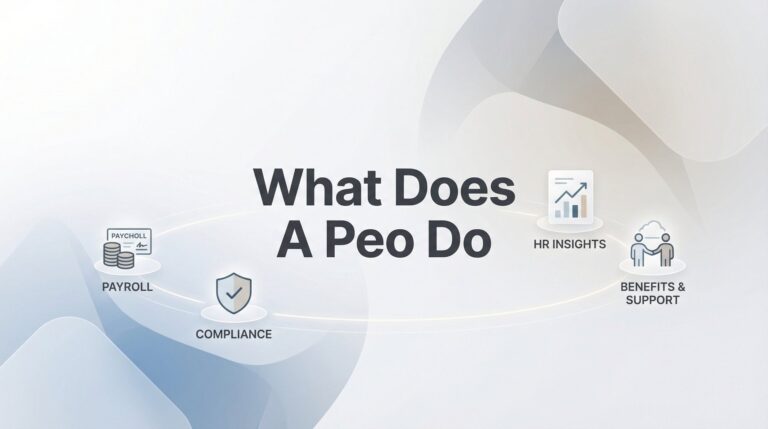
A PEO (Professional Employer Organization) becomes your employer of record for tax and benefits purposes while you maintain full control of your team and operations. They handle payroll processing, benefits administration, tax compliance, and HR paperwork—removing the administrative burden so you can focus on running and growing your business without becoming an expert in employment law and regulations.
Most business owners pay their PEO invoices without questioning whether the costs are fair, potentially overpaying by 15-30% monthly. This guide provides a systematic approach to PEO expense benchmarking, helping you understand what you’re actually paying, compare it against market reality for companies like yours, and negotiate from a position of knowledge rather than assumption.

PEO HR compliance services promise to handle regulatory headaches like DOL audits, worker misclassification issues, and state-specific employment laws, but their actual coverage varies significantly between providers. While some PEOs offer dedicated compliance specialists and proactive monitoring, others deliver only generic guidance and template documents, making it crucial for business owners to understand exactly what protection they’re purchasing beyond the marketing promises.
At five employees, most PEOs will take your business but won’t prioritize it—and you’ll likely overpay for features you don’t need. This guide reveals the real math behind PEO for 5 employees, identifies which providers actually want small teams, and provides seven practical strategies to structure a cost-effective partnership or confidently decide when alternative solutions make more financial sense.
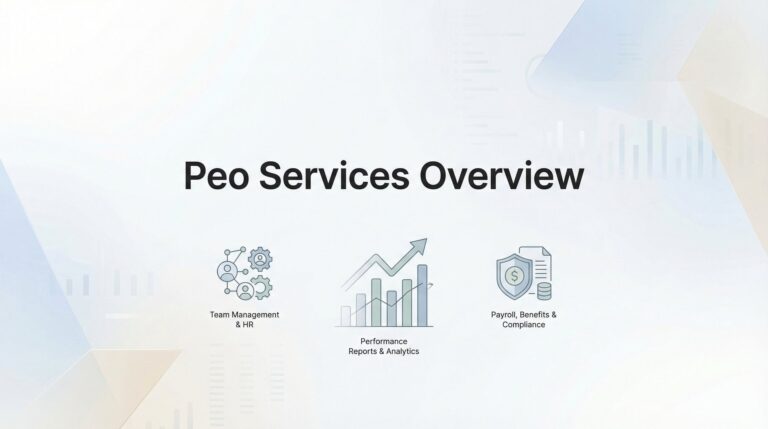
Not all PEO services are created equal—what one provider calls “comprehensive HR” might be another’s basic package. This PEO services overview breaks down what’s actually included in standard agreements versus optional add-ons, helping you understand the core functions every legitimate provider delivers, where service boundaries typically fall, and how to evaluate whether you’re paying for what your business truly needs before signing a contract.

A PEO for 10 employees requires specific strategies since you’re past startup phase but lack budget for dedicated HR. This guide covers seven tactical approaches including negotiating per-employee pricing instead of percentage-of-payroll rates, optimizing benefits access, and managing compliance exposure at this pivotal headcount where your leverage with providers fundamentally changes compared to smaller or larger teams.