
This PEO cost forecasting guide helps businesses build accurate budget projections by accounting for workforce variables most companies overlook—like headcount changes, benefits enrollment patterns, and workers’ comp experience mods. Learn to create a working forecast model that prevents budget surprises and enables accurate provider comparisons beyond initial quotes.
PEO payroll services operate through a co-employment model where your employees technically work under the PEO’s tax ID, fundamentally changing how payroll and compliance function compared to standalone providers. This bundled approach makes sense when you need integrated payroll, benefits, and compliance management, but the co-employment structure isn’t just “payroll plus extras”—it’s a different employment relationship that solves specific problems while potentially creating new considerati…
At 20 employees, companies face real HR complexity without the scale to justify dedicated staff, making this the sweet spot for PEO value—but only if you choose the right one. This guide breaks down seven specific strategies to evaluate and maximize a PEO for 20 employees, helping you avoid rigid contracts, unnecessary bundled services, and providers that treat smaller accounts as afterthoughts while focusing on the support and flexibility your growing team actually needs.

PEO benefits administration handles the complex, time-consuming work of managing employee benefits—from plan documents and carrier portals to COBRA notices and ACA reporting—freeing small business owners from administrative tasks that can consume hours each week. By partnering with a PEO, companies gain access to better insurance rates through group purchasing power and professional management of open enrollment, though it requires accepting tradeoffs in plan flexibility and carrier selec…
PEO payroll reconciliation accounting becomes complex when your bank statements, payroll registers, and general ledger don’t align due to the co-employment model. This practical guide reveals the predictable patterns behind common discrepancies—like wage base cap resets, benefit changes, and multi-state tax allocations—and walks you through a proven reconciliation process that prevents variances from compounding into year-end headaches.

At 30 employees, you’re too large for DIY HR but not big enough for a full department, making PEO selection critical. This guide provides seven targeted strategies for choosing a PEO for 30 employees, focusing on calculating your true HR costs, evaluating service models specific to mid-sized teams, and avoiding common pitfalls that occur at this unique growth stage where benefits complexity increases but you haven’t yet hit the 50+ employee compliance threshold.

PEO workers comp captive programs promise savings through risk-sharing, but they’re not the only option for reducing workers compensation costs. This guide explores seven practical peo workers comp captive alternatives—including guaranteed cost programs, self-insurance, and state funds—each with different risk profiles and cost structures to help you choose the right approach for your business without the long-term captive commitment.

PEO workers compensation management allows businesses to join a master insurance policy through a co-employment arrangement, fundamentally changing how premiums are calculated and claims are handled compared to traditional standalone coverage. This structural shift can help businesses escape poor loss history and access better rates, but it’s not a one-size-fits-all solution—understanding the specific tradeoffs is essential before making the switch.

This practical guide shows business owners how to build a PEO savings projection model from scratch, enabling them to evaluate provider proposals using their own data rather than generic sales projections. The framework covers establishing your current HR cost baseline, stress-testing different scenarios, and projecting realistic savings over 1-3 years based on your specific industry, claims history, and growth trajectory.

At 50 employees, companies cross critical regulatory thresholds triggering FMLA and ACA requirements while gaining negotiating leverage most don’t use. This guide reveals seven strategies to avoid overpaying for bundled PEO services and structure a partnership that addresses your specific compliance needs without the unnecessary costs that plague companies treating PEO for 50 employees the same way startups do.
When IRS or DOL audit notices arrive, businesses using a PEO for audit protection gain significant advantages through co-employment arrangements that shift compliance responsibilities and documentation burdens to experienced professionals. Unlike managing payroll independently with scattered records and uncertain classifications, PEO partnerships provide systematic compliance infrastructure, proper worker classification, accurate tax withholding, and expert representation during audits—transf…
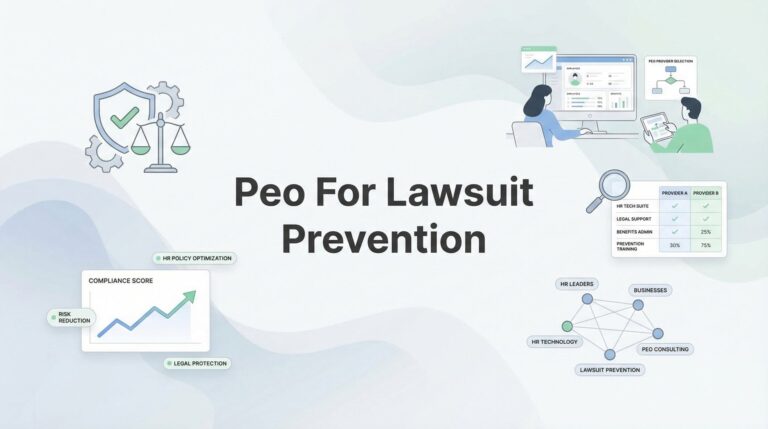
Employment lawsuits cost small businesses $40,000-$125,000 in legal fees alone, often before reaching settlement. A PEO for lawsuit prevention provides the compliance systems, documentation frameworks, and expert guidance that reduce legal exposure through co-employment—not by transferring liability completely, but by establishing the professional HR infrastructure most growing businesses lack internally to navigate federal regulations, state protections, and evolving employment law requireme…