
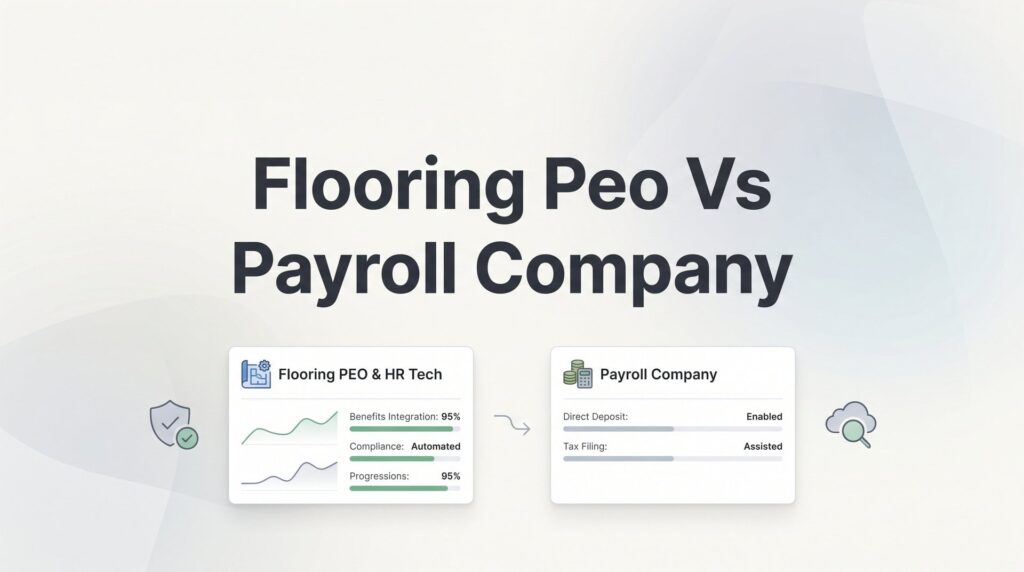
Flooring-specific PEO context. For flooring contractors, the PEO vs payroll-only decision is shaped by workers\' comp pool dynamics, industry-specific compliance, and the operational support needed for a flooring workforce. Payroll-only providers don't handle adhesive/solvent OSHA Hazard Communication, ergonomic safety programs, or commercial flooring class-code complexity.
Looking for the full Flooring PEO guide? See our PEO for Flooring Contractors pillar page covering the complete industry profile — pain points, recommended PEOs, PEO economics, when each model wins, and a decision framework specific to flooring.
Top Flooring HR & Compliance Pain Points
- Back and knee injuries from installation work. Flooring installation has high frequency of moderate-severity musculoskeletal claims (back strains, knee injuries from kneeling). PEO claims management closes these faster, reducing reserve impact on future mod rates.
- Adhesive and solvent exposure compliance. OSHA Hazard Communication requires SDS documentation for all adhesives and solvents, employee training on chemical hazards, and PPE protocols. Documentation gaps trigger citations averaging $16K each.
- Commercial vs residential workers' comp class differences. Different flooring types (carpet, hardwood, tile, vinyl) carry different class codes. Commercial flooring crews work alongside other trades, exposing them to general construction hazards. PEO administration handles class-code splits automatically.
- Seasonal commercial project cycles. Commercial flooring projects spike during retail/office build-out cycles. Headcount swings drive eligibility complexity and unemployment claim management.
- Vehicle accidents for service techs. Residential flooring service techs drive 20K–40K miles annually. PEO fleet-safety programs reduce accident frequency.
PEO vs Payroll-Only for flooring contractors
When payroll-only works: Single-owner residential flooring installers under 5 employees with simple operations and their own workers' comp.
When PEO wins: At 10+ employees or any commercial work, PEO wins. Workers' comp pool savings plus OSHA compliance support justify it.
For the full PEO vs payroll company comparison — feature matrices, cost math, and decision frameworks — see our PEO vs payroll company guide.
Recommended PEOs for flooring contractors
- CoAdvantage: construction pool fits flooring workers' comp profile; adhesive/chemical exposure compliance programs
- Insperity: flooring vertical with ergonomic safety consulting; multi-state operational depth for commercial flooring chains
- Paychex Employer Services: mid-market flooring with accounting and commercial-contract integration
- TriNet: residential service-heavy flooring with modern HR tech needs
Flooring PEO — Common Questions
What's the workers' comp class code for flooring contractors under a PEO?
Does a PEO help reduce flooring injuries from kneeling and lifting?
How do PEOs handle adhesive and solvent OSHA compliance?
Should commercial flooring contractors use a different PEO than residential?
Can a PEO help with VOC compliance for flooring adhesives?
Get a Free Flooring PEO Comparison
We score 40+ PEOs against your specific flooring profile — mod rate, multi-state operations, compliance load. Free, delivered in 5–10 business days.
Get My Free Comparison