
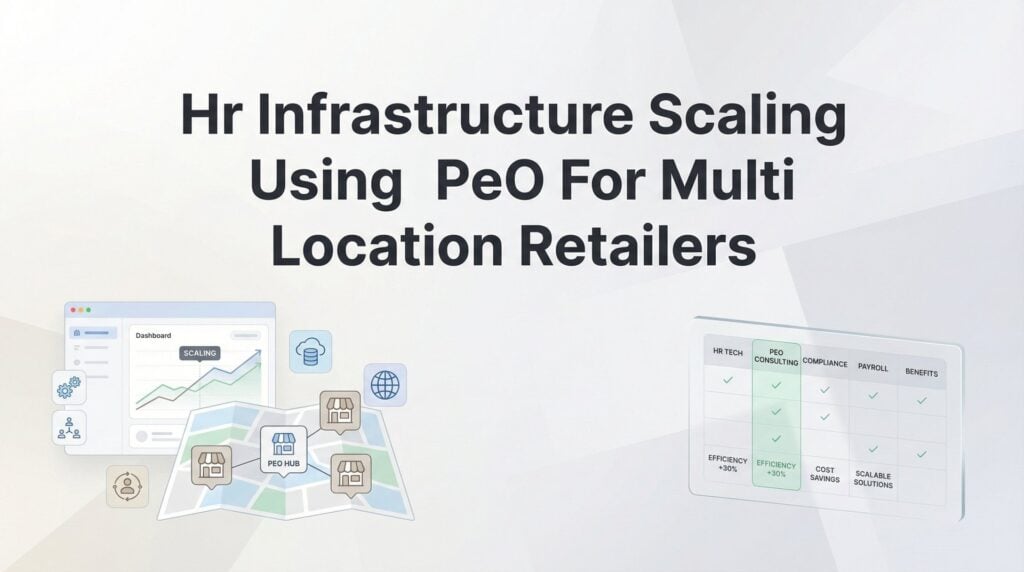
Multi-location retail creates HR complexity that single-site operations never face. You’re juggling different state wage laws, varying local ordinances, inconsistent manager capabilities across stores, and the constant churn that defines retail employment. Adding locations should grow revenue, not administrative headaches.
Yet many retailers find their HR infrastructure buckling under expansion. Payroll errors multiply, compliance gaps widen, and store managers spend more time on paperwork than customers. A PEO can provide the scaffolding for scalable HR, but only if you deploy it strategically.
These seven approaches address the specific friction points multi-location retailers encounter when building HR systems that grow with the business rather than against it.
1. Centralize Compliance While Localizing Execution
The Challenge It Solves
When you operate in multiple states, you’re not just dealing with different tax rates. You’re managing fundamentally different employment frameworks. California has meal break requirements that don’t exist in Texas. New York City has predictive scheduling laws that don’t apply in upstate locations. Oregon mandates paid sick leave with accrual rules that differ from Washington’s system.
Store managers can’t reasonably track these variations while running daily operations. The typical solution is either hiring expensive regional HR specialists or accepting compliance exposure across your footprint.
The Strategy Explained
A well-structured PEO partnership creates a hub-and-spoke compliance model. The PEO monitors regulatory changes, updates policies, and maintains the master compliance framework. Store managers execute standardized processes that the PEO has already vetted for local requirements.
This isn’t about handing off responsibility. It’s about separating regulatory monitoring from operational execution. Your PEO should be tracking when Seattle updates its minimum wage schedule or when a new state implements pay transparency requirements. Your store managers should be following clear protocols that account for those rules without needing to understand the underlying legislation.
The practical benefit shows up when you open a new location. Instead of researching that state’s employment law landscape from scratch, you’re implementing pre-built processes the PEO has already configured for compliance in that jurisdiction. Companies pursuing rapid multi-state expansion find this pre-configured compliance infrastructure particularly valuable.
Implementation Steps
1. Map every location to its applicable regulatory framework—state laws, county ordinances, city-specific requirements—and confirm your PEO actively monitors all relevant jurisdictions.
2. Establish clear ownership boundaries: PEO owns policy updates and regulatory alerts, you own ensuring store managers follow updated procedures.
3. Build a quarterly compliance review process where the PEO walks through recent regulatory changes and you assess whether current store-level execution matches updated requirements.
Pro Tips
Don’t assume your PEO automatically covers every local ordinance. Some providers focus on state-level compliance but miss city-specific rules. Before expanding into markets with aggressive local employment regulations, explicitly confirm coverage. The compliance failure that costs you isn’t usually the obvious state law violation. It’s the local sick leave ordinance you didn’t know existed.
2. Build Tiered Onboarding That Scales With Store Count
The Challenge It Solves
Retail hiring happens in bursts. You’re bringing on fifteen seasonal workers for holiday traffic, replacing three people who quit the same week, and staffing a new location simultaneously. Traditional onboarding breaks down when you’re processing this volume across multiple sites with varying manager experience levels.
Paper-based systems create inconsistency. Digital systems without proper structure create chaos. You end up with incomplete I-9s, missing tax elections, and new hires who show up for their first shift without being properly enrolled in your workers comp coverage.
The Strategy Explained
Modern PEO platforms provide onboarding infrastructure that separates universal requirements from location-specific elements. The system enforces completion of federal forms, benefits elections, and policy acknowledgments while allowing you to layer in store-specific training modules or local requirement.
Think of it as a two-tier system. Tier one is the non-negotiable foundation the PEO manages: tax forms, I-9 verification, benefits enrollment, harassment prevention training. Tier two is your customization layer: store-specific procedures, product knowledge, safety protocols relevant to that location’s layout.
This structure ensures compliance consistency while preserving operational flexibility. A new hire in your Portland location completes the same core onboarding as someone in your Phoenix store, but each receives location-appropriate information without manual intervention from your corporate HR team.
Implementation Steps
1. Audit your current onboarding to identify which elements must be identical across all locations versus which should vary by store, region, or state.
2. Configure your PEO’s onboarding platform with mandatory completion gates for compliance items—new hires cannot proceed to tier two until tier one is complete and verified.
3. Create location-specific onboarding modules that store managers can update independently without breaking the core compliance framework.
Pro Tips
Retail turnover means you’ll onboard the same role repeatedly. Build role-specific onboarding tracks rather than one generic process. A cashier onboarding should look different from a store manager onboarding. The time you invest in template creation pays back quickly when you’re processing high volumes. Most PEO platforms support this branching logic, but you have to configure it intentionally. Understanding the pros and cons of using a PEO helps you set realistic expectations for what these platforms can handle.
3. Standardize Benefits Without Losing Regional Flexibility
The Challenge It Solves
Offering consistent benefits across multiple locations gets expensive fast when you’re negotiating separate contracts in each market. Smaller location headcounts mean worse pricing. Regional carriers mean fragmented administration. Employees transferring between stores face coverage disruptions.
But forcing identical benefits across drastically different cost-of-living markets creates different problems. The health plan that’s competitive in rural Missouri feels inadequate in San Francisco. The 401(k) match that attracts talent in one region underperforms in another.
The Strategy Explained
PEO master health plans consolidate your entire workforce into a single risk pool, which typically improves pricing and simplifies administration. You’re accessing the PEO’s negotiated rates rather than shopping as a mid-sized retailer with fragmented locations.
The strategic opportunity is using that consolidated foundation to create flexible overlays. You maintain core benefits that every employee receives regardless of location, then layer in regional adjustments where market conditions demand it. This might mean enhanced coverage options in high-cost markets or supplemental benefits that address location-specific needs. Retailers focused on employee retention through PEO benefits often find this flexibility critical for competing in tight labor markets.
The administrative advantage is significant. One benefits platform, one renewal cycle, one set of carrier relationships. When an employee transfers from your Dallas store to your Denver location, their coverage continues without re-enrollment or waiting periods.
Implementation Steps
1. Define your benefits floor—the minimum coverage every location receives—then identify markets where competitive pressure or cost-of-living differences justify enhancements.
2. Review your PEO’s master plan options to confirm they support the coverage levels and carrier networks relevant to your geographic footprint.
3. Build a benefits communication strategy that explains both universal coverage and location-specific options clearly, since confusion drives poor enrollment decisions.
Pro Tips
Pay attention to carrier network coverage in your specific markets. A PEO’s master plan might offer excellent pricing but use a carrier with limited provider networks in states where you operate. This matters more in retail than office environments because your workforce is less likely to travel for medical care. Verify network adequacy in each market before committing.
4. Create Payroll Workflows That Handle Retail’s Messiness
The Challenge It Solves
Retail payroll is structurally messy. You have employees working variable schedules, picking up shifts at multiple locations, crossing state lines for coverage, and accumulating overtime in unpredictable patterns. Tipped employees, commission structures, and shift differentials add complexity. Seasonal volume swings mean your payroll processing load fluctuates dramatically.
Standard payroll systems assume relatively stable schedules and single-location employment. They break down when your reality involves constant schedule changes, multi-state tax withholding for employees who work in multiple stores, and integration requirements with retail-specific scheduling software.
The Strategy Explained
A PEO built for multi-location operations should handle the structural complexity of retail payroll without requiring manual workarounds. This means native support for multi-state withholding when employees work across state lines, automated overtime calculations that account for state-specific rules, and integration capabilities with the scheduling and point-of-sale systems you actually use.
The workflow improvement comes from eliminating manual data transfer. Your scheduling system feeds hours directly into payroll processing. Your POS system handles commission calculations. Your time tracking integrates with the PEO’s platform. Store managers verify hours and approve exceptions, but they’re not manually entering data or calculating overtime.
This reduces errors and speeds up processing, but the real value is scalability. Adding locations doesn’t proportionally increase your payroll administration burden because the systems handle the complexity automatically.
Implementation Steps
1. Map your current payroll workflow to identify every point where data transfers manually between systems or where store managers perform calculations that could be automated.
2. Confirm your PEO supports direct integrations with your scheduling software, time tracking system, and POS platform—or provides equivalent functionality within their platform.
3. Establish clear approval workflows that define which exceptions require store manager review versus corporate HR intervention, preventing bottlenecks while maintaining appropriate oversight.
Pro Tips
Multi-state tax withholding is where retailers frequently discover their PEO’s limitations. If you have employees who regularly work in multiple states, confirm the platform handles this automatically rather than requiring manual tax election changes. The administrative cost of managing this manually across dozens of employees negates much of the PEO’s value. Understanding how to track and reconcile payroll tax accounting through your PEO helps you catch errors before they compound.
5. Distribute HR Support Without Hiring Regional Specialists
The Challenge It Solves
Store managers need HR support, but they need it for fundamentally different issues than your corporate team handles. They’re dealing with attendance problems, minor workplace conflicts, performance documentation, and questions about applying policies to specific situations. These issues require quick responses, not deep expertise.
Hiring regional HR specialists to support store-level needs gets expensive as you scale. You’re adding headcount to provide support that’s unevenly utilized—some stores need constant guidance, others rarely call. Centralized corporate HR creates response delays that leave managers making decisions without proper support.
The Strategy Explained
A properly structured PEO relationship extends HR capabilities to every location through their support infrastructure. Store managers get access to HR professionals who can answer policy questions, guide them through documentation requirements, and provide coaching on handling common employee relations issues.
This isn’t about outsourcing judgment. It’s about giving managers access to expertise when they need it. Your store manager in Phoenix can call the PEO’s HR support line when an employee requests FMLA leave and get immediate guidance on documentation requirements and approval processes. Your manager in Atlanta can get coaching on how to document performance issues properly before they escalate. Understanding what HR compliance protection actually covers helps you set appropriate expectations for this support.
The economic model works because the PEO distributes support costs across their entire client base. You’re accessing a team of specialists without carrying the fixed cost of employing them directly.
Implementation Steps
1. Define which types of HR issues store managers should handle with PEO support versus escalating to your corporate team, creating clear decision trees that prevent confusion.
2. Train store managers on how to access PEO HR support effectively—what information to have ready, how to document guidance received, when to loop in corporate HR.
3. Establish a feedback loop where you review the types of questions managers are asking the PEO to identify patterns that might indicate training gaps or policy clarity issues.
Pro Tips
PEO HR support quality varies dramatically between providers. Some offer genuine expertise with reasonable response times. Others provide call center support that reads from scripts. Before committing, test their support system with realistic scenarios your managers actually face. Ask about average response times, whether you get dedicated contacts versus general queues, and how they handle urgent situations outside business hours.
6. Implement Risk Management That Protects Every Location
The Challenge It Solves
Workers compensation in multi-state retail creates compounding complexity. Each state has different coverage requirements, rating structures, and claim procedures. Managing separate policies across multiple states means dealing with different carriers, renewal cycles, and audit processes. A workplace injury at one location can impact your entire experience modification if not handled properly.
Safety programs face similar scaling challenges. Corporate-level safety policies often don’t account for location-specific risks. Store managers lack training to implement effective safety protocols. Incident tracking happens inconsistently, preventing you from identifying patterns before they become expensive problems.
The Strategy Explained
PEO master workers compensation policies consolidate your entire workforce under single coverage, eliminating the need to manage multiple state-specific policies. You’re accessing the PEO’s experience modification rate, which is typically better than what you’d achieve independently, and simplifying administration to one renewal cycle and one carrier relationship. Understanding workers comp cost allocation models helps you evaluate whether a PEO’s pricing actually benefits your specific risk profile.
The risk management advantage extends beyond insurance pricing. Quality PEOs provide safety program infrastructure: standardized training modules, incident reporting systems, claims management support, and loss prevention resources. This gives every location access to professional risk management without requiring you to build that capability internally.
The practical impact shows up in claim outcomes. Proper incident documentation, immediate medical care coordination, and professional claims management reduce both claim costs and lost time. These improvements compound across your location portfolio.
Implementation Steps
1. Review your current workers comp experience across all locations to establish baseline costs and identify high-risk areas that need immediate attention.
2. Confirm your PEO provides workers comp coverage in every state where you operate and understand how their master policy pricing compares to your current costs.
3. Implement the PEO’s incident reporting system consistently across all locations and train store managers on proper documentation and immediate response procedures.
Pro Tips
The PEO’s experience mod includes all their clients, which means your claims performance affects your costs but so does everyone else’s. This usually works in your favor if you run safe operations, but it can create frustration if you’re subsidizing other clients’ poor safety records. Ask potential PEOs about their overall loss ratios and whether they offer any performance-based pricing adjustments for clients who maintain strong safety records.
7. Design Reporting That Reveals Cross-Location Patterns
The Challenge It Solves
Store-level metrics tell you what’s happening at individual locations but obscure patterns that only become visible across your portfolio. You might notice turnover is high at your Phoenix store without realizing it’s actually high across all stores that opened in the past six months. You see overtime costs climbing at several locations without recognizing the common thread is inadequate scheduling practices.
Fragmented HR systems make portfolio-level analysis nearly impossible. Data lives in different formats across locations. Pulling consolidated reports requires manual aggregation. By the time you identify a pattern, it’s already spread across multiple stores.
The Strategy Explained
A centralized PEO platform creates a single data source for all HR metrics across your entire footprint. You can compare turnover rates between regions, identify compensation patterns that correlate with retention, track benefits utilization across different markets, and spot compliance issues before they multiply.
The strategic value is moving from reactive problem-solving to pattern recognition. You’re not just addressing the attendance issue at one store. You’re identifying that attendance problems correlate with specific manager behaviors or scheduling practices, then addressing the root cause across your portfolio. Conducting regular HR infrastructure cost analysis helps you quantify whether your PEO investment is delivering expected returns across locations.
This level of insight is what separates retailers who scale successfully from those who simply accumulate locations. You’re making decisions based on actual data about what works across your specific business rather than industry generalizations or anecdotal observations.
Implementation Steps
1. Define the HR metrics that actually matter for your retail operations—not generic KPIs, but the specific indicators that correlate with store performance in your business.
2. Configure your PEO’s reporting tools to deliver these metrics in formats that support decision-making, with appropriate comparison groups and trend analysis.
3. Establish a regular cadence for reviewing cross-location data with your operations team, focusing on identifying patterns and testing hypotheses rather than just reviewing numbers.
Pro Tips
Most PEO platforms offer extensive reporting capabilities that clients never fully utilize. The limitation usually isn’t the system—it’s knowing which questions to ask. Start with a few high-value reports that directly inform business decisions rather than trying to track everything. As you get comfortable with the data, expand your analysis. The retailers who extract the most value from PEO reporting are those who treat it as a strategic tool, not just compliance documentation.
Putting These Strategies Into Practice
Start with your biggest pain point. For most multi-location retailers, that’s either compliance exposure or payroll complexity. A PEO won’t magically solve structural problems, but it can provide infrastructure that makes scaling HR manageable rather than chaotic.
The retailers who get the most from PEO partnerships are those who treat the relationship as a platform to build on, not a problem to hand off. You’re still responsible for making good operational decisions, managing your people effectively, and running your business. The PEO provides tools and infrastructure that let you do those things across multiple locations without proportional increases in administrative burden.
Before signing with any provider, map your current location count against your 18-month expansion plans. Pressure-test whether the PEO’s capabilities match where you’re headed, not just where you are today. The wrong choice won’t just cost you money. It’ll create friction that slows expansion and creates the exact administrative chaos you’re trying to avoid.
Before you sign that PEO renewal, make sure you’re not leaving money on the table. Many businesses unknowingly overpay because of bundled fees, hidden administrative markups, and contracts designed to limit flexibility. We give you a clear, side-by-side breakdown of pricing, services, and contract terms so you can see exactly what you’re paying for and choose the option that truly fits your business.
