
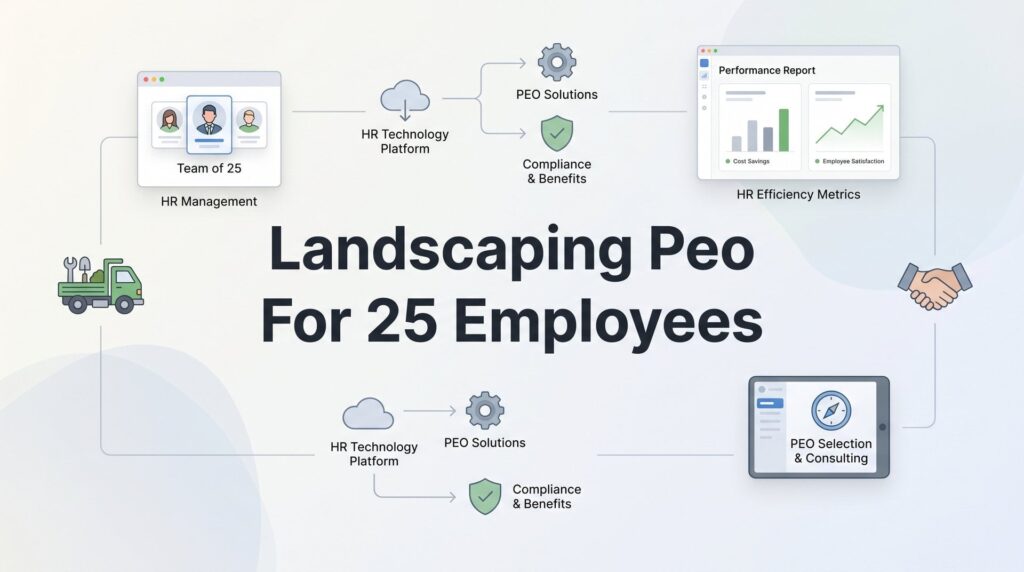
At 25 employees, your landscaping business sits at a critical inflection point. You’re past the scrappy startup phase where you could handle payroll yourself, but you’re not large enough to justify a full-time HR director. Meanwhile, you’re juggling seasonal workforce fluctuations, workers’ comp premiums that feel punitive given your industry’s risk profile, and compliance requirements that multiply every time you cross a new state line for a commercial contract.
A PEO can solve these problems—but only if you choose the right partner and structure the relationship correctly.
The landscaping industry brings unique complications that generic PEO advice doesn’t address. Your workforce scales dramatically between winter and summer. Your workers’ comp classification codes (typically 0042 for lawn care, 0106 for tree services) put you in high-risk categories regardless of your actual safety record. And if you’re doing commercial work across state lines, you’re dealing with compliance requirements that most small businesses never face.
This guide covers the specific strategies that matter for landscaping operations at your headcount, with particular attention to the cost structures, coverage gaps, and operational realities that standard PEO evaluations miss entirely.
1. Negotiate Workers’ Comp Based on Your Actual Experience Mod
The Challenge It Solves
Most PEOs quote workers’ comp rates based on industry averages for landscaping classification codes. If you’ve invested in safety training, maintained a clean claims history, and built a strong experience modification rate, you’re essentially subsidizing higher-risk operators in the PEO’s pool. At 25 employees, this difference can mean tens of thousands of dollars annually.
The default assumption is that all landscaping companies carry similar risk. That’s categorically false, and accepting it without pushback means you’re overpaying from day one.
The Strategy Explained
Before you accept any workers’ comp quote, pull your current experience modification rate and your claims history for the past three years. If your mod is below 1.0, you have concrete leverage. If you’ve had zero lost-time accidents or a demonstrable safety program, that’s additional negotiating power.
Most PEOs will initially quote pooled rates. Push them to show you how your specific experience mod affects your premium. Ask whether they offer safety credit programs or tiered pricing for companies with strong safety records. Some PEOs allow for experience-rated pricing once you’ve been with them for a policy period—get that commitment in writing before you sign.
The key is making your safety record a contractual factor, not just a talking point during sales conversations. Understanding litigation risk mitigation for landscaping companies can help you frame these negotiations more effectively.
Implementation Steps
1. Request your current experience mod and loss runs from your existing workers’ comp carrier (you’re legally entitled to both).
2. During PEO negotiations, present this documentation and explicitly ask how it affects your quoted rate.
3. If the PEO won’t adjust pricing based on your mod, ask for a contractual commitment to re-rate you after 12 months based on your claims performance within their program.
4. Document any safety programs you currently run (toolbox talks, equipment training, incident reporting systems) and ask whether the PEO offers premium reductions for maintaining these programs.
Pro Tips
Don’t accept vague promises about “working with you on pricing later.” Get specific rate adjustments or review timelines written into the contract. If a PEO refuses to acknowledge your experience mod at all, that’s a red flag that they’re not set up to reward good operators—and you’ll likely subsidize poor performers indefinitely.
2. Structure Seasonal Workforce Handling Before You Sign
The Challenge It Solves
Landscaping operations don’t maintain steady headcount. You might run with 15 core employees through winter, scale to 25-30 during spring installation season, and potentially hit 35-40 during peak summer maintenance. Most PEO pricing models charge per-employee-per-month, which creates billing volatility and potential disputes about when employees are “active” versus “inactive.”
If your PEO contract doesn’t explicitly address seasonal fluctuations, you’ll face administrative friction every time you scale up or down—and potentially pay for employees who aren’t actually working.
The Strategy Explained
You need clear contractual language about how the PEO handles seasonal hires, rehires, and workforce scaling. Specifically, you want to understand their billing cutoff dates (do you pay for the full month if someone starts mid-month?), their process for seasonal layoffs (can you remove employees from the system without penalty?), and their onboarding velocity during peak hiring periods.
Many landscaping companies rehire the same seasonal workers each spring. If your PEO treats these as “new hires” requiring full onboarding paperwork every season instead of reactivations, you’re creating unnecessary administrative burden. Clarify this upfront.
Implementation Steps
1. Map out your typical workforce fluctuation pattern for the past two years (monthly headcount from January through December).
2. During contract negotiations, walk through this pattern with the PEO and ask specifically how billing would work for each month.
3. Request written confirmation of their onboarding timeline—how many new employees can they process in a single week if you’re scaling up quickly in March?
4. Ask whether seasonal rehires can be flagged in their system to streamline reactivation rather than treating them as entirely new employees.
5. Clarify the billing treatment for employees who work partial months—do you pay the full monthly fee, or is there proration?
Pro Tips
If the PEO’s standard contract doesn’t address seasonal fluctuations well, this is a legitimate reason to negotiate custom terms or walk away. You’re not an outlier case—seasonal workforce management is fundamental to landscaping operations, and any PEO claiming expertise in your industry should have clear answers to these questions. Companies at similar headcounts face comparable challenges, as outlined in our guide on PEO considerations for 25 employees.
3. Verify Multi-State Coverage Actually Works for Your Territory
The Challenge It Solves
Commercial landscaping contracts often cross state lines. If you’re based in Kentucky but you’ve landed a contract for a corporate campus in Ohio, you’ve just entered a monopolistic workers’ comp state that requires separate coverage. Most PEOs will tell you they operate in “all 50 states,” but that doesn’t mean their workers’ comp coverage, tax registration, and compliance infrastructure actually function seamlessly everywhere you need to work.
The risk isn’t just administrative hassle—it’s potential coverage gaps, compliance violations, and unexpected costs when you discover mid-contract that your PEO can’t actually support your multi-state operations.
The Strategy Explained
You need to audit the PEO’s actual operational presence in every state where you currently work or plan to work. This means more than checking a coverage map on their website. You need to understand whether they’re registered as an employer in those states, whether their workers’ comp policy extends to those jurisdictions, and how they handle monopolistic states (Ohio, Washington, Wyoming, North Dakota).
For monopolistic states, many PEOs require you to maintain separate workers’ comp policies, which fragments your coverage and can create coordination problems when claims arise. Get clarity on this before you sign.
Implementation Steps
1. List every state where you’ve performed work in the past 24 months, plus any states where you’re actively bidding on contracts.
2. Ask the PEO directly: “Are you registered as an employer of record in [specific state]?” for each jurisdiction on your list.
3. For monopolistic states, ask whether their workers’ comp coverage extends there or whether you’ll need to maintain separate policies.
4. Request documentation of their tax registration and compliance infrastructure in each state—vague assurances aren’t sufficient.
5. If you work in multiple states regularly, ask about their process for adding new states mid-contract (timeline, fees, administrative requirements).
Pro Tips
If the PEO hesitates or provides vague answers about specific states, push harder. This isn’t a minor administrative detail—it’s a fundamental question about whether they can actually support your business model. And if they claim they can “get registered” in a new state when needed, find out how long that process takes. You can’t afford to delay a commercial contract because your PEO needs six weeks to complete state registration. Similar considerations apply to managing remote and distributed teams across multiple jurisdictions.
4. Benchmark Benefits Against What Your Crews Actually Value
The Challenge It Solves
PEOs often promote their benefits packages as a major selling point, emphasizing Fortune 500-level health insurance and retirement plans. But if you’re running a landscaping crew, your employees’ priorities likely differ significantly from office workers. Field workers often value accident insurance, short-term disability coverage, and straightforward medical plans over complex HSA options or employer stock programs.
If the PEO’s benefits package doesn’t align with what actually helps you retain seasonal workers and protect your year-round crew, you’re paying for features that don’t drive value.
The Strategy Explained
Start by understanding what your current employees actually use and value. If you’re offering health insurance now, check your utilization rates. Talk to your crew leads about what benefits matter most—often it’s things like dental coverage, accident insurance that covers emergency room visits for job-related injuries, or disability insurance that provides income protection during recovery from injuries.
Then evaluate the PEO’s benefits package against those priorities. Many PEOs offer multiple plan tiers, but the quoted pricing often assumes the mid-tier plan. If your crews would realistically choose the lower-cost option, make sure you’re comparing costs based on that assumption, not the plan the PEO highlights in their proposal.
Implementation Steps
1. Survey your current employees (anonymously if possible) about which benefits they actually use and which ones they’d value if available.
2. Request the PEO’s full benefits guide, not just the summary sheet—you need to see deductibles, coverage limits, and employee contribution requirements.
3. Pay particular attention to accident insurance and disability coverage, since these directly address the injury risks your crews face.
4. Ask whether the PEO offers voluntary benefits that employees can opt into at their own cost (supplemental life insurance, accident coverage, etc.)—these can be valuable retention tools without increasing your costs.
5. Clarify how benefits eligibility works for seasonal employees—do they qualify immediately, or is there a waiting period that effectively excludes your seasonal workforce?
Pro Tips
Don’t assume that “better” benefits automatically mean better retention. If the PEO’s health plan has a $3,000 deductible and high monthly premiums, many field workers will decline coverage entirely. Sometimes a more modest plan with lower employee contributions gets higher participation and better serves your workforce. Ask the PEO for participation rate data from similar landscaping clients if they claim expertise in your industry.
5. Build Your Exit Strategy Into the Initial Contract
The Challenge It Solves
Most businesses evaluate PEOs based on what they offer during the relationship. Almost no one thinks carefully about what happens when you leave—and that’s where PEO contracts often contain the most problematic terms. You need to protect your ability to transition away from the PEO without losing critical data, damaging your workers’ comp experience mod, or facing punitive termination fees.
At 25 employees, you’re at a size where you might outgrow the PEO in a few years, or you might decide to bring HR in-house if your business model shifts. Locking yourself into a relationship with poor exit terms can cost you significantly down the road.
The Strategy Explained
Your contract should explicitly address three critical exit factors: data portability, experience modifier ownership, and termination terms. Data portability means you can export all employee records, payroll history, tax filings, and benefits information in a usable format when you leave. Experience modifier ownership means your workers’ comp claims history stays with your business, not with the PEO’s pool. Termination terms cover notice periods, final billing, and any fees associated with ending the relationship.
Many PEO contracts default to annual auto-renewal with 60-90 day termination notice requirements. If you miss that window, you’re locked in for another full year. That’s a problem if your business circumstances change or if the PEO’s service quality deteriorates. Companies planning for growth should also consider how PEO dynamics change at 50 employees.
Implementation Steps
1. Request explicit contract language confirming that all employee data remains your property and can be exported in standard formats (CSV, PDF) upon termination.
2. Ask how your workers’ comp experience mod is calculated and whether you retain your individual claims history if you leave—this should be documented in writing.
3. Identify the contract’s auto-renewal terms and termination notice requirements, then negotiate these to the shortest reasonable period (30-60 days is more appropriate than 90+ days).
4. Clarify any termination fees, final billing procedures, or “wind-down” costs that apply when you end the relationship.
5. Request a transition support commitment—will the PEO provide reasonable assistance during your exit, or will they immediately cut off access to systems and support?
Pro Tips
If the PEO resists providing clear exit terms or claims their standard contract “doesn’t work that way,” that’s a significant warning sign. Any reputable PEO should be confident enough in their service quality to offer reasonable exit provisions. And if they claim your experience mod “stays with the pool,” walk away—that’s not how workers’ comp experience rating actually works, and it suggests they’re either uninformed or deliberately misleading you.
6. Integrate Field Operations With PEO Systems From Day One
The Challenge It Solves
Landscaping operations don’t run from a central office with employees clocking in at the same location every day. Your crews are distributed across multiple job sites, often working from home to the first site of the day, and tracking time via mobile devices or paper timesheets that get submitted weekly. If your PEO’s systems don’t integrate with how your field operations actually work, you’ll create administrative bottlenecks that waste time and increase payroll errors.
Many PEOs are built for office environments and assume employees will use desktop computers to access HR systems. That doesn’t match your operational reality, and forcing your crew leads to adapt to office-centric systems creates unnecessary friction.
The Strategy Explained
You need to evaluate the PEO’s technology infrastructure specifically for field workforce compatibility. This means mobile-friendly time tracking, GPS integration capabilities if you use field service software, and straightforward processes for crew leads who may not be comfortable with complex HR platforms. If you’re currently using software like Aspire, LMN, or Jobber for job scheduling and time tracking, you need to know whether the PEO’s payroll system can integrate with those tools or whether you’ll be manually transferring data between systems.
The goal is to minimize duplicate data entry and make it easy for your crew leads to submit accurate time records without requiring them to learn entirely new systems. Technology companies have developed specific approaches to HR infrastructure scaling with PEOs that can inform your evaluation.
Implementation Steps
1. Identify all the software systems you currently use for scheduling, time tracking, and job management.
2. Ask the PEO whether they offer direct integrations with those systems or whether data transfer will be manual.
3. Request a demonstration of their mobile time-tracking interface—actually see what your crew leads would use, not just the administrative dashboard.
4. Clarify their process for handling field-based employees who may not have email addresses or regular computer access (this is common in landscaping operations).
5. Ask about training and support for crew leads—will the PEO provide on-site training, or is it all self-service online resources?
Pro Tips
If the PEO’s systems require manual data entry from your field service software into their payroll platform every pay period, calculate how much time that will actually take. At 25 employees across multiple crews, this could easily become a 3-4 hour task twice a month. That’s a real cost that doesn’t show up in the PEO’s quoted pricing, and it might outweigh the administrative savings they’re promising.
7. Evaluate Total Cost Structure, Not Just the Quoted Rate
The Challenge It Solves
PEOs typically quote pricing as a percentage of payroll or a per-employee-per-month fee. But the total cost of a PEO relationship includes implementation fees, benefits administration markups, workers’ comp premiums, state unemployment tax rates, technology fees, and various administrative charges that don’t appear in the initial quote. At 25 employees, these additional costs can add 15-25% to what you thought you’d be paying.
If you’re comparing PEOs based solely on their quoted administrative fee, you’re missing the majority of the cost picture—and you’re likely to be surprised when the first invoice arrives.
The Strategy Explained
Request a complete cost breakdown that includes every fee, premium, and charge you’ll pay over a 12-month period. This should include the administrative fee, workers’ comp premiums (including your estimated mod and classification codes), state unemployment tax rates, benefits costs (both employer and employee portions), technology or platform fees, implementation or onboarding fees, and any per-transaction charges for things like adding new employees or processing terminations.
Then calculate your true per-employee cost by dividing the total annual cost by your average headcount. This is the only meaningful comparison metric when evaluating multiple PEO proposals. As your business grows, the evaluation criteria at 100 employees shifts significantly.
Implementation Steps
1. Create a spreadsheet listing every cost category (administrative fees, workers’ comp, SUTA, benefits, technology, implementation, etc.).
2. Request specific pricing for each category from every PEO you’re evaluating—don’t accept vague estimates or “we’ll determine that later” responses.
3. Ask for their estimated state unemployment tax rate (SUTA) and confirm whether you’ll pay their pooled rate or your individual experience rate.
4. Calculate the total annual cost for each PEO based on your projected average headcount (accounting for seasonal fluctuations).
5. Divide the total annual cost by your average headcount to get a true per-employee annual cost for comparison purposes.
Pro Tips
Pay particular attention to workers’ comp premiums and SUTA rates, since these often represent 60-70% of your total PEO cost. A PEO with a slightly higher administrative fee but significantly better workers’ comp rates will almost always be cheaper overall. And if a PEO refuses to provide detailed cost breakdowns, claiming they “need more information” before they can quote specific numbers, that’s often a sign they’re hiding unfavorable pricing in categories they hope you won’t scrutinize.
Putting It All Together
At 25 employees, a PEO can genuinely transform how you manage HR, reduce your workers’ comp burden, and give your crews access to benefits that help with retention. But the landscaping industry’s specific challenges—seasonal fluctuations, high-risk classification codes, multi-state operations, and distributed workforces—mean you can’t rely on generic PEO evaluation criteria.
Start with workers’ comp and seasonal pricing, since those two factors alone can make or break your ROI. If a PEO won’t acknowledge your experience mod or provide clear answers about how they bill during your off-season, you’re likely looking at a relationship that will cost more and deliver less than you expect.
Then work through integration requirements and exit terms before you sign anything. Your crew leads shouldn’t need to become HR software experts just to submit timesheets, and you shouldn’t be locked into a multi-year contract with no reasonable way out if circumstances change.
The right PEO relationship should feel like gaining a strategic partner who understands the operational realities of running a landscaping business at your scale. If the conversations during the sales process feel like you’re explaining your business model to someone who’s never worked with a field-based operation before, that’s probably how the ongoing relationship will feel too.
Before you sign that PEO renewal, make sure you’re not leaving money on the table. Many businesses unknowingly overpay because of bundled fees, hidden administrative markups, and contracts designed to limit flexibility. We give you a clear, side-by-side breakdown of pricing, services, and contract terms—so you can see exactly what you’re paying for and choose the option that truly fits your business.
