
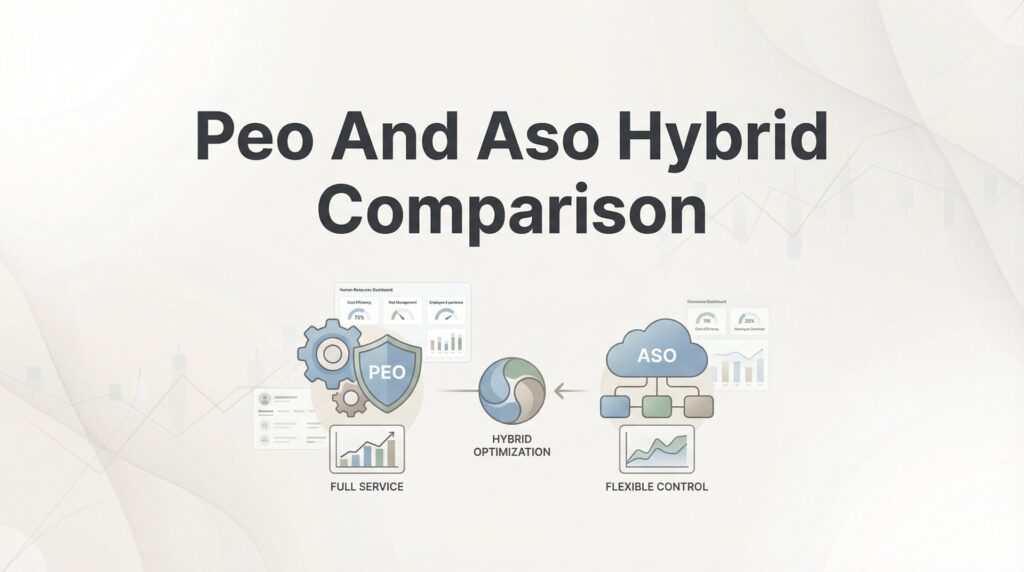
The PEO versus ASO decision isn’t always binary. Many businesses discover that a hybrid approach—combining elements of both models—fits their operational reality better than choosing one or the other. Maybe you want the co-employment benefits structure of a PEO for health insurance leverage, but prefer to keep payroll tax liability and workers’ comp in-house through an ASO arrangement. Or perhaps you’re outgrowing a full PEO but aren’t ready to bring everything internal.
This guide walks through seven practical comparison strategies to help you evaluate whether a hybrid model makes sense, and how to structure one that actually works for your specific situation. We’ll focus on the real decision factors: where the cost breaks fall, which risks shift under each configuration, and how to avoid the operational headaches that catch businesses off guard.
1. Map Your HR Functions to Employer-of-Record Requirements
The Challenge It Solves
Most businesses evaluate PEO versus ASO as an all-or-nothing choice, when the real question is which specific functions genuinely benefit from co-employment versus administrative support alone. You might need co-employment for benefits but not for payroll tax filing. Or you might want compliance guidance without transferring liability.
The problem is that bundled PEO contracts make it hard to see which services you’re actually using and which you’re just paying for because they’re included in the package.
The Strategy Explained
Start by creating a simple spreadsheet that lists every HR function your business handles: payroll processing, tax filing, benefits administration, workers’ comp, compliance guidance, employee onboarding, HR policy development, and so on.
For each function, ask two questions: Does this require co-employment to work properly? And do we have the internal capacity to handle this ourselves? Benefits administration typically requires co-employment if you want access to master health plans with better rates. Payroll processing doesn’t—you can run payroll through an ASO or internal system without co-employment.
The goal is to identify where co-employment actually adds value versus where you’re paying for a legal structure you don’t need. Understanding how PEOs operate helps clarify which functions genuinely require the co-employment relationship.
Implementation Steps
1. List every HR function you currently outsource or handle internally, from payroll to compliance training to benefits enrollment.
2. Mark which functions legally require co-employment (typically just benefits access to master plans and certain tax credits) versus those that work fine under administrative support.
3. Assess your internal capacity honestly—can your team handle payroll tax filing if you bring it in-house, or will mistakes cost more than outsourcing?
4. Identify functions where you want guidance but not liability transfer, like compliance advisory versus compliance assumption.
Pro Tips
Don’t assume you need co-employment just because a PEO rep says you do. Many functions work perfectly well under ASO arrangements. Focus on the two or three functions that genuinely drive value for your business, then build your model around those.
2. Calculate the True Cost Differential by Service Component
The Challenge It Solves
PEO pricing is intentionally opaque. You get a per-employee-per-month fee or a percentage of payroll, but you can’t see what you’re paying for each individual service. ASO pricing is typically unbundled, which means more line items but also more transparency about where your money goes.
Without breaking down costs by component, you can’t tell whether you’re overpaying for services you barely use or getting good value on the functions that matter most.
The Strategy Explained
Request itemized pricing from both PEO and ASO providers for the same scope of services. If a PEO charges $150 per employee per month, ask them to break that down: How much goes to payroll processing? Benefits administration? Workers’ comp? Compliance support? Most PEOs won’t provide this breakdown voluntarily, but you can reverse-engineer it by comparing their bundled fee to what you’d pay for each service separately through an ASO or direct vendor. Using cost accounting methods to compare internal HR vs PEO expenses helps identify which components are priced competitively and which are marked up significantly. Then model different hybrid configurations. Maybe you keep benefits through a PEO co-employment arrangement but move payroll to an ASO. Or you handle payroll internally but outsource compliance guidance to an ASO. Run the numbers on each configuration to find where you get the best value.
Most PEOs won’t provide this breakdown voluntarily, but you can reverse-engineer it by comparing their bundled fee to what you’d pay for each service separately through an ASO or direct vendor. Using cost accounting methods to compare internal HR vs PEO expenses helps identify which components are priced competitively and which are marked up significantly.
Then model different hybrid configurations. Maybe you keep benefits through a PEO co-employment arrangement but move payroll to an ASO. Or you handle payroll internally but outsource compliance guidance to an ASO. Run the numbers on each configuration to find where you get the best value.
Implementation Steps
1. Get detailed quotes from at least two PEO providers and two ASO providers for the same employee count and service scope.
2. Break down the PEO bundled fee by estimating what each component would cost separately—use ASO pricing as a benchmark.
3. Identify services where the PEO pricing seems high relative to unbundled alternatives, and services where bundled pricing actually delivers value.
4. Model three scenarios: full PEO, full ASO, and hybrid (PEO for benefits only, ASO for everything else, or another configuration that fits your needs).
Pro Tips
Pay attention to hidden fees in PEO contracts: implementation fees, per-check charges, state registration fees, and annual increases that aren’t capped. These can add 15-25% to your effective cost. ASO contracts typically have clearer fee structures, but watch for per-transaction charges that add up with high employee turnover.
3. Evaluate Benefits Access and Leverage Trade-offs
The Challenge It Solves
The biggest selling point for PEOs is benefits leverage—access to master health plans that offer better rates than you could negotiate on your own. But that leverage matters most for smaller companies. If you’re already large enough to negotiate decent rates directly with insurers, paying for co-employment just to access PEO plans might not make financial sense.
The question is whether the benefits savings from PEO leverage outweigh the cost of co-employment fees, and whether you can structure a hybrid that gives you benefits access without paying for services you don’t need.
The Strategy Explained
Start by getting quotes for health insurance both through your current broker (or direct from insurers) and through PEO master plans. Compare not just premiums but plan quality, network access, and employee cost-sharing. Sometimes PEO plans have lower premiums but worse coverage or narrower networks.
If the PEO benefits savings are significant—say, 20% or more on premiums—then co-employment for benefits alone might justify the cost. But if the difference is marginal, you’re better off keeping benefits separate and using an ASO for everything else. Understanding when PEO benefits administration outsourcing makes sense helps frame this decision.
Some providers offer benefits-only PEO arrangements where you get co-employment for benefits access but handle payroll and other functions yourself or through an ASO. This isn’t common, but it’s worth asking about if benefits leverage is your primary driver.
Implementation Steps
1. Get health insurance quotes from at least two brokers or direct insurers for your current employee count and demographics.
2. Request PEO benefits quotes from providers that offer master health plans—make sure they’re quoting based on your actual employee demographics, not generic rates.
3. Compare total annual benefits costs (premiums plus employee contributions) between direct plans and PEO master plans.
4. Ask PEO providers if they offer benefits-only co-employment arrangements, and what the fee structure looks like compared to full-service PEO pricing.
Pro Tips
Benefits leverage typically matters most for companies with 10-50 employees. Below 10, you’re often on fully underwritten plans regardless. Above 50-100, you can usually negotiate competitive rates directly. If you’re in that middle range and your workforce is relatively healthy, PEO benefits access can deliver real savings. If your workforce has higher health risks, PEO master plans might not accept you or might charge higher rates than expected.
4. Assess Compliance Risk Distribution Under Each Model
The Challenge It Solves
One of the biggest differences between PEO and ASO arrangements is who assumes compliance liability. Under co-employment, the PEO becomes a joint employer and assumes certain legal responsibilities—payroll tax filing, workers’ comp compliance, and sometimes wage-and-hour adherence. Under an ASO arrangement, you get guidance and administrative support, but all liability stays with you.
The challenge is understanding which risks actually transfer under co-employment versus which remain yours regardless, and whether the risk transfer justifies the cost.
The Strategy Explained
PEOs don’t assume all employment liability—they typically cover payroll tax obligations and workers’ comp compliance because those are tied to their role as employer of record. But they don’t usually assume liability for discrimination claims, wrongful termination, or wage-and-hour violations unless those stem from their own policy guidance.
ASOs provide compliance guidance and may offer access to legal resources, but they’re explicitly advisory. If you misclassify employees or violate wage-and-hour laws, that’s on you even if an ASO consultant told you it was fine. Reviewing PEO risk management and liability support clarifies what’s actually covered under co-employment.
The key question is which risks you’re most worried about and whether co-employment actually addresses them. If your biggest concern is payroll tax penalties or workers’ comp audits, a PEO transfers those risks. If you’re worried about employment litigation or HR policy mistakes, co-employment doesn’t help much—you need good employment practices liability insurance and competent internal HR leadership regardless of your outsourcing model.
Implementation Steps
1. List the compliance risks that keep you up at night: payroll tax penalties, workers’ comp audits, wage-and-hour violations, discrimination claims, benefits compliance (ACA, COBRA, ERISA).
2. Review PEO contracts carefully to see which risks they explicitly assume versus which they disclaim—most contracts have detailed liability limitation clauses.
3. Compare that to ASO contracts, which typically include broad disclaimers stating they’re advisory only and assume no liability for client compliance failures.
4. Evaluate whether the risks that actually transfer under co-employment justify the cost difference between PEO and ASO arrangements.
Pro Tips
Don’t assume a PEO relationship shields you from all employment liability. You’re still jointly liable for most employment practices issues, and if the PEO goes out of business or fails to pay payroll taxes (rare but it happens), you can still be on the hook. Understanding where PEO contracts create liability helps you read the indemnification clauses carefully.
5. Test Operational Control Requirements Against Each Structure
The Challenge It Solves
PEOs standardize processes across all their clients. That’s how they achieve economies of scale and maintain compliance. But standardization means less flexibility. You might have to use their payroll schedule, their benefits enrollment process, their HR policies, and their technology platforms.
For some businesses, that structure is helpful—it forces consistency and reduces the burden on internal staff. For others, it’s a constraint that conflicts with how they actually operate.
The Strategy Explained
Map out the operational processes that matter most to your business: How do you handle payroll approvals? What’s your performance review cycle? How do you manage benefits enrollment? What HR technology do you use, and how integrated is it with other systems?
Then ask PEO providers how much flexibility you have within their systems. Can you run off-cycle payroll when needed? Can you customize benefits enrollment periods? Can you integrate their platform with your existing HRIS or accounting software? Evaluating the PEO HR technology platform helps determine whether their systems will work with your operations.
ASO arrangements typically offer more flexibility because you’re buying services à la carte rather than joining a standardized program. You can choose which processes to outsource and which to keep in-house, and you can usually integrate ASO services with your existing systems more easily.
The trade-off is that flexibility requires more internal management. If you don’t have strong HR leadership to coordinate multiple vendors and maintain process consistency, PEO standardization might actually be a benefit rather than a constraint.
Implementation Steps
1. Identify the three to five operational processes where you need the most flexibility—these might be payroll timing, benefits customization, HR policy adaptation, or technology integration.
2. Ask PEO providers specifically how they handle these processes and where you have room to deviate from their standard approach.
3. Compare that to ASO offerings, where you typically have more control but also more responsibility for coordinating services.
4. Assess your internal HR capacity honestly—do you have someone who can manage a more flexible but complex ASO arrangement, or do you need the structure a PEO provides?
Pro Tips
If you’re in a fast-growth phase or have unique operational needs (seasonal workforce, project-based staffing, frequent acquisitions), ASO flexibility usually serves you better. If you’re in a stable operational mode and want to minimize HR administrative burden, PEO standardization can be helpful. Hybrid models work well when you need flexibility in some areas but standardization in others—just make sure you’re clear about which is which before you commit.
6. Model Your Growth Trajectory Against Transition Thresholds
The Challenge It Solves
Your HR outsourcing needs change as you grow. A full PEO might make sense at 15 employees but become unnecessarily expensive at 75. Or you might start with an ASO but realize you need benefits leverage as you scale past 30 employees.
The problem is that switching models is disruptive and expensive. If you choose a structure that doesn’t scale with your growth trajectory, you’ll face a painful transition within a year or two.
The Strategy Explained
Project where your headcount will be in 12, 24, and 36 months. Then identify the typical transition thresholds where businesses outgrow or grow into different models. Many businesses find that PEOs make the most sense between 10 and 50 employees, where benefits leverage matters but you don’t have the scale to negotiate directly with insurers or build robust internal HR.
Above 50-75 employees, you often reach a point where you can get competitive benefits rates on your own and where PEO per-employee fees start to add up significantly. That’s when many businesses transition to ASO arrangements or bring more HR functions in-house. Having a clear PEO termination process helps you plan for this transition before you’re locked into a contract.
Below 10 employees, you might not get much benefits leverage from a PEO, and the per-employee fees can be disproportionately high. A simple ASO or even direct vendor relationships (payroll provider plus benefits broker) often make more sense.
Hybrid models can serve as transition strategies—moving from full PEO to benefits-only PEO while bringing payroll in-house, for example. Or starting with ASO and adding PEO co-employment just for benefits as you grow past 20 employees.
Implementation Steps
1. Project your headcount growth realistically over the next three years, including any planned expansions, acquisitions, or new locations.
2. Identify the employee count thresholds where your outsourcing needs will likely shift—typically around 10, 30, 50, and 100 employees.
3. Evaluate whether your current model (or the one you’re considering) will still make sense at those future headcounts, or whether you’ll face a disruptive transition.
4. Consider hybrid arrangements that give you flexibility to adjust as you grow without having to switch providers entirely.
Pro Tips
If you’re in rapid growth mode, prioritize flexibility over cost optimization. A slightly more expensive arrangement that scales smoothly is better than saving money now but facing a messy transition in 18 months. Ask providers about their typical client lifecycle—if most clients leave after two years, that’s a signal the model doesn’t scale well.
7. Run a Pilot Comparison Before Full Commitment
The Challenge It Solves
PEO and ASO contracts typically require annual commitments with significant switching costs if you’re unhappy. That makes it risky to commit fully without testing whether the model actually works for your business.
The challenge is that most providers won’t let you pilot their services on a small scale before signing a full contract. But there are ways to test assumptions and validate your decision before you’re locked in.
The Strategy Explained
If you’re considering a hybrid model, you might be able to structure a phased implementation that lets you test one component before committing to the full arrangement. For example, you could start with ASO payroll services while keeping benefits separate, then add benefits administration after three months if the relationship is working well.
Or if you’re evaluating PEO versus ASO, you could run a detailed cost analysis on your last 12 months of HR expenses and model what they would have been under each arrangement. Include not just direct costs but also time spent by internal staff, compliance penalties or near-misses, and benefits claims experience. Understanding the key PEO vs ASO decision factors helps structure this analysis effectively.
Another approach is to implement the new model for a subset of employees first—maybe a specific location or division—before rolling it out company-wide. This isn’t always possible with PEO co-employment (some states don’t allow partial co-employment), but it can work with ASO arrangements.
Implementation Steps
1. Identify which components of the model you’re least certain about—these are the ones worth testing before full commitment.
2. Ask providers if they offer phased implementation or pilot programs, or if you can start with a subset of services before adding more.
3. Define clear success metrics for the pilot: cost savings targets, compliance improvements, time savings for internal staff, employee satisfaction with benefits or payroll.
4. Set a specific evaluation period (typically 90-180 days) and decision criteria for whether to expand, adjust, or exit the arrangement.
Pro Tips
Even if you can’t run a true pilot, you can validate assumptions before signing. Talk to current clients of the provider—not just references they give you, but companies you find through your network. Ask about hidden costs, service quality issues, and whether the model delivered what was promised. That due diligence is worth more than any sales pitch.
Making the Right Hybrid Call
Start with your non-negotiables: benefits leverage, compliance risk tolerance, operational control needs. Then work backward to the model configuration that serves them. Most businesses find that the hybrid question isn’t about finding the perfect split, but about being honest about what you can handle internally versus what genuinely requires outside support.
The companies that get hybrid models right are the ones that focus on two or three core functions where outsourcing delivers clear value—usually benefits access and compliance guidance—and keep everything else as simple and flexible as possible. The companies that struggle are the ones that try to optimize every component separately and end up with a fragmented mess of vendors that nobody can manage effectively.
Run the numbers on your specific situation. Model what your costs and risks look like under full PEO, full ASO, and the hybrid configurations that make sense for your business. Test assumptions with a limited pilot if possible, and build in flexibility for adjustment as your business evolves.
Before you sign that PEO renewal, make sure you’re not leaving money on the table. Many businesses unknowingly overpay because of bundled fees, hidden administrative markups, and contracts designed to limit flexibility. We give you a clear, side-by-side breakdown of pricing, services, and contract terms—so you can see exactly what you’re paying for and choose the option that truly fits your business.
