How PEOs work across industries like construction, healthcare, startups, and multi-state employers.
Finding the right construction PEO for 5 employees requires focusing on workers’ comp savings first, then evaluating flexible pricing models that don’t penalize small crews. This guide reveals five targeted strategies to help micro construction businesses access better insurance rates and compliance support without overpaying or getting trapped in contracts designed for larger companies.
At 15 employees, construction companies face real HR challenges—workers’ comp claims, multi-site payroll, and compliance issues—without the resources for dedicated staff. This guide reveals seven strategic criteria for selecting a construction PEO for 15 employees that truly understands your industry’s unique risks, from proper trade classifications to field-ready safety programs, helping you avoid generic providers that promise support but can’t deliver construction-specific solutions.
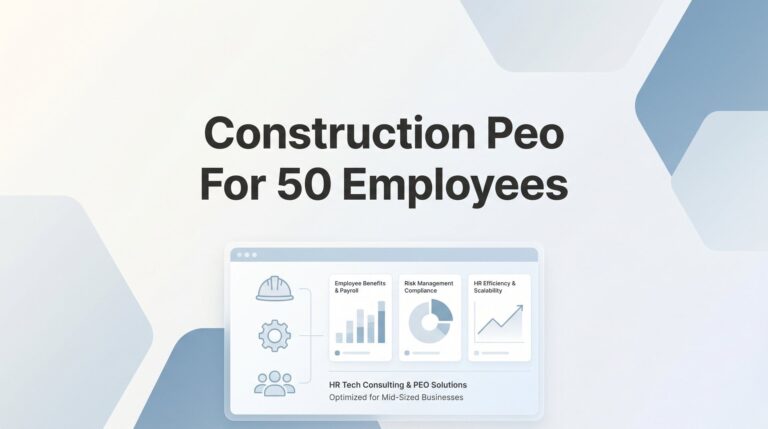
Construction companies with 50 employees face critical HR challenges including escalating workers’ comp costs, complex OSHA compliance across multiple crews, and competitive benefits needs—without the scale to justify a full internal HR team. Selecting the right Construction PEO for 50 employees requires looking beyond generic features to find partners who understand certified payroll, prevailing wage requirements, and construction-specific safety programs that impact your experience modifica…
General contractors face unique HR challenges including fluctuating crew sizes, multi-state compliance, and high workers’ comp costs. This guide outlines seven construction-specific PEO strategies that help general contractors control costs, reduce compliance risk, and improve operational efficiency—from managing experience modification rates to handling multi-state payroll and subcontractor relationships that directly impact your bottom line and competitive positioning.
When your construction company reaches 100 employees, selecting the right PEO becomes critical as workers’ comp exposure, multi-site compliance, and operational complexity dramatically increase. This guide delivers seven targeted strategies for evaluating a construction PEO for 100 employees, focusing on experience mod rates, union/non-union workforce management, and cost structures that actually impact your margins at this specific headcount threshold.
Construction companies with 25 employees face unique HR challenges—too large for DIY payroll management but too small for dedicated HR staff. This guide provides seven targeted strategies for selecting a construction PEO for 25 employees that understands your specific operational scale, from managing fluctuating workers’ comp premiums and OSHA compliance to properly classifying multi-trade crews and offering competitive benefits that retain skilled workers.
Finding the best PEO for general contractors requires looking beyond standard HR solutions that don’t account for the unique challenges of construction work—shifting job sites, complex workers’ comp classifications, and project-specific prevailing wage requirements. This guide identifies seven essential selection criteria that help general contractors choose a PEO built specifically for their industry, avoiding providers that will create more administrative headaches than they solve.
Healthcare practices struggle with rising labor costs not because they overpay employees, but because they lack the purchasing power and administrative infrastructure to negotiate better rates on benefits, workers’ comp, and insurance. This guide shows how partnering with a Professional Employer Organization enables labor cost optimization using PEO for healthcare practices by accessing enterprise-level pricing and streamlining HR operations that small to mid-sized practices can’t achieve ind…
Manufacturing firms struggling with high workers’ comp premiums, overtime costs, and OSHA compliance can achieve labor cost optimization using PEO for manufacturing firms through a strategic six-step approach. This framework shows how to audit current expenses, leverage a PEO’s pooled buying power to reduce insurance and benefits costs, and measure real ROI—but only when paired with sound operational fundamentals.
Construction companies experience dramatic workforce fluctuations—doubling during peak seasons and spreading across multiple states—while managing prevailing wages, union requirements, and frequent workers’ comp claims. HR infrastructure scaling using a PEO for construction companies offers a flexible solution that adapts to these unique challenges, but choosing the wrong provider can be costlier than managing HR in-house. This guide reveals how to evaluate your readiness for a PEO partnershi…
