Coverage of tax responsibility, workers’ comp, liability exposure, and regulatory obligations under co-employment.
Partnering with a PEO means sharing employer responsibilities like payroll, benefits, and compliance, but you still carry legal and financial exposure if issues arise. This guide covers seven essential PEO internal audit considerations that help business owners verify accuracy, maintain compliance, and protect against costly surprises—from payroll tax verification to benefits administration and regulatory filings—giving you control over a relationship where your company’s reputation and finan…

Before signing with a PEO provider, conduct a thorough PEO state employment law risk review to evaluate how they handle multi-state compliance challenges. Companies operating across states like California, Texas, and New York face vastly different leave laws, wage payment rules, and penalty structures—making your PEO choice either a critical safety net or a major liability exposure. This systematic review process helps you stress-test a provider’s state-specific compliance capabilities before…
Employment lawsuits cost small businesses $125,000-$250,000 to defend, but most companies aren’t properly using their PEO’s compliance infrastructure for protection. This PEO employment litigation prevention guide provides six practical operational steps to structure your co-employment relationship effectively, from documentation systems to termination protocols, helping you leverage the protection you’re already paying for instead of leaving yourself exposed to costly wrongful termination an…
A PEO workers comp risk transfer framework doesn’t eliminate workplace injury liability—it redistributes it between you and the PEO through co-employment. This breakdown explains exactly which workers comp risks transfer to the PEO, which remain your responsibility, and how to evaluate whether a PEO’s structure genuinely reduces your exposure or simply creates an illusion of protection without the sales pitch.

Retail enterprises managing multi-state operations face complex compliance challenges including wage violations, predictive scheduling laws, and jurisdiction-specific OSHA standards that can trigger costly class-action exposure. This guide evaluates the top PEO for retail enterprise compliance risk management solutions specifically designed to navigate retail-specific regulations like tip pooling policies and minor labor restrictions across hundreds of locations, helping companies build proac…
When you join a PEO, workers comp coverage is bundled in, but most business owners don’t understand the peo workers comp excess insurance layer that sits above the primary policy. This excess coverage acts as a critical financial backstop for catastrophic claims—like severe accidents, multi-employee incidents, or seven-figure occupational disease cases—that exceed primary policy limits, protecting your business from direct liability exposure when disaster strikes.
When an employee gets injured at work, the critical first 24-48 hours determine whether you face a smooth workers comp claim or a costly, prolonged issue that damages your experience modifier. This operational guide provides a clear PEO workers comp injury management protocol, detailing exactly which responsibilities belong to you versus your PEO partner, and how to coordinate effectively from the moment of injury through successful return-to-work.
Rising workers’ comp premiums often stem from governance gaps, not bad luck. This guide outlines seven essential elements of a PEO workers comp safety governance framework that establish clear accountability between your company and your PEO, prevent finger-pointing during incidents, reduce workplace injuries, and lower your experience modification rate—transforming workers’ comp from a cost center into a strategic advantage.
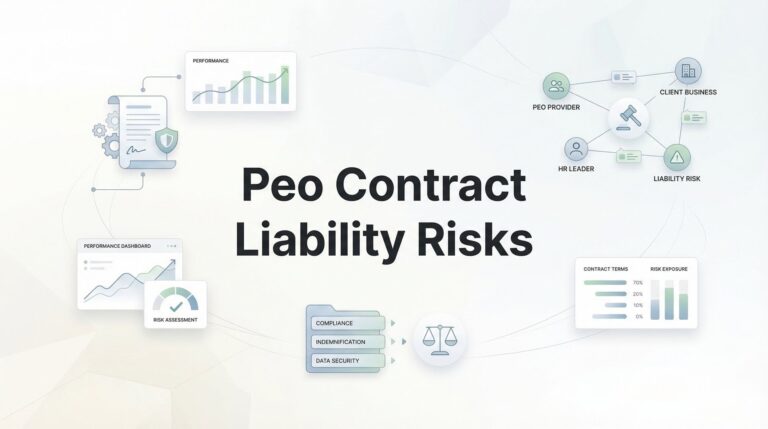
PEO contracts often contain hidden liability traps in their co-employment agreements that leave business owners personally exposed despite believing they’re protected. This guide identifies seven critical PEO contract liability risks—including shared liability loopholes, conditional protections, and state-specific limitations—that can result in unexpected legal and financial consequences, plus practical strategies to identify and address each vulnerability before signing your agreement.
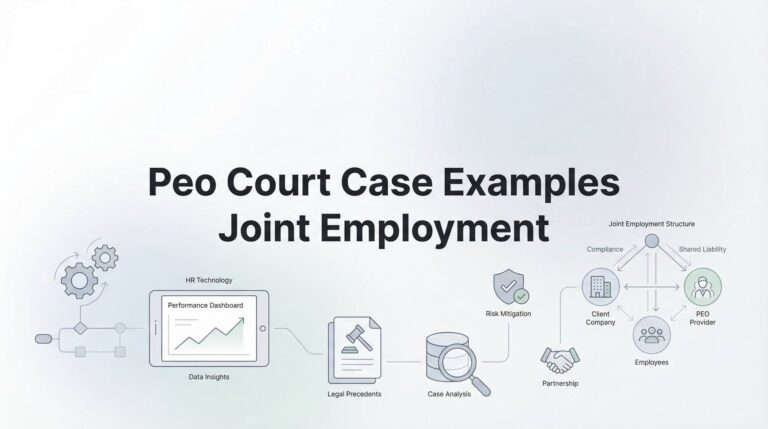
Joint employment liability in PEO relationships depends on actual workplace control, not just contract terms—a distinction that has cost businesses millions in court. This analysis of landmark PEO court case examples joint employment reveals seven critical patterns from real lawsuits involving wage violations, discrimination claims, and workplace injuries, showing business owners how to structure their PEO arrangements to minimize legal exposure based on what judges actually rule on.
