
Most businesses sign a single PEO contract and call it done. But companies with complex workforce structures—multiple locations, seasonal fluctuations, or mixed employee types—often leave money on the table with this one-size-fits-all approach.
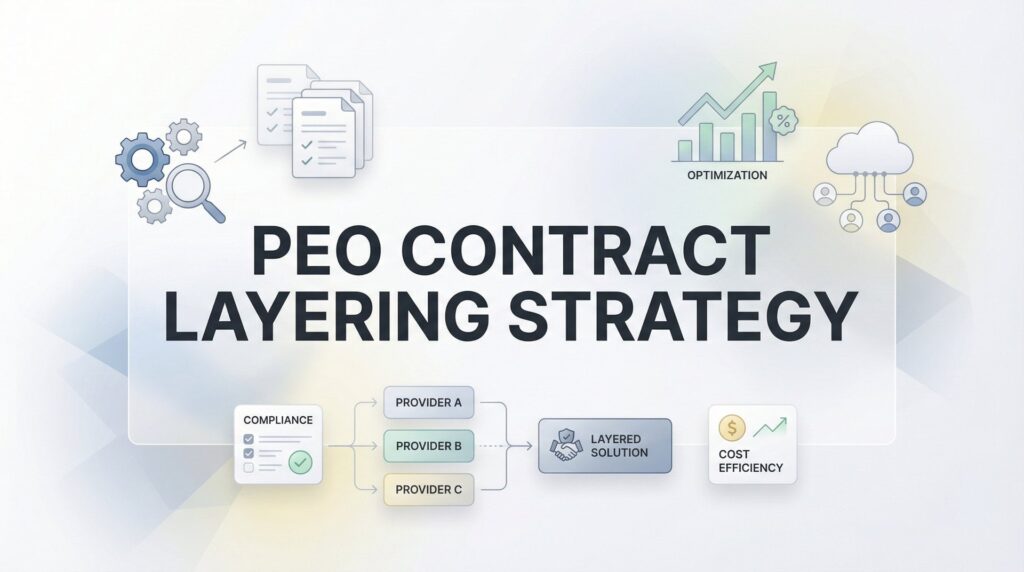
Contract layering is the practice of strategically structuring multiple PEO agreements or service tiers to match different workforce segments, rather than forcing everyone into identical terms. This isn’t about gaming the system. It’s about recognizing that your warehouse workers in Texas have different needs than your remote software developers, and your PEO arrangement should reflect that reality.
When done right, layering can reduce per-employee costs, improve benefits matching, and give you more negotiating leverage at renewal time. When done wrong, it creates administrative chaos and compliance gaps.
This guide walks through the practical steps to evaluate whether layering makes sense for your situation, structure agreements that actually work together, and avoid the pitfalls that trip up most companies attempting this strategy.
Step 1: Audit Your Workforce Segments and Current Contract Gaps
Before you consider layering PEO contracts, you need a clear picture of who actually works for you and what they need. Start by mapping your employee groups across four dimensions: location, classification, benefits usage, and risk profile.
Location matters because state regulations, workers’ comp rates, and local benefit expectations vary dramatically. Your California team faces different compliance requirements and cost structures than your Florida employees. Companies operating across state lines face unique challenges that require specialized PEO solutions for multi-state operations. Classification separates W-2 employees from contractors, full-time from part-time, and exempt from non-exempt—each group has distinct service needs.
Benefits usage reveals where you’re overpaying. If your warehouse team rarely uses the premium health plan you’re bundled into, you’re subsidizing benefits they don’t want. Risk profile looks at workers’ comp exposure, turnover rates, and compliance complexity by employee type.
Once you’ve mapped these segments, compare them against your current PEO contract. Where are the mismatches? You might find you’re paying for robust HR support for a remote team that never calls the helpline. Or you’re getting basic workers’ comp coverage for a high-risk manufacturing crew that needs specialized safety programs.
Calculate the cost differential by getting segment-specific quotes from other providers. What would it cost to cover just your Texas warehouse team versus your current blended rate? What about your remote workers who need minimal on-site services?
Document which services each segment actually uses versus what you’re paying for across the board. Pull six months of data on HR support tickets, benefits enrollments, payroll complexity, and compliance assistance by employee group. This usage data becomes your negotiating foundation.
The goal isn’t to find perfect alignment—that’s impossible with any single contract. You’re looking for meaningful gaps where the cost of mismatch exceeds the complexity of managing multiple agreements.
Step 2: Determine If Layering Is Worth the Complexity for Your Business
Contract layering sounds attractive until you account for what it actually takes to manage multiple PEO relationships. The financial threshold matters: layering typically makes sense starting around 75 employees with genuinely distinct segments.
Below that number, the administrative overhead usually outweighs potential savings. You need enough employees in each segment to justify separate agreements and enough total headcount to absorb the coordination costs.
Someone on your team will own this multi-provider relationship day-to-day. That’s not a casual side responsibility. Managing layered contracts requires coordinating payroll across systems, reconciling benefits data, ensuring compliance reporting doesn’t fall through gaps, and serving as the escalation point when providers give conflicting guidance.
Budget for roughly 0.25 to 0.5 FTE of dedicated HR time. If you don’t have that capacity, layering becomes a risk rather than an opportunity.
Layering backfires in predictable scenarios. If you have too few employees per segment—say, splitting 80 employees across three PEOs—you lose economies of scale and increase per-employee costs despite better service matching. Overlapping state requirements create compliance headaches when multiple providers operate in the same jurisdiction with different interpretations.
Benefits portability becomes a problem if employees regularly move between segments. Switching someone from one PEO to another mid-year can trigger waiting periods, benefits gaps, and administrative friction that damages employee experience.
Run a decision framework: calculate your projected annual savings from segment-specific pricing, then subtract the cost of additional HR time, system integration, and complexity buffer (usually 15-20% of gross savings). A thorough measuring PEO financial performance will help you determine whether layering delivers real value. If you’re not clearing at least $50,000 in net annual savings, the juice isn’t worth the squeeze.
Consider your operational maturity too. If your HR team is already stretched managing a single PEO relationship, adding complexity won’t improve outcomes.
Step 3: Structure Your Primary and Secondary PEO Relationships
Once you’ve decided to layer, you need a clear hierarchy. Choose an anchor PEO to handle your compliance-heavy, high-touch employee segments. This provider should have deep expertise in your most complex areas—whether that’s multi-state compliance, high-risk workers’ comp, or specialized benefits administration.
Your secondary providers handle more commoditized services for lower-complexity segments. They might cover remote workers who need basic payroll and benefits, or seasonal employees who don’t require year-round HR support. Understanding PEO co-employment basics helps you identify which services belong with which provider.
Common layering structures include geographic splits, where different PEOs cover different states or regions. This is the cleanest approach because it minimizes overlap and keeps compliance boundaries clear. Another structure separates employees by benefits tier—core employees get comprehensive coverage through your primary PEO, while contractors or part-timers use a secondary provider with lighter services.
Some companies layer by risk profile, using a specialized PEO for high-risk manufacturing workers and a standard provider for office staff. This works when workers’ comp rates vary significantly by classification.
Disclosure matters when negotiating these arrangements. Most PEOs prefer exclusive relationships and may have contract language restricting multi-provider setups. Address this upfront. Tell prospective providers you’re running a layered structure and need terms that acknowledge it.
Negotiate pricing that reflects your total employee count, not just the segment they’ll cover. A PEO covering 40 of your 100 employees should price based on your full workforce size—you’re a larger, more stable client than your segment size suggests.
Ensure your primary PEO handles the most complex compliance functions. They should own multi-state tax filings, ACA reporting, and any industry-specific regulatory requirements. Secondary providers should handle straightforward payroll and benefits administration for their segments.
Don’t split compliance responsibilities across providers in the same jurisdiction. If both PEOs are filing state unemployment taxes for different employee groups in Texas, you’re creating audit risk and administrative redundancy.
Build flexibility into your agreements from the start. You need the ability to move employee groups between providers as your business changes without triggering penalties or coverage gaps.
Step 4: Align Contract Terms, Renewal Dates, and Exit Provisions
Renewal timing is a strategic decision, not an administrative detail. Staggered renewal dates give you leverage—when one contract comes up for renewal, you can use competitive quotes from other providers, including your secondary PEO, to negotiate better terms.
If your primary contract renews in January and your secondary in July, you’ve got two annual opportunities to pressure test pricing and service quality. This approach works best when you have confidence in your ability to manage transitions and absorb potential disruption.
Synchronized renewal dates work better if you want cleaner decision-making. You can evaluate your entire PEO strategy at once, compare total costs across providers, and potentially consolidate or restructure without timing mismatches creating gaps.
Match notice periods and termination clauses across all agreements. If your primary contract requires 90 days’ notice to terminate but your secondary only requires 30 days, you can’t smoothly transition employees between providers if circumstances change.
Align these terms to at least 90 days across all contracts. This gives you enough runway to move employee groups, complete benefits re-enrollment, and handle compliance transitions without rushing. A comprehensive PEO contract negotiation guide can help you secure favorable terms across all your agreements.
Build explicit flexibility provisions for moving employees between providers. Your contracts should spell out the process for transferring employee groups, including how benefits continuity is maintained, how workers’ comp experience mods are handled, and who owns compliance filings during transition periods.
Eliminate auto-renewal clauses from every layered contract. These provisions lock you into another term if you miss a narrow notification window—often 60 to 90 days before renewal. With multiple contracts to track, auto-renewals become traps.
Replace them with affirmative renewal language requiring both parties to agree to continue the relationship. This forces an annual strategic review and prevents inadvertent contract extensions.
Pay close attention to exit provisions around data ownership and employee records. When you terminate a PEO relationship, you need immediate access to payroll history, benefits documentation, and compliance filings. Contracts should specify data delivery timelines and formats, with penalties if the provider delays.
Step 5: Create Your Internal Coordination System
Layered contracts fail when no one owns the operational coordination. Designate a single point of ownership—typically your HR director or a senior HR manager—who manages the multi-PEO relationship day-to-day.
This person isn’t just tracking contracts. They’re reconciling data across systems, ensuring payroll runs smoothly across providers, coordinating benefits enrollment, and serving as the escalation point when issues arise. Understanding how to use a PEO alongside your internal HR department becomes critical when managing multiple provider relationships.
Build data reconciliation processes that run weekly at minimum. You need to verify that employee counts match across PEO systems, payroll totals reconcile to your internal records, and benefits deductions align with enrollment data. Discrepancies caught early are easy fixes. Discrepancies found at year-end become compliance nightmares.
Create a master employee roster that maps which employees are covered by which PEO, updated in real-time as people join, leave, or transfer between segments. This becomes your source of truth when questions arise about coverage, benefits eligibility, or compliance reporting.
Your employee communication strategy should make multiple PEOs invisible to your workforce. Employees shouldn’t need to know or care that they’re covered by a different provider than their colleague down the hall. Standardize how employees access payroll, benefits, and HR support regardless of which PEO provides the backend services.
This might mean using a unified HR portal that integrates with multiple PEO systems, or simply creating consistent internal processes for common requests like time-off approvals or benefits questions.
Establish clear escalation protocols for when providers give conflicting guidance. If your primary PEO says one thing about California meal break requirements and your secondary PEO says another, who makes the final call? Document decision-making authority and create a process for resolving provider disagreements quickly.
Schedule quarterly business reviews with each provider, but don’t do them in isolation. Use insights from one PEO relationship to pressure test the other. If your secondary provider is delivering better responsiveness or more competitive pricing, that becomes leverage in conversations with your primary PEO.
Step 6: Monitor, Measure, and Adjust Your Layered Structure
Layering isn’t a set-it-and-forget-it strategy. Run quarterly cost comparisons to verify you’re actually saving what you projected. Pull total PEO costs by segment, including per-employee fees, benefits premiums, workers’ comp rates, and any administrative charges.
Compare these actuals against what you’d pay under a single-provider arrangement at your current employee count. Market pricing changes—what looked like a 20% savings at implementation might shrink to 8% a year later if your primary PEO has dropped rates for companies your size. Implementing how to track PEO costs accurately helps you track these shifts accurately.
Track service quality metrics across providers. Measure response times for HR inquiries, payroll error rates, benefits enrollment accuracy, and compliance issue resolution speed. If one provider consistently underperforms, that’s your signal to renegotiate or replace them.
Don’t tolerate mediocre service from a secondary provider just because they’re cheaper. Poor execution from any PEO in your layered structure creates risk across your entire workforce.
Identify trigger points for consolidating back to a single provider. If your workforce composition changes—maybe you close a location or shift to a fully remote model—the segments that justified layering might disappear. If your cost savings drop below $30,000 annually or your HR team is spending more than 10 hours per week managing provider coordination, consolidation probably makes sense. Having a clear PEO exit and cancellation guide ready ensures you can transition smoothly when needed.
Run an annual strategic review that asks whether your workforce structure still justifies the layered approach. Employee count by segment, geographic distribution, benefits utilization patterns, and risk profiles all shift over time. What worked two years ago might not serve your current reality.
This review should include fresh market pricing from alternative providers. Even if you’re not planning to switch, knowing what’s available keeps your current providers honest and gives you data for renewal negotiations.
Be willing to adjust your structure mid-contract if circumstances change dramatically. If you acquire another company or make a major hiring push in a new state, your layered contracts might need restructuring before renewal dates arrive. Build relationships with your PEO account managers that allow for these conversations without triggering penalties.
Making Layering Work for Your Business
Contract layering isn’t for every company, but for businesses with genuinely distinct workforce segments, it can deliver meaningful cost savings and better-matched services. The key is treating it as an ongoing operational discipline, not a one-time negotiation win.
Before you start: confirm you have at least 75 employees with clear segment differences, someone to own the multi-provider relationship, and realistic savings projections that account for added complexity. If those pieces aren’t in place, a well-negotiated single contract will serve you better than a poorly managed layered structure.
The businesses that succeed with layering share common traits. They have strong internal HR operations, clear workforce segmentation that isn’t likely to change dramatically year-to-year, and leadership that understands the tradeoff between cost optimization and operational simplicity.
If you’re considering this approach, start small. Layer one distinct segment—maybe a geographic location or a clearly defined employee group—while keeping the majority of your workforce under your primary PEO. Test the operational reality before committing to a complex multi-provider structure.
Before you sign that PEO renewal, make sure you’re not leaving money on the table. Many businesses unknowingly overpay because of bundled fees, hidden administrative markups, and contracts designed to limit flexibility. We give you a clear, side-by-side breakdown of pricing, services, and contract terms—so you can see exactly what you’re paying for and choose the option that truly fits your business.
