
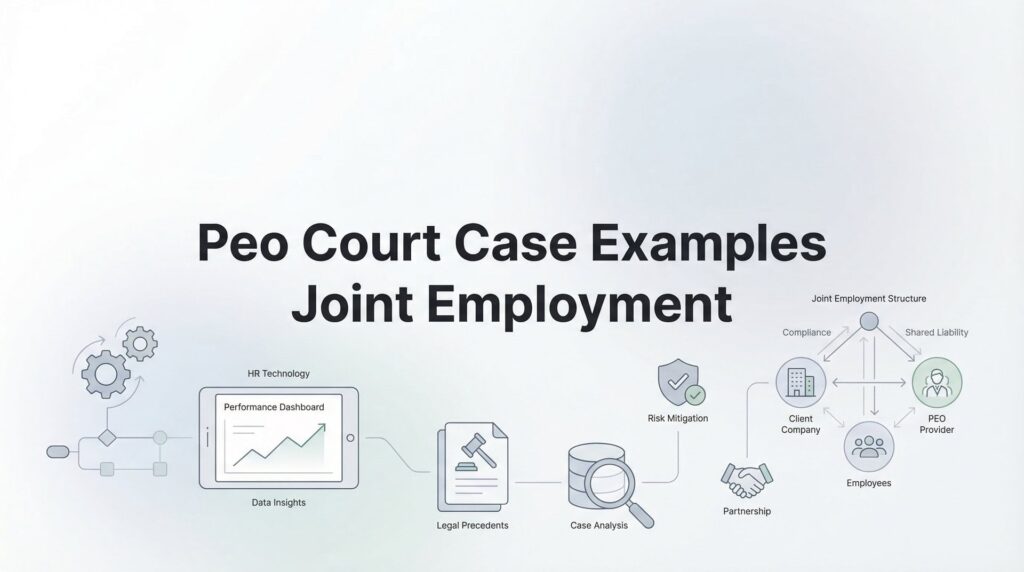
Joint employment liability is one of the murkiest areas of PEO relationships—and the courtroom is where that murkiness gets expensive. When lawsuits hit, judges don’t care about your contract language as much as they care about who actually controlled the worker. This matters because joint employment findings can make your business liable for wage violations, discrimination claims, and workplace injuries even when you thought your PEO had it covered.
We’ve analyzed landmark court cases involving PEO arrangements to extract practical lessons that can protect your business. These aren’t theoretical concerns—they’re patterns that have cost companies millions in settlements and judgments.
Here’s what the courts have actually ruled, and what it means for how you structure your PEO relationship.
1. Control Over Daily Work Trumps Contract Language
The Challenge It Solves
Your PEO contract might clearly state that workers are co-employed, with specific divisions of responsibility outlined across 40 pages of legal text. But when a lawsuit lands, courts apply what’s called the “economic reality test”—and that test doesn’t start with reading your contract. It starts with examining who actually ran the workplace day-to-day.
This disconnect creates exposure because most business owners assume their signed agreement protects them. It doesn’t work that way in litigation.
The Strategy Explained
Courts look at practical factors: Who sets the work schedule? Who assigns tasks? Who decides how work gets done? Who provides the tools and equipment? Who determines if someone gets overtime?
These questions matter more than contractual language because judges apply tests designed to protect workers, not validate business arrangements. The economic reality test examines the totality of circumstances—the actual working relationship as it exists in practice.
If your managers are making daily operational decisions about workers, you’re exercising control. That control creates joint employer status regardless of what your PEO service agreement says about responsibility allocation.
Implementation Steps
1. Audit which employment functions your managers actually perform versus what your PEO handles—focus on daily operational decisions, not just payroll processing.
2. Document the division of responsibilities in practice, not just in theory, and compare this to what your contract states.
3. Identify areas where your control is necessary for business operations and accept that these create joint employer exposure you need to manage.
Pro Tips
Don’t try to eliminate all control—that’s not realistic or desirable. Instead, be intentional about which functions you retain and structure your liability protections accordingly. The goal is alignment between your actual practices and your risk management strategy.
2. Wage and Hour Claims Create Highest Exposure
The Challenge It Solves
Fair Labor Standards Act violations carry some of the most straightforward paths to joint liability in PEO arrangements. When workers aren’t paid correctly for overtime, miss meal breaks, or get misclassified as exempt, courts frequently hold both the PEO and the client company responsible.
This happens because wage and hour compliance requires coordination between whoever processes payroll (typically the PEO) and whoever controls when people work (typically you). When that coordination breaks down, both parties often share liability.
The Strategy Explained
The FLSA uses a broad definition of employer that can encompass multiple entities. Courts don’t require that you be the sole employer—they can find joint employment when multiple parties benefit from the work and exercise control over employment conditions.
Wage violations are particularly problematic because they often affect entire classes of workers, creating collective action exposure. A single misclassification error can turn into a lawsuit covering years of unpaid overtime for dozens of employees. Understanding how co-employment actually works helps clarify why both parties face exposure.
Your PEO might handle payroll processing, but if your managers approve timecards, set schedules, and decide who works overtime, you’re deeply involved in the wage and hour compliance chain. That involvement creates liability exposure.
Implementation Steps
1. Establish clear protocols for who approves overtime, how time is recorded, and when meal breaks occur—then document that your PEO has visibility into these decisions.
2. Review exempt classifications annually with both your PEO and employment counsel, especially when job duties change.
3. Create an audit trail showing that wage and hour decisions involve input from your PEO’s compliance team, not just your operational managers.
Pro Tips
Wage and hour audits should happen before litigation, not during discovery. Ask your PEO specifically what compliance monitoring they perform and whether they’ll indemnify you for violations they should have caught. Many won’t.
3. Termination Decisions Are Most Dangerous
The Challenge It Solves
Firing someone is where joint employment liability gets tested most aggressively. When a terminated employee sues for wrongful termination, discrimination, or retaliation, their attorney will immediately examine who participated in the termination decision and how much influence each party had.
This scrutiny matters because termination decisions reveal the true power dynamics in an employment relationship. Courts view firing authority as one of the strongest indicators of employer status.
The Strategy Explained
Most PEO arrangements give the client company final say over terminations—and that’s exactly what creates joint employer findings. Even if your PEO provides HR guidance, reviews the decision, and processes the final paperwork, you’re the one who decided this person no longer has a job.
The practical reality is that you need termination authority to run your business. You can’t outsource the decision about who works for you. But that necessary control comes with legal exposure.
When wrongful termination claims arise, plaintiffs typically name both the PEO and the client company as defendants. Businesses focused on lawsuit prevention through PEO partnerships need to understand this dynamic clearly.
Implementation Steps
1. Require your PEO’s HR team to review all termination decisions before they happen, creating documentation that compliance guidance was provided.
2. Follow progressive discipline processes consistently, with documentation at each step that involves your PEO’s input.
3. Never terminate someone without consulting your PEO first, especially in cases involving protected characteristics, medical leave, or complaints about working conditions.
Pro Tips
The documentation you create before termination matters more than anything you write afterward. If your PEO’s HR team advised against a termination and you proceeded anyway, that’s discoverable evidence that can undermine your defense. Take their guidance seriously.
4. Workers’ Comp Hinges on Right to Control
The Challenge It Solves
Your PEO holds the workers’ compensation policy, processes claims, and manages the insurance relationship. But when a workplace injury leads to litigation—especially when there’s a third-party lawsuit or a claim that safety violations contributed to the injury—courts examine who actually controlled workplace safety.
This creates exposure because workers’ comp liability doesn’t always follow the insurance policy. It follows the right to control working conditions.
The Strategy Explained
If your managers set safety procedures, provide equipment, train workers on safe practices, and oversee daily operations where injuries might occur, you’re exercising the kind of control that creates employer status for workers’ comp purposes.
The insurance policy your PEO provides covers routine claims. But when serious injuries lead to litigation examining whether negligence or safety violations occurred, both entities can face exposure. Learning how to track and verify workers’ comp accounting through your PEO helps you maintain proper documentation.
This dual exposure becomes especially problematic in industries with elevated safety risks—construction, manufacturing, warehousing, and transportation operations where serious injuries are more likely.
Implementation Steps
1. Clarify in writing which party is responsible for safety training, equipment provision, and workplace safety inspections—then actually follow that division of responsibility.
2. Involve your PEO in safety program development and incident investigations, creating documentation that they have visibility into workplace conditions.
3. Report all workplace injuries to your PEO immediately, even minor ones, and follow their claims management process consistently.
Pro Tips
Ask your PEO specifically whether their workers’ comp coverage includes employer’s liability coverage and what the limits are. Many businesses discover during litigation that the coverage is far less comprehensive than they assumed.
5. Discrimination Claims Name Both Employers
The Challenge It Solves
Title VII of the Civil Rights Act, the Americans with Disabilities Act, and similar state laws all use broad definitions of “employer” that can encompass multiple entities. When discrimination claims arise, plaintiffs routinely name both the PEO and the client company as co-defendants.
This happens because discrimination claims examine who made employment decisions based on protected characteristics—and those decisions typically involve both parties in a PEO arrangement.
The Strategy Explained
Your PEO might handle benefits administration and process accommodation requests, but your managers make hiring decisions, assign work, evaluate performance, and determine promotions. Both functions can create discrimination liability.
Courts apply an “integrated enterprise” test in some cases, looking at whether the PEO and client company operate as a single employer for purposes of discrimination laws. Factors include interrelation of operations, common management, centralized control of labor relations, and common ownership.
Even without meeting the integrated enterprise test, both entities can be held liable as joint employers if they both exercised control over employment terms and conditions. Understanding what HR compliance protection actually covers helps set realistic expectations.
Implementation Steps
1. Route all accommodation requests, harassment complaints, and discrimination concerns through your PEO’s HR team immediately, creating a documented response process.
2. Train your managers on protected characteristics and require them to consult with your PEO before making any employment decision that might implicate discrimination laws.
3. Review your hiring, promotion, and discipline practices annually with your PEO to identify patterns that might create disparate impact exposure.
Pro Tips
Discrimination claims often arise after terminations, which is why the intersection of termination authority and discrimination exposure is so dangerous. Never fire someone who has recently complained about discrimination, requested an accommodation, or taken protected leave without thorough legal review from your PEO’s counsel.
6. State Tests Create Uneven Risk
The Challenge It Solves
Federal employment laws provide one framework for joint employment analysis, but state laws often apply different, stricter tests. California’s ABC test, Massachusetts’ independent contractor statute, and New Jersey’s employment classification rules all create varying levels of joint employer exposure.
This matters enormously for businesses operating in multiple states, because your PEO relationship might create different liability profiles depending on where your workers are located.
The Strategy Explained
California’s ABC test, established in the Dynamex case and later codified in AB5, presumes workers are employees unless the hiring entity proves all three factors: the worker is free from control, performs work outside the usual course of business, and is customarily engaged in an independent trade. This test makes joint employment findings more likely.
Other states apply different standards. Some use common law control tests that focus primarily on who directs the work. Others use economic reality tests similar to federal FLSA analysis. Companies with workers across state lines should explore PEO solutions for multi-state payroll compliance to navigate these variations.
The practical result is that your joint employment exposure isn’t uniform across your workforce. Workers in California, Massachusetts, or New Jersey might have stronger claims than workers in states with more employer-friendly tests.
Implementation Steps
1. Identify which states have the strictest joint employment or worker classification standards, then prioritize compliance efforts in those jurisdictions.
2. Ask your PEO specifically how they structure co-employment relationships in high-risk states and what additional protections they provide.
3. Consider whether certain high-risk functions—like hiring, termination, or discipline—should be handled differently in states with stricter standards.
Pro Tips
Multi-state operations create the most complex joint employment exposure because you’re simultaneously complying with federal law and multiple state frameworks. Don’t assume your PEO has optimized for every jurisdiction where you have workers. Ask specifically.
7. Indemnification Has Limits
The Challenge It Solves
Your PEO contract probably includes indemnification provisions stating that each party will defend the other against certain claims. These provisions create a sense of protection—but they have significant limitations that become apparent during actual litigation.
The problem is that indemnification is a contractual promise between two private parties. It doesn’t change your liability to third parties like employees or government agencies. And it doesn’t always hold up when public policy interests are at stake.
The Strategy Explained
When an employee sues for discrimination or wage violations, they can name both you and your PEO as defendants regardless of what your contract says about indemnification. The court will determine liability based on employment law, not your private agreement.
After liability is established, you might have a contractual claim against your PEO for indemnification—but that’s a separate issue that gets resolved later. You’re still defending the lawsuit, still potentially liable for damages, and still facing the costs and disruption of litigation.
Some courts have held that indemnification provisions can’t override public policy, especially in cases involving wage and hour laws or workplace safety regulations. Before signing, review the risk management and liability support your PEO actually provides versus what’s excluded.
Implementation Steps
1. Review your PEO contract’s indemnification provisions with employment counsel, focusing on what types of claims are covered and what triggers the indemnification obligation.
2. Understand that indemnification is a financial protection, not a liability shield—you may still be named in lawsuits and need to participate in defense even if your PEO ultimately pays.
3. Verify that your PEO carries adequate insurance to back up their indemnification obligations, because a contractual promise is only as good as their ability to pay.
Pro Tips
The most important protection isn’t indemnification—it’s avoiding the liability in the first place. Focus your energy on compliance and proper documentation rather than relying on your PEO to clean up problems after they occur. Indemnification is your backup plan, not your primary strategy.
Moving Forward: Reality Over Paperwork
The common thread across these cases: courts care about reality over paperwork. Your PEO contract might say one thing, but if your managers are making hiring decisions, setting schedules, and handling discipline, you’re likely a joint employer in the eyes of the law.
The practical takeaway isn’t to avoid PEOs—it’s to be intentional about which employment functions you retain versus delegate. Document your arrangement clearly, audit your practices annually, and don’t assume your PEO’s insurance covers everything.
For businesses evaluating PEO options, ask specifically how each provider structures the co-employment relationship and what liability protections they offer when joint employment claims arise. The answers vary significantly between providers, and those differences matter when litigation hits.
Before you sign that PEO renewal, make sure you’re not leaving money on the table. Many businesses unknowingly overpay because of bundled fees, hidden administrative markups, and contracts designed to limit flexibility. We give you a clear, side-by-side breakdown of pricing, services, and contract terms—so you can see exactly what you’re paying for and choose the option that truly fits your business.
