
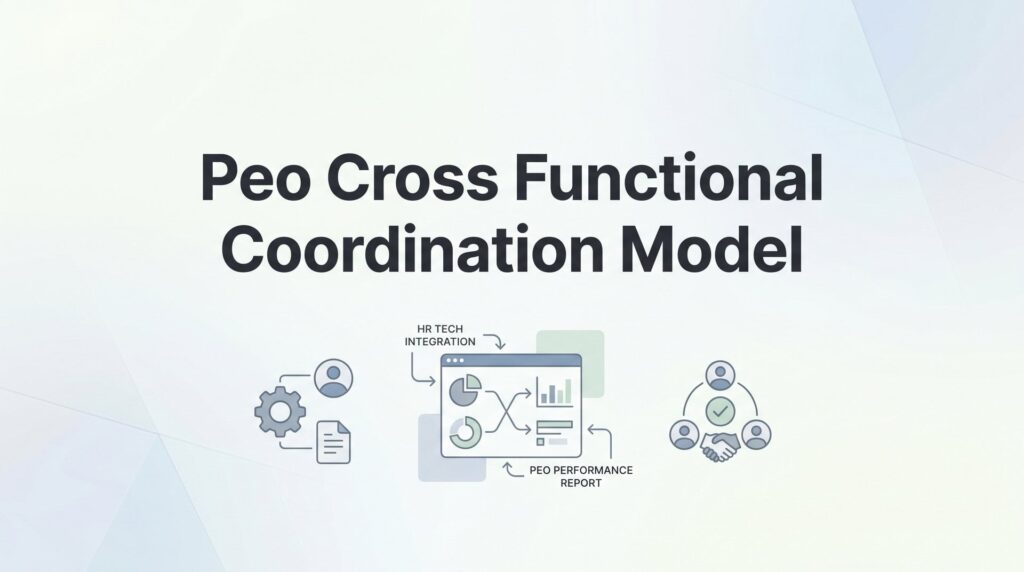
When you bring a PEO into your business, you’re not just adding an HR vendor. You’re layering a co-employment relationship across every department that touches people operations. Finance needs to reconcile payroll costs. Operations cares about workers’ comp classifications. Legal wants to know who owns what liability. IT needs to provision system access. And HR is trying to hold it all together.
Without a deliberate coordination model, these handoffs break down fast. You end up with duplicated work, missed compliance deadlines, and finger-pointing between your internal team and the PEO’s service reps.
This article lays out seven practical strategies for building cross-functional coordination around your PEO relationship. Not theoretical frameworks — the operational plumbing that keeps things from falling apart once the honeymoon period ends.
These strategies matter most for companies in the 25–150 employee range where departments are lean, people wear multiple hats, and nobody has time to chase down whose job it is to update a benefits enrollment or flag a state-level compliance change. If you’re evaluating PEO providers or already working with one and feeling the friction, this is your playbook for getting internal alignment right.
1. Assign a Single Internal PEO Relationship Owner
The Challenge It Solves
Most PEO providers assign you a dedicated service rep or account manager on their side. That’s great — until you realize your internal team has three different people calling that rep with conflicting questions. Finance is asking about payroll reports. HR is asking about benefits changes. Operations is asking about a workers’ comp claim. The PEO rep gets confused, priorities get mixed up, and things slip.
The mismatch isn’t the PEO’s fault. It’s a structural gap on your side.
The Strategy Explained
Designate one internal person as the primary owner of the PEO relationship. This doesn’t have to be your HR director — it could be a COO, an office manager, or a senior ops lead, depending on your org structure. What matters is that this person has the authority and visibility to coordinate across departments, not just manage HR tasks.
This person becomes the single point of contact your PEO service rep talks to, the internal escalation point when something breaks, and the person who tracks whether the relationship is delivering value over time. Understanding how a PEO works at a structural level helps this person navigate the co-employment dynamic more effectively.
Implementation Steps
1. Identify who in your organization has cross-departmental visibility and the bandwidth to own vendor coordination. Don’t default to HR just because it’s an HR vendor.
2. Formally communicate this role to your PEO service rep so they know who to contact for what — and who has final authority on escalations.
3. Set a standing 30-minute monthly check-in between the relationship owner and the PEO rep to catch issues before they compound.
4. Document the role’s responsibilities and share them internally so other departments know who to route PEO-related questions through.
Pro Tips
The relationship owner doesn’t need to know everything about HR. They need to be organized, responsive, and good at connecting the right internal people to the right PEO resources. If the person you’re considering tends to hoard information or avoid cross-departmental conversations, pick someone else.
2. Map Every PEO Touchpoint to a Department Owner
The Challenge It Solves
Co-employment creates shared responsibilities that many businesses underestimate during PEO onboarding. The PEO handles certain functions. You handle others. And there’s a gray zone in the middle where both parties assume the other is covering it. That gray zone is where compliance deadlines get missed, benefit changes don’t get communicated, and payroll discrepancies sit unresolved for months.
The Strategy Explained
Build a simple responsibility matrix — a spreadsheet works fine — that lists every PEO-related function and maps it to a specific internal department and named owner. Include a backup owner for each function so there’s no single point of failure when someone’s on vacation or leaves the company.
The matrix should cover payroll processing and reconciliation, benefits administration and open enrollment, workers’ comp management, state and federal compliance filings, onboarding and offboarding workflows, employee relations issues, and reporting and data requests. If your PEO touches it, it belongs in the matrix. Companies that also maintain an internal HR team should review guidance on using a PEO alongside internal HR to avoid overlap in the matrix.
Implementation Steps
1. Pull your PEO’s service agreement and list every function they’re responsible for, every function you’re responsible for, and every shared function.
2. For each function, assign a primary internal owner (by name, not just department) and a backup.
3. Share the completed matrix with department heads and get explicit sign-off — not just awareness. You want people to own their lane, not just know about it.
4. Review and update the matrix any time there’s a personnel change, a PEO contract renewal, or a new service added.
Pro Tips
Don’t let this become a document that lives in a folder nobody opens. Keep it in a shared workspace your team actually uses — a Notion page, a Google Sheet, a project management tool. Accessibility matters more than formatting.
3. Build a Shared Calendar for PEO-Driven Deadlines
The Challenge It Solves
PEO relationships come with a predictable rhythm of deadlines: open enrollment windows, quarterly payroll tax filings, workers’ comp audits, contract renewals, benefits renewal negotiations, and state-level compliance updates. These deadlines don’t just affect HR. They affect finance (budgeting, accruals), operations (staffing decisions tied to benefits eligibility), and sometimes legal. When they live only in HR’s inbox, the rest of the organization gets blindsided.
The Strategy Explained
Create a shared calendar that captures every PEO-driven deadline and milestone, with enough lead time built in for each department to prepare. The calendar isn’t just a reminder system — it’s a coordination tool. Seeing a workers’ comp audit on the horizon prompts operations to pull incident logs. Seeing open enrollment coming up prompts finance to update benefit cost projections.
The goal is to move from reactive scrambling to proactive preparation across every department that touches the PEO relationship. For companies operating across multiple states, a state employment law risk review should feed directly into this calendar to capture jurisdiction-specific deadlines.
Implementation Steps
1. At the start of each contract year, work with your PEO rep to pull a complete list of all scheduled deadlines, reporting windows, and renewal dates.
2. Add each deadline to a shared calendar with a 30-day and 7-day advance reminder. Assign each reminder to the relevant department owner from your responsibility matrix.
3. Include context in each calendar event — not just “open enrollment” but “open enrollment: HR to send employee communications, finance to confirm premium contribution rates by [date].”
4. Review the calendar at each quarterly cross-functional meeting (covered in the next strategy) to catch anything that’s shifted or been added.
Pro Tips
Ask your PEO for their standard annual timeline during onboarding. Most providers have a predictable cadence they can share upfront. Getting this during the first 90 days, when everyone is still paying close attention, is much easier than trying to reconstruct it six months in.
4. Run Quarterly Cross-Functional PEO Reviews
The Challenge It Solves
The most common failure mode in PEO relationships isn’t a dramatic blowup — it’s slow drift. Costs creep up. Service quality quietly degrades. Compliance gaps accumulate. And because no single department sees the full picture, nobody raises a flag until it’s renewal time and the problems are baked into another contract year.
The Strategy Explained
Hold a structured 60-minute quarterly review with representatives from HR, finance, and operations. The purpose isn’t to relitigate every issue — it’s to surface patterns before they become problems. Think of it as a systems check, not a complaint session.
Each department brings a short update: what’s working, what’s creating friction, and what’s coming up in the next quarter that the PEO needs to support. The relationship owner facilitates and captures action items. Anything that can’t be resolved internally gets escalated to the PEO service rep with a documented ask.
Implementation Steps
1. Schedule all four quarterly reviews at the start of the year so they don’t get bumped. Treat them as fixed commitments, not optional check-ins.
2. Create a simple standing agenda: (a) department updates on PEO-related friction points, (b) review of any open issues from the last quarter, (c) preview of upcoming deadlines and resource needs, (d) cost review against budget.
3. Assign the relationship owner to send a brief pre-read 48 hours before each meeting so attendees come prepared rather than thinking out loud for 45 minutes.
4. Document decisions and action items in a shared log. This becomes invaluable context during annual renewal negotiations. A PEO savings projection model can give your quarterly reviews a concrete financial benchmark to measure against.
Pro Tips
Keep finance in the room for every quarterly review, not just the annual one. Cost drift in PEO relationships often shows up first in payroll reconciliation and benefits invoicing — areas finance sees before HR does. Their perspective catches things that would otherwise go unnoticed until renewal.
5. Create a PEO Escalation Path Beyond HR
The Challenge It Solves
When finance has a payroll reconciliation issue or operations has a workers’ comp classification dispute, the instinct is to route it through HR. HR then routes it to the PEO. The PEO responds to HR. HR translates the response back to finance or operations. You’ve added two unnecessary handoffs to every issue, and the people who actually understand the problem are one step removed from the people trying to solve it.
The Strategy Explained
Design tiered escalation routes that let finance and operations resolve PEO issues directly, within defined boundaries, without bottlenecking everything through HR. This isn’t about cutting HR out — it’s about right-sizing the path for each type of issue.
Tier one handles routine requests: payroll reports, benefits enrollment confirmations, basic compliance questions. These can go directly from the relevant department to the PEO’s support team. Tier two covers issues with cost implications or cross-departmental impact: billing disputes, classification changes, policy interpretations. These route through the relationship owner. Tier three is reserved for escalations involving legal exposure, contract disputes, or service failures that require senior-level PEO contact. Understanding how to prevent employment litigation through your PEO helps define what belongs in that third tier.
Implementation Steps
1. Work with your PEO to understand what types of requests their service team can handle directly from non-HR contacts, and what requires your designated relationship owner to initiate.
2. Document the three tiers with clear examples of what belongs in each, and share with all department heads.
3. Get the relevant PEO contact information for each tier — direct email, phone, and escalation path on their side — and make sure it’s accessible to the right people internally.
4. Test the escalation path in the first 60 days with a low-stakes issue so you know it actually works before you need it for something urgent.
Pro Tips
Some PEO providers are set up for multi-contact client relationships. Others strongly prefer a single point of contact. Know which model your provider uses before you design your escalation path — and if their preference creates friction for your organization, that’s worth raising in your next quarterly review.
6. Align Internal Data Systems with PEO Reporting
The Challenge It Solves
PEO providers generate a lot of data: payroll registers, benefits invoices, workers’ comp loss runs, headcount reports, tax filings. The problem is that this data comes in the PEO’s format, using the PEO’s categories and codes. If your internal GL structure, headcount tracking, and financial reporting systems use different labels, every reporting cycle becomes a manual translation exercise. Finance spends hours reconciling. Errors accumulate. And the data you’re getting from the PEO stops being useful because it takes too long to make it usable.
The Strategy Explained
During onboarding — not six months later — map your PEO’s standard report outputs to your internal systems. This means aligning payroll cost categories to your GL codes, matching headcount definitions, and confirming how benefits costs get allocated across departments. The goal is to get to a state where PEO reports can flow into your systems with minimal manual intervention. A practical guide on allocating PEO expenses across departments can serve as a useful template for this mapping exercise.
Implementation Steps
1. Pull sample reports from your PEO during the contract or implementation phase — before you’re live — and share them with your finance lead.
2. Identify every field that doesn’t map cleanly to your internal systems and document the translation logic needed for each one.
3. Ask your PEO whether they can customize report formats or export configurations to match your GL structure. Many can, but you have to ask early.
4. Build a simple reconciliation template that finance can use each payroll cycle to catch discrepancies before they compound.
Pro Tips
If you’re mid-contract and already dealing with reconciliation headaches, don’t wait for renewal to fix this. Schedule a working session with your PEO’s implementation or reporting team and your finance lead. An hour of focused problem-solving can eliminate recurring monthly friction that’s been costing you time for years.
7. Document the Gray Zone Between You and the PEO
The Challenge It Solves
Co-employment creates a shared employer relationship — and with it, a set of genuinely ambiguous responsibilities that most PEO contracts don’t fully resolve. Who handles a harassment complaint: you or the PEO? Who makes the final call on a termination? Who owns the safety program? Who communicates a policy change to employees? These questions don’t have universal answers. They depend on your specific contract, your state, and how your PEO is structured. But if you haven’t worked out the answers in advance, you’ll be figuring them out in the middle of a situation where speed and clarity matter.
The Strategy Explained
Create a living document that explicitly addresses ownership for every ambiguous function in your PEO relationship. This isn’t your PEO contract — it’s an internal operating guide that translates contract language into plain-English role clarity for your team. It should be updated whenever your PEO relationship changes, whenever you add a new service, and whenever a gray-zone situation surfaces that wasn’t covered.
Share this document with every department head who touches people operations. The point isn’t legal precision — it’s operational clarity so your team doesn’t freeze when something unexpected happens. Reviewing PEO financial disclosure requirements can help you identify contract language that often creates these gray-zone ambiguities in the first place.
Implementation Steps
1. Start with the highest-risk ambiguities: employee relations complaints, terminations, leave management, workplace safety, and wage and hour compliance. Work through each one with your HR lead and legal counsel if available.
2. For each function, document: who initiates action, who has final decision authority, who communicates to the employee, and what the PEO’s role is in supporting or reviewing the decision.
3. Review the document with your PEO service rep to confirm their understanding aligns with yours. Misalignments here are better discovered in a planning meeting than during an active employee situation.
4. Store the document somewhere accessible and make sure new managers receive it as part of their onboarding.
Pro Tips
Pay particular attention to termination decisions. This is the single most common area where co-employment confusion creates legal exposure. Your PEO may have strong opinions about process — documentation requirements, timing, severance — but the decision to terminate generally stays with you as the worksite employer. Make sure everyone in a management role understands that distinction clearly.
Pulling It All Together: Start With the Gaps You Already Feel
You don’t need to implement all seven of these strategies at once. The right starting point depends on where you are in the PEO lifecycle.
If you’re pre-PEO and still evaluating providers, build the coordination model during the selection process. Use the responsibility matrix and escalation path as evaluation criteria — a PEO that can’t clearly articulate how they support multi-department client relationships is a signal worth paying attention to. The PEO comparison resources at PEO Metrics can help you evaluate providers with coordination and service structure in mind, not just price.
If you’re mid-contract and feeling friction, start with two things: the responsibility matrix and the escalation path. These two tools address the most common source of coordination failure — unclear ownership at department handoff points — and you can build them without your PEO’s involvement.
If you’re approaching renewal, add the quarterly review cadence and the gray-zone documentation to your checklist. Renewal is your best leverage point for resetting service expectations and clarifying ambiguous responsibilities that have been causing problems.
The goal isn’t a perfect coordination model. It’s making sure no single department is carrying the full weight of a relationship that touches every part of your business. When finance, operations, and HR are all aligned on how the PEO fits into their workflows, the relationship actually delivers what it promised during the sales process.
And if it’s not delivering — if costs have drifted, service has degraded, or the contract terms no longer fit where your business is headed — that’s worth examining honestly before you auto-renew.
Many businesses unknowingly overpay because of bundled fees, hidden administrative markups, and contracts designed to limit flexibility. A clear, side-by-side breakdown of pricing, services, and contract terms lets you see exactly what you’re paying for. Don’t auto-renew. Make an informed, confident decision.
