
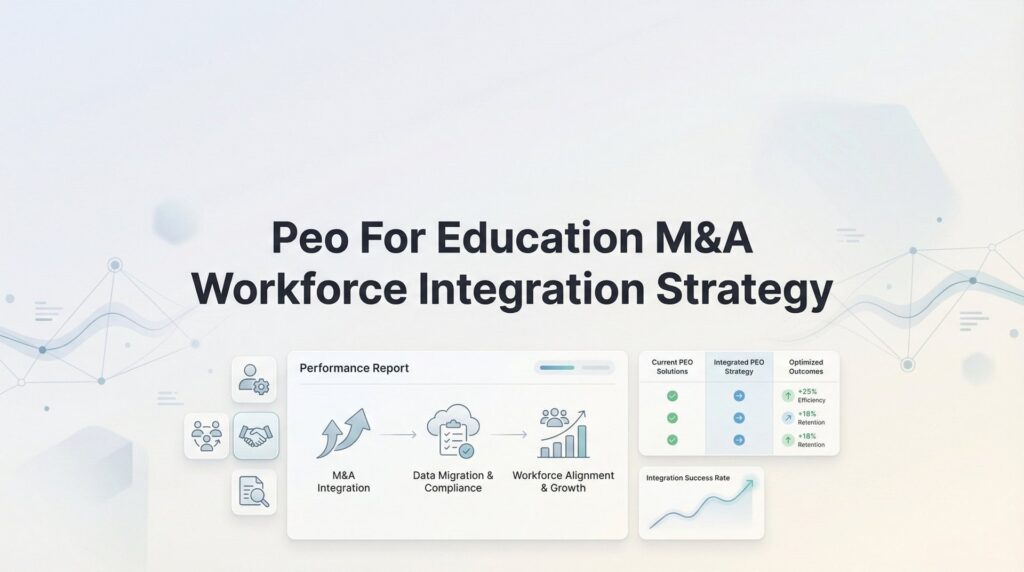
Education M&A deals—whether charter school networks acquiring independent schools, EdTech companies merging, or private equity rolling up tutoring centers—create workforce integration challenges that differ sharply from standard corporate mergers. You’re dealing with academic calendars that can’t flex, teachers with union contracts or tenure protections, and compliance requirements that vary wildly by state and institution type.
A PEO can smooth these transitions, but only if you deploy it strategically.
These seven approaches address the specific friction points that derail education sector workforce integrations, from harmonizing wildly different compensation structures to maintaining accreditation during the transition. This isn’t about generic M&A advice with “education” swapped in. It’s about the operational realities of combining workforces when your employees are teachers, administrators, and support staff whose work is governed by academic years, credentialing bodies, and often public accountability standards.
1. Pre-Close Benefits Gap Analysis for Education Compensation
The Challenge It Solves
Education compensation structures include elements you won’t find in most corporate settings: tuition remission for employees’ children, sabbatical accrual systems, summer pay structures where some staff are on 10-month contracts while others receive 12-month salaries, and pension systems that may or may not transfer between institutions. When you’re acquiring a school or education company, these benefits represent real financial obligations that often aren’t properly quantified during due diligence.
The acquiring entity discovers post-close that they’ve inherited compensation commitments they didn’t budget for, or worse, that the target’s employees are expecting benefits that weren’t disclosed in the deal documents.
The Strategy Explained
Before the deal closes, conduct a comprehensive mapping exercise of every non-standard benefit at the target institution. This means going beyond the standard health insurance and 401(k) review. You need to identify tuition remission commitments (who’s eligible, what the annual cost runs, whether it covers K-12 or higher education), sabbatical accrual (how many employees are eligible, what the payout obligation looks like), summer pay structures (what percentage of staff are on academic-year contracts), and any pension obligations that might not transfer cleanly.
This analysis informs your deal terms and integration budget. If the target has generous tuition remission that you can’t match, that becomes a negotiating point or a known cost you’ll need to grandfather. If they have significant sabbatical accrual liability, that affects your purchase price or requires a carve-out. Understanding how to track and account for benefits expenses under a PEO arrangement becomes critical during this phase.
Implementation Steps
1. Request detailed benefits documentation during due diligence, specifically asking about education-specific benefits that wouldn’t appear in standard corporate HR audits.
2. Calculate the annual cost of maintaining these benefits post-acquisition, including both direct costs and administrative complexity.
3. Determine which benefits you’ll harmonize immediately, which you’ll grandfather for existing employees, and which require negotiation or carve-outs in the purchase agreement.
4. Share findings with your PEO provider before enrollment to understand which benefits they can accommodate within their standard offerings and which require custom arrangements.
Pro Tips
Don’t assume the target’s HR team has accurately documented all benefit obligations. Teachers and staff often have informal arrangements or historical precedents that aren’t in writing but represent real expectations. Interview department heads and review past communications to uncover these commitments before they become post-close surprises.
2. PEO as Transition Employer During Credential Verification
The Challenge It Solves
Teacher licenses don’t automatically transfer across state lines. When you acquire a school in a different state or merge institutions that operate across multiple states, you face a credential verification period where you need to confirm that every teacher holds the appropriate license for their role and location. This process can take weeks or months, depending on state requirements and how quickly credentialing boards respond.
The risk is that you’re employing teachers whose credentials haven’t been verified, which creates compliance exposure and potential accreditation problems. But you can’t simply not staff classrooms while you wait for paperwork to clear.
The Strategy Explained
Use the PEO’s co-employment structure to cover staff during the credential verification window. The PEO becomes the employer of record while you’re confirming that all teaching credentials are valid and properly documented. This creates a buffer period where the PEO assumes some of the compliance risk while you complete the verification process.
This is particularly valuable when you’re consolidating multiple schools or educational entities that have operated under different credentialing standards. The PEO’s HR infrastructure can systematically track credential status, expiration dates, and renewal requirements across your entire workforce, flagging issues before they become compliance problems. Organizations pursuing a roll-up acquisition strategy find this approach especially valuable.
Implementation Steps
1. Identify all positions that require state-specific credentials, including not just teachers but also counselors, administrators, and specialized support staff.
2. Coordinate with the PEO to establish a credential verification protocol that meets your state’s requirements and any accreditation standards you’re subject to.
3. Enroll staff in the PEO arrangement with the explicit understanding that this is a transition period while credentials are verified and any gaps are resolved.
4. Build a tracking system that flags credential expirations and renewal deadlines, ensuring you don’t face compliance lapses after the initial verification is complete.
Pro Tips
Some states have reciprocity agreements that expedite credential transfers, while others require full re-application. Know which states you’re operating in and what the actual timeline looks like. Don’t assume a 30-day verification window when the reality might be 90 days or longer.
3. Academic Calendar-Aligned PEO Implementation
The Challenge It Solves
Standard PEO implementations assume you can execute HR transitions within 30 days and that your business operates on a continuous calendar. Education doesn’t work that way. Mid-semester HR changes create operational chaos, increase staff attrition, and risk disrupting student services. Teachers can’t easily switch benefit providers or payroll systems while they’re in the middle of a teaching term.
If you force a PEO transition during the academic year, you’ll face pushback from staff, potential disruption to operations, and higher risk of losing key employees who view the transition as evidence of instability.
The Strategy Explained
Structure your PEO enrollment timing around natural breaks in the academic calendar—semester transitions, summer break, or winter recess. This means your deal closing and your PEO implementation might not happen simultaneously. You may close the acquisition in October but delay PEO enrollment until January or June when you can execute the transition without disrupting ongoing operations.
This requires negotiating flexible implementation timelines with your PEO provider. Standard contracts often assume immediate enrollment, but education M&A demands more nuanced timing. You need a provider that understands why you can’t flip the switch mid-semester and is willing to accommodate phased enrollment aligned with your academic calendar. Building a solid PEO cost forecasting model helps you plan for these delayed implementation scenarios.
Implementation Steps
1. Map your academic calendar before negotiating PEO terms, identifying the natural transition windows when you can implement significant HR changes without operational disruption.
2. Negotiate a phased implementation schedule with your PEO that aligns enrollment with these calendar breaks, even if it means delaying implementation by several months.
3. Communicate the transition timeline to staff well in advance, explaining why you’re waiting until a semester break and what will change when the transition occurs.
4. Use the delay period to complete benefits gap analysis and credential verification, so you’re ready to execute a smooth transition when the calendar allows.
Pro Tips
Summer break is often the cleanest transition window, but it’s also when many education staff are on modified schedules or taking time off. Plan your communication and enrollment activities accordingly, and don’t assume everyone will be checking email in July.
4. Multi-State Compliance Consolidation
The Challenge It Solves
Charter school networks and education companies often operate across multiple states, each with different requirements for teacher classification, background checks, continuing education mandates, and reporting obligations. When you’re acquiring schools or merging entities that span several states, you inherit a patchwork of compliance requirements that are difficult to centralize and expensive to maintain with separate systems.
The administrative burden of tracking different state requirements, ensuring timely filings, and maintaining compliant documentation across multiple jurisdictions creates significant operational drag and compliance risk.
The Strategy Explained
Leverage the PEO’s multi-state infrastructure to consolidate compliance administration across all your locations. A PEO with strong education sector experience maintains expertise in state-specific requirements for teacher classification, background check protocols, and reporting obligations. Finding the right PEO for multi-state operations can centralize tracking and ensure you’re meeting each state’s requirements without building separate HR infrastructure in every location.
This is particularly valuable when you’re consolidating multiple acquired entities that have been managing compliance independently. Instead of maintaining separate systems and processes in each state, you can centralize through the PEO while still meeting local requirements.
Implementation Steps
1. Document the states where you operate and identify the specific compliance requirements that vary by location, focusing on areas where non-compliance creates significant risk.
2. Evaluate PEO providers based on their actual experience in education sector compliance, not just their ability to handle multi-state operations generally.
3. Establish clear protocols for how the PEO will track and manage state-specific requirements, including background check renewals, continuing education mandates, and reporting deadlines.
4. Build internal oversight to ensure the PEO is actually meeting state-specific obligations, rather than applying a one-size-fits-all approach that might miss important nuances.
Pro Tips
Not all PEOs have genuine education sector expertise. Ask specific questions about their experience with teacher classification rules, academic calendar considerations, and credentialing requirements. Generic multi-state capability isn’t the same as understanding education-specific compliance.
5. Union and Tenure Employee Carve-Outs
The Challenge It Solves
Many K-12 employees and some higher education staff have collective bargaining agreements that restrict or prohibit co-employment arrangements. Tenure protections create additional complications where employment status changes might trigger review or challenge. If you try to force all employees into a PEO arrangement, you’ll face union grievances, potential legal challenges, and staff attrition among your most protected employees.
But you still need workforce integration support for the non-union staff, and you can’t simply abandon the PEO approach because a portion of your workforce has employment protections.
The Strategy Explained
Structure a hybrid arrangement where the PEO covers non-union staff and employees without tenure protections, while you maintain direct employment for protected groups. This means running parallel HR systems during the integration period, but it preserves your ability to use PEO benefits pooling and compliance support for a significant portion of your workforce without triggering union contract violations.
This requires careful coordination to ensure you’re not creating inequities between employee groups or inadvertently violating labor agreements. Understanding PEO compliance protection limitations helps you navigate what actually gets covered in these hybrid arrangements. The PEO needs to understand which employees are covered and which are carved out, and your payroll and benefits administration must accommodate both groups without creating compliance gaps.
Implementation Steps
1. Review all collective bargaining agreements and tenure policies to identify which employees cannot be included in a co-employment arrangement without triggering contract violations.
2. Negotiate with your PEO provider to establish a carve-out structure that allows partial workforce enrollment while maintaining direct employment for protected groups.
3. Communicate clearly to all employee groups about why some staff are enrolled in the PEO arrangement while others remain under direct employment, avoiding language that suggests one group is more valued than the other.
4. Ensure your benefits and compensation structures don’t create significant disparities between PEO-covered and directly employed staff, which could fuel resentment or union grievances.
Pro Tips
Consult with labor counsel before implementing any co-employment arrangement that affects unionized or tenured employees. The cost of fixing a labor violation after the fact far exceeds the cost of getting it right initially.
6. Benefits Pooling for Plan Harmonization
The Challenge It Solves
When you merge educational institutions, you often inherit dramatically different health coverage levels. One school might offer generous coverage with low employee contributions, while the acquired entity has bare-bones plans with high deductibles. You can’t simply force everyone onto the lower-tier plan without risking staff attrition, but maintaining separate plans post-acquisition is administratively complex and creates inequity.
The challenge is finding a middle ground that doesn’t represent a significant downgrade for employees from the better plan while also not dramatically increasing costs by bringing everyone up to the highest tier.
The Strategy Explained
Use the PEO’s pooled benefits structure to create middle-ground health coverage that represents a reasonable compromise between the legacy plans. PEO pooling gives you access to coverage options and pricing that might not be available to a single institution, particularly if you’re a smaller organization or operating in a high-cost region. A thoughtful how to harmonize workforce practices with your PEO addresses these benefit disparities systematically.
This works because you’re not asking employees to accept a plan that’s clearly inferior to what they had before. You’re offering a plan that might be different but is defensible as comparable coverage. The pooling also gives you negotiating leverage you wouldn’t have as a standalone entity, which can help control costs while maintaining reasonable coverage levels.
Implementation Steps
1. Document the current health plans at both the acquiring and target entities, including premium costs, deductibles, coverage levels, and employee contribution requirements.
2. Work with the PEO to identify plan options within their pooled offerings that represent a reasonable middle ground between the legacy plans.
3. Model the financial impact on employees from both entities, identifying who will see increases in contributions or out-of-pocket costs and determining whether you need to provide transition subsidies.
4. Communicate the plan changes well in advance of enrollment, explaining the rationale for harmonization and providing clear comparisons so employees understand what’s changing.
Pro Tips
Consider offering a transition subsidy for employees who face significant increases in contributions or out-of-pocket costs. A one-year subsidy that phases out can smooth the transition without creating a permanent cost burden.
7. Exit-Ready Contract Structuring
The Challenge It Solves
PEO arrangements should be transitional tools during M&A integration, not permanent dependencies. But many PEO contracts are structured to lock you in with long terms, auto-renewal clauses, and data portability restrictions that make exit difficult. If you sign a standard three-year contract with automatic renewal, you might find yourself stuck in a PEO arrangement long after the integration is complete and you’re ready to bring HR in-house.
The risk is that you use the PEO effectively during integration but then can’t cleanly exit when you’ve built the internal infrastructure to manage HR independently.
The Strategy Explained
Negotiate PEO terms from day one that allow clean exit after integration completion, with full data portability and no penalties for early termination once you’ve met a minimum commitment period. This means explicitly discussing exit scenarios during contract negotiation, not waiting until you’re ready to leave to discover the obstacles.
Specify data portability requirements in the contract—you need to be able to extract employee records, benefits history, payroll data, and compliance documentation in formats that can be imported into your own systems. Organizations planning to eventually integrate with their own HRIS platform should negotiate these data export capabilities upfront. Without this, you’ll face significant administrative burden during exit that might discourage you from leaving even when it makes sense.
Implementation Steps
1. Negotiate a contract term that aligns with your expected integration timeline, typically 12-24 months for education M&A, rather than accepting a standard three-year term.
2. Include explicit data portability provisions that specify formats, timelines, and the PEO’s obligations to support your exit process.
3. Establish clear termination rights that allow exit without penalties once you’ve completed a minimum commitment period, avoiding auto-renewal clauses that extend your obligation indefinitely.
4. Document the exit process in the contract, including transition support obligations, data transfer protocols, and final reconciliation procedures.
Pro Tips
Test data portability before you actually need it. Request sample data exports during the contract period to confirm the PEO can deliver what they promised and that the formats are actually usable. Discovering data portability problems when you’re trying to exit is too late.
Putting It All Together
Education M&A workforce integration isn’t a generic HR exercise with academic window dressing. The constraints are real: academic calendars dictate timing, credentialing requirements create compliance exposure, and union or tenure protections limit your structural options.
A PEO can be a powerful integration tool, but only when deployed with these sector-specific realities in mind.
Start with the benefits gap analysis before the deal closes. You need to know what compensation commitments you’re inheriting and what harmonization will actually cost. Structure your PEO enrollment around academic calendar breaks, not arbitrary 30-day implementation windows that ignore operational reality. Use the PEO strategically during credential verification to reduce compliance risk while you confirm everyone’s licenses are valid.
Build exit flexibility from day one. Negotiate contract terms that allow you to leave cleanly once integration is complete, with full data portability and no penalties for moving on. The goal isn’t permanent PEO dependence. It’s using co-employment strategically to bridge the integration period while you build the infrastructure for long-term independence.
Before you sign that PEO renewal, make sure you’re not leaving money on the table. Many businesses unknowingly overpay because of bundled fees, hidden administrative markups, and contracts designed to limit flexibility. We give you a clear, side-by-side breakdown of pricing, services, and contract terms so you can see exactly what you’re paying for and choose the option that truly fits your business. Connect with our team
