
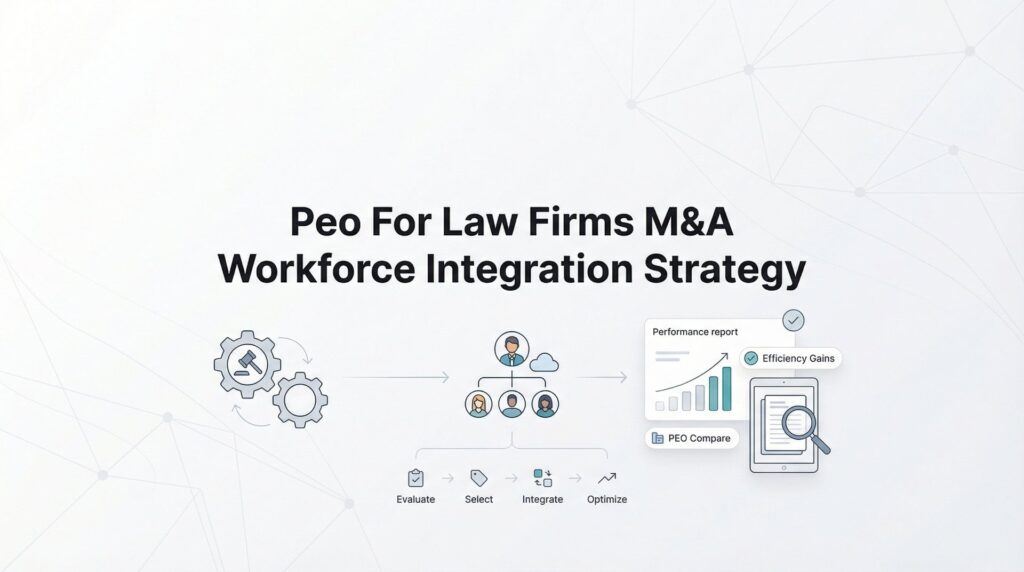
Law firm mergers create HR complexity that most industries never face. You’re combining partnership structures, associate compensation tiers, support staff with different benefit histories, and often multiple state bar compliance requirements—all while trying to retain the talent that made the acquisition worthwhile.
A PEO can absorb much of this integration burden, but only if you approach it strategically.
The workforce challenges are different here. You’re not just merging headcount. You’re integrating attorneys licensed across different jurisdictions, paralegals with firm-specific institutional knowledge, and partners with portable books of business who can walk if the transition feels mishandled. Get the HR piece wrong, and you lose the people who made the acquisition worth doing in the first place.
These seven strategies address the specific workforce challenges law firms encounter during M&A—from harmonizing billable-hour-linked compensation to managing multi-state attorney licensing compliance. Each focuses on practical implementation rather than theory.
1. Conduct a Pre-Close Benefits Gap Analysis with PEO Support
The Challenge It Solves
Benefits disparities between merging law firms are rarely minor. One firm offers 4 weeks PTO to associates; the other caps at 2. Partner health plans differ by thousands in annual value. Retirement match formulas don’t align. Support staff have accumulated varying PTO banks under different accrual policies.
Without mapping these gaps before the deal closes, you’re forced into reactive harmonization—which usually means disappointing someone.
The Strategy Explained
Run a comprehensive benefits comparison at least 60 days before close. Document every benefit category: health insurance (premiums, deductibles, network coverage), retirement plans (match percentages, vesting schedules), PTO policies (accrual rates, carryover rules, payout provisions), disability coverage, life insurance, and any firm-specific perks.
A PEO with law firm M&A experience can accelerate this process. They’ve seen the common friction points and can identify which disparities require immediate harmonization versus gradual alignment. Understanding PEO benefits administration outsourcing helps you evaluate what to delegate during this analysis phase.
The goal isn’t perfect equality on day one. It’s understanding the cost and complexity of eventual harmonization so you can build realistic timelines and budget appropriately.
Implementation Steps
1. Request complete benefits documentation from both firms—plan documents, carrier contracts, employee handbooks, and current contribution rates.
2. Map benefits side-by-side in a comparison matrix, flagging items where the gap exceeds 20% in value or creates potential retention risk with key personnel.
3. Engage your PEO to model harmonization scenarios—leveling up to the better benefit, meeting in the middle, or maintaining separate tiers temporarily.
4. Identify which benefits must align immediately (typically health insurance and payroll) versus which can phase in over 12-24 months (retirement vesting, PTO accrual formulas).
Pro Tips
Don’t assume you’ll level everyone up to the best benefit. That’s often cost-prohibitive. More realistic: create a new unified structure that’s competitive but sustainable, then grandfather existing employees where necessary. And pay special attention to support staff PTO banks—paralegals with 15 years of accrued time won’t accept losing it without a fight.
2. Structure Parallel Payroll Systems During the Transition Window
The Challenge It Solves
Law firms often have fundamentally different compensation models. One firm pays associates on strict salary bands tied to class year. The other uses modified lockstep with discretionary bonuses. Partners might be on draws against distributions in one firm and guaranteed payments in the other.
Forcing immediate payroll consolidation creates errors, confusion, and compensation disputes during an already stressful transition.
The Strategy Explained
Run two separate payroll structures under the PEO umbrella for the first 3-6 months post-close. This gives you time to reconcile compensation philosophies, model the financial impact of harmonization, and communicate changes clearly before implementation.
The PEO handles the administrative complexity of maintaining parallel systems while you focus on the strategic work of designing a unified compensation structure that works for the merged entity. Building accurate projections requires understanding how to forecast your PEO costs across both legacy structures.
This approach costs slightly more in administrative fees short-term, but it prevents the much larger cost of compensation errors or rushed decisions that create long-term pay equity problems.
Implementation Steps
1. Establish separate payroll codes within the PEO system for each legacy firm, maintaining their existing pay cycles, bonus structures, and deduction schedules.
2. Set a specific transition date (typically 90-180 days post-close) when you’ll consolidate to a single payroll structure.
3. Use the parallel period to collect actual payroll data, identify outliers, and model how different harmonization approaches affect individual employees.
4. Communicate the transition timeline clearly—employees need to know this is temporary and when to expect the unified structure.
Pro Tips
Don’t extend parallel payroll beyond six months unless the firms are dramatically different in size or structure. The administrative burden compounds quickly, and employees start wondering if the merger is actually happening. Use the parallel period to make decisions, not delay them.
3. Centralize Multi-State Attorney Compliance Through PEO Infrastructure
The Challenge It Solves
Attorneys licensed in multiple jurisdictions create ongoing compliance tracking requirements that compound during mergers. You need to track bar admissions, CLE requirements that vary by state, trust account regulations, and jurisdiction-specific employment law that applies differently to attorneys versus support staff.
When you merge two firms, you’re suddenly managing compliance across every state where either firm had licensed attorneys—often a dozen or more jurisdictions.
The Strategy Explained
Leverage the PEO’s multi-state payroll and compliance infrastructure to centralize tracking and reporting. Instead of maintaining separate systems for each state’s requirements, you create a unified compliance framework that automatically handles withholding, unemployment insurance, workers’ compensation, and employment law variations. Firms operating across multiple jurisdictions should evaluate PEOs designed for multi-state companies to handle this complexity.
The PEO becomes your compliance database. When an attorney is admitted to a new bar or moves to a different office, the system updates automatically to reflect the new compliance obligations.
This matters more during M&A because you’re inheriting compliance histories you didn’t create. The PEO can audit both firms’ current compliance status and identify gaps before they become problems.
Implementation Steps
1. Compile a complete list of all attorneys from both firms, including every jurisdiction where they hold active bar licenses.
2. Work with the PEO to configure multi-state payroll settings for each location where attorneys are licensed, ensuring proper tax withholding and unemployment insurance coverage.
3. Establish a centralized tracking system for CLE requirements, using the PEO’s HR platform to set reminders for renewal deadlines that vary by state.
4. Create standardized onboarding processes for future lateral hires that automatically capture bar admission information and configure compliance settings.
Pro Tips
Pay particular attention to states where only one or two attorneys are licensed. These outlier jurisdictions are easy to overlook but create compliance risk if forgotten. Before finalizing your PEO selection, conduct a state employment law compliance audit to identify jurisdiction-specific exposures you’re inheriting.
4. Create Retention-Focused Benefits Packages for Key Rainmakers
The Challenge It Solves
Partners with significant books of business can leave during integration uncertainty—and they’ll take their clients with them. The most dangerous period is the first 12 months post-close, when they’re evaluating whether the merged firm serves their practice better than going independent or joining a competitor.
Standard benefits packages don’t address this risk. You need targeted retention tools that make leaving financially unattractive.
The Strategy Explained
Design tiered executive benefit structures specifically for high-value partners you cannot afford to lose. This might include enhanced retirement contributions, deferred compensation arrangements, supplemental health coverage for family members, or executive disability policies that exceed standard group coverage.
The PEO can administer these enhanced benefits alongside standard packages, creating clear differentiation without requiring separate administrative systems. The key is making the enhanced benefits valuable enough to influence retention decisions but structured so they’re forfeited if the partner leaves within a specified period. Understanding how PEO arrangements impact employee retention helps you design packages that actually move the needle.
This isn’t about fairness across all partners. It’s about identifying the 3-5 individuals whose departure would materially damage the merged firm’s revenue, then making their compensation package sticky enough to keep them through the integration period.
Implementation Steps
1. Identify partners whose departure would create significant client attrition or practice group instability—typically those generating $2M+ in annual revenue or leading critical practice areas.
2. Design retention packages that include both immediate enhanced benefits (better health coverage, higher retirement match) and deferred elements that vest over 24-36 months.
3. Work with the PEO to structure these as formal executive benefit plans with clear vesting schedules and forfeiture provisions.
4. Communicate these packages individually and confidentially—broadcasting tiered benefits firm-wide creates resentment without adding retention value.
Pro Tips
Don’t wait until a rainmaker threatens to leave before offering enhanced benefits. By then, they’ve already mentally checked out. Structure these packages during the merger negotiation phase, so key partners see immediate value in staying. And make sure the vesting schedule extends beyond the integration period—you want them committed to the merged firm’s long-term success, not just through the transition.
5. Migrate Support Staff Without Disrupting Firm Operations
The Challenge It Solves
Paralegals, legal secretaries, and administrative staff often have firm-specific institutional knowledge that takes years to rebuild if lost. They know client preferences, document management systems, billing procedures, and the informal workflows that keep cases moving.
Mishandling their integration creates operational disruption that affects client service—and clients notice when their paralegal suddenly doesn’t know the case history.
The Strategy Explained
Implement PEO onboarding processes that explicitly preserve seniority, PTO accruals, and benefits continuity for support staff. This isn’t just about being fair—it’s about signaling that their institutional knowledge is valued and their role in the merged firm is secure.
The PEO handles the administrative complexity of transferring employment records, converting PTO banks, and maintaining benefits without coverage gaps. You focus on the operational piece: ensuring support staff understand their new reporting structures, technology systems, and client assignments. Firms executing serial acquisitions should consider a PEO roll-up strategy that standardizes these migration processes.
The goal is making the transition feel like a smooth handoff rather than a termination and rehire. Support staff who feel their tenure and contributions are respected stay. Those who feel like they’re starting over leave.
Implementation Steps
1. Audit all support staff employment records from both firms, documenting hire dates, current PTO balances, benefits enrollment, and any firm-specific certifications or training.
2. Configure the PEO system to recognize original hire dates for seniority purposes, even though they’re technically new employees of the PEO.
3. Convert PTO balances from both firms’ accrual systems into the merged firm’s policy without requiring staff to forfeit accrued time.
4. Assign dedicated HR support during the first 60 days to answer benefits questions and resolve any discrepancies in employment records.
Pro Tips
Pay special attention to support staff who’ve been with their firm for 10+ years. They’re the ones with the deepest institutional knowledge and the most to lose if integration is handled poorly. A small gesture—like preserving their original hire date for anniversary recognition—costs nothing but signals respect. And don’t assume support staff care less about benefits than attorneys. Many have family health coverage or retirement savings that matter more to them than billable rates.
6. Establish Unified HR Policies While Respecting Firm Culture Differences
The Challenge It Solves
Every law firm has unwritten cultural norms that matter more than official policies. One firm has a strict 9-to-5 presence expectation; the other operates on flexible hours as long as billable targets are met. One firm’s dress code is formal; the other went business casual years ago.
Forcing immediate cultural alignment creates resentment. Ignoring policy differences creates confusion and inequity.
The Strategy Explained
Use the PEO’s policy frameworks as neutral ground for integration. Instead of one firm imposing its policies on the other, you adopt the PEO’s standard templates as a baseline, then customize where firm-specific needs require it.
This approach removes the “winner and loser” dynamic. Both legacy firms are adapting to a new standard rather than one firm capitulating to the other’s preferences. Ensuring your unified policies meet legal requirements means understanding what HR compliance protection PEOs actually cover.
The key is distinguishing between policies that need immediate alignment (harassment reporting, timekeeping, expense reimbursement) and those that can evolve gradually (dress code, remote work flexibility, office hour expectations). Immediate alignment prevents compliance gaps. Gradual alignment gives cultures time to merge organically.
Implementation Steps
1. Review both firms’ employee handbooks side-by-side, identifying policies where differences create compliance risk versus those that reflect cultural preferences.
2. Adopt the PEO’s standard policy templates for compliance-critical areas (anti-discrimination, safety, timekeeping, leave management).
3. Flag cultural policies (dress code, remote work, office hours) for gradual alignment over 6-12 months, allowing time for leadership to observe what actually works in the merged environment.
4. Communicate clearly which policies are changing immediately and which are under review—uncertainty creates anxiety.
Pro Tips
Don’t underestimate how much employees care about seemingly minor policies. The firm that allowed jeans on Fridays will resent losing that if the acquiring firm is more formal. Where possible, adopt the more flexible policy unless there’s a compelling business reason not to. And involve employees in policy discussions where appropriate—they’ll accept changes more readily if they feel heard.
7. Plan Your PEO Exit Strategy Before You Begin
The Challenge It Solves
Many law firms use PEO support specifically for the 12-24 month integration period, then transition to internal HR once the merged entity stabilizes. But PEO contracts often include auto-renewal provisions, data portability restrictions, or termination fees that make exiting expensive or complicated.
If you don’t plan the exit before you start, you may find yourself locked into a PEO relationship that no longer serves the firm’s needs.
The Strategy Explained
Structure your PEO contract with explicit provisions around transitional use. This includes clear termination windows, data portability requirements that ensure you can export employee records and payroll history cleanly, and pricing that reflects the temporary nature of the engagement.
Some PEOs offer specific M&A integration packages designed for transitional use. These typically include shorter contract terms, reduced termination penalties, and enhanced data migration support when you’re ready to exit. If you’re planning to connect the PEO to existing systems, review how to integrate your PEO with an existing HRIS platform before signing.
The goal isn’t necessarily to leave the PEO—some firms find the ongoing value justifies staying. But you want the option to exit without penalty if your internal HR capabilities mature to the point where the PEO is no longer cost-effective.
Implementation Steps
1. Negotiate contract terms that allow termination with 90-120 days notice rather than requiring a full year commitment beyond the initial term.
2. Include explicit data portability provisions that require the PEO to export all employee records, payroll history, benefits enrollment data, and compliance documentation in standard formats.
3. Clarify who owns the data throughout the relationship—some PEOs claim ownership of records they create, which complicates transitions.
4. Set a specific review date (typically 18 months post-close) to evaluate whether continuing the PEO relationship makes financial and operational sense.
Pro Tips
Don’t wait until you’re ready to leave before reviewing your contract’s exit provisions. By then, you’re locked in. And be realistic about your firm’s internal HR capabilities—many firms overestimate how quickly they can build the infrastructure to replace PEO services. If you’re not prepared to hire dedicated HR staff, implement payroll systems, and manage multi-state compliance internally, staying with the PEO may be the smarter long-term play.
Moving Forward with Integration
Law firm M&A workforce integration requires balancing speed with precision. The strategies above work best when implemented in sequence: start with benefits gap analysis before close, structure your payroll transition approach, then layer in compliance centralization and retention-focused packages.
Not every firm needs all seven strategies. Smaller acquisitions may skip the parallel payroll phase entirely if compensation structures are similar enough. Larger multi-office mergers may need to extend it beyond six months. Single-state deals don’t face the same multi-jurisdiction compliance complexity as national mergers.
The key is matching your PEO engagement to your specific integration timeline and complexity.
If you’re merging two 15-attorney firms in the same city, your needs are fundamentally different from combining a 200-lawyer regional firm with offices across eight states. The former might need PEO support for 6-12 months to harmonize benefits and establish unified policies. The latter could require 18-24 months of PEO infrastructure to manage the compliance and cultural integration challenges.
Before selecting a PEO for M&A support, compare providers on their law firm experience, multi-state capabilities, and contract flexibility for transitional arrangements. A PEO that primarily serves small businesses won’t understand the nuances of partner compensation structures or multi-state bar compliance. And one that requires rigid three-year contracts won’t work if you’re planning a transitional engagement.
Before you sign that PEO renewal, make sure you’re not leaving money on the table. Many businesses unknowingly overpay because of bundled fees, hidden administrative markups, and contracts designed to limit flexibility. We give you a clear, side-by-side breakdown of pricing, services, and contract terms—so you can see exactly what you’re paying for and choose the option that truly fits your business. Reach out to us
