
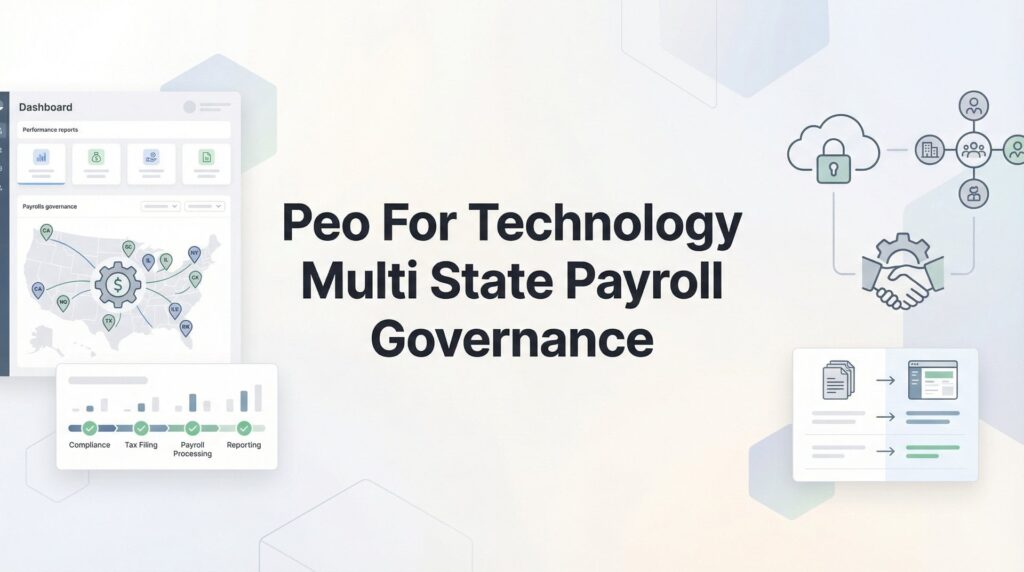
You hire a senior engineer in Austin. Two weeks later, you bring on a product manager in Denver. Next month, it’s a designer in Portland. Each new hire triggers a cascade of payroll compliance requirements: state tax registrations, unemployment insurance accounts, withholding calculations that vary by jurisdiction, and wage laws that contradict each other across state lines.
For technology companies with distributed teams, multi-state payroll isn’t just an operational task—it’s a governance challenge. You’re not simply processing paychecks. You’re maintaining consistent employment policies across jurisdictions with conflicting rules, creating audit trails that satisfy both state labor boards and SOC 2 auditors, and ensuring every equity grant, bonus structure, and overtime calculation complies with a patchwork of state regulations.
This article addresses how PEOs handle the specific intersection of tech industry compensation structures and multi-state payroll governance. We’ll cover what governance actually requires, where PEOs add value, and the gaps you need to watch for when your compensation includes stock options and your team spans 20+ states.
The Multi-State Governance Problem Tech Companies Actually Face
Remote-first hiring creates a compliance footprint that expands faster than most companies anticipate. A 50-person tech startup might have employees in 15 states. A 200-person company could easily span 30+ jurisdictions. Each state brings its own tax withholding requirements, and many add city or county-level taxes on top.
Here’s what that actually means: When you hire someone in New York City, you’re dealing with federal withholding, New York state tax, NYC resident tax, and potentially Metropolitan Commuter Transportation Mobility Tax. Hire in Philadelphia, and you’re managing Pennsylvania state tax plus the city’s wage tax—which applies differently depending on whether the employee lives in the city or commutes from the suburbs. Portland adds a Metro Supportive Housing Services tax. San Francisco has its own payroll expense tax.
The registration burden alone becomes significant. Most states require you to register as an employer before your first paycheck, establish an unemployment insurance account, and often register for state disability or paid family leave programs. Miss a registration deadline, and you’re facing penalties before you’ve even processed payroll. Understanding how co-employment solves cross-border tax headaches becomes essential at this stage.
Tech compensation structures make this harder. A base salary is straightforward. But when you’re paying sign-on bonuses, annual performance bonuses, and granting stock options, state rules diverge quickly. California requires you to include certain bonuses in overtime calculations. Some states tax equity compensation at grant, others at vest, others at exercise. RSU withholding rates vary. ISO and NSO reporting obligations differ by jurisdiction.
The governance challenge isn’t just getting payroll right once. It’s building systems that maintain compliance as you scale. When California updates its overtime rules or Colorado passes new wage transparency requirements, someone needs to update your policies, adjust your payroll configurations, and document the changes for audit purposes. When you hire your first employee in a new state, someone needs to research that state’s final pay requirements, meal break rules, and exempt salary thresholds—then ensure your employment policies reflect those rules.
Most tech companies don’t have dedicated multi-state payroll compliance teams. The responsibility falls on an HR generalist, a finance person wearing multiple hats, or founders managing it themselves until it becomes unmanageable. That’s the governance gap PEOs are designed to fill.
What Multi-State Payroll Governance Actually Requires
Governance starts with registration. Every state where you employ someone typically requires an employer account for unemployment insurance, a withholding tax account, and potentially additional registrations for state disability insurance or paid family leave. New York requires four separate registrations. California requires registration with EDD, payment of Employment Training Tax, and registration for State Disability Insurance.
Someone has to handle these registrations when you hire in a new state. That means researching state-specific requirements, completing applications, waiting for account numbers, and tracking renewal deadlines. Many states require quarterly filings. Some require annual reconciliations. All of them send correspondence to whatever address you provided during registration—which becomes a problem when that was your accountant’s office and they’ve since changed firms.
Then there’s policy documentation. Your employee handbook needs to address overtime rules, meal and rest break requirements, final pay timing, and paid sick leave—all of which vary by state. California requires a 30-minute meal break before the fifth hour of work. Oregon requires a meal break before the end of the fifth hour. That’s a meaningful operational difference if you’re managing shift schedules.
Final pay requirements create particularly messy compliance scenarios. California requires immediate final payment when you terminate someone. Colorado gives you 24 hours if you initiated the termination, next payday if the employee quit. Most states allow payment by the next regular payday. Conducting a thorough state employment law risk review before signing with any provider helps you understand these variations.
Audit-ready recordkeeping adds another layer. State labor boards want documentation proving you paid correctly, provided required breaks, and maintained proper classification. SOC 2 audits—common in tech—require documented HR policies, evidence of policy enforcement, and access controls around payroll data. Your payroll system needs to generate reports that satisfy both audiences.
This is where governance becomes more than just compliance. It’s about creating consistent, defensible employment practices across jurisdictions while maintaining the flexibility to handle state-specific requirements. Most companies struggle with this because they’re using payroll software designed for single-state operations and bolting on multi-state functionality that doesn’t quite work.
How PEOs Handle Multi-State Governance for Tech Companies
A PEO’s core value in multi-state situations is simple: they maintain employer registrations in all 50 states already. When you hire someone in a new state, you’re not starting from scratch with registration research and applications. The PEO’s existing infrastructure covers you immediately.
This matters more than it sounds. Without a PEO, hiring your first employee in Washington means registering with the Employment Security Department, setting up a paid family and medical leave account, and potentially registering for workers’ compensation. With a PEO, that employee goes onto the PEO’s existing Washington registrations. You’re operational in that state the day they start.
Tax jurisdiction assignment happens automatically. The PEO’s payroll system knows that an employee working from Denver needs Colorado state withholding, Denver occupational privilege tax, and potentially RTD tax depending on their specific location. An employee in Yonkers gets New York state withholding plus Yonkers resident tax. You’re not manually configuring these calculations or researching local tax requirements.
Compliance updates get centralized. When California changes its overtime calculation rules or increases the exempt salary threshold, the PEO updates their payroll system and policy templates. You’re not monitoring state legislative sessions or subscribing to compliance newsletters. The PEO’s compliance team handles that monitoring, interprets how changes affect payroll operations, and implements updates across their entire client base. This is why many growing companies explore PEO HR compliance protection as a core benefit.
This is particularly valuable for states that change frequently. California updates wage and hour rules constantly. New York adjusts exempt thresholds regularly. Colorado has been aggressive with new wage transparency and pay equity requirements. A PEO with strong compliance infrastructure keeps you current without requiring internal expertise.
For tech companies, the reporting capabilities matter. Most PEOs can generate state-by-state compliance reports showing you’re meeting wage and hour requirements, maintaining proper documentation, and handling tax withholding correctly. These reports become valuable during investor due diligence, board audits, or if you’re preparing for acquisition.
The governance model shifts from “we need to figure out how to comply in each state” to “the PEO handles baseline compliance, and we focus on company-specific policies.” You’re still responsible for your employment policies, performance management, and termination decisions. But the mechanical compliance—registrations, tax calculations, state-specific wage rules—gets handled through the PEO’s infrastructure.
Governance Gaps to Watch For in PEO Arrangements
Not all PEOs handle local taxes comprehensively. State-level taxes are standard. But city and county taxes—especially in tech hubs—can fall into gray areas. New York City’s various taxes are usually covered. San Francisco’s payroll expense tax might not be. Portland’s Metro tax is relatively new and not all PEO systems have implemented it correctly.
Before you commit, ask specifically: Which local taxes do you handle automatically, and which require manual processing or fall outside your system? If you have employees in San Francisco, NYC, Philadelphia, Portland, or other cities with local payroll taxes, verify exact coverage. Understanding payroll tax penalty protection helps you evaluate what’s actually at stake.
Equity compensation is where many PEOs show limitations. Standard W-2 payroll is their core competency. But stock options, RSUs, ESPP contributions, and the various tax elections around equity often fall outside their standard service scope.
Here’s what typically happens: The PEO will process the W-2 income when your equity vests or is exercised. They’ll handle supplemental withholding at the standard rates. But the specialized reporting—Section 83(b) elections, ISO vs. NSO tracking, AMT calculations, state-specific equity tax treatment—usually requires separate systems or manual intervention.
If your compensation structure includes significant equity, clarify exactly what the PEO handles and what remains your responsibility. Some PEOs partner with specialized equity administration platforms. Others expect you to manage equity separately and feed them the W-2 implications. Very few handle the full lifecycle of equity compensation within their core platform.
Multi-state workers create another complexity. An employee who works remotely from Colorado but travels frequently to your California office for meetings creates questions about tax withholding allocation, which state’s wage laws apply, and where you have employment nexus. An employee who splits time between two states—maybe they’re in New York three days a week and Florida two days—requires apportionment calculations that many PEO systems don’t handle automatically.
Most PEOs default to withholding based on the employee’s primary work location. If you have employees who genuinely work across multiple states, you may need to manage withholding allocation manually or accept some compliance risk.
The final gap is international expansion. PEOs are domestic solutions. They handle the 50 U.S. states and maybe Puerto Rico and other territories. If you’re hiring employees in Canada, the UK, or anywhere else internationally, the PEO can’t help. You’ll need an Employer of Record service for international hiring or establish legal entities in those countries.
Evaluating PEO Fit for Your Tech Company’s Governance Needs
Start with state footprint questions. Ask the PEO: How many states are you currently registered in? Most established PEOs will say all 50. Then ask: What’s your process when I hire in a new state? The answer should be “nothing changes on your end”—not “we’ll need to complete registrations first.” Reviewing the best PEOs for multi-state companies gives you a baseline for comparison.
Dig into their compliance update process. How do you monitor state law changes? How quickly do you implement updates to payroll calculations or policy templates? Who on your team handles compliance research? You’re looking for evidence of a dedicated compliance function, not a reactive approach where they address issues as clients raise them.
Reporting capabilities matter for governance. Ask: Can you generate state-by-state compliance reports? Can I get documentation showing we’re meeting wage and hour requirements in each jurisdiction? What audit support do you provide if we’re preparing for SOC 2 or if a state labor board initiates an investigation?
For tech companies specifically, address equity compensation upfront. Walk through your current equity structure—ISOs, NSOs, RSUs, whatever you’re using—and ask exactly what they handle. If they say “we can process that,” push for specifics. Do they track ISO vs. NSO elections? Do they handle AMT calculations? How do they report equity compensation for state tax purposes in states with different treatment rules?
Local tax coverage deserves explicit verification. List every city and county where you currently have employees. Ask: Which of these local taxes do you handle automatically? The PEO should be able to give you a clear yes/no for each jurisdiction, not vague assurances that they “handle local taxes.”
Cost considerations are real but need context. Multi-state payroll governance is genuinely complex. If a PEO is charging $150-200 per employee per month and that eliminates the need for a full-time payroll specialist or compliance manager, the math often works. Using a PEO cost forecasting guide helps you model these scenarios accurately before committing.
Compare what you’re paying now—including the fully loaded cost of internal time spent on payroll compliance—against PEO fees. Factor in risk reduction. A missed state registration or incorrect overtime calculation can cost more in penalties than months of PEO fees.
When a PEO Doesn’t Solve Your Governance Problem
International expansion breaks the PEO model. If you’re hiring employees in London, Toronto, or Singapore, a domestic PEO can’t help. You need an Employer of Record service that operates in those countries, or you need to establish legal entities and run payroll locally. Some PEOs partner with international EOR providers, but it’s a separate service with separate pricing.
Highly customized equity programs may exceed what PEOs can accommodate. If you’ve built complex vesting schedules, performance-based equity grants, or unusual stock option structures, you might need a specialized equity administration platform and a payroll provider with deeper stock compensation expertise. Standard PEOs handle common equity structures reasonably well. They struggle with edge cases.
Companies with robust existing HR infrastructure sometimes find PEO governance redundant. If you already have a dedicated payroll team, compliance specialists who monitor state law changes, and systems that handle multi-state complexity well, adding a PEO layer creates duplicate costs without adding value. The PEO model works best when you’re filling a capability gap, not when you’re already handling these functions internally. For tech companies specifically, understanding HR infrastructure scaling strategies helps clarify when internal builds make more sense.
Very small companies—under 10 employees, all in one or two states—may not have enough complexity to justify PEO costs. Multi-state governance becomes valuable when you’re actually operating in multiple states. If you’re a five-person team all working from California, you’re better off with standard payroll software and a good employment attorney than paying PEO fees for multi-state infrastructure you don’t need yet.
Companies planning rapid international expansion should think carefully about building around a PEO. If your hiring roadmap includes significant international growth in the next 12-24 months, you might be better served by an international EOR from the start, even if it costs more initially. Switching from a PEO to an international solution mid-growth creates friction.
Making the Governance Decision
The core value proposition is straightforward: PEOs centralize multi-state payroll compliance, eliminate your state registration burden, and maintain the audit-ready documentation that tech companies increasingly need. They handle the mechanical complexity of operating in 20+ states so you can focus on building your product and growing your team.
But that value only materializes if the PEO actually covers your specific needs. Verify their local tax handling for your current employee locations. Clarify their equity compensation capabilities against your actual equity structure. Confirm their compliance reporting meets your audit requirements. Ask direct questions about what happens when you hire in a new state, how quickly they implement state law changes, and what falls outside their standard service scope.
The governance challenge tech companies face—distributed teams, complex compensation, rapid expansion across state lines—is real. A PEO can solve it, but only if you choose a provider whose capabilities align with your current reality and projected growth. Don’t assume all PEOs are equivalent. Their multi-state infrastructure might be similar, but their depth of coverage in the areas that matter to tech companies varies significantly.
Before you sign that PEO renewal, make sure you’re not leaving money on the table. Many businesses unknowingly overpay because of bundled fees, hidden administrative markups, and contracts designed to limit flexibility. We give you a clear, side-by-side breakdown of pricing, services, and contract terms—so you can see exactly what you’re paying for and choose the option that truly fits your business. Get a free analysis
