
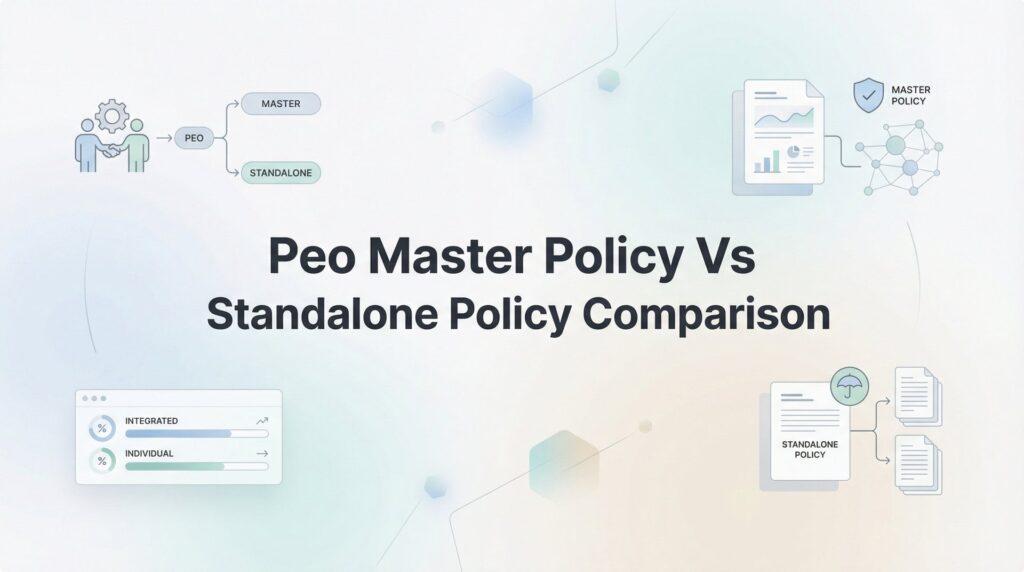
When you join a PEO, your employees typically get coverage under the PEO’s master insurance policy—a pooled arrangement that bundles your workers with thousands of others. The alternative is maintaining your own standalone policies where you’re the named insured and control everything directly.
Neither option is universally better.
The right choice depends on your risk profile, growth trajectory, and how much control you need over coverage decisions. A master policy might save you thousands in premiums and administrative headaches. Or it might lock you into coverage terms that don’t match your actual exposure, while erasing the claims history you’ve spent years building.
This guide breaks down the seven factors that actually matter when evaluating these two approaches, so you can make a decision based on your specific situation rather than generic advice.
1. Premium Cost Structures
The Challenge It Solves
Premium costs are rarely straightforward when comparing PEO master policies to standalone coverage. You’re not just comparing rates—you’re comparing fundamentally different risk pooling mechanisms that can swing your annual insurance spend by 20% or more in either direction.
The question isn’t “which is cheaper” but “which pricing model works better for your specific risk profile.”
The Strategy Explained
PEO master policies pool your employees with thousands of other workers across multiple client companies. This creates a large-group insurance arrangement where premiums are based on the collective risk profile rather than your individual claims history.
For companies with problematic claims experience or those too small to negotiate favorable rates independently, this pooling can provide access to lower premiums than they could secure on their own. You benefit from the PEO’s negotiating power and the statistical stability of a larger risk pool.
Standalone policies price your coverage based entirely on your own payroll, classification codes, and claims history. If you’ve invested in safety programs and maintained clean claims records, you can leverage that track record for lower premiums. But you’re also absorbing the full cost of any incidents without the cushion of a larger pool.
The cost advantage shifts as companies grow. Smaller businesses often find master policies more affordable. Larger companies with 50+ employees frequently discover they can negotiate better standalone rates.
Implementation Steps
1. Request detailed premium breakdowns from your PEO showing exactly what portion covers insurance versus administrative fees—many PEOs bundle these costs making true comparison difficult.
2. Obtain standalone quotes from at least two carriers for identical coverage limits and deductibles to establish your independent market pricing baseline.
3. Calculate the total annual cost difference including any PEO administrative fees that wouldn’t exist with standalone coverage, not just the insurance premium line item. Understanding how PEO workers’ comp premiums are calculated can help you identify where costs are actually coming from.
Pro Tips
Ask your PEO how often their master policy rates increase and what drives those changes. You’re exposed to rate volatility from other clients’ claims even if your own experience is excellent. Also verify whether the PEO’s quoted premium is guaranteed or subject to adjustment based on final payroll audits—surprises at year-end are common.
2. Coverage Customization Limits
The Challenge It Solves
Insurance needs vary dramatically by industry, growth stage, and risk tolerance. A construction company needs different liability limits than a software consultancy. A business planning international expansion needs coverage a local retailer doesn’t.
Master policies offer standardized coverage designed to work for most clients. That standardization is the problem when you’re not “most clients.”
The Strategy Explained
PEO master policies are negotiated between the PEO and their insurance carriers to cover a broad range of client companies. You get the coverage terms the PEO secured, which typically includes workers compensation, general liability, and sometimes employment practices liability insurance.
What you can’t do is modify those terms significantly. Need higher liability limits because you’re working with enterprise clients who require $5 million in coverage? That might not be available under the master policy. Want to add cyber liability or professional liability? Those often require separate standalone policies anyway.
The PEO has limited flexibility to customize because they’re managing one master contract covering thousands of employees across dozens of client companies. Your specific needs don’t justify renegotiating carrier agreements.
Standalone policies give you complete control. You work directly with brokers and carriers to structure coverage matching your actual exposures. You can adjust limits, add endorsements, modify deductibles, and layer umbrella policies as your business evolves.
Implementation Steps
1. List every coverage requirement from your contracts, leases, and regulatory obligations—many businesses discover gaps only when a client or landlord requests a certificate of insurance the PEO can’t provide.
2. Compare the PEO’s master policy terms against those requirements line by line, noting any coverage limits, exclusions, or missing coverages that create gaps. Understanding the accounting implications of master policies can also reveal hidden financial considerations.
3. Calculate the cost of purchasing additional standalone policies to fill those gaps, since you’ll need them regardless of the PEO arrangement.
Pro Tips
Pay special attention to how the master policy handles subcontractors and 1099 workers. Many PEO policies cover only W-2 employees under the co-employment arrangement, forcing you to secure separate coverage for contractors. If your business model relies heavily on flexible labor, this limitation can eliminate much of the master policy’s cost advantage.
3. Claims Experience Rules
The Challenge It Solves
Your claims history is one of the most valuable assets—or liabilities—affecting insurance costs. How that history is tracked and who owns it makes a substantial difference in your long-term cost trajectory and market options.
Under master policies, you’re essentially renting space in someone else’s claims record. That changes everything about how incidents affect your premiums.
The Strategy Explained
Workers compensation uses experience modification rates (e-mods) to adjust premiums based on claims history. An e-mod of 1.0 is average. Below 1.0 means you pay less than standard rates. Above 1.0 means you pay more.
With PEO master policies, the e-mod is calculated at the PEO level, not yours individually. Your claims get pooled with everyone else’s. If you have excellent safety records, you’re subsidizing clients with poor performance. If you have problematic claims history, you’re benefiting from better performers in the pool.
This creates a built-in cross-subsidy. Companies with strong safety programs and minimal claims often pay more under master policies than they would with standalone coverage reflecting their actual performance. Companies with frequent claims or high-severity incidents pay less.
The bigger problem emerges when you leave the PEO. Your individual claims history may not be separately tracked or portable. Many businesses discover they can’t demonstrate their safety record to new carriers because everything was reported under the PEO’s policy number.
Standalone policies build your own e-mod based exclusively on your claims. Good performance translates directly to lower premiums. Poor performance costs you more. But that history belongs to you and follows you when you change carriers or insurance structures.
Implementation Steps
1. Request your individual loss runs from the PEO showing every claim filed under your client code for the past five years—this documentation is essential for future insurance applications.
2. Ask the PEO’s insurance carrier whether they can provide an estimated individual e-mod calculation for your company separate from the pooled rate.
3. Have a standalone carrier run hypothetical quotes using your actual claims data to see what your premiums would be with an individual e-mod. Implementing a workers’ comp safety governance framework can help improve your claims experience over time.
Pro Tips
If you’re planning to leave a PEO within the next few years, start requesting detailed loss runs now. Some PEOs make this information difficult to obtain after you’ve terminated the relationship. You’ll need this documentation to secure competitive standalone coverage and prove your claims history to new carriers.
4. Administrative Burden
The Challenge It Solves
Insurance administration is tedious and time-consuming. Renewals, certificates of insurance, policy changes, compliance documentation, and audit responses all require attention from someone in your organization.
For small businesses without dedicated HR staff, this administrative load can justify a PEO relationship even when the premiums aren’t dramatically lower.
The Strategy Explained
PEOs handle the operational details of insurance administration as part of their service model. They manage policy renewals, respond to certificate requests from your clients and vendors, process coverage changes when you hire or terminate employees, and handle workers compensation audits.
When a general contractor requests a certificate of insurance before you can start a project, you submit a request to the PEO and they issue it. When your lease requires proof of liability coverage, the PEO provides the documentation. When state regulators request workers compensation verification, the PEO manages that compliance requirement.
This administrative transfer is particularly valuable for businesses without HR infrastructure. You’re not maintaining broker relationships, tracking renewal dates, or learning insurance terminology and requirements. Understanding how a PEO works helps clarify exactly which administrative tasks transfer to them.
Standalone policies shift all this responsibility to you. You’ll need either internal staff who understand insurance administration or a broker relationship to manage these tasks. Certificate requests become your problem. Audit responses require your time. Policy modifications need your attention.
The workload isn’t overwhelming for larger companies with HR teams, but it’s real. Budget 5-10 hours monthly for insurance administration tasks if you’re managing standalone policies without broker support.
Implementation Steps
1. Track how many certificate of insurance requests you receive monthly and how urgently you need them issued—businesses with frequent COI requests benefit more from PEO administration.
2. Calculate the internal cost of managing insurance administration by estimating staff hours and multiplying by loaded labor rates, including both routine tasks and annual renewals.
3. Compare that internal cost against the PEO’s administrative fee component to determine whether you’re paying a reasonable premium for the service or could handle it more cost-effectively yourself.
Pro Tips
Don’t underestimate the value of having someone else handle workers compensation audits. These annual reviews require detailed payroll records, classification verification, and often contentious negotiations over additional premiums. PEOs absorb this headache entirely, which has real value even if it’s hard to quantify precisely.
5. Exit Scenario Risks
The Challenge It Solves
Business circumstances change. You might outgrow the PEO’s service model, find better pricing elsewhere, or decide you need more control over HR functions. When that happens, transitioning your insurance coverage creates risks that don’t exist with standalone policies. The exit process isn’t just about finding new coverage—it’s about avoiding gaps
The exit process isn’t just about finding new coverage—it’s about avoiding gaps that create liability exposure.
The Strategy Explained
When you leave a PEO, you lose coverage under their master policy immediately. You need new standalone policies in place before your PEO termination date, which creates a coordination challenge with real consequences.
Workers compensation is particularly problematic. Most states prohibit any gap in coverage, even for a single day. If your standalone policy doesn’t start exactly when your PEO coverage ends, you’re operating illegally and exposed to fines plus unlimited liability for any workplace injuries during that gap.
The timing rarely aligns perfectly. PEO contracts often require 30-60 days termination notice. Insurance carriers need time to underwrite new policies, inspect your facilities, and issue coverage. If you’re leaving the PEO due to service problems or disputes, they may not be motivated to help ensure a smooth transition. Having a detailed PEO exit and cancellation guide can help you navigate these complexities.
You’ll also face underwriting scrutiny you didn’t experience when joining the PEO. Carriers will want your claims history, which may not be separately tracked. They’ll evaluate your risk profile independently rather than accepting you as part of a pooled arrangement. Companies with problematic claims or difficult-to-insure operations sometimes discover they can’t obtain standalone coverage at any reasonable price.
Standalone policies don’t have this exit risk. You can change carriers at renewal without changing your employment structure. Your coverage transitions are standard insurance marketplace moves, not fundamental changes to your business operations.
Implementation Steps
1. Start the exit planning process at least 90 days before your intended PEO termination date to allow time for underwriting, inspections, and policy issuance without rushed decisions.
2. Obtain firm standalone quotes with confirmed effective dates before submitting termination notice to the PEO—don’t assume coverage will be available when you need it.
3. Verify that your new standalone policies include tail coverage for any claims that occurred during the PEO period but are reported after you leave, since the PEO’s master policy may not cover claims reported after termination.
Pro Tips
Ask your PEO about their policy for issuing certificates of insurance during the transition period. Some businesses discover they can’t get COIs for new contracts during their final 30 days with the PEO, which can disrupt business development and project starts. Build this into your exit timeline.
6. Carrier Relationships and Market Access
The Challenge It Solves
Not all insurance carriers participate in PEO master policy programs. The carriers willing to write large pooled arrangements often differ from those offering the most competitive direct coverage to small businesses.
This market segmentation means you’re choosing between different carrier ecosystems, not just different policy structures.
The Strategy Explained
PEO master policies are typically written by carriers specializing in large-group arrangements and comfortable with the unique risk profile of pooled employment relationships. These carriers understand PEO operations and price accordingly, but they may not be the same insurers offering the best rates for standalone small business coverage.
Some top-tier carriers don’t participate in PEO programs at all. They prefer direct relationships with insured businesses where they can underwrite risk individually and maintain ongoing carrier-client relationships. If your industry or risk profile would qualify for preferred rates with these carriers, the PEO master policy blocks that access.
The reverse is also true. Some carriers participating in PEO master programs won’t write standalone coverage for small businesses in certain industries. They’ll insure a 10-person construction company as part of a PEO pool but won’t issue a direct policy to that same company.
This creates a strategic question: which insurance market do you want access to? The PEO master policy market is narrower but provides entry to coverage tiers small businesses can’t typically access independently. The standalone market is broader but requires you to qualify on your own merits. Comparing top PEO providers can help you understand which carriers different PEOs work with.
Implementation Steps
1. Ask your PEO which carrier underwrites their master policy and research that carrier’s financial strength ratings and reputation for claims handling in your industry.
2. Request standalone quotes from carriers known for strong performance in your industry to compare not just pricing but carrier quality and service levels.
3. Verify whether the PEO’s carrier has any exclusions or limitations specific to your industry or operations that wouldn’t apply under standalone coverage with a specialized carrier.
Pro Tips
Pay attention to the PEO’s carrier stability. If the PEO changes their master policy carrier, you’re changing insurance companies whether you want to or not. Ask about their carrier history and how often they’ve switched in the past five years. Frequent changes suggest either pricing pressure or carrier dissatisfaction with the PEO’s risk pool.
7. Control Over Policy Decisions
The Challenge It Solves
Insurance isn’t static. Business needs evolve, coverage requirements change, and strategic decisions about risk management affect your operations. Who controls those decisions matters more than most businesses realize when evaluating PEO arrangements.
With master policies, you’re a participant in someone else’s insurance program. With standalone policies, you’re the decision maker.
The Strategy Explained
PEO master policies give the PEO control over fundamental insurance decisions. They choose the carrier, negotiate the terms, set the deductibles, and determine what coverage is available. You can request changes, but you can’t demand them.
If the PEO’s carrier increases rates by 15% at renewal, you’re paying the increase or leaving the PEO entirely. If you want to add coverage for a new exposure, you’re dependent on whether the PEO can or will modify their master policy. If you disagree with how a claim is being handled, you’re working through the PEO rather than directly with the carrier.
This lack of control has real business implications. Companies expanding into new service lines sometimes discover the PEO’s master policy doesn’t cover the new activities. Businesses implementing safety programs can’t directly negotiate premium reductions based on their improved performance. Organizations with specific risk management preferences can’t structure their coverage accordingly.
Standalone policies put you in the driver’s seat. You select the carrier based on your priorities—whether that’s price, service quality, claims handling reputation, or financial strength. You negotiate terms directly or through your broker. You make strategic decisions about deductibles, limits, and coverage scope based on your risk tolerance and business strategy. Learning how to negotiate your PEO contract can help you secure more favorable terms if you do choose the master policy route.
When problems arise, you have direct relationships with carriers and brokers who work for you. You’re not filtered through a PEO’s account management structure.
Implementation Steps
1. Review your PEO agreement to understand what insurance decisions you can influence and what’s entirely under PEO control—many businesses don’t realize how limited their input is until they need to make a change.
2. Identify any upcoming business changes that might require insurance modifications and verify whether the PEO’s master policy can accommodate them before you’re locked into operational decisions.
3. Ask the PEO about their process for handling coverage disputes or claims disagreements to understand how much advocacy they provide versus simply administering the carrier’s decisions.
Pro Tips
Control becomes more valuable as your business matures and develops specific insurance needs. Early-stage companies often benefit from the simplicity of letting the PEO handle everything. Growing businesses with developing risk management sophistication frequently find the lack of control frustrating. Consider where you’ll be in three years, not just where you are today.
Moving Forward
The master policy versus standalone decision isn’t about finding the objectively better option—it’s about matching your insurance structure to your actual business needs.
Companies with straightforward operations and limited HR bandwidth often benefit from PEO master policies. The administrative relief and access to pooled rates can outweigh the loss of control and customization, especially for businesses under 25 employees or those with challenging claims history.
Businesses with specialized coverage needs, strong safety records they want to leverage, or exit plans on the horizon may find standalone policies worth the extra management overhead. The ability to build your own claims experience, control coverage decisions, and avoid transition risks often justifies the additional administrative burden.
Review these seven factors against your specific situation. Don’t rely on generic advice or assume that what worked for another company will work for yours. Model both scenarios with actual quotes that include all costs—premiums, administrative fees, and the internal expense of managing insurance if you go standalone.
Before you sign that PEO renewal, make sure you’re not leaving money on the table. Many businesses unknowingly overpay because of bundled fees, hidden administrative markups, and contracts designed to limit flexibility. We give you a clear, side-by-side breakdown of pricing, services, and contract terms—so you can see exactly what you’re paying for and choose the option that truly fits your business.
