
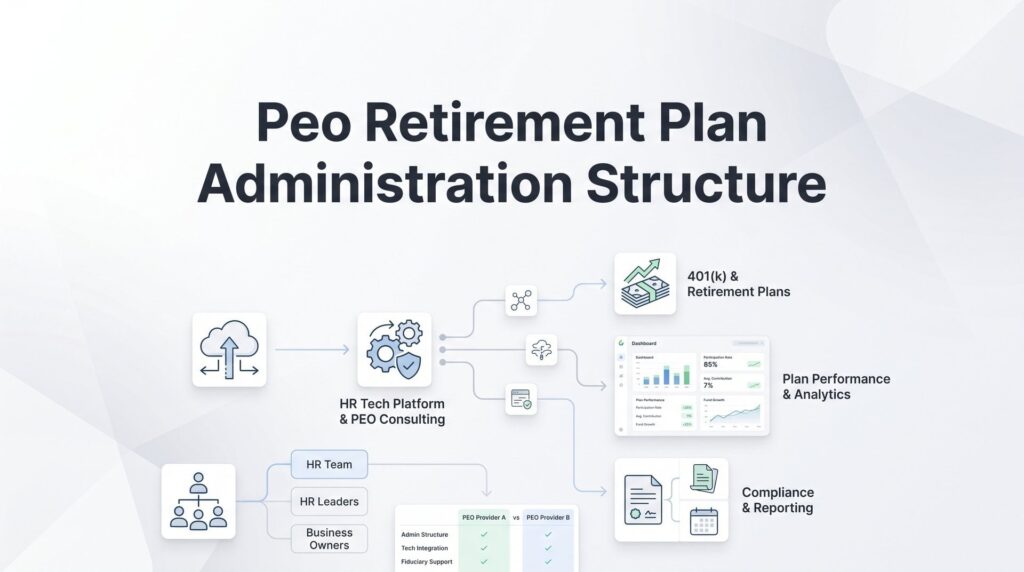
Most business owners who sign up with a PEO see “retirement benefits” somewhere in the proposal and move on. It’s a checkbox. Employees get a 401(k), the PEO handles the paperwork, everyone wins. Right?
Not exactly. The retirement plan structure inside a PEO relationship is one of the most mechanically complex — and least understood — parts of co-employment. Who sponsors the plan, who holds fiduciary responsibility, what your employees are actually paying in fees, and what happens to their balances when you eventually leave the PEO: these are structural questions that matter enormously and rarely get asked before the contract is signed.
This isn’t an argument for or against PEO retirement plans. Some are genuinely excellent, especially for smaller companies that couldn’t access institutional pricing on their own. Others are quietly expensive in ways that only become visible when you dig into the plan documents. The point is that you can’t evaluate what you don’t understand, and most PEO sales conversations don’t go anywhere near this level of detail.
So let’s go behind the scenes. Here’s how PEO retirement plan administration actually works, what you’re responsible for even when the PEO runs the show, and what questions you should be asking before you commit.
The Multiple Employer Plan Structure Most PEOs Use
Here’s the structural reality most business owners don’t realize going in: when you join a PEO’s retirement plan, your employees aren’t joining your company’s 401(k). They’re joining the PEO’s plan — a Multiple Employer Plan (MEP) that covers employees from dozens or hundreds of different client companies simultaneously.
In a PEO-sponsored MEP, the PEO is the plan sponsor. Not you. That distinction has real consequences across compliance, control, and what happens when the relationship ends.
Under ERISA, the plan sponsor carries significant fiduciary responsibility. In a typical PEO arrangement, the PEO assumes what’s called 3(16) plan administrator responsibility — handling the administrative functions like Form 5500 filing, plan document maintenance, and nondiscrimination testing. This genuinely offloads a meaningful compliance burden from the business owner, which is one of the legitimate advantages of the MEP structure.
But there’s a tradeoff. Because the PEO is the sponsor, you don’t control the plan. You don’t choose the investment options. You don’t negotiate fees with the recordkeeper. You don’t decide whether to add a Roth option or adjust the employer match formula without going through the PEO’s plan design constraints. You’re a participating employer inside someone else’s plan, not the architect of your own. Understanding the full scope of PEO benefits administration helps clarify where your control ends and the PEO’s begins.
It’s worth knowing that the SECURE Act of 2019 created a distinct structure called a Pooled Employer Plan (PEP), which is similar to a MEP but with a designated Pooled Plan Provider (PPP) serving as the named fiduciary. Some PEOs have migrated to PEP structures, which carry slightly different regulatory treatment and can simplify some compliance obligations. If you’re evaluating a PEO, it’s worth asking which structure they use — MEP or PEP — because the answer affects how fiduciary responsibility is allocated and how the plan is treated for audit purposes.
The contrast with running your own standalone 401(k) is significant. A single-employer plan gives you full control over plan design, fund selection, and fee negotiation. You’re the named fiduciary, which means more responsibility, but also more flexibility. For a company with 10 employees, that flexibility often isn’t worth the administrative overhead. For a company with 75 employees and specific compensation structures, it might be exactly what you need. Weighing this tradeoff is central to the broader benefits administration outsourcing decision.
The MEP structure also changes how the IRS and DOL treat audit requirements. Single-employer plans with 100 or more eligible participants generally require an independent audit. MEPs are evaluated differently — the audit threshold applies at the plan level, not the employer level, which means your participation in a large MEP doesn’t automatically trigger an audit obligation for your company. That’s a real administrative relief for smaller employers.
Who Picks the Funds — and Who Profits From the Lineup
Inside a PEO’s retirement plan, there’s a chain of vendors you’ll never directly interact with but whose decisions directly affect your employees’ retirement outcomes. Understanding this chain is important.
The typical structure looks something like this: the PEO selects a recordkeeper (the platform that tracks individual account balances and processes contributions), a third-party administrator (TPA) that handles compliance testing and plan administration, and either an investment advisor or a curated fund platform that determines which investment options are available to participants. As a client company, you generally have no seat at any of these tables.
The pooled buying power of a large MEP can be a genuine advantage here. PEOs with significant assets under management can negotiate access to institutional share classes of mutual funds — lower-cost versions of the same funds that individual small businesses typically can’t access. If a PEO has negotiated well, your employees might be paying meaningfully less in fund expenses than they would in a small standalone plan. That’s real money over a 30-year career.
But the same structure can work against employees when revenue-sharing arrangements are involved. Some recordkeepers charge lower platform fees to the PEO in exchange for offering higher-cost fund share classes that kick back a portion of the expense ratio to the recordkeeper or other parties in the chain. This is legal and disclosed in plan documents, but it’s rarely surfaced in a PEO sales conversation. Understanding where your money goes requires a deeper PEO profit structure investigation than most business owners undertake.
The fiduciary question matters here too. A PEO that takes on 3(38) investment manager responsibility is making investment decisions on behalf of plan participants and is legally accountable for those decisions. A PEO that only assumes 3(21) co-fiduciary status provides investment recommendations but leaves final decision-making to someone else — often the plan sponsor, which in this case is still the PEO, but the accountability structure differs. Ask specifically which fiduciary standard applies to investment decisions in the plan.
Most business owners never see the plan’s total expense ratio — the all-in annual cost that participants pay across fund expenses, recordkeeping fees, and any revenue-sharing arrangements. This number should be disclosed in the plan’s fee disclosure documents (required under ERISA 408(b)(2)), but you have to know to ask for it. A reasonable all-in expense ratio for a well-run plan is typically under 1% annually. Plans with revenue-sharing baked in can run meaningfully higher, and that difference compounds significantly over time for your employees.
Get the fee disclosure documents before you sign. Knowing how to uncover benefit plan transparency issues before committing can save your employees thousands over their careers.
Compliance Obligations You Still Own
There’s a common misunderstanding worth clearing up directly: joining a PEO’s retirement plan doesn’t make you compliance-free. It shifts certain obligations to the PEO, but it doesn’t eliminate your role in keeping the plan clean.
The PEO handles the heavy lifting — Form 5500 preparation and filing, nondiscrimination testing (ADP/ACP tests that ensure the plan doesn’t disproportionately benefit highly compensated employees), and maintaining the plan document. For most small businesses, these are genuinely burdensome tasks, and having the PEO absorb them is a real operational benefit.
What you still own: timely remittance of employee deferrals and accurate census data. These sound simple. They’re not always.
DOL regulations require that employee salary deferrals be deposited into the plan as soon as administratively feasible — typically within a few business days of payroll for small plans. Late remittances are one of the most common plan compliance failures, and the DOL takes them seriously. In a PEO structure, the payroll flows through the PEO, which should help with timing. But if your payroll data is late, incorrect, or inconsistently coded, the deferral timing can slip, and the compliance obligation still traces back to the plan sponsor — which is the PEO, but the operational failure originated with you. Understanding the difference between a PEO vs payroll company helps clarify why these obligations flow the way they do.
Census data errors create a different category of problem. Nondiscrimination testing depends on accurate classification of employees as highly compensated or non-highly compensated, correct hours data, and proper eligibility tracking. If your HR records are messy and you’re feeding bad data into the PEO’s system, the testing results can be wrong. Correcting failed nondiscrimination tests is expensive and time-consuming, and while the PEO will manage the correction process, the headache is shared.
On the regulatory side, SECURE 2.0 (enacted in late 2022) introduced mandatory auto-enrollment requirements for new 401(k) plans established after December 29, 2022. Plans must automatically enroll eligible employees at a minimum 3% deferral rate, scaling up over time. PEOs that are onboarding new client companies into their MEP or PEP structures need to ensure their plan design complies with these requirements. Before joining, carefully review the PEO service agreement to understand how auto-enrollment and other compliance responsibilities are allocated between you and the PEO.
What Happens to the Plan When You Leave the PEO
This is the question almost nobody asks before signing. It’s also one of the most structurally significant aspects of the entire arrangement.
When you terminate your PEO relationship, your employees are no longer eligible to participate in the PEO’s MEP or PEP. They don’t take the plan with them. The plan stays with the PEO. Your employees’ account balances remain in the plan temporarily, but the co-employment relationship that made them eligible to participate is gone.
What happens next is a distributable event. Employees typically receive notices informing them that they can roll their balances to an IRA, roll into a new employer plan if one is established, or take a distribution (which triggers taxes and potential penalties). The PEO will manage the notification process, but the experience for your employees is disruptive regardless of how smoothly the PEO handles it. Having a solid PEO exit plan in place before you need one makes this transition far less chaotic.
There’s often a gap period between when you leave the PEO and when a new retirement plan is up and running — if you set one up at all. During that gap, employees can’t make new contributions. If they’re mid-year and had planned on hitting their contribution limit, that’s a real disruption to their retirement savings. Some employees, confused by the distribution notices, accidentally take taxable distributions instead of rolling over, creating unintended tax consequences. It happens more than it should.
Employer match vesting is another dimension that deserves attention before you sign anything. PEO plans often use vesting schedules for employer match contributions — employees don’t own the full match until they’ve been in the plan for a certain period. When you leave the PEO, employees who haven’t fully vested may forfeit unvested match balances depending on how the plan document handles termination events. Some PEOs accelerate vesting upon plan exit; others don’t. This can become a retention issue if key employees realize they’re walking away from unvested contributions during a transition.
The practical lesson: ask your PEO, before you sign, exactly what happens to the retirement plan upon termination of the agreement. Get it in writing. Understand the vesting schedule and how it’s handled at exit. Knowing how to negotiate your PEO contract gives you leverage to secure better exit terms on retirement plan provisions.
Evaluating Retirement Plan Structure Before You Commit
Comparing retirement plan offerings across PEOs is harder than comparing health insurance premiums or workers’ comp rates. There’s no standardized disclosure format, and most PEOs don’t lead with plan-level expense data in their proposals. You have to ask for it directly, and you have to know what you’re looking at when you get it.
A few structural questions that should be non-negotiable before you commit:
What is the plan’s total expense ratio? This is the all-in annual cost participants pay, including fund expenses and any revenue-sharing or recordkeeping fees passed through to participants. Ask for the fee disclosure document, not just a summary.
Who is the investment fiduciary, and at what level? Is the PEO or their investment advisor serving as a 3(38) investment manager (discretionary control) or a 3(21) co-fiduciary (advisory only)? The answer determines who’s accountable if the fund lineup underperforms or is inappropriate for participants.
What fund options are available? How many funds are in the lineup? Are index funds available? What are the expense ratios on the core options? A plan with only actively managed, high-cost funds is a structural disadvantage for participants.
What happens to vesting upon termination of the PEO agreement? Get the specific plan document language, not a verbal assurance.
Is the plan a MEP or a PEP? And what does that mean for how compliance obligations are allocated?
On the question of when a PEO retirement plan is genuinely the right fit versus when it’s a constraint: for companies under 50 employees, the pooled buying power of a PEO MEP often delivers real value. Using cost accounting methods to compare internal HR vs PEO expenses can help quantify whether the MEP’s pooled pricing advantage justifies the loss of plan control.
For companies closer to 100 employees, or businesses with specific plan design needs — profit-sharing formulas, defined benefit components, or highly compensated employee structures that require careful nondiscrimination planning — the constraints of a PEO’s standardized plan design can start to outweigh the convenience. If you already have a well-designed standalone plan with competitive fees, folding it into a PEO’s MEP may not be an upgrade.
The comparison challenge is real. Two PEOs might both offer “401(k) with employer match” as a line item, but one might run a plan with a 0.65% all-in expense ratio and access to institutional index funds, while the other runs a plan at 1.4% with revenue-sharing arrangements that benefit the recordkeeper. Reviewing the best PEO companies side by side is the only way to surface these differences before they cost your employees real money over 20 years.
The Bottom Line on PEO Retirement Plans
The retirement plan structure inside a PEO isn’t a minor administrative detail. It’s a structural commitment that shapes your employees’ retirement outcomes, your exposure to compliance obligations, and your flexibility to exit the relationship cleanly if you ever need to.
Treat it with the same scrutiny you’d apply to health insurance carrier selection or workers’ comp pricing. Ask for the fee disclosure documents. Understand who holds fiduciary responsibility for investment decisions. Know what happens to your employees’ balances — and their unvested match — if you leave. Ask about auto-enrollment compliance under SECURE 2.0. Get the vesting language in writing.
The PEO market has a wide range of retirement plan quality, and the differences aren’t visible in a standard proposal. Some PEOs have invested in genuinely competitive plan structures that deliver real value to small and mid-sized employers. Others are running plans that look fine on the surface but quietly cost participants more than they should.
If you’re comparing PEO providers and want to see how their retirement plan structures actually stack up against each other — fund lineups, fee structures, fiduciary arrangements, and exit terms — that’s exactly the kind of side-by-side analysis that makes the hidden differences visible. Don’t auto-renew. Make an informed, confident decision.
