
Most business owners don’t think about their loss ratio until something goes wrong. A workers’ comp renewal comes back 20% higher. A PEO account manager calls to say your pricing is being adjusted. Or worse, you get a non-renewal notice and suddenly you’re scrambling to find coverage. That’s usually when the term “loss ratio” enters the conversation — and by then, you’re already behind.
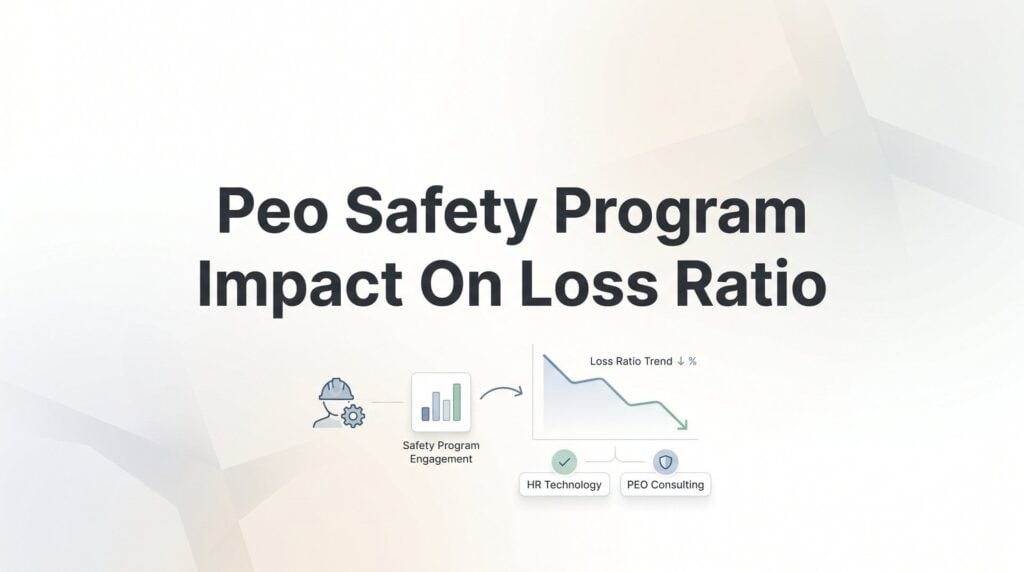
Here’s the reality: your loss ratio is the single biggest lever determining what you pay for workers’ comp inside a PEO arrangement. And your PEO’s safety program — how real it is, how deeply it’s implemented, how seriously your team engages with it — directly moves that number. The connection is mechanical, not theoretical.
But most companies evaluating PEOs treat safety programs as a checkbox. They see “safety support included” in the sales deck and move on. That’s a mistake that tends to show up on your invoice 18 months later.
This article walks through the actual mechanics: how loss ratios get calculated inside a PEO structure, what a legitimate safety program does to move those numbers, where the financial impact shows up in your costs, and how to evaluate whether a PEO’s safety offering is substantive or just window dressing. If you’re looking for broader context on PEO risk management and how workers’ comp is structured inside a co-employment arrangement, that foundational material is worth reading first. This piece goes deeper on a specific piece of that puzzle.
The Mechanics Behind Loss Ratios Inside a PEO
A loss ratio, at its core, is straightforward: incurred claims divided by earned premium. If a PEO’s workers’ comp program collects $10 million in premium across all its clients and pays out $7 million in claims, the aggregate loss ratio is 70%. Whether that’s good or bad depends on the carrier’s target, but generally speaking, the lower the loss ratio, the healthier the program.
PEOs care about this number intensely because their entire carrier relationship depends on it. When a PEO negotiates a master workers’ comp policy, the carrier is underwriting the whole book — every client company pooled together. If that aggregate loss ratio deteriorates year over year, the carrier reprices the master policy, tightens terms, or walks away entirely. That pricing pressure flows directly downstream to clients.
Your company feeds into this pool. Every claim your employees file becomes part of the PEO’s aggregate loss data. If your team has a bad year — a serious injury, a few repetitive strain claims, a slip-and-fall that turns into a long-tail case — that shows up in the pool. In a fully blended model, your bad year is partially absorbed by the group. But don’t mistake that for insulation. PEOs track individual client loss performance, and high-loss-ratio accounts get repriced, surcharged, or quietly pushed out at renewal. Understanding how to track and verify workers’ comp accounting through your PEO can help you stay ahead of these adjustments.
This is where the pricing model distinction matters. Some PEOs use a pooled/blended approach where the PEO’s aggregate loss ratio sets pricing for all clients, and your individual mod rate is largely irrelevant. Others pass through experience-rated workers’ comp, meaning your company’s own experience modification rate (EMR) directly determines your premium allocation. The EMR, calculated by organizations like NCCI, compares your actual claims history to what’s expected for your industry. A mod rate above 1.0 means you’re worse than average. Below 1.0 means you’re better.
In a pass-through model, a strong safety program that improves your individual mod rate translates almost directly into lower premium costs for your company. In a pooled model, your safety improvements benefit the whole group — which is still valuable, but the individual financial feedback loop is less direct. Knowing which model your PEO uses is essential context before you try to evaluate what their safety program is actually worth to you.
What a Real PEO Safety Program Looks Like
The term “safety program” gets used loosely. Some PEOs have dedicated safety consultants, structured audit protocols, and claims intervention teams. Others have a PDF handbook and a quarterly webinar. The difference in loss ratio impact between those two is significant.
A substantive PEO safety program typically operates across three stages, each compressing the loss ratio from a different angle.
Pre-injury prevention is where claim frequency gets reduced. This includes jobsite hazard assessments, OSHA compliance support, safety manual development tailored to your operations, and ongoing training for supervisors and frontline workers. The goal is reducing how often injuries happen. Fewer incidents mean fewer claims, which directly lowers the numerator in the loss ratio calculation.
Post-injury claims management addresses claim severity once an incident does occur. This is often where PEOs with weak programs fall apart. A real claims management function means rapid incident reporting, nurse triage on first contact, active case management to guide injured workers through treatment, and aggressive monitoring of medical costs and disability duration. Left unmanaged, a moderate injury can become an expensive long-tail claim. Active intervention caps that exposure.
Return-to-work programs are the third lever. Getting an injured employee back to modified duty quickly reduces the total cost per claim, limits indemnity payments, and signals to the carrier that claims are being actively managed. PEOs with structured return-to-work program strategies consistently show lower average cost per claim than those without them.
Here’s where you need to ask hard questions. Does the PEO run these functions in-house with dedicated staff, or is it outsourced to a third-party vendor with minimal oversight? In-house tends to mean tighter integration, faster response, and more accountability. Outsourced can work, but only if the PEO has genuine oversight of the vendor’s performance and outcome data.
The red flag to watch for: a PEO that lists “safety program” as a feature in its proposal but can’t tell you the name of their safety director, can’t show you their aggregate loss ratio trends, and can’t explain their claims intervention process in specific terms. That’s a checkbox, not a program. It won’t move your loss ratio, and it won’t protect your renewal pricing.
Tracing Safety Improvements to Your Actual Costs
Understanding the connection conceptually is one thing. Seeing how it moves through to your invoice is another.
The cost transmission path works like this: a well-run safety program reduces claim frequency and severity over time. That improvement shows up in the PEO’s aggregate loss ratio, which supports better carrier pricing on the master policy. For clients in experience-rated arrangements, individual mod rate improvement translates to a lower workers’ comp premium allocation. Depending on how your PEO structures its pricing, that shows up as a lower per-employee cost, a reduced workers’ comp line item, or in some cases a lower admin fee at renewal. A thorough loss trend analysis can help you quantify these improvements over time.
The part most businesses don’t account for is the time lag. Safety program investments don’t show up in loss ratio data immediately. Claims take time to mature — meaning the full cost of an injury often isn’t known for 12 to 24 months, sometimes longer for complex cases. It generally takes multiple policy periods for reduced claim frequency and severity to flow through into improved loss ratio numbers and then into better pricing.
What this means practically: if you join a PEO with a strong safety program, your first-year cost may not look dramatically better than a cheaper PEO with a weak one. The payoff is in years two and three, as the safety infrastructure starts compressing your claims experience. Businesses that evaluate PEOs purely on year-one pricing often miss this entirely and end up with a cheaper option that costs more over a three-year horizon. Using a cost accounting comparison framework can help you model the true multi-year expense.
This dynamic is especially pronounced in high-hazard industries. A roofing contractor, electrical subcontractor, or light manufacturing operation has a baseline claim frequency that makes safety program quality financially material in ways a software company simply doesn’t experience. For those industries, a PEO with genuinely strong safety infrastructure can offer more competitive workers’ comp rates because their aggregate loss ratios support it. They’ve earned better carrier terms by managing claims well across their book, and that pricing advantage gets passed to clients who fit the profile.
Industry Context: Why the Impact Varies So Much
Not every business should weight PEO safety program quality the same way in their evaluation. The financial impact of safety program quality on loss ratio is directly proportional to how often and how severely your employees get hurt.
For a desk-based technology company, the workers’ comp exposure is low. Claims are infrequent, typically minor, and the baseline loss ratio is already favorable. A PEO’s safety program quality isn’t going to move the needle much on costs in that environment. The evaluation criteria for a tech company should probably weight other factors — like benefits administration quality — more heavily.
For a construction trade, staffing company, or manufacturing operation, the calculus is completely different. Claim frequency is higher, severity is higher, and the cost of a single serious injury can materially impact the loss ratio for a policy period. In these industries, the quality of a PEO’s safety program isn’t a nice-to-have. It’s a core financial consideration.
PEOs that specialize in high-hazard industries tend to develop more sophisticated safety capabilities over time, simply because their clients demand it and their carrier relationships depend on it. They’ve built out dedicated safety consultants with industry-specific expertise, tighter claims management protocols, and better return-to-work infrastructure. That specialization matters. A generalist PEO serving mostly white-collar clients may technically offer safety services, but their team may not have the depth to handle the complexity of a construction or manufacturing account effectively.
If your business operates in a moderate-to-high-hazard industry, asking a PEO which industries make up the majority of their book is a reasonable question. A PEO whose client base is predominantly low-risk may not have the safety program depth your operation actually needs, even if their marketing materials suggest otherwise.
How to Actually Evaluate a PEO’s Safety Program
Marketing language is easy. What you want is outcome data and specific answers to specific questions. Here’s what to ask.
What is your current aggregate loss ratio, and how has it trended over the past three years? A PEO that genuinely manages safety well should be able to share this — or at minimum, describe the trend directionally. Reluctance to answer is itself informative. Reviewing their loss ratio management approach can give you additional context for interpreting their response.
Do you have dedicated safety consultants on staff, or is safety support outsourced? If outsourced, ask who the vendor is and how performance is measured. Ask how many safety consultants they have relative to the number of client companies they serve. A ratio of one safety consultant per several hundred clients is very different from one per several thousand.
What’s your average time-to-return-to-work for modified duty cases? This is a specific, measurable outcome. A PEO with a real return-to-work program should have data on this. If they don’t track it, that tells you something about how seriously they manage claims post-injury.
How do you handle claims that exceed a threshold amount? Ask specifically what happens when a claim looks like it might become complex or expensive. Is there an escalation protocol? Who manages it? What authority does the claims team have to intervene with medical providers?
Beyond the questions, look at the service agreement carefully. What are the PEO’s actual obligations regarding safety services? What happens if loss ratios deteriorate — who bears the cost of repricing? Understand the indemnification language around workplace injuries and make sure you’re not signing something that shifts liability in unexpected ways. Understanding the differences between a CPEO vs PEO structure can also inform how liability and risk are allocated.
The broader principle here: compare PEOs on outcomes, not inputs. The number of training sessions offered or the length of the safety manual doesn’t tell you much. Loss ratio trends and mod rate trajectories over time tell you everything. If a PEO can show you that their clients in your industry have seen improving mod rates over a three-to-five year period, that’s evidence of a program that actually works.
When Safety Programs Can’t Fix the Problem
There’s an honest conversation worth having here. No PEO safety program, regardless of how sophisticated it is, can overcome a fundamentally unsafe operation or a management team that won’t enforce safety protocols.
If your company has high turnover in hazardous roles, supervisors who don’t take incident reporting seriously, or a culture where safety shortcuts are tolerated, the PEO’s safety consultants will run into a wall. They can provide training, conduct audits, and build out protocols — but implementation requires your buy-in. Without it, the claim frequency stays high, the loss ratio stays elevated, and eventually the PEO reprices you or declines to renew your account.
There’s also a scenario where the loss ratio damage is already done before you approach a PEO. If your company has a significantly elevated mod rate from prior years of poor claims experience, many PEOs will either decline to write you or add a surcharge that offsets any potential savings. In that situation, the right move is to address the underlying safety culture and claims history before shopping for a PEO, not after. Spending a year or two improving your claims record, implementing legitimate safety protocols, and demonstrating a downward trend in your mod rate will put you in a much stronger position when you do approach PEOs. A detailed historical loss analysis can help you understand exactly where you stand before starting that process.
Some businesses in this situation also benefit from working with a standalone TPA (third-party administrator) or a safety consultant independently before bringing a PEO into the picture. Getting your loss history to a place where PEOs will compete for your business is worth the intermediate step. When you’re ready to make the move, a practical transition guide can help you navigate the switch smoothly.
The Bottom Line on Safety Programs and What You Pay
The connection between PEO safety programs and loss ratios is real and financially material — but only under two conditions: the safety program has genuine operational depth, and your business is willing to participate in it seriously.
If both of those are true, the financial payoff over a multi-year PEO relationship is meaningful. Lower claim frequency, better mod rates, more competitive workers’ comp pricing, and a PEO carrier relationship that doesn’t deteriorate at every renewal. That’s worth paying attention to during the evaluation process.
What that means practically: when you’re comparing PEOs, don’t just look at the first-year price. Ask for aggregate loss ratio data. Ask how their safety program is staffed and how outcomes are measured. Ask specifically what happens to your pricing if loss ratios move in either direction. Get specifics, not marketing language.
The businesses that get burned on PEO renewals are almost always the ones that evaluated on price alone and didn’t ask these questions up front. By the time the renewal comes in higher, the leverage is gone.
Before you sign that PEO renewal, make sure you’re not leaving money on the table. Many businesses unknowingly overpay because of bundled fees, hidden administrative markups, and contracts designed to limit flexibility. A clear, side-by-side breakdown of pricing, services, and contract terms lets you see exactly what you’re paying for and choose the option that actually fits your business and your risk profile. Don’t auto-renew. Make an informed, confident decision.
