
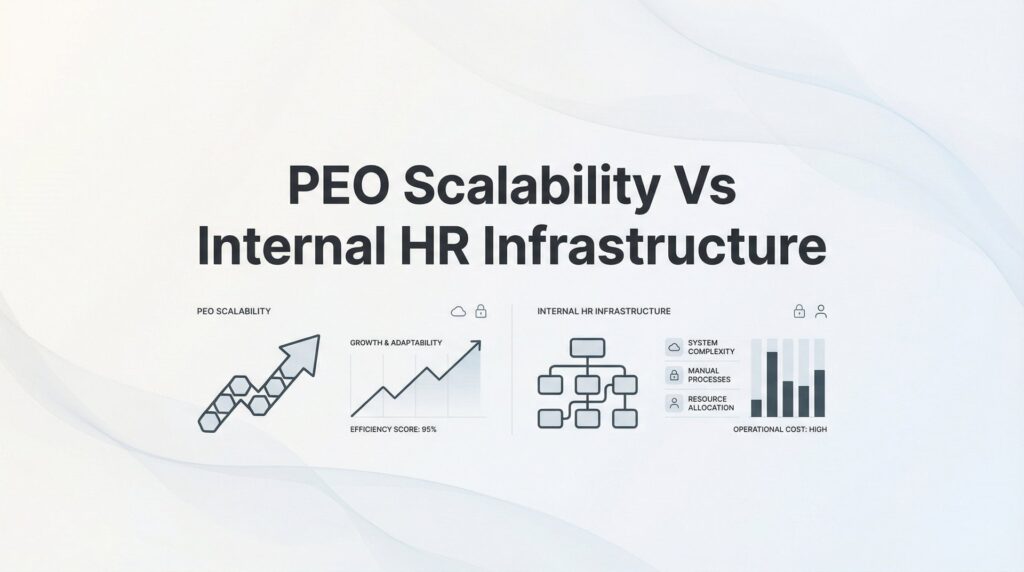
The scalability question isn’t really about PEOs versus internal HR—it’s about matching your infrastructure model to how your business actually grows. Some companies scale linearly, adding headcount at predictable rates. Others grow in bursts through acquisitions or geographic expansion. A few need to scale down as quickly as they scale up. Each pattern demands a different infrastructure approach, and choosing wrong creates friction that compounds over time.
This guide walks through seven practical frameworks for making this decision based on your specific growth trajectory, not generic advice about company size thresholds.
1. Map Your Growth Pattern Before Comparing Models
The Challenge It Solves
Most businesses evaluate PEO scalability versus internal HR based on current headcount—a snapshot metric that tells you almost nothing about which infrastructure model you actually need. A 50-person company growing 10% annually has completely different infrastructure requirements than a 50-person company planning to double through acquisition in six months. The problem is that most decision frameworks ignore growth pattern entirely and focus solely on static size thresholds.
The Strategy Explained
Start by categorizing your growth pattern into one of three types: linear, burst, or volatile. Linear growth means predictable headcount increases—you’re adding 2-3 people per quarter, expanding methodically. Burst growth means irregular jumps—acquisitions, major contract wins, or geographic expansion that adds 20-30 people at once. Volatile growth means significant fluctuation—you’re scaling up and down based on project cycles or seasonal demand.
Each pattern favors different infrastructure. Linear growth can support internal HR build because you have time to develop systems incrementally. Burst growth strongly favors PEO scalability because you need instant infrastructure that works across multiple states without building it yourself. Volatile growth benefits from PEO flexibility because you’re not carrying fixed HR overhead during contraction periods. Companies experiencing rapid expansion often find that PEO solutions for growing companies provide the infrastructure flexibility they need.
Implementation Steps
1. Plot your actual headcount over the past 24 months and project forward 18 months based on your business plan—look for the pattern, not just the trend line.
2. Identify your growth drivers: organic hiring, acquisitions, geographic expansion, or project-based staffing—each driver creates different infrastructure demands.
3. Assess whether your growth is self-funded or investor-backed—funding stage affects how much infrastructure investment makes sense and when transitions should happen.
Pro Tips
Don’t confuse aspirational growth projections with actual growth patterns. If you’ve been growing 15% annually for three years, your infrastructure decision should assume that pattern continues—not the 100% growth rate in your pitch deck. Be honest about volatility too. If your headcount swings by 20% seasonally, that’s a structural characteristic that demands flexible infrastructure.
2. Calculate Your True Infrastructure Switching Costs
The Challenge It Solves
The most expensive infrastructure decision isn’t choosing PEO versus internal HR—it’s building on the wrong foundation and having to switch later. Many businesses underestimate the friction costs of transitioning between models. They see the monthly PEO fee or the HR director salary, but miss the hidden costs of migration: data transfer, system integration, policy rewriting, and the operational disruption during transition periods.
The Strategy Explained
Think of infrastructure switching costs as technical debt. Every month you operate on the wrong model, you accumulate debt that makes transition harder. If you start with internal HR and realize at 75 employees that multi-state compliance is overwhelming, you’re not just paying PEO fees—you’re paying to unwind homegrown systems, migrate employee data, and retrain managers on new processes.
Understanding how to leave a PEO properly can help you plan for these transitions and minimize disruption.
Implementation Steps
1. Estimate the full cost of switching from your current model to the alternative—include technology migration, process documentation, employee communication, and the opportunity cost of leadership attention during transition.
2. Identify your likely trigger points for transition based on headcount, geographic expansion, or funding stage—then calculate whether those triggers are 12 months away or 36 months away.
3. Evaluate whether starting with the “wrong” model for 18 months costs less than the switching costs you’d incur by transitioning mid-growth.
Pro Tips
Switching costs aren’t symmetrical. Moving from PEO to internal HR is generally more expensive than moving from internal to PEO because you’re building infrastructure rather than outsourcing it. If you’re genuinely uncertain about your growth trajectory, starting with PEO scalability and transitioning later often costs less than starting internal and switching to PEO when compliance complexity overwhelms your team.
3. Assess Multi-State and Geographic Complexity Honestly
The Challenge It Solves
Geographic complexity is the single factor that most consistently tips the decision toward PEO scalability. A 40-person company operating in one state can reasonably build internal HR infrastructure. That same 40-person company with employees in seven states faces exponentially more compliance burden—different wage laws, unemployment systems, workers’ comp requirements, and tax filings. Internal HR teams often underestimate this complexity until they’re already drowning in it.
The Strategy Explained
Evaluate your current and planned geographic footprint realistically. If you’re hiring remote workers across multiple states or planning physical expansion, each additional state adds compliance layers that demand specialized knowledge. PEO scalability handles this complexity through existing infrastructure—they’ve already built the multi-state compliance systems you’d need to create from scratch. Businesses operating across state lines often benefit from PEO solutions designed for multi-state operations.
The tipping point isn’t a specific number of states—it’s the ratio of compliance complexity to internal HR capacity. A well-resourced HR team might handle three states effectively. That same team would struggle with eight states while also managing core HR functions like recruiting, onboarding, and performance management.
Implementation Steps
1. Map your current employee distribution by state and identify your planned expansion over the next 18 months—include remote hiring patterns, not just office locations.
2. Research the specific compliance requirements for your top five employee concentration states—look for outliers with unusual wage laws, mandatory benefits, or complex tax structures.
3. Calculate the internal cost of maintaining compliance in each state: payroll tax registration, unemployment filings, workers’ comp policies, and ongoing regulatory monitoring—then compare to PEO per-employee fees.
Pro Tips
California, New York, and Massachusetts are compliance multipliers. If these states represent significant portions of your workforce, the compliance burden justifies PEO scalability even at lower headcounts. Conversely, if you’re concentrated in business-friendly states with simpler regulatory environments, internal HR becomes viable earlier. Geographic concentration matters as much as total headcount.
4. Evaluate Your Tolerance for HR Operational Risk
The Challenge It Solves
HR operational risk isn’t abstract—it’s the cost of compliance failures, misclassified workers, payroll errors, and benefits administration mistakes. Different businesses have vastly different risk tolerance based on their industry, funding stage, and leadership priorities. A venture-backed SaaS company optimizing for growth velocity has different risk tolerance than a bootstrapped services firm where the founder personally guarantees compliance.
The Strategy Explained
Categorize your organization’s risk appetite across three dimensions: compliance risk, operational risk, and reputational risk. Compliance risk is the exposure to fines, penalties, and legal issues from regulatory failures. Operational risk is the probability of payroll errors, benefits mistakes, or HR process breakdowns. Reputational risk is the employee experience damage from HR infrastructure failures.
PEO scalability transfers most compliance risk to the provider through co-employment. They own payroll tax liability, workers’ comp claims, and benefits administration accuracy. Understanding how PEO compliance protection actually works helps you evaluate how much risk transfer you’re actually getting. Internal HR keeps that risk in-house, which gives you control but requires expertise and systems to manage it properly.
Implementation Steps
1. Assess your current HR team’s compliance expertise—do they have deep knowledge of multi-state employment law, or are they generalists learning as they go?
2. Review your past 12 months for HR-related issues: payroll corrections, benefits enrollment errors, compliance near-misses, or employee complaints about HR processes—these indicate your baseline operational risk level.
3. Determine whether your leadership team views HR infrastructure as a strategic capability to build or an operational necessity to outsource—this philosophical stance affects how much risk you’re willing to accept in exchange for control.
Pro Tips
High-growth companies often underestimate how quickly HR operational risk scales. At 30 employees, one HR generalist can manage most issues. At 100 employees across five states, that same generalist is now a bottleneck and a single point of failure. If your growth trajectory is steep, your risk tolerance should favor infrastructure that scales ahead of your headcount, not behind it.
5. Run a Realistic Total Cost Comparison at Multiple Scale Points
The Challenge It Solves
Most cost comparisons between PEO and internal HR are misleading because they compare visible costs (PEO fees) against incomplete internal costs (HR salaries only). This creates the illusion that internal HR is cheaper when it often isn’t. A proper cost comparison captures hidden internal expenses: HRIS systems, payroll software, benefits broker fees, compliance consulting, workers’ comp administration, and the opportunity cost of leadership time spent on HR issues.
The Strategy Explained
Build a total cost model that includes every dollar spent on HR infrastructure, not just the obvious line items. For PEO scalability, this means the per-employee-per-month fee plus any additional services you purchase. For internal HR, this means salaries, benefits, technology, professional services, and allocated overhead for finance team involvement in payroll and benefits administration. Using a structured cost modeling approach for PEO versus internal HR ensures you’re capturing all relevant expenses.
The critical insight is that cost curves cross at different points for different businesses. A company growing from 40 to 80 employees might find PEO costs lower throughout that range. Another company with concentrated geography and simple benefits might see internal HR become cost-effective at 60 employees. Run the model at 50, 75, 100, and 150 employees to identify where the crossover happens for your specific situation.
Implementation Steps
1. Calculate your true internal HR cost by adding: HR staff fully-loaded compensation, HRIS and payroll platform fees, benefits broker commissions, workers’ comp administration, compliance consulting, and 10-15% of finance team time allocated to payroll and benefits support.
2. Get actual PEO quotes at your current headcount and projected headcount at 12 and 24 months—don’t use industry averages, use real pricing for your specific employee distribution and benefits requirements.
3. Model both scenarios at multiple scale points and identify the headcount range where costs converge—this is your decision zone, not a single threshold number.
Pro Tips
Don’t ignore the timing of cost curves. PEO fees scale linearly with headcount—you pay more as you grow, but incrementally. Internal HR requires step-function investments—you hire an HR director at 50 employees whether you’re at 50 or 59. This creates periods where internal HR is temporarily more expensive until you grow into the capacity. Factor these step-functions into your cost modeling.
6. Test Your HR Function Requirements Against PEO Limitations
The Challenge It Solves
PEO scalability works exceptionally well for transactional HR functions: payroll, benefits administration, compliance filings, and workers’ comp. It works less well for strategic HR functions that require deep company-specific knowledge: culture development, performance management system design, compensation philosophy, and talent development programs. The mismatch happens when businesses need strategic HR capabilities but only have PEO infrastructure to deliver them.
The Strategy Explained
Separate your HR function requirements into three categories: transactional (must be accurate and compliant), strategic (must align with company culture and goals), and hybrid (elements of both). Transactional functions like payroll processing and benefits enrollment are ideal PEO candidates. Strategic functions like designing your performance review process or building your employer brand require internal ownership.
The decision framework is about matching functions to the right infrastructure. Many businesses successfully use a PEO alongside their internal HR department for transactional work while building internal HR capacity for strategic functions. This hybrid approach captures PEO efficiency for compliance and administration while maintaining control over culture and talent strategy.
Implementation Steps
1. List every HR function your business currently performs or needs to perform in the next 18 months—include recruiting, onboarding, performance management, compensation planning, benefits design, compliance, payroll, and employee relations.
2. Categorize each function as transactional, strategic, or hybrid based on how much customization and company-specific knowledge it requires—be honest about which functions actually need custom approaches versus which ones work fine with standardized processes.
3. Evaluate whether your current or planned PEO can handle the transactional and hybrid functions adequately—some PEOs offer more customization than others, and some strategic functions can be partially outsourced with internal oversight.
Pro Tips
The biggest PEO limitation isn’t what they can’t do—it’s the lack of context they have about your specific business. A PEO can administer your performance review process, but they can’t design a system that reinforces your unique company values. If strategic HR is genuinely important to your business model, you need internal capability regardless of whether you use a PEO for transactional work.
7. Build a Decision Timeline That Matches Your Funding and Growth Stage
The Challenge It Solves
Infrastructure decisions don’t happen in a vacuum—they happen alongside funding rounds, acquisition plans, and growth milestones. A Series A company optimizing for growth velocity has different infrastructure priorities than a profitable bootstrapped company optimizing for margin. The mistake is making infrastructure decisions based solely on current state without accounting for planned transitions in the next 12-24 months.
The Strategy Explained
Align your infrastructure decisions with your funding and growth stage. Early-stage companies benefit from PEO scalability because it minimizes fixed costs and infrastructure investment during the highest-risk growth period. Later-stage companies often transition to internal HR as they optimize unit economics and build specialized people operations capabilities.
The key is identifying trigger points that should prompt infrastructure reevaluation: closing a significant funding round, planning an acquisition, expanding to new markets, or reaching profitability. Understanding PEO ROI and cost-benefit analysis at each stage helps you make data-driven decisions rather than arbitrary ones. These milestones change your infrastructure requirements and your ability to invest in building versus outsourcing.
Implementation Steps
1. Map your funding and growth milestones over the next 24 months—include planned funding rounds, acquisition targets, geographic expansion, and profitability goals.
2. Identify which milestones materially change your HR infrastructure requirements—a Series B that adds 50 employees in 12 months creates different demands than steady 15% annual growth.
3. Build a decision timeline that evaluates infrastructure fit at each milestone rather than making a single decision today—plan to reassess when triggers hit, not on an arbitrary annual schedule.
Pro Tips
Investor expectations matter more than most founders realize. If you’re venture-backed and optimizing for growth, your investors generally prefer you use PEO scalability and invest capital in product and sales rather than building HR infrastructure. If you’re bootstrapped and optimizing for margin, the calculation shifts toward internal HR earlier because you’re keeping those dollars in the business rather than paying PEO fees.
Making the Decision That Matches Where You’re Actually Headed
Making this decision well means being honest about your growth pattern, your risk tolerance, and your actual HR function requirements—not just your current headcount. Most businesses benefit from starting with PEO scalability and transitioning to internal infrastructure when specific triggers hit: geographic complexity that exceeds PEO capabilities, strategic HR needs that require custom approaches, or cost curves that have clearly crossed.
The framework that matters most is the one that accounts for where you’re actually headed, not where you are today. A 60-person company planning to stay regional and grow methodically has different infrastructure needs than a 60-person company planning to double through acquisition and expand nationally. Use these seven decision frameworks to match your infrastructure model to your specific growth trajectory.
Before you sign that PEO renewal, make sure you’re not leaving money on the table. Many businesses unknowingly overpay because of bundled fees, hidden administrative markups, and contracts designed to limit flexibility. We give you a clear, side-by-side breakdown of pricing, services, and contract terms—so you can see exactly what you’re paying for and choose the option that truly fits your business. Don’t auto-renew. Make an informed, confident decision.
