
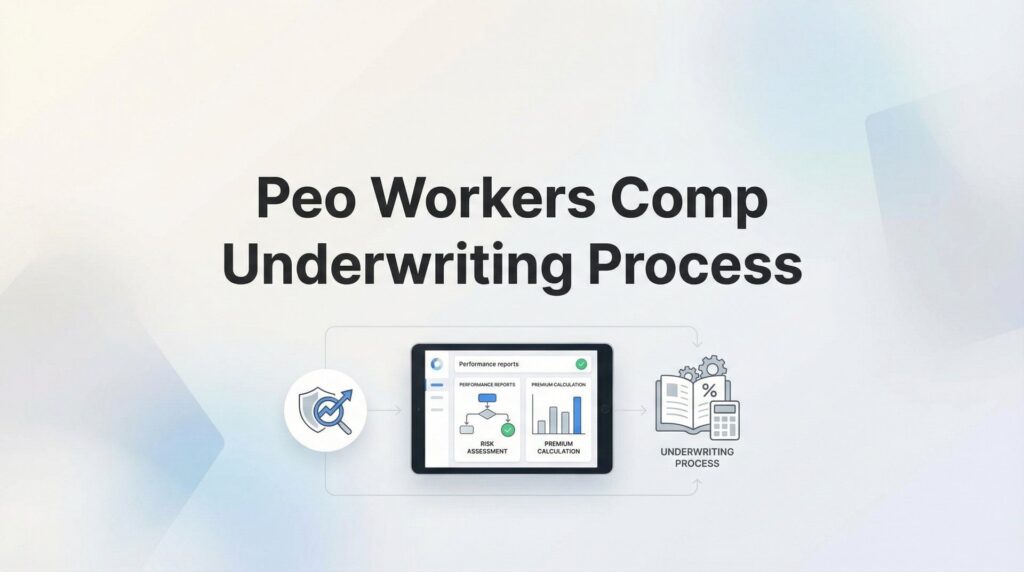
Getting workers comp coverage through a PEO isn’t like buying a standalone policy. The underwriting process is different—sometimes frustratingly so—because you’re joining a master policy alongside dozens or hundreds of other businesses. PEOs evaluate your company through a risk lens that weighs your claims history, industry classification, and operational practices against their entire portfolio. Understanding how this process actually works gives you leverage. You can prepare documentation that addresses underwriter concerns before they become objections, position your business favorably, and avoid the common mistakes that lead to higher rates or outright declinations. This guide walks you through each stage of PEO workers comp underwriting, from initial submission to final rate confirmation, so you know exactly what to expect and how to influence the outcome.
Step 1: Gather Your Loss Runs and Claims History Before You Apply
No PEO will quote you without loss runs. Period. These documents show your workers comp claims history for the past three to five years, and they’re the foundation of the entire underwriting process.
Request them from your current carrier the moment you start exploring PEO options. Don’t wait until you’re ready to submit an application. Carriers are legally required to provide loss runs, but they’re not required to do it quickly. Two to three weeks is typical. Some carriers drag it out longer, especially if you’re leaving them.
What are underwriters actually looking for in your loss runs? Claim frequency matters more than you’d think. A single large claim might be bad luck. Five small claims in two years suggests a pattern—and patterns make underwriters nervous. They’re trying to predict whether you’ll add risk to their master policy pool. Understanding claims frequency analysis helps you anticipate what underwriters will flag.
If you’ve been uninsured or switched carriers frequently, gathering loss runs gets messier. You’ll need to track down every carrier you’ve worked with during the lookback period. Some states maintain databases that can help, but expect this to take longer. If you’ve had coverage gaps, be prepared to explain them. Underwriters will ask.
Here’s what makes loss runs tricky: they’re not standardized. Different carriers format them differently. Some include detailed claim narratives, others just show dollar amounts. Make sure yours show claim status (open or closed), incurred amounts, and dates of injury. Incomplete loss runs will delay your application while the PEO requests clarification.
One more thing—review your loss runs before submitting them. Errors happen. A claim that was closed might still show as open. A claim that shouldn’t be attributed to your business might appear because of a previous owner or entity structure change. Catch these issues early, get them corrected with your carrier, and submit clean documentation.
Step 2: Verify Your NCCI Classification Codes Are Accurate
Your NCCI classification codes determine your base workers comp rate. Get them wrong, and you’ll either overpay dramatically or face a nasty surprise when the PEO’s underwriter corrects them mid-process.
Most businesses assume their current class codes are accurate because their existing carrier assigned them. That’s a mistake. Misclassification is common, and it usually goes unnoticed until you switch coverage or undergo an audit.
Here’s the problem: class codes should reflect actual job duties, not job titles. Your “warehouse manager” might spend 60% of their time on a forklift, which puts them in a higher-risk classification than office management. Your “administrative assistant” who occasionally helps with installations isn’t clerical—they’re doing field work, which carries a different rate.
Audit your classifications before the PEO does. A solid payroll classification strategy ensures you’re not overpaying or setting yourself up for audit surprises. Look at what employees actually do day-to-day. If you have hybrid roles, understand how NCCI handles them. Generally, you classify based on the highest-risk duty performed, even if it’s not the primary responsibility.
Common misclassification scenarios that torpedo PEO applications: clerical staff coded as such but performing warehouse duties, subcontractors treated as employees without proper classification, and seasonal workers lumped into incorrect codes because of payroll system limitations.
When the PEO’s classification differs from your current policy, expect friction. The underwriter will explain why they’re reclassifying certain roles, but you’ll see the rate impact immediately. Sometimes they’re right. Sometimes they’re being overly conservative because they’re worried about audit exposure.
If you disagree with a classification, push back with documentation. NCCI publishes detailed scopes for each code. Show the underwriter how your employees’ duties align with your proposed classification. Job descriptions help. Time studies help more. If 80% of someone’s time is clerical and 20% is light assembly, you can often justify the clerical code—but you need to prove it.
Get this right upfront. Reclassification mid-contract doesn’t just increase your premium—it can trigger retroactive adjustments that blow up your budget.
Step 3: Complete the Underwriting Application With Precision
The underwriting application is where most businesses either strengthen their position or create problems they didn’t need to have. Treat it like a legal document, because functionally, it is.
Underwriters scrutinize three sections more than anything else: payroll breakdown by class code, safety programs, and prior declinations or cancellations. Each one tells them something about your risk profile.
Payroll by class code needs to be exact. Don’t estimate. Don’t round. Use actual payroll data from your most recent fiscal year, broken down by the classifications you’ve already verified. If your payroll fluctuates seasonally, note that. PEOs use this data to calculate your premium, and discrepancies will surface during reconciliation.
Safety programs matter more than most businesses realize. You don’t need an elaborate written manual if you’re a ten-person operation, but you do need something documented. What’s your return-to-work process? How do you onboard new employees on safety protocols? Do you conduct regular safety meetings? Building a safety governance framework demonstrates organizational commitment to risk management.
Prior declinations are a red flag underwriters can’t ignore. If another PEO or carrier declined you in the past year, you need to disclose it—and explain what’s changed since then. Hiding it doesn’t work. Underwriters check industry databases. When they find an undisclosed declination, your application gets rejected immediately.
How do you present high-risk operations without sabotaging your application? Be honest, but frame it with context. If you operate in construction, don’t pretend you’re low-risk. Instead, highlight what you do to manage that risk: subcontractor agreements with insurance requirements, site-specific safety plans, regular equipment inspections.
Documentation that strengthens your application: safety manuals, even basic ones; training records showing new hire orientation and ongoing safety training; return-to-work programs that demonstrate you actively manage claims; and any third-party safety certifications or audits you’ve completed.
What triggers automatic scrutiny or declination? Significant gaps in coverage history. Multiple claims involving the same type of injury. Prior experience modification rates above certain thresholds. Industries the PEO doesn’t cover under their master policy. Any indication of misclassified employees or unreported payroll.
Fill out the application in one sitting if possible, with your payroll records, loss runs, and safety documentation in front of you. Inconsistencies between sections raise questions. If your payroll total doesn’t align with your employee count, the underwriter will ask why. If your safety program description doesn’t match your claims history, they’ll want clarification.
Step 4: Prepare for the Experience Modification Rate Conversation
Your Experience Modification Rate—your EMR—is a numerical representation of your claims history compared to other businesses in your industry. An EMR of 1.0 is average. Below 1.0 is better than average. Above 1.0 signals higher risk.
PEOs care about your EMR because it directly affects pricing, and some have hard cutoffs. A PEO might decline any business with an EMR above 1.25. Another might work with you at 1.5 but impose conditions. There’s no industry standard—it varies by PEO and by your industry.
If your EMR is above 1.0, you need a narrative before the underwriter asks for one. What drove the claims? Were they isolated incidents or systemic issues? More importantly, what’s changed since those claims occurred?
Mitigation strategies that actually work: documented safety improvements with dates and details. If you implemented a new safety training program after a series of claims, show the underwriter the program outline and training logs. Implementing safety incentive programs can demonstrate proactive risk management to underwriters.
Hiring a safety consultant and implementing their recommendations carries weight. So does achieving a reduction in claim frequency over the past 12 months. Underwriters want to see trajectory, not just current state.
When can PEOs offer coverage despite a high EMR? When you’re in an industry they specialize in and they understand your risk profile. When you demonstrate clear, documented improvements. When you agree to conditions—often including more frequent safety audits, mandatory participation in the PEO’s safety programs, or higher upfront deposits.
Here’s something most businesses don’t realize: joining a PEO’s master policy can eventually improve your standalone EMR. Because you’re part of a larger pool, your individual claims get diluted across the master policy’s experience. After a few years of stable performance under the PEO, your EMR can reset lower when calculated independently. This isn’t immediate, and it’s not guaranteed, but it’s a legitimate long-term benefit for businesses rebuilding their risk profile.
If your EMR is elevated, don’t hide from it. Address it directly in your application narrative. Underwriters appreciate transparency and a clear plan more than they appreciate optimistic projections with no supporting evidence.
Step 5: Respond to Underwriter Questions and Site Visit Requests
After you submit your application, expect follow-up questions. It’s rare for an underwriting process to proceed without at least some clarification requests, especially if you’re in a higher-risk industry or have any claims history.
Common follow-up questions: requests for additional detail on specific claims from your loss runs, clarification on employee duties that seem to span multiple classifications, explanation of coverage gaps or carrier changes, and documentation of safety programs you mentioned in your application.
How you answer matters as much as what you answer. Be direct. Don’t volunteer information beyond what’s asked—that’s not dishonesty, it’s discipline. If the underwriter asks about a specific claim, explain what happened and what you did in response. Don’t use that as an opportunity to mention three other claims they haven’t asked about yet.
Site visits happen frequently for manufacturing, construction, and other hands-on industries. The underwriter wants to see your operation firsthand: how you store materials, whether employees use required safety equipment, how you manage high-risk tasks.
Preparing for a site inspection isn’t about staging a performance. It’s about making sure your actual practices align with what you described in your application. If you said you conduct weekly safety meetings, have documentation available. If you mentioned specific equipment safety features, make sure they’re visible and functional.
Walk through your facility before the inspector arrives. Look for obvious hazards: blocked exits, missing guardrails, improperly stored chemicals, equipment without safety labels. Fix what you can immediately. Document what requires longer-term remediation and have a timeline ready to discuss.
Conditional approvals are common when underwriters see potential but also see gaps. They might approve your application contingent on specific safety improvements within 30 or 60 days. This isn’t rejection—it’s negotiation. If the conditions are reasonable and you can meet them, accept the terms and follow through. Understanding the full underwriting risk review process helps you anticipate what conditions might be attached.
Timeline expectations: from complete application submission to final underwriting decision, expect one to three weeks for straightforward cases. Complex situations—multiple locations, high EMR, unusual industry classifications—can take longer. If you’re facing a deadline, communicate that upfront. Some PEOs can expedite if needed, but you need to ask.
Step 6: Review the Final Rate Structure and Coverage Terms
You’ve made it through underwriting. Now comes the rate structure conversation, which is where many businesses realize PEO workers comp pricing works differently than they expected.
PEO workers comp rates aren’t structured like traditional policy pricing. You’re not paying a single annual premium. Instead, you’re typically paying a rate per $100 of payroll, calculated and billed as payroll is processed—usually weekly or biweekly. This is pay-as-you-go workers comp, and it eliminates the large upfront premium and year-end audit surprise that come with traditional policies.
What’s negotiable in a PEO workers comp arrangement? Less than you might hope, but more than nothing. The base workers comp rates themselves are usually non-negotiable—they’re filed with state regulators and tied to your classification codes. But administrative fees, safety program fees, and payment terms often have flexibility.
If you’re a larger employer or in a particularly stable industry, you might negotiate lower administrative fees or waived setup costs. Safety credits exist at some PEOs for businesses with strong safety records or participation in their safety programs. Understanding how PEOs calculate premiums gives you leverage in these negotiations.
Coverage exclusions deserve close attention. Some PEOs carve out certain job classifications they won’t cover under the master policy—often the highest-risk roles. If that happens, you’ll need separate coverage for those employees, which defeats much of the purpose of using a PEO. Make sure you understand exactly which employees are covered and which aren’t before you sign.
Subcontractor treatment varies widely. Some PEOs include your subcontractors under the master policy if they meet certain insurance requirements. Others exclude them entirely. If you use subcontractors regularly, clarify this upfront. Misunderstanding subcontractor coverage creates massive liability exposure.
Comparing quotes across multiple PEOs gets complicated because underwriting criteria vary. One PEO might classify your warehouse workers differently than another, resulting in different base rates. One might require higher safety program participation. Another might offer better terms but have a higher administrative fee that offsets the rate advantage. A comparison of top PEO providers can help you understand how different companies approach these factors.
Build a comparison spreadsheet that breaks down: base workers comp rate by classification, administrative fees (monthly or per-employee), any additional safety or program fees, payment terms and frequency, coverage exclusions or limitations, and contract length and termination terms.
Don’t just compare the total estimated annual cost. Understand what drives that cost and what flexibility you have if your business changes. If you plan to hire significantly or shift your employee mix, how does that affect pricing under each PEO’s structure?
Putting It All Together
The PEO workers comp underwriting process rewards preparation. Businesses that arrive with clean loss runs, accurate classification codes, and documented safety programs move through underwriting faster and secure better rates. Those that scramble to gather documentation or discover classification errors mid-process face delays, higher premiums, or declinations.
Before you start: request loss runs immediately, audit your class codes against actual job duties, and compile your safety documentation. If your EMR is elevated, have a clear narrative about what’s changed. The underwriting process isn’t adversarial—it’s a risk assessment. Your job is to make that assessment as straightforward as possible.
Workers comp is one of the largest line items in a PEO relationship, and small differences in rates or administrative fees compound quickly across your entire payroll. Understanding how underwriting works gives you the leverage to negotiate better terms and avoid the common mistakes that cost businesses thousands in unnecessary premium.
Before you sign that PEO renewal, make sure you’re not leaving money on the table. Many businesses unknowingly overpay because of bundled fees, hidden administrative markups, and contracts designed to limit flexibility. We give you a clear, side-by-side breakdown of pricing, services, and contract terms—so you can see exactly what you’re paying for and choose the option that truly fits your business. Don’t auto-renew. Make an informed, confident decision.
