

If you’re a founder or first HR hire at a seed to Series B tech company, you probably have engineers in more than one state, a benefits package to settle, and nobody who owns HR full time. The real choice is between co-employment through a PEO and payroll software paired with separately sourced benefits. These tools were picked for startup fit: multi-state hiring, benefits access, cash constraints, and global contractors. We also weighed how clearly each one says whether it is a PEO or payroll-only, and how open it is about pricing.
PEO Metrics may receive placement fees from vendors. Vendor details change often, so confirm current pricing, minimums, state coverage, and CPEO status on each official site; the notes below reflect what was verified as of October 2026 only where stated, and otherwise point you to the vendor’s website.
Quick Comparison of the Tools
- PEO Metrics: best for startups deciding between a PEO and a payroll company that want quotes compared before signing; pricing on its website; it compares multiple PEOs on pricing and metrics before you commit to co-employment.
- Justworks: best for small startups wanting an all-in-one PEO; tiered per-employee pricing, see website; publishes plan pricing so you can model costs before talking to sales.
- TriNet: best for funded startups wanting tech-oriented benefits; quote-based; offers industry-tailored plan design for tech employers.
- Rippling: best for engineering-heavy startups wanting HR and IT in one system; modular per-employee pricing, see website; ties onboarding to laptop and app provisioning.
- Gusto: best for lean, single-state startups that want payroll only; tiered base plus per-employee fee, see website; self-serve payroll setup without co-employment.
- Deel: best for startups with international engineers or contractors; per-worker fees, see website; employer of record hiring abroad without a foreign entity.
- Insperity: best for fast-hiring startups with no in-house HR lead; quote-based; assigned HR representatives for hands-on advisory support.
- ADP TotalSource: best for scaling startups wanting a large-brand PEO; quote-based; backed by ADP’s payroll and benefits infrastructure and reporting.
1. PEO Metrics
PEO Metrics is a PEO comparison and consulting service, not a PEO or a payroll provider. It is built for businesses that have not yet decided who to hand employer responsibilities to and want the options laid out with numbers rather than sales pitches.
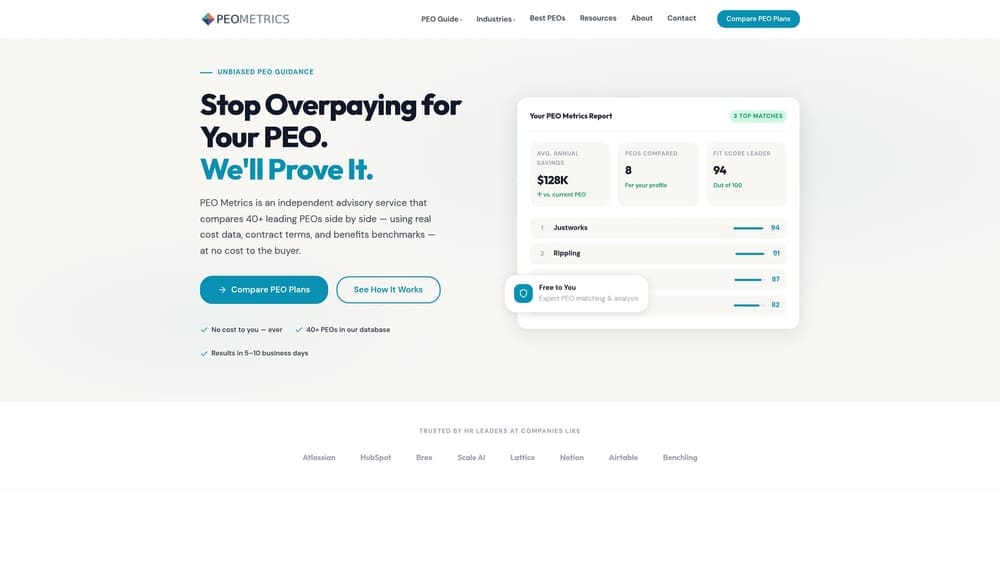
Its distinctive value on this list is sequence. Every other tool here asks you to evaluate it on its own terms. PEO Metrics lets you compare several PEO providers on pricing and metrics before you commit to co-employment, which matters because PEO contracts can carry bundled fees and terms that are hard to judge from a single quote. As noted above, it may receive vendor placement fees, so ask how any recommendation was reached.
- Side-by-side PEO comparison, so you see how providers differ on the same dimensions.
- Pricing analysis that helps you spot bundled fees and administrative markups.
- Detailed provider metrics, giving you more to weigh than a brochure does.
- Consultative guidance on selection, useful when nobody on your team has bought a PEO before.
There is nothing to integrate and little setup: it is an advisory engagement, typically run by the founder or whoever owns the benefits decision. The limits are plain. It does not run payroll or provide benefits, so you still need a provider afterward. And if your team has already settled on payroll-only, it adds little. Pricing details are on the website.
Best for: Startups deciding between a PEO and a payroll company that want quotes compared before signing.
2. Justworks
Justworks is a PEO that bundles payroll, benefits access, compliance support, and workers’ comp for small and growing teams. For a startup with a handful of employees across a few states, it is one of the more straightforward ways to get under a large group benefits plan without hiring an HR lead.
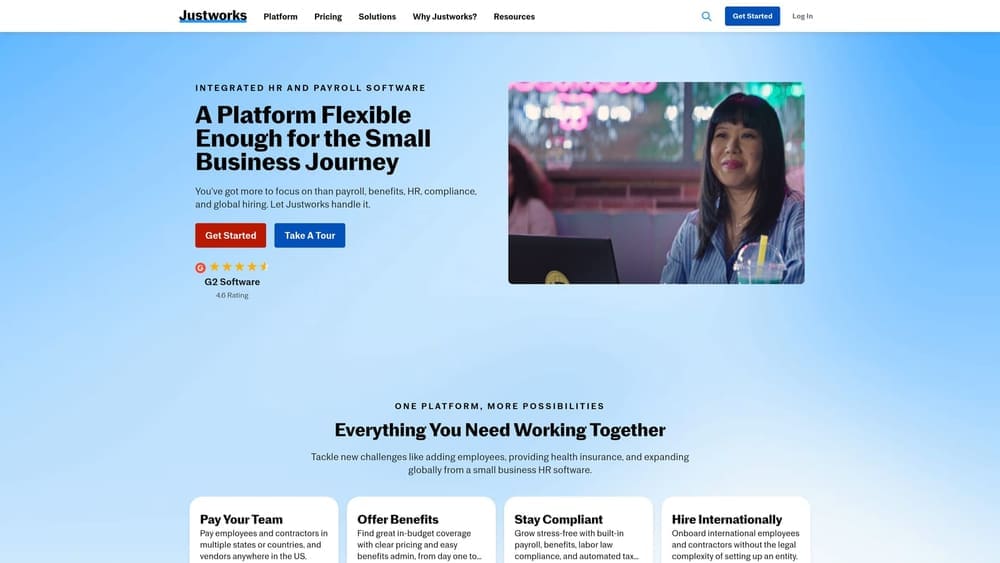
What sets it apart here is pricing visibility. It uses tiered per-employee-per-month plans, and the plan structure is published, so a founder can build a rough cost model before ever speaking to sales. Most PEOs on this list do not allow that.
- Co-employment, so Justworks shares certain employer duties and filings with you.
- Payroll built into the same platform as benefits and onboarding.
- Benefits access through the PEO’s group arrangement, useful when your headcount is too small to get good carrier terms alone.
- Compliance support and workers’ comp coverage without separate vendors.
It connects with accounting and HR tools; check the website for the current list. Setup is typically owned by whoever handles finance or people operations, and onboarding employees is largely self-service.
The trade-offs: it is less suited to larger teams, and if you want to keep your own benefits carriers or broker, a PEO’s pooled plan structure will get in the way. Confirm current tier prices on the site, since they change.
Best for: Small startups wanting an all-in-one PEO with visible pricing.
3. TriNet
TriNet is a PEO with industry-specific offerings, including one aimed at technology companies. It covers payroll, benefits, and HR compliance, and is geared to employers that want a benefits package competitive enough to recruit engineers.
The limitation comes first here: pricing is quote-based and the sales process is heavier than self-serve options like Justworks. Expect a conversation, a quote, and a contract to review, so give yourself time and compare against other quotes.
What it does differently is tailor plan design to tech employers rather than offering one generic package.
- A technology industry offering, so plan options reflect how tech companies hire and compete.
- Benefits plan options that give you choices rather than a single bundled plan.
- Payroll folded into the same service as benefits.
- HR compliance support, which helps when you hire across state lines without an in-house specialist.
Integration details are on the website; ask during the sales process which systems connect to your accounting and HRIS. Day to day, it usually falls to a people-ops or finance owner working with TriNet’s service team. Pricing is quote-based and typically moves with headcount and the benefits you select. Verify any minimums and state coverage directly.
Best for: Funded startups wanting competitive, tech-oriented benefits packages.
4. Rippling
Rippling combines HRIS, payroll, and IT management in one platform, with a PEO option available. It is aimed at companies that want people data, payroll, and device and app control tied together.
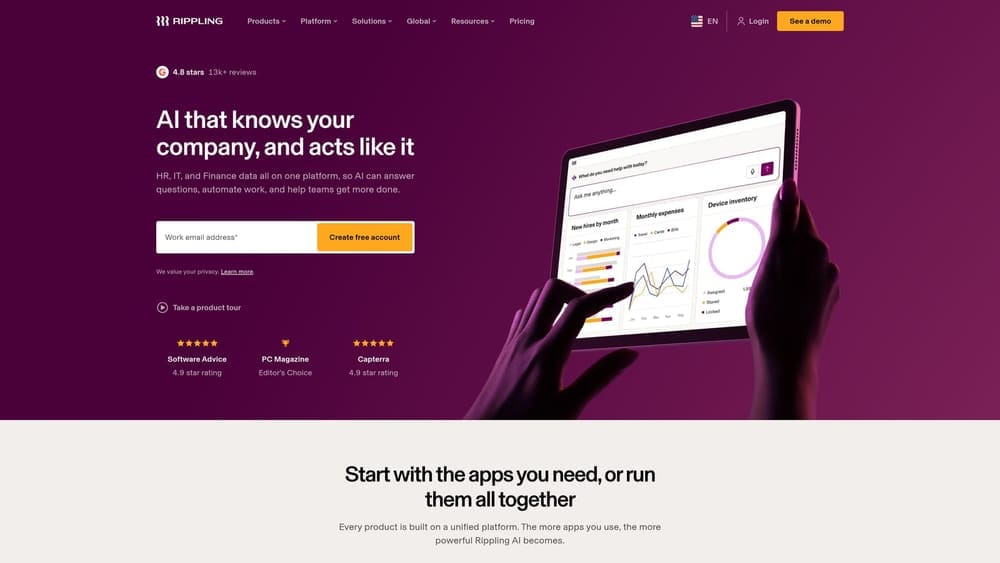
Its edge is the link between HR and IT. When a new engineer is hired, onboarding can drive provisioning of laptops and app access, which no other tool here does as a core feature. That is a real time saver for engineering-heavy teams that otherwise hand this to a founder or an overloaded ops person.
- HRIS that keeps employee records in one place.
- Payroll in the same system as the HR data.
- Device and app management, so access follows hiring and offboarding.
- A PEO option if you want co-employment, rather than being forced into one model.
- Onboarding workflows that trigger tasks across HR and IT.
It has a large app marketplace, so check that your accounting and engineering tools are covered. Setup takes more thought than a payroll-only tool because you are choosing modules, and someone should own the configuration.
The main drawback is pricing: it is modular and per-employee, so cost can climb as you add modules. Get a quote for the full set you expect to use, not just the starting point. Confirm whether the PEO option fits your states and benefits plans.
Best for: Engineering-heavy startups wanting HR and IT in one system.
5. Gusto
Gusto is a payroll-first platform with HR tools and benefits administration. It is not a PEO, which is the point: you stay the sole employer, with no co-employment.
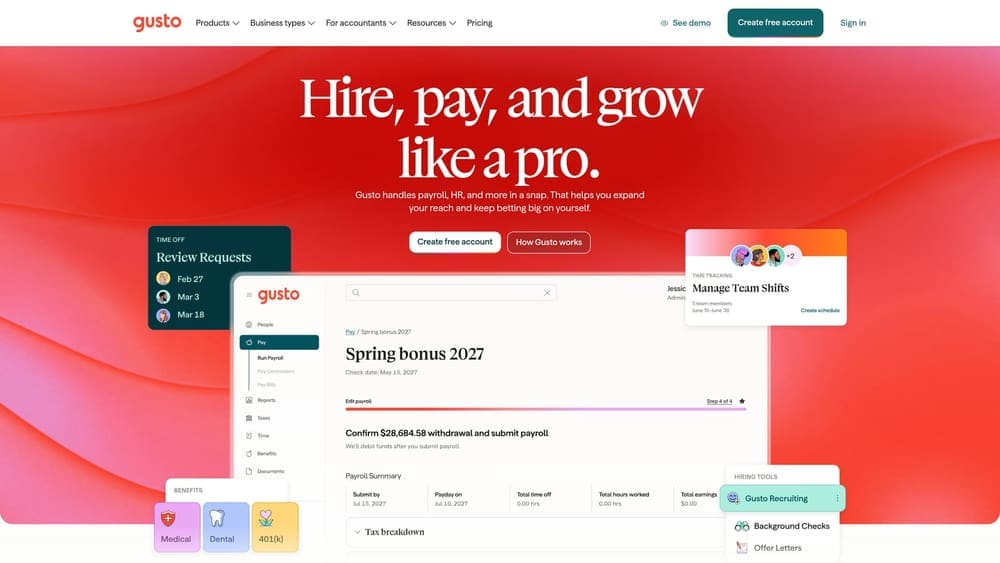
That has consequences. You keep control of your benefits carriers and broker, but you also carry full employer responsibility and must source your own compliance expertise and benefits advice. A payroll company will file payroll taxes and run payroll; it will not take on your employer duties the way a PEO shares them.
Its standout is self-serve setup for very small teams, and it works well when you have a clear picture of your needs.
- Payroll and tax filing handled in the platform, saving manual filings.
- Benefits administration, so you can offer plans you or a broker select.
- Onboarding that collects new hire paperwork digitally.
- Time tracking for hourly or mixed teams.
It integrates with accounting and time-tracking tools; see the website. A founder or office manager can usually run it. Pricing is a tiered base plan plus a per-employee fee, so cost grows with headcount and the tier you choose.
It is a weaker fit if you are hiring in many states and want someone else to absorb compliance work, or if you cannot get good small-group benefits on your own.
Best for: Lean, single-state startups that want payroll-only.
6. Deel
Deel is a global platform for payroll, contractor payments, and employer of record (EOR) services. An EOR is the legal employer in another country, which is different from a PEO: it solves international hiring, not domestic co-employment.
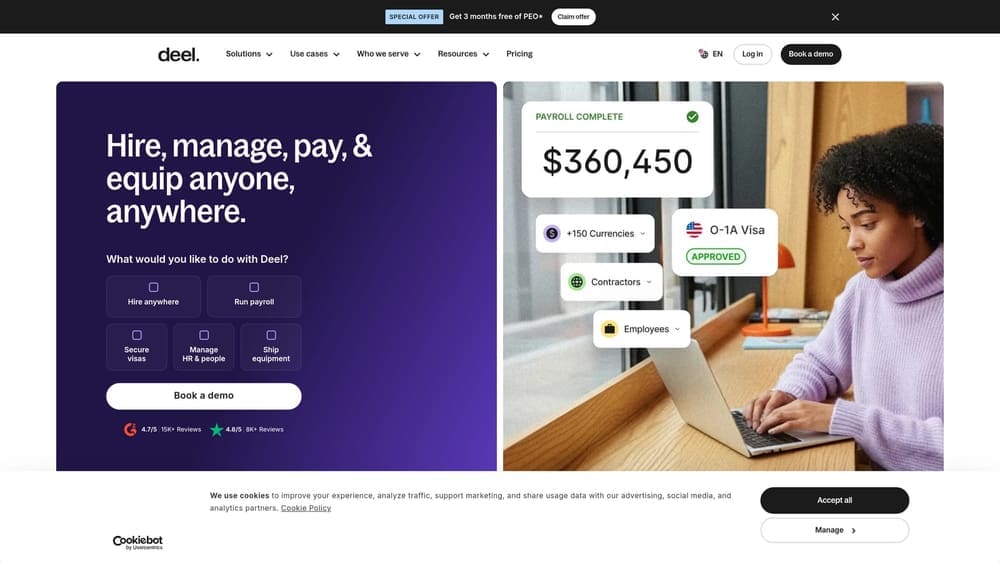
Its distinctive strength is hiring engineers abroad without setting up a foreign entity. The EOR employs them locally and handles local contracts and payroll, while you direct the work.
- Employer of record services, so a worker abroad is employed compliantly in their country.
- Global payroll across multiple countries in one system.
- Contractor payments for paying freelancers internationally.
- Compliance documentation that helps with contracts and local requirements.
It integrates with accounting and HRIS tools; check the website. Setup depends on the countries involved, and someone, often finance or ops, needs to own it. Contractor misclassification remains your risk to manage, so choose EOR for people who work like employees.
The limitation is cost: per-worker EOR fees are generally higher than domestic payroll. It also does not replace a PEO for your US team’s benefits. Pricing is per worker, and varies by service and country, so get a quote for your specific hires.
Best for: Startups with international engineers or contractors.
7. Insperity
Insperity is a large PEO built around a high-touch HR advisory model. It is meant for companies that want a person to call rather than a platform to configure.
Its standout is hands-on support from assigned HR representatives, which suits a startup with no HR lead and a lot of hiring. That support can substitute for an early HR hire.
- Dedicated HR representatives who handle employee relations questions.
- Payroll included with the PEO relationship.
- Benefits offered through the PEO’s arrangement.
- Compliance support that helps as you add employees in new locations.
Integration specifics are on the website, so ask which tools connect to your stack. Setup is typically led by Insperity’s onboarding team with a founder or ops owner as contact.
The caution: it may be more service than a very small team needs, and you are paying for that. Review the contract and exit terms carefully before signing. Pricing is quote-based and generally depends on headcount and the services selected. Verify minimums directly.
Best for: Fast-hiring startups with no in-house HR lead.
8. ADP TotalSource
ADP TotalSource is ADP’s PEO offering, and it is separate from ADP’s payroll-only products. That distinction matters: buying ADP payroll does not put you in co-employment, while TotalSource does.
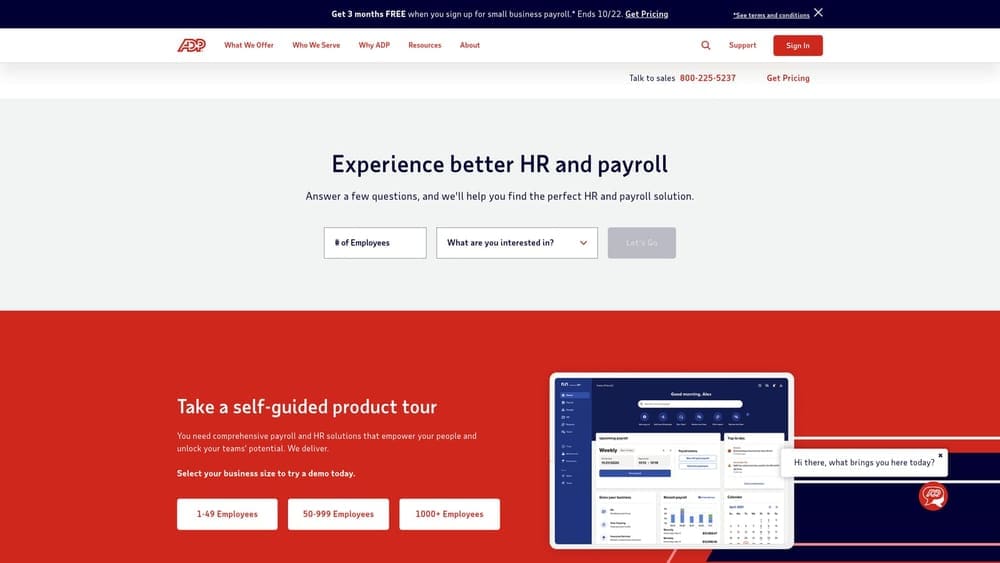
It stands out for the infrastructure behind it. ADP’s scale in payroll and benefits, along with its reporting, gives larger or scaling teams data and stability that smaller vendors may not match.
- PEO co-employment, sharing employer responsibilities with ADP.
- Payroll tied to the PEO service.
- Benefits offered through the PEO’s plans.
- Reporting that gives finance and leadership visibility into workforce costs.
- Compliance support as your state footprint grows.
It works within the ADP ecosystem; ask what connects to your accounting and HR tools. Implementation is typically a guided project with an ops or finance owner.
It is usually better matched to teams with some scale, so confirm eligibility and minimums early. Pricing is quote-based, normally shaped by headcount and plan choices, so compare it against other quotes.
Best for: Scaling startups that want a large-brand PEO.
Matching the Right Model to Your Startup’s Stage
The brand matters less than three facts: how many states your people work in, how ambitious your benefits plans are, and whether anyone owns HR. If you’re undecided, compare first. PEO Metrics puts providers side by side before you commit to co-employment, and our PEO comparison work is the natural starting point. [LINK CHECK: PEO vs payroll guide]
- Payroll-only: Gusto fits a lean, single-state team that already has a benefits broker and can handle compliance.
- PEO: Justworks, TriNet, Insperity, or ADP TotalSource suit startups wanting bundled benefits and compliance support. Rippling is the option if HR and IT in one system matter most.
- EOR: Deel fits engineers abroad. It complements a domestic PEO or payroll tool rather than replacing it.
Keep in mind that PEOs generally do not handle equity administration, and an EOR is not a PEO. Confirm CPEO status on the IRS list if it matters to you.
Before you sign that PEO renewal, make sure you’re not leaving money on the table.
Many businesses unknowingly overpay because of bundled fees, hidden administrative markups, and contracts designed to limit flexibility. We give you a clear, side-by-side breakdown of pricing, services, and contract terms, so you can see exactly what you’re paying for and choose the option that truly fits your business.
