
Cybersecurity firms face a version of the HR problem that most PEO sales reps aren’t fully prepared for. You’re competing for talent in one of the tightest hiring markets in tech, often managing employees across multiple states, and sometimes dealing with compliance requirements that touch clearance documentation, federal contractor standards, or sensitive data handling. A PEO can absorb a lot of that operational weight — but only if it’s the right fit for your environment.
Not every PEO on this list is built the same way. Some are better for fast-growing startups that need clean self-service and transparent pricing. Others bring deep compliance infrastructure that matters more for firms with government-adjacent work. And one isn’t a PEO at all — it’s where you should start before you talk to any of them.
Here are the top PEO providers worth evaluating if you’re running a cybersecurity company.
1. PEO Metrics
Best for: Cybersecurity companies still in the evaluation stage before committing to a PEO provider
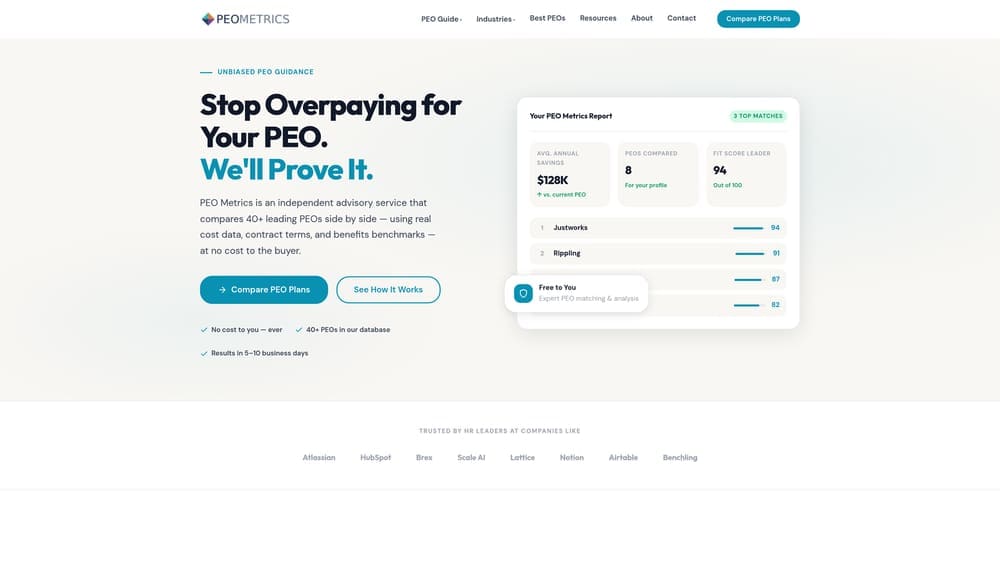
PEO Metrics is an independent PEO comparison and advisory service — not a PEO itself — that helps businesses evaluate providers side-by-side before signing anything.
Where This Tool Shines
Most cybersecurity companies make their most expensive PEO mistakes during the selection process, not after. Bundled fees, percentage-of-payroll structures on high-salary tech workforces, and contracts with limited flexibility can cost you significantly over a multi-year term. PEO Metrics exists to surface those differences before you’re locked in.
The value is particularly relevant for cybersecurity firms because your per-employee costs are likely high. A PEO charging a percentage of payroll looks very different at $90K average salaries than it does at $45K. Getting a structured, side-by-side comparison of pricing models and contract terms before you engage any provider’s sales team is a meaningful advantage.
Key Features
Side-by-Side Provider Comparisons: Detailed comparisons across multiple PEO providers with standardized metrics — not marketing copy.
Unbiased Guidance: Not tied to any single PEO provider, so recommendations reflect your actual needs rather than referral incentives.
Pricing Analysis: Helps identify where you might be overpaying, including hidden administrative markups and fee structures that compound at scale.
Tailored Recommendations: Matching is based on company size, industry, compliance needs, and workforce structure — not a generic checklist.
Pre-Negotiation Clarity: Gives you informed footing before any provider puts a contract in front of you.
Best For
Any cybersecurity company that hasn’t yet signed with a PEO, is approaching a renewal decision, or wants to pressure-test whether their current provider is actually competitive. This is the right starting point before engaging any of the providers listed below.
Pricing
Consultation-based. Contact PEO Metrics directly for details. Given what you’d spend on a PEO over a multi-year contract, the upfront advisory investment tends to pay for itself quickly.
2. Justworks
Best for: Tech-forward cybersecurity startups that want transparent pricing and a clean self-service experience
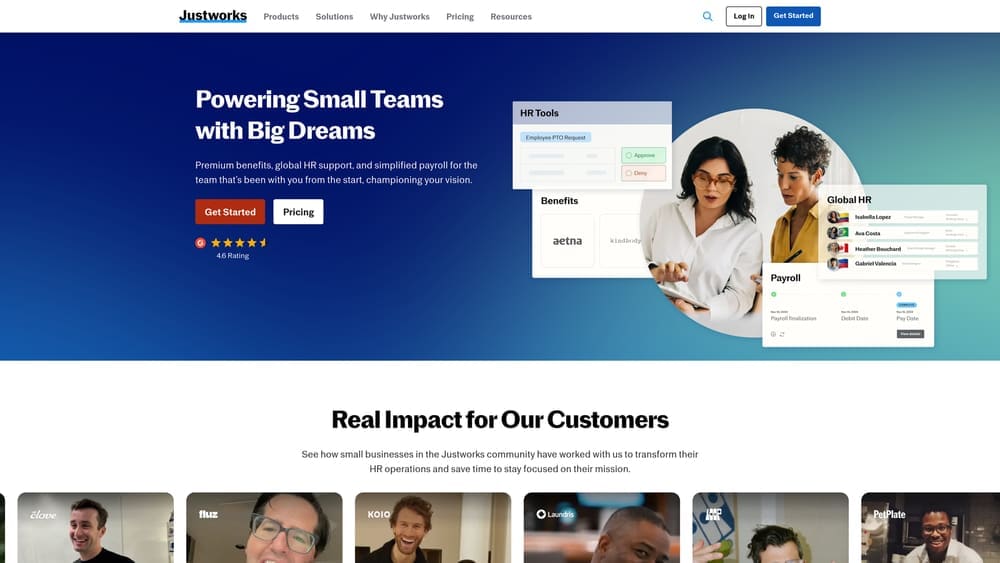
Justworks is a modern PEO platform built around flat per-employee pricing and an intuitive interface — one of the few PEOs that publishes its pricing publicly.
Where This Tool Shines
For cybersecurity companies with higher-than-average salaries, the pricing model matters a lot. Justworks charges a flat per-employee monthly fee rather than a percentage of payroll, which means your PEO costs don’t scale with your compensation levels. That’s a real structural advantage when your engineers are earning well above market average.
The platform is also genuinely easy to use. HR admins and employees both get a clean self-service experience, which reduces the friction that typically comes with onboarding distributed technical teams. ESAC and IRS certification adds a layer of credibility for companies that need to demonstrate due diligence in their vendor relationships.
Key Features
Flat Per-Employee Pricing: Publicly listed and predictable — rare in the PEO industry and valuable for high-salary workforces.
ESAC and IRS-Certified: Meets the certification standards that signal financial stability and compliance rigor.
Strong Benefits Access: Medical, dental, and vision coverage through large-group purchasing power competitive with what larger companies offer.
Clean Admin Interface: Intuitive for both HR admins and employees, reducing onboarding friction for distributed teams.
Multi-State Compliance Support: Handles payroll and compliance across multiple states — relevant for cybersecurity firms hiring remotely.
Best For
Cybersecurity startups and growth-stage companies with 10–150 employees that want transparent pricing, solid benefits, and a platform their technical team won’t resist using. Less ideal for companies that need deep enterprise-grade customization or attorney-backed HR compliance support.
Pricing
Starts around $59–$99 per employee per month depending on plan and headcount. Pricing is publicly listed on their website, which makes budgeting straightforward.
3. TriNet
Best for: Cybersecurity companies that want a PEO with an established technology industry vertical and strong multi-state infrastructure
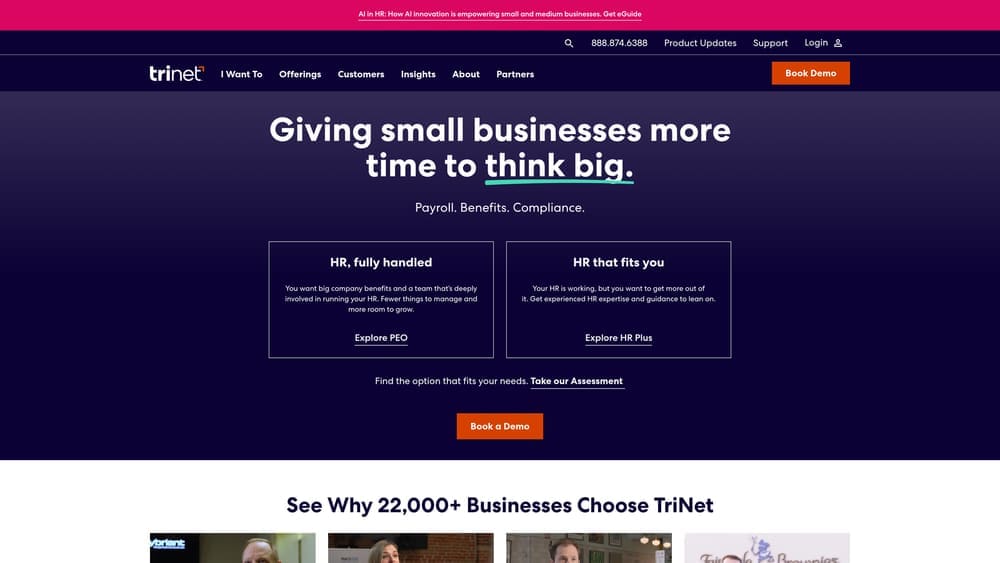
TriNet is a large PEO with a dedicated technology vertical, serving many tech and software companies with industry-specific HR guidance and multi-state compliance support.
Where This Tool Shines
TriNet’s technology vertical is a genuine differentiator. Most PEOs treat all industries roughly the same. TriNet has built HR frameworks and benefits structures specifically around tech company needs, which means the HR guidance you receive is more likely to reflect the realities of hiring software engineers and security professionals than advice from a generalist provider.
Multi-state compliance is another area where TriNet performs well. Cybersecurity companies frequently hire across state lines, and managing state-specific tax registration, wage law compliance, and benefits portability gets complicated fast. TriNet’s infrastructure handles that complexity at scale. One honest tradeoff worth noting: some customers report that service responsiveness can vary as account size grows — something to ask about directly during your evaluation.
Key Features
Technology Industry Vertical: Dedicated HR guidance and resources built around tech company workforce dynamics.
Multi-State Payroll Compliance: Strong infrastructure for companies hiring remotely across multiple states.
Competitive Benefits Packages: Group purchasing power that makes competitive health and retirement benefits accessible at smaller company sizes.
Industry-Specific HR Support: HR team knowledge extends into tech-relevant employment scenarios, not just generic HR administration.
Reporting and Analytics: Robust platform for workforce data and HR reporting, useful for companies that need visibility into headcount costs.
Best For
Cybersecurity companies in the 20–500 employee range that prioritize industry-specific HR support and have distributed teams across multiple states. Larger firms should evaluate service model carefully before committing.
Pricing
Custom pricing — typically structured as a percentage of payroll or per-employee fee. Contact TriNet directly for a quote. Not the most transparent pricing model, which is worth factoring in for high-salary teams.
4. ADP TotalSource
Best for: Established cybersecurity companies that need enterprise-grade HR infrastructure and deep compliance documentation
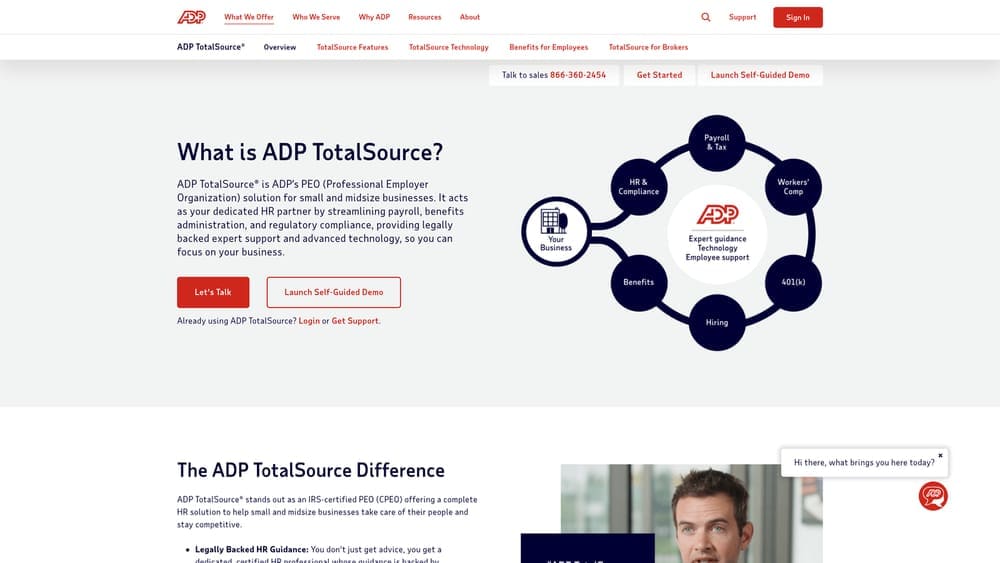
ADP TotalSource is one of the largest PEOs in the US, offering broad compliance support, extensive integrations, and a dedicated HR business partner model for mid-market companies.
Where This Tool Shines
ADP TotalSource makes the most sense for cybersecurity companies that have grown past the startup phase and need enterprise-grade HR infrastructure. The compliance documentation depth, workers’ comp administration, and risk management capabilities are more developed here than at most PEOs. For firms with government-adjacent work or audit exposure, that documentation rigor has real value.
The integration layer is also worth noting. ADP TotalSource connects with a wide range of HRIS, payroll, and business tools — which matters if you’ve already built out a tech stack and need your HR platform to fit into it rather than replace it. The dedicated HR business partner model provides a consistent point of contact rather than a rotating support queue.
Key Features
ESAC and IRS-Certified: Strong compliance credentials with thorough documentation practices.
Wide Integration Capabilities: Connects with major HRIS, payroll, and business systems to fit into existing tech stacks.
Dedicated HR Business Partner: Assigned HR contact rather than general support, providing more continuity.
Risk Management and Workers’ Comp: Robust administration for companies that need thorough risk documentation.
Scalable Structure: Handles growth from small business to mid-market without requiring a platform change.
Best For
Cybersecurity companies with 50+ employees that have complex HR needs, existing systems to integrate, and a need for enterprise-grade compliance documentation. Less ideal for cost-sensitive startups — ADP TotalSource typically sits at the higher end of the pricing spectrum.
Pricing
Custom pricing — contact ADP for a quote. Generally positioned at the higher end of the market. Worth comparing carefully against alternatives using a service like PEO Metrics before committing.
5. Rippling
Best for: Cybersecurity companies that want HR and IT management unified in a single platform
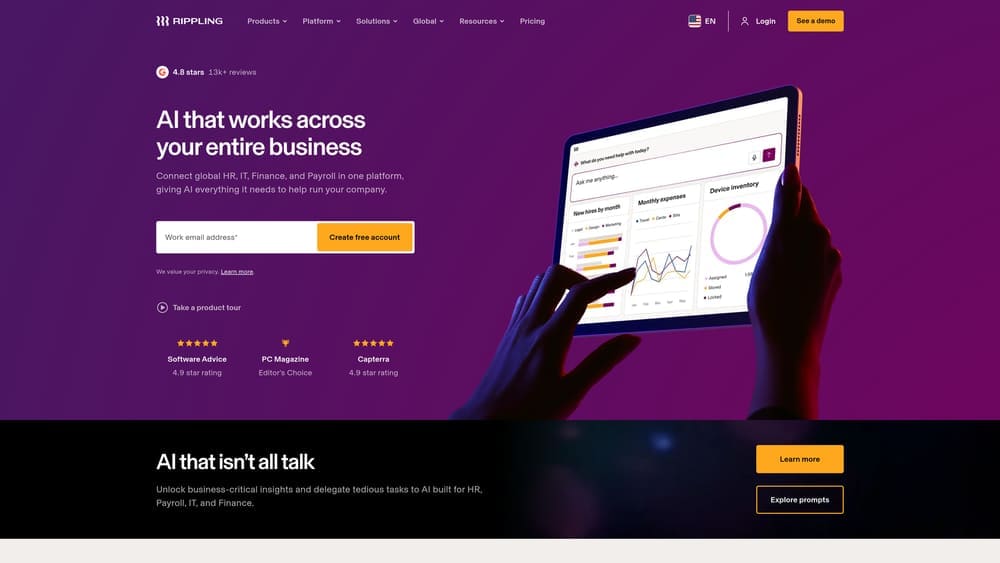
Rippling is a workforce management platform with PEO capabilities that uniquely combines HR, payroll, and IT management — including device provisioning and software access control — in one system.
Where This Tool Shines
Rippling’s differentiator is the IT layer, and for cybersecurity companies specifically, this is worth paying attention to. Controlling device access, managing software provisioning, and revoking system access during offboarding are security-critical workflows. Most PEOs treat these as entirely separate from HR. Rippling treats them as part of the same operational system.
For a cybersecurity firm, that integration isn’t just convenient — it reduces the gap between HR processes and security protocols. Automated offboarding that simultaneously processes payroll termination and revokes application access is a meaningfully different capability than what traditional PEOs offer. If your security team is already frustrated by the lag between HR actions and IT access changes, Rippling addresses that directly.
Key Features
Native IT Management: Device provisioning, software access control, and endpoint management within the same platform as HR and payroll.
Automated Onboarding and Offboarding: Access provisioning and revocation tied directly to employment status changes.
PEO and EOR Options: Flexible co-employment structures including employer of record for international or contractor scenarios.
500+ App Integrations: Connects with a broad range of business tools across HR, finance, and operations.
Workflow Automation: Reduces manual HR tasks through configurable automated workflows across the employee lifecycle.
Best For
Cybersecurity companies where the HR-IT boundary is a real operational friction point. Particularly valuable for firms with strict access control requirements, distributed remote teams, or security teams that want tighter integration between people operations and system access management.
Pricing
Modular pricing starting around $8 per employee per month for the base platform. PEO pricing varies and requires a direct quote. Total cost depends heavily on which modules you enable.
6. Insperity
Best for: Smaller cybersecurity companies that need enterprise-quality benefits to compete for talent
Insperity is a full-service PEO known for rich benefits administration and a high-touch service model that helps smaller companies offer benefits packages competitive with much larger employers.
Where This Tool Shines
In cybersecurity, benefits quality is a hiring lever. You’re competing against large enterprises and well-funded tech companies for a limited pool of qualified candidates. Insperity’s access to large-group health insurance plans gives smaller firms benefits options they couldn’t access independently — which matters when a candidate is comparing your offer against one from a Fortune 500 company.
The white-glove service model is a genuine differentiator for HR teams that are lean or stretched. Insperity assigns dedicated HR specialists rather than routing you through a general support queue. For a cybersecurity company where the HR function is often one or two people managing complex employment scenarios, that dedicated support relationship has real operational value.
Key Features
Large-Group Health Insurance Access: Competitive medical, dental, and vision coverage at rates typically available only to much larger employers.
Dedicated HR Specialist: Assigned HR support rather than general queue-based service.
Comprehensive Benefits Suite: Medical, dental, vision, 401(k), and supplemental benefits in one administration platform.
Performance Management Tools: Built-in tools for performance reviews, goal tracking, and employee development.
Workforce Optimization Consulting: HR advisory that goes beyond basic administration into organizational effectiveness.
Best For
Cybersecurity companies with 10–150 employees that prioritize benefits quality and want hands-on HR support. Not the best fit for cost-sensitive companies — Insperity’s pricing generally runs above market average, and the value equation depends on how much you weight benefits competitiveness and service quality.
Pricing
Custom pricing — generally higher than market average. Best evaluated when benefits quality and dedicated HR support are primary priorities, not when cost minimization is the main driver.
7. Oasis (a Paychex Company)
Best for: Mid-market cybersecurity companies that want reliable payroll infrastructure and solid compliance support without the enterprise price tag
Oasis is a mid-market PEO backed by Paychex’s payroll infrastructure, offering dependable co-employment services with the compliance depth of a major payroll provider.
Where This Tool Shines
Oasis benefits from Paychex’s underlying payroll infrastructure — one of the most established in the industry. For cybersecurity companies that have had payroll reliability issues with smaller providers or need consistent multi-state tax compliance without a lot of customization overhead, Oasis delivers solid fundamentals.
It’s not the most tech-forward platform on this list. If you’re comparing it to Rippling or Justworks on UI and automation, Oasis will feel more traditional. But reliability and compliance depth matter for companies with complex multi-state payroll needs, and Paychex’s infrastructure provides both. It occupies a mid-market position that works well for companies that have outgrown startup-tier PEOs but don’t need enterprise-level complexity.
Key Features
Paychex Payroll Infrastructure: Backed by one of the most established payroll processing platforms in the US for reliability and compliance accuracy.
Full Co-Employment Structure: Complete PEO co-employment model with employer liability sharing.
Multi-State Payroll Compliance: State-specific tax administration and compliance handling for distributed workforces.
Benefits Administration: Health, retirement, and supplemental benefits with group purchasing access.
Dedicated Service Teams: HR support with assigned service contacts rather than anonymous queue-based support.
Best For
Cybersecurity companies in the 25–300 employee range that prioritize payroll reliability and multi-state compliance over platform innovation. A reasonable mid-market option when the flashier platforms feel like more than you need.
Pricing
Custom pricing — contact for a quote. Mid-market positioning generally means more competitive than enterprise-tier PEOs like ADP TotalSource.
8. Engage PEO
Best for: Cybersecurity firms with significant regulatory exposure or government-adjacent work that need attorney-backed HR compliance support
Engage PEO is a boutique PEO with in-house employment attorneys providing compliance guidance — a meaningful differentiator for cybersecurity companies navigating complex employment law or regulatory environments.
Where This Tool Shines
Most PEOs handle compliance through HR generalists. Engage PEO has in-house employment attorneys on staff. For a cybersecurity firm doing government-adjacent work, handling clearance-related employment situations, or managing complex multi-state employment law exposure, that distinction matters. You’re not getting HR guidance filtered through a generalist — you’re getting it informed by actual legal expertise.
The boutique service model also means more personalized attention than you’d typically get from a large PEO. Each client gets a dedicated HR professional, and the firm’s smaller scale means your account isn’t lost in a queue. The tradeoff is that Engage PEO has less name recognition and a smaller platform footprint than the majors — which may matter if you need extensive integrations or advanced reporting.
Key Features
In-House Employment Attorneys: Compliance guidance backed by legal expertise, not just HR generalists — a genuine differentiator for complex regulatory environments.
Dedicated HR Professional: Each client has an assigned HR contact for consistent, relationship-based support.
Multi-State Employment Law Support: Handles cross-state employment complexity with legal-grade compliance oversight.
Strong HR Compliance Infrastructure: Built for companies with complex employment situations, not just standard HR administration.
Boutique Service Model: More personalized attention and responsiveness than large-scale PEO providers typically offer.
Best For
Cybersecurity companies with regulatory complexity, government contractor exposure, or employment situations that regularly touch legal gray areas. Also a strong fit for firms that have had frustrating experiences with the impersonal service models of larger PEOs.
Pricing
Custom pricing — contact for a quote. Boutique pricing typically reflects the higher-touch service model, so expect costs above the mid-market average. Evaluate against the value of attorney-backed compliance support for your specific situation.
Matching the Right PEO to Your Cybersecurity Company
There’s no single right answer here. The best PEO for your firm depends on where you are in your growth stage, what your biggest operational pain points actually are, and how much regulatory complexity you’re managing.
A few quick-reference patterns that tend to hold up in practice:
Prioritizing pricing transparency and startup-friendly structure: Justworks is the clearest option. Flat per-employee pricing and public rate cards make budgeting straightforward for high-salary tech teams.
Need HR and IT management unified: Rippling is the only provider on this list that genuinely integrates both. For cybersecurity firms where access control during onboarding and offboarding is a security concern, that’s a real operational advantage.
Competing for talent with enterprise-quality benefits: Insperity’s large-group health plan access is hard to match at smaller company sizes. If benefits competitiveness is your primary hiring lever, it’s worth the premium.
Government-adjacent work or regulatory complexity: Engage PEO’s in-house attorney model is the most relevant option here. TriNet and ADP TotalSource also bring strong compliance infrastructure for firms that need documentation depth.
Established mid-market company needing enterprise infrastructure: ADP TotalSource scales well and integrates broadly. Best for companies that have outgrown startup-tier PEOs and need a platform that fits into an existing tech stack.
One thing worth flagging before you engage any provider: cybersecurity companies with high average salaries need to pay close attention to fee structures. A percentage-of-payroll pricing model compounds quickly when your average employee earns well above market. That’s one of the more common places cybersecurity firms overpay without realizing it.
Before you sign that PEO renewal, make sure you’re not leaving money on the table. Many businesses unknowingly overpay because of bundled fees, hidden administrative markups, and contracts designed to limit flexibility. Don’t auto-renew. Make an informed, confident decision.
Before you sign that PEO renewal, make sure you’re not leaving money on the table.
Many businesses unknowingly overpay because of bundled fees, hidden administrative markups, and contracts designed to limit flexibility. We give you a clear, side-by-side breakdown of pricing, services, and contract terms—so you can see exactly what you’re paying for and choose the option that truly fits your business.
