
Restoration work sits in a category of its own when it comes to workforce complexity. You’re managing rapid headcount swings after disaster events, navigating multiple NCCI class codes across demolition, hazmat, and remediation work, staying ahead of OSHA standards for confined spaces and respiratory protection, and often deploying crews across state lines with different workers’ comp jurisdictions. That’s a lot for any HR team to handle — and most don’t have a dedicated one.
Not every PEO is built for this. Many are designed for office-based employers or light-touch industries where workers’ comp is an afterthought. For restoration companies, picking the wrong PEO can mean misclassified workers, inflated mod rates, or a contract that locks you in when you need flexibility most.
The tools below are evaluated on what actually matters for restoration: workers’ comp expertise across relevant class codes, ability to handle volatile headcounts, safety program support, multi-state capabilities, and transparent pricing. If you want to compare providers side-by-side before committing, PEO Metrics offers an unbiased comparison service built for exactly this kind of evaluation. For a broader look at PEO options in the trades, see the PEO for construction guide.
1. PEO Metrics
Best for: Restoration companies that want unbiased, side-by-side PEO comparisons before signing anything.
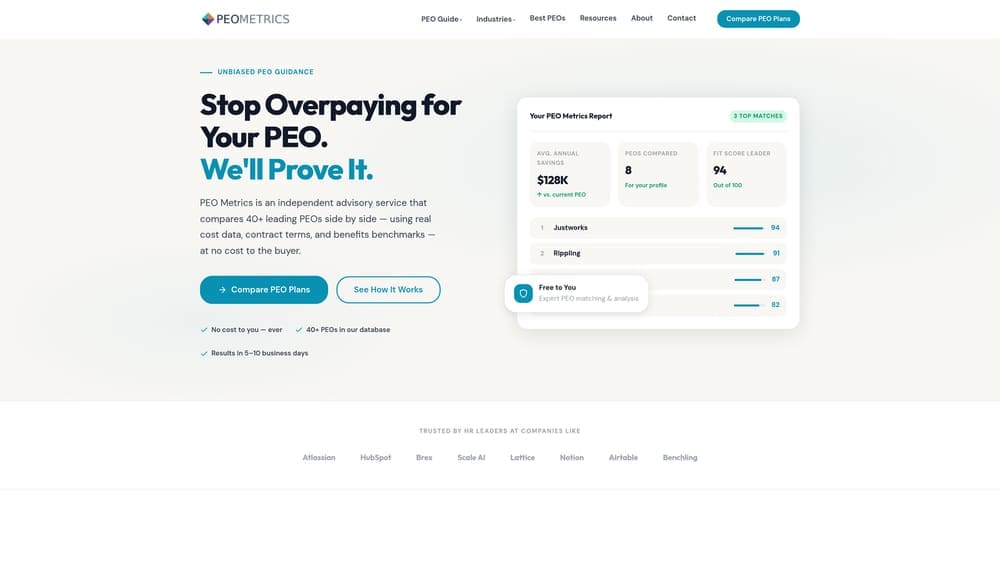
PEO Metrics is an independent comparison platform that helps restoration businesses evaluate multiple PEO providers using real pricing, coverage, and service data — without being steered toward one provider.
Where This Tool Shines
The core value here is independence. PEO Metrics isn’t affiliated with any single PEO, which means the comparisons aren’t shaped by referral incentives or preferred-provider arrangements. For restoration companies navigating a confusing market full of bundled fees and opaque contract terms, that objectivity matters.
The platform is particularly useful if you’re not sure which PEO can actually handle your risk profile. High experience modification rates, difficult-to-place class codes like asbestos abatement or demolition, and multi-state deployment requirements all narrow the field considerably. PEO Metrics helps you filter for providers that can realistically serve your business rather than wasting time on discovery calls with providers who’ll decline your account anyway.
Key Features
Side-by-Side Provider Comparisons: Granular pricing breakdowns across multiple PEOs so you can see exactly what you’re paying for at each provider.
Industry-Specific Filtering: Filter for high-risk trades and restoration-relevant criteria, not just general SMB categories.
Workers’ Comp Rate Comparisons: Compare workers’ comp rates across providers — critical for restoration companies where comp costs can make or break a PEO arrangement.
No Provider Affiliation: Completely unbiased; the platform doesn’t earn commissions from PEO placements.
Free Consultation: Access to a free consultation for businesses actively evaluating PEO options.
Best For
Any restoration company that’s about to sign or renew a PEO contract without having compared alternatives. Especially useful for businesses with elevated mod rates or complex class code situations who need to know which providers will actually take their account — and at what cost.
Pricing
Free comparison service. No cost to the employer. The value is in the time and money saved by not signing the wrong contract.
2. Insperity
Best for: Mid-size restoration companies scaling operations and needing serious risk management infrastructure.
Insperity is a full-service PEO with a strong reputation for risk consulting and safety program development — two things that matter enormously in restoration work.

Where This Tool Shines
Insperity’s risk management team goes beyond basic workers’ comp administration. They offer actual safety program development and workplace safety consulting, which translates directly into lower incident rates and, over time, lower mod rates. For a restoration company doing mold remediation, demolition, or asbestos work, that kind of hands-on safety support is worth real money.
Their HR advisory services also stand out for companies in growth mode. If you’re scaling from a regional operator to a multi-state franchise footprint, having dedicated HR professionals who understand compliance across jurisdictions is genuinely useful rather than just a checkbox feature.
Key Features
Dedicated Risk Management Specialists: Actual safety consultants, not just a compliance checklist, who can help build OSHA-aligned safety programs for field crews.
HR Advisory Services: Performance management, employee relations, and HR guidance from professionals assigned to your account.
Comprehensive Benefits: Competitive health insurance, 401(k), and ancillary benefits that help attract IICRC-certified technicians in a tight labor market.
Multi-State Compliance Support: Strong infrastructure for employers operating across state lines with different employment law requirements.
Best For
Restoration companies in the 50-500 employee range that are growing, have complex compliance needs, and want a PEO that brings real safety expertise rather than just payroll processing. Less suited for very small operators or companies in the early startup phase.
Pricing
Custom pricing. Insperity typically works best with companies in the 50-5,000 employee range. Expect a thorough underwriting process given the risk profile of restoration work.
3. ADP TotalSource
Best for: Restoration companies operating across multiple states that need enterprise-grade payroll and workers’ comp infrastructure.
ADP TotalSource is the PEO arm of ADP, offering multi-state payroll automation and a large carrier network for workers’ comp placement.
Where This Tool Shines
Multi-state compliance is where ADP TotalSource earns its place on this list. When your crew deploys from Florida to Texas to North Carolina after a hurricane season, you’re dealing with different state tax withholding rules, different workers’ comp jurisdictions, and different employment law requirements simultaneously. ADP’s payroll infrastructure handles that complexity at scale without the manual overhead that breaks smaller PEOs.
The carrier network for workers’ comp is also a real differentiator. Restoration companies with difficult class codes sometimes struggle to get placed at reasonable rates. A larger carrier network means more options and more negotiating leverage on your behalf.
Key Features
Multi-State Payroll Automation: Tax compliance, withholding, and filing across multiple states handled automatically.
Large Workers’ Comp Carrier Network: Access to multiple carriers improves placement options for high-risk or difficult-to-classify restoration work.
Mobile Field Tools: Mobile app for time tracking and pay stub access, useful for field crews who aren’t sitting at a desk.
ADP Ecosystem Integration: Connects with ADP’s broader HR technology suite for businesses already using ADP products.
Best For
Mid-to-large restoration operators, particularly franchise-affiliated companies like SERVPRO or ServiceMaster franchisees, that regularly deploy crews across state lines and need payroll infrastructure that won’t break under that complexity.
Pricing
Custom pricing based on headcount and services selected. Generally requires minimum employee counts — not the best fit for very small operators under 10 employees.
4. Paychex PEO
Best for: Restoration companies with significant seasonal headcount swings that need a PEO that can flex up and down.
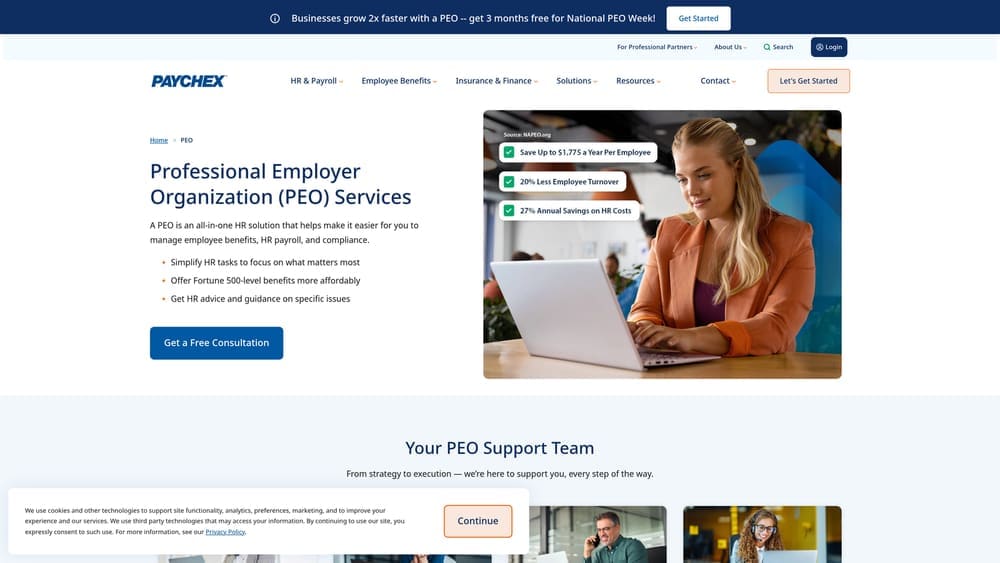
Paychex PEO offers scalable service tiers and flexible workers’ comp administration, making it a practical fit for the unpredictable staffing cycles common in disaster response work.
Where This Tool Shines
The headcount flexibility is the real story here. Most PEOs are designed for steady-state employers. Restoration companies aren’t steady-state — you might go from 20 employees to 80 in two weeks after a major weather event, then scale back down. Paychex has service structures that accommodate that kind of movement without penalizing you for it.
Pay-as-you-go workers’ comp is another meaningful feature. Rather than paying a large upfront premium based on estimated payroll, you pay as actual wages are processed. For a business where payroll can spike dramatically during surge periods, this smooths out cash flow and reduces the risk of large end-of-year audit adjustments.
Key Features
Scalable Service Tiers: Service levels that flex with your headcount rather than locking you into a fixed structure.
Dedicated HR Professional: A named HR contact assigned to your account, not a rotating call center.
Pay-As-You-Go Workers’ Comp: Workers’ comp premiums tied to actual payroll processed, reducing large audit surprises.
Employee Self-Service Portal: Benefits enrollment and payroll access for employees, including field workers.
Best For
Small to mid-size restoration companies (10-200 employees) that experience significant seasonal surges and need a PEO that won’t penalize them for headcount volatility. Also a reasonable option for companies wanting a dedicated HR contact rather than a general support queue.
Pricing
Custom pricing. Paychex serves companies from around 10 to 1,000+ employees, giving it a wider range than some competitors at the enterprise end of the market.
5. TriNet
Best for: Restoration companies competing for skilled IICRC-certified technicians who need Fortune 500-level benefits to close the gap with larger employers.
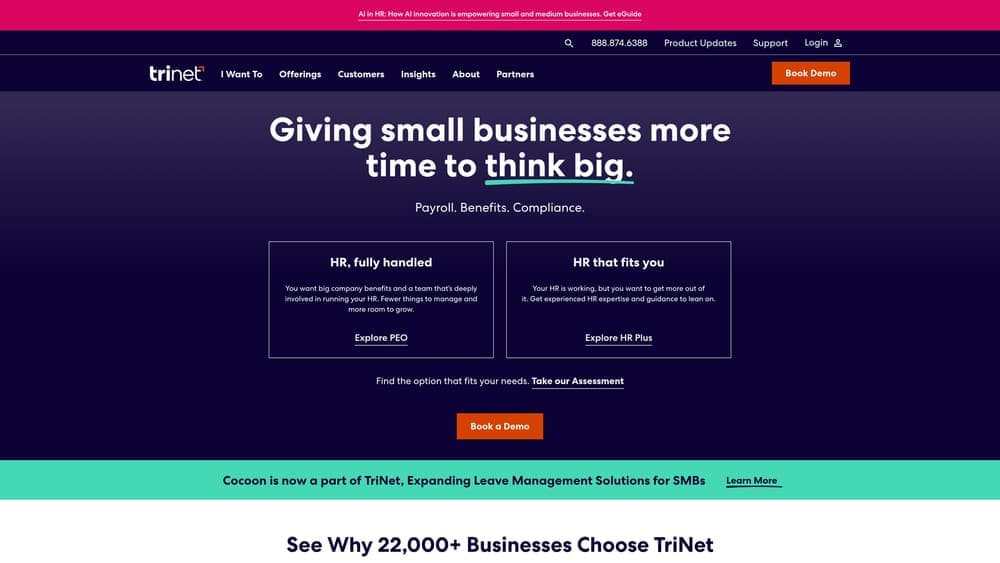
TriNet is a PEO known for providing access to large-group benefits packages that small and mid-size businesses couldn’t access independently.
Where This Tool Shines
Hiring and retaining IICRC-certified water damage technicians, mold remediation specialists, and experienced project managers is genuinely difficult. These are skilled tradespeople who have options. Offering a competitive health insurance package and solid 401(k) through a PEO like TriNet can be a real differentiator when you’re competing against larger restoration companies or contractors for the same talent pool.
TriNet’s cloud-based HR platform also gives managers real-time visibility into workforce data, which is useful when you’re managing crews across multiple active job sites. The OSHA and state-level compliance support rounds out the offering for restoration companies navigating a complex regulatory environment.
Key Features
Large-Group Benefits Access: Health insurance, dental, vision, and ancillary benefits at rates typically available only to much larger employers.
Industry-Specific HR Guidance: HR support that accounts for the specific dynamics of high-risk trade industries.
Regulatory Compliance Support: Assistance with OSHA requirements and state-level employment regulations across jurisdictions.
Real-Time HR Reporting: Cloud-based platform with visibility into workforce data across multiple locations and job sites.
Best For
Restoration companies in the 10-200 employee range that are struggling to compete on benefits and want to use PEO access to level the playing field when recruiting experienced technicians. Less focused on heavy risk management or safety program development compared to some others on this list.
Pricing
Custom per-employee pricing. TriNet typically serves SMBs in the 5-500 employee range. Pricing varies based on benefits selected and headcount.
6. Oasis (a Paychex Company)
Best for: Restoration companies operating in hurricane-prone Southeast and Gulf Coast markets that need fast onboarding during post-storm surge periods.
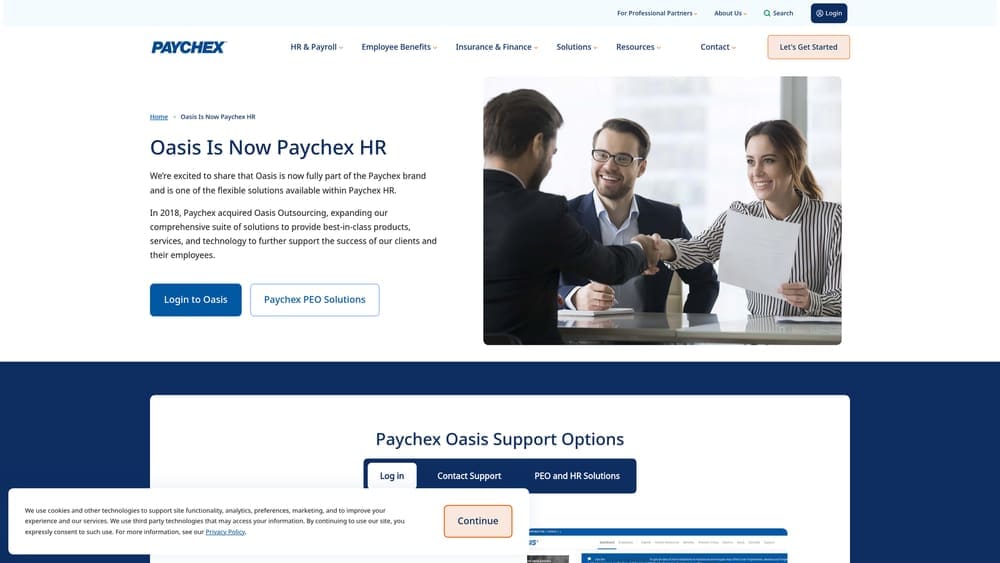
Oasis, now operating under the Paychex umbrella, has regional depth in disaster-prone markets and onboarding capabilities suited for rapid workforce scaling.
Where This Tool Shines
Speed matters in restoration. When a Category 4 hurricane makes landfall and you need to double your workforce within a week, a PEO with slow credentialing or cumbersome onboarding processes creates real operational problems. Oasis has built its service model around markets where this kind of surge is a recurring reality, not an edge case.
The regional expertise also means familiarity with state-specific workers’ comp requirements in markets like Florida, Texas, Louisiana, and Georgia — states with their own distinct compliance environments that a nationally-focused PEO might handle less fluently.
Key Features
Fast-Track Onboarding: Streamlined onboarding designed to handle rapid workforce additions without bottlenecks.
Regional Market Expertise: Familiarity with hurricane and storm-prone Southeast markets and their specific regulatory environments.
Workers’ Comp Claims Management: Active claims management support, not just premium administration.
Multi-State Payroll Capabilities: Payroll processing across state lines for companies deploying crews regionally.
Best For
Restoration companies based in or frequently operating in the Southeast and Gulf Coast regions, particularly those affiliated with franchise networks that activate large-scale response operations after major weather events.
Pricing
Custom pricing. Oasis now operates under Paychex’s infrastructure and pricing framework. Contact directly for current rates and service structures.
7. Justworks
Best for: Small restoration startups or newer operators that want straightforward PEO services without complex customization.
Justworks is a PEO with transparent flat-rate pricing and a clean, simple platform — a different profile from the full-service enterprise options above.
Where This Tool Shines
Justworks is honest about what it is: a clean, accessible PEO with predictable pricing and a straightforward interface. For a restoration company with 10-25 employees that doesn’t need deep safety consulting or complex multi-state infrastructure, that simplicity has real value. You know what you’re paying, onboarding is fast, and the platform doesn’t require an HR professional to operate.
The 24/7 support access is worth noting for a field-based business. If a payroll issue surfaces on a Saturday morning when your crew is mid-job, having someone to call matters more than it might for an office-based employer with predictable schedules.
Key Features
Transparent Flat-Rate Pricing: Per-employee monthly pricing with no hidden administrative markups buried in the contract.
Simple Onboarding and Benefits Enrollment: Clean interface that doesn’t require HR expertise to navigate.
Multi-State Compliance Support: Basic compliance support for employers operating across state lines.
24/7 Support: Around-the-clock access to support staff, useful for businesses with non-traditional operating hours.
Best For
Smaller restoration operators, early-stage companies, or businesses that want PEO access primarily for benefits and payroll rather than deep risk management. Companies with elevated mod rates or complex class code situations may find Justworks’ risk appetite limited compared to trades-specialized providers.
Pricing
Starts at $59 per employee per month for the basic plan. Plus plan at $109 per employee per month. One of the few PEOs on this list with published, transparent pricing.
8. CoAdvantage
Best for: Restoration companies with elevated experience modification rates or hard-to-place workers’ comp class codes that other PEOs won’t touch.
CoAdvantage is a PEO with deep roots in construction and trades-adjacent industries, and a reputation for working with employer profiles that more risk-averse PEOs decline.
Where This Tool Shines
This is the provider to know if you’ve been told “no” by other PEOs. Restoration companies doing asbestos abatement, demolition, or hazardous waste cleanup often have class codes and mod rates that push them outside the acceptable risk window for mainstream PEOs. CoAdvantage has built flexible workers’ comp programs specifically for these situations.
Their loss control consulting is also genuinely substantive. Reducing your experience modification rate over time is one of the highest-leverage things a restoration company can do to control costs — and it requires actual safety program work, not just paperwork. CoAdvantage’s approach to loss control is more hands-on than most.
Key Features
High-Risk Industry Specialization: Specific experience with construction, trades, and restoration-adjacent employers that have complex risk profiles.
Flexible Workers’ Comp Programs: Access to workers’ comp arrangements for difficult class codes that standard PEOs often can’t accommodate.
Safety Program Development and Loss Control: Active consulting to help reduce incident rates and improve mod rates over time.
Dedicated Account Management: Hands-on account management rather than a generic support queue.
Best For
Restoration companies that have been declined by other PEOs, have a high experience modification rate, or perform specialty work like asbestos abatement or hazardous demolition that creates workers’ comp placement challenges. Also a strong fit for companies that want active loss control support rather than passive administration.
Pricing
Custom pricing. CoAdvantage is known for working with higher-risk employer profiles, so expect a thorough underwriting review. Contact directly for a quote based on your specific class codes and headcount.
Picking the Right Fit for Your Restoration Business
The honest answer is that there’s no single best PEO for every restoration company. The right choice depends heavily on your risk profile, headcount patterns, geographic footprint, and what you actually need the PEO to do.
If you’re a smaller operator under 25 employees and primarily need payroll and benefits access without complexity, Justworks is worth a look for its transparent pricing alone. If you’re in the Southeast and need a PEO that can move fast during storm season, Oasis has the regional context that matters. If you’ve got a difficult mod rate or hard-to-place class codes, CoAdvantage is the one to call. For multi-state franchise operations with serious payroll infrastructure needs, ADP TotalSource is built for that scale. And if you want genuine risk management and safety program development, Insperity earns its place at the table.
But before you commit to any of them, the most useful thing you can do is compare them side-by-side on the metrics that actually matter for your business: workers’ comp rates, administrative fees, contract flexibility, and how they handle your specific class codes. That’s exactly what PEO Metrics is built for — a free, unbiased comparison that puts real pricing data in front of you without the sales pressure.
Restoration companies routinely overpay on PEO arrangements because they signed with the first provider that said yes, or auto-renewed without checking whether better options exist. Workers’ comp rate differences alone can represent tens of thousands of dollars annually for a 30-person restoration company. That’s worth a conversation before you sign anything.
