
Real estate brokerages run on a workforce model that breaks most standard HR software. You’ve got W-2 agents, 1099 contractors, administrative staff, and transaction coordinators — often all under one roof. That mix creates real headaches when it comes to payroll, benefits, and compliance.
The question most brokerage owners eventually face: do you need a PEO, or will a payroll company get the job done? They’re not the same thing. A payroll company processes checks and files taxes. A PEO takes on co-employment, bundles your workers into a larger risk pool for benefits and workers’ comp, and handles HR compliance on your behalf.
That distinction matters a lot depending on how your brokerage is structured. Here’s the part most generic comparisons miss: PEOs are built around W-2 employees. If your licensed agents are classified as 1099 contractors (which is typical), they fall outside the co-employment model entirely. That changes the cost-benefit math significantly — especially if your W-2 headcount is small.
This guide breaks down eight solutions — PEOs and payroll platforms — so you can match the right tool to your actual situation.
1. PEO Metrics
Best for: Brokerages evaluating PEO options for the first time or switching providers
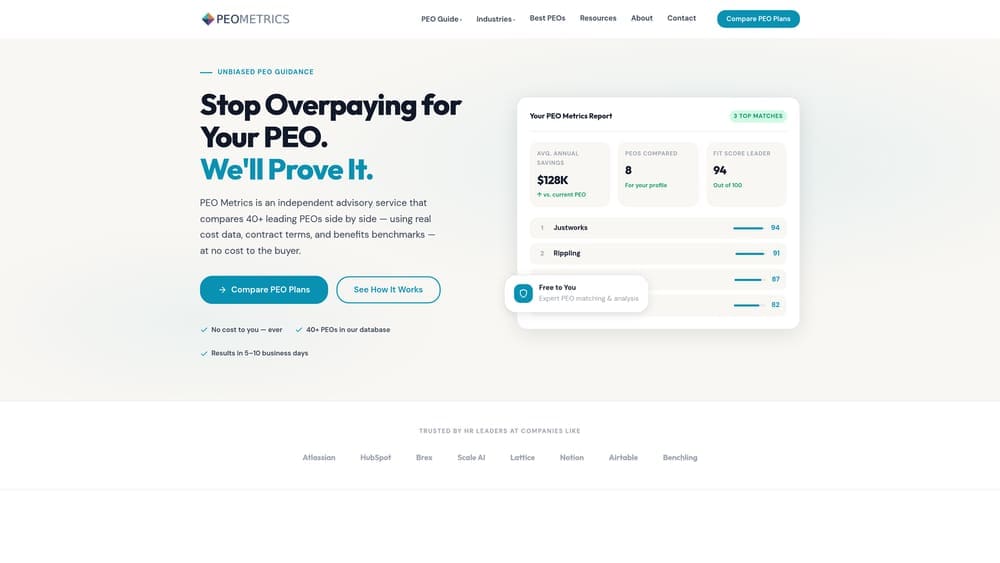
PEO Metrics is an independent PEO comparison service, not a PEO itself — it helps you evaluate providers side-by-side without vendor bias.
Where This Tool Shines
Most brokerage owners who go through a PEO sales process end up comparing proposals from two or three vendors, each using different pricing structures and bundling different services. It’s genuinely hard to know if you’re getting a fair deal or just a persuasive sales rep.
PEO Metrics solves that problem by surfacing pricing, features, and fit data in one place. It’s particularly useful for brokerages trying to figure out whether a PEO even makes sense for their headcount structure before they start taking sales calls.
Key Features
Side-by-Side Comparisons: Compare PEO providers on pricing, services, and contract terms without relying on each vendor’s own materials.
Unbiased Guidance: No vendor kickbacks or preferred-provider relationships — the analysis reflects your situation, not a sales commission.
PEO vs. Payroll Fit Assessment: Helps identify whether your headcount and workforce structure actually justifies a PEO or whether a payroll-only platform is the better call.
Pricing Transparency: Surfaces cost differences that are difficult to spot from vendor sales calls alone, especially in percentage-of-payroll models.
Provider Switching Support: Useful for brokerages that already have a PEO but suspect they’re overpaying or underserved.
Best For
Brokerage owners who are new to the PEO market, or those coming off a contract renewal and wondering if they’re still getting fair value. Also useful for HR leads tasked with evaluating options but lacking a clear benchmark for what “good” looks like in this space.
Pricing
Free to use. PEO Metrics operates as a comparison service, not a software subscription.
2. Justworks
Best for: Smaller brokerages that want enterprise-level benefits without enterprise complexity
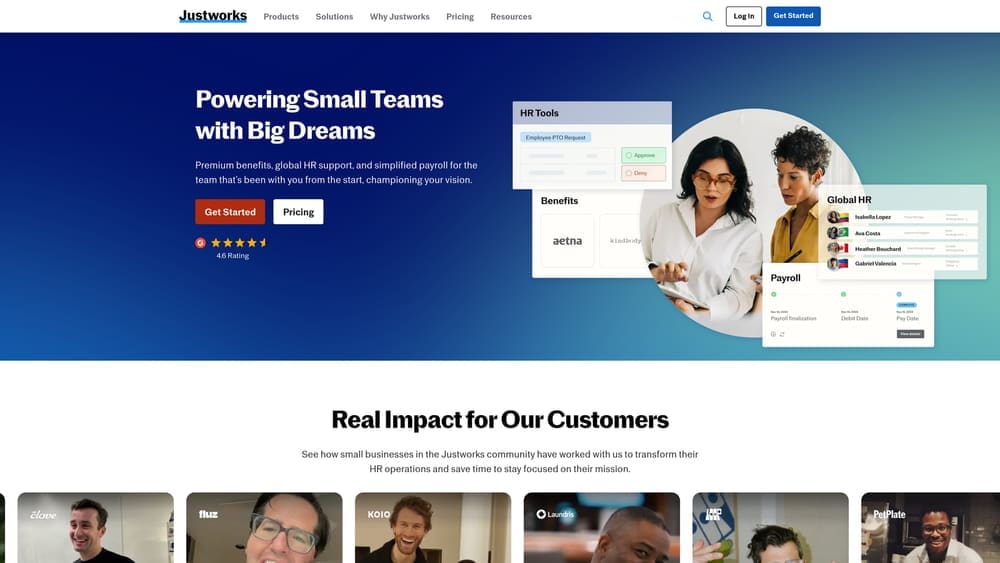
Justworks is a certified PEO with flat per-employee pricing and a clean, approachable interface built for companies that don’t have a dedicated HR team.
Where This Tool Shines
Justworks stands out for pricing transparency. Most PEOs quote as a percentage of payroll, which can be frustrating to model out. Justworks uses a flat per-employee-per-month fee, making it easier to budget — especially for brokerages with stable W-2 headcount.
The benefits access is strong for the price point. Co-employment pools your W-2 employees with Justworks’ broader client base, which means access to large-group health insurance rates that a small brokerage couldn’t negotiate independently. That’s one of the core value propositions of any PEO, and Justworks delivers it cleanly.
Key Features
Flat-Rate Pricing: Per-employee-per-month model is easier to forecast than percentage-of-payroll structures.
Large-Group Health Insurance Access: Co-employment gives your W-2 staff access to better rates than most small businesses can obtain directly.
Full PEO Stack: Payroll, benefits, compliance, and workers’ comp managed under one roof.
ESAC-Accredited and IRS-Certified: Both designations matter when evaluating PEO credibility and financial stability.
W-2 Only Coverage: 1099 agents are not covered under the co-employment model — important to understand before signing.
Best For
Brokerages with a defined W-2 staff (admin, coordinators, managers) looking for clean benefits access and predictable HR costs. Less useful if your entire operation runs on 1099 agents with minimal W-2 headcount.
Pricing
Starts around $59–$99 per employee per month depending on plan tier. Transparent and easy to model upfront.
3. TriNet
Best for: Brokerages that want tailored HR support, not just a software platform
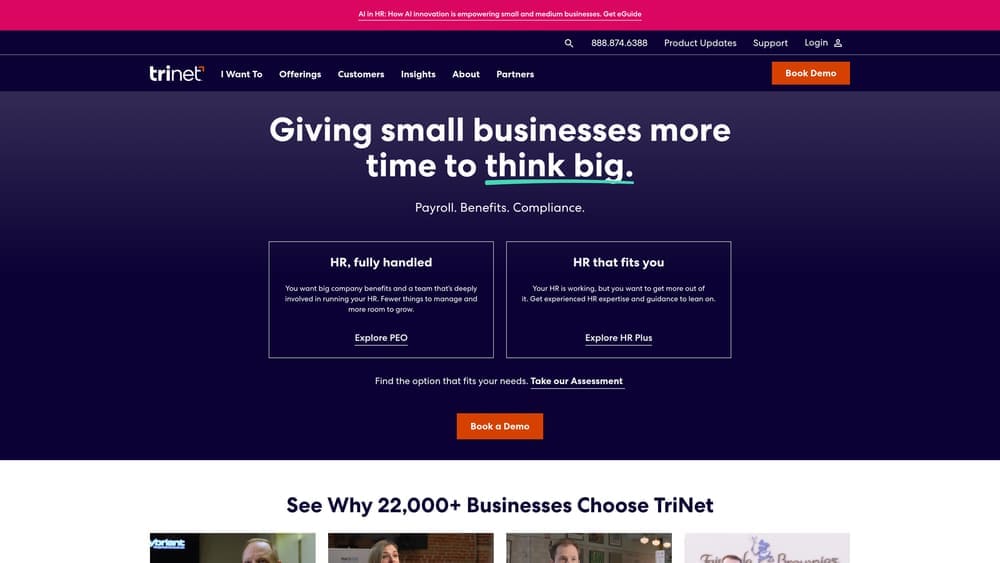
TriNet is a full-service PEO with vertical-focused HR packages and dedicated support teams, designed for businesses that want more than a generic solution.
Where This Tool Shines
TriNet’s differentiator is the depth of its HR support. You’re not just getting software — you’re getting access to HR professionals who can help navigate compliance questions, employee relations issues, and benefits decisions. For a growing brokerage adding W-2 staff, that human layer can be genuinely valuable.
The benefits packages are competitive, and the multi-state payroll and compliance capabilities are solid. If your brokerage operates across state lines — which creates real wage and hour complexity — TriNet handles that reasonably well.
Key Features
Vertical-Focused HR Bundles: Packages can be tailored toward professional services and real estate environments rather than generic small business configurations.
Dedicated HR Support Team: A real team, not just a ticketing system — useful when you have actual HR questions that need judgment calls.
Competitive Benefits Access: Health, dental, and vision plans through co-employment pooling at better rates than most small businesses can access independently.
Multi-State Compliance Management: Handles payroll tax filing, wage and hour compliance, and benefits administration across multiple states.
Quote-Based Pricing: Less transparent upfront than flat-rate competitors — you’ll need to go through a sales process to get real numbers.
Best For
Mid-size brokerages with meaningful W-2 headcount that want both strong benefits access and hands-on HR support. Not the best fit for brokerages primarily looking to minimize cost.
Pricing
Quote-based. Typically structured as a percentage of payroll or per-employee fee. Expect to engage sales to get a real number.
4. ADP TotalSource
Best for: Established brokerages that need deep compliance support and multi-state payroll
ADP TotalSource is ADP’s full PEO offering, built on top of one of the most established payroll and compliance infrastructures in the market.
Where This Tool Shines
ADP TotalSource’s strongest suit is compliance depth. If your brokerage is operating in multiple states, managing a mix of employment classifications, and worried about staying current with changing employment regulations, ADP’s infrastructure is hard to match. They’ve been doing this at scale for a long time.
The dedicated HR business partner model means you have a named contact, not just a support queue. For brokerages that have had bad experiences with impersonal HR platforms, that matters.
Key Features
Payroll and Tax Compliance Engine: Built on ADP’s core infrastructure — reliable, proven, and capable of handling complex multi-state situations.
Multi-State Compliance Capabilities: Strong handling of wage and hour laws, state-specific tax requirements, and employment regulation changes.
ADP HR Technology Ecosystem: Access to ADP’s broader platform integrations, reporting tools, and HR analytics.
Dedicated HR Business Partner: An assigned HR contact who knows your account, not a rotating support team.
Better Suited for Established Operations: Pricing and complexity skew toward brokerages with established headcount rather than early-stage operations.
Best For
Brokerages with 10 or more W-2 employees, multi-state operations, and a need for serious compliance infrastructure. The cost and complexity may not be justified for smaller operations.
Pricing
Quote-based. Typically structured as a percentage of payroll. Requires a sales conversation for accurate numbers.
5. Rippling
Best for: Brokerages that want flexibility to grow into or out of PEO services without switching platforms
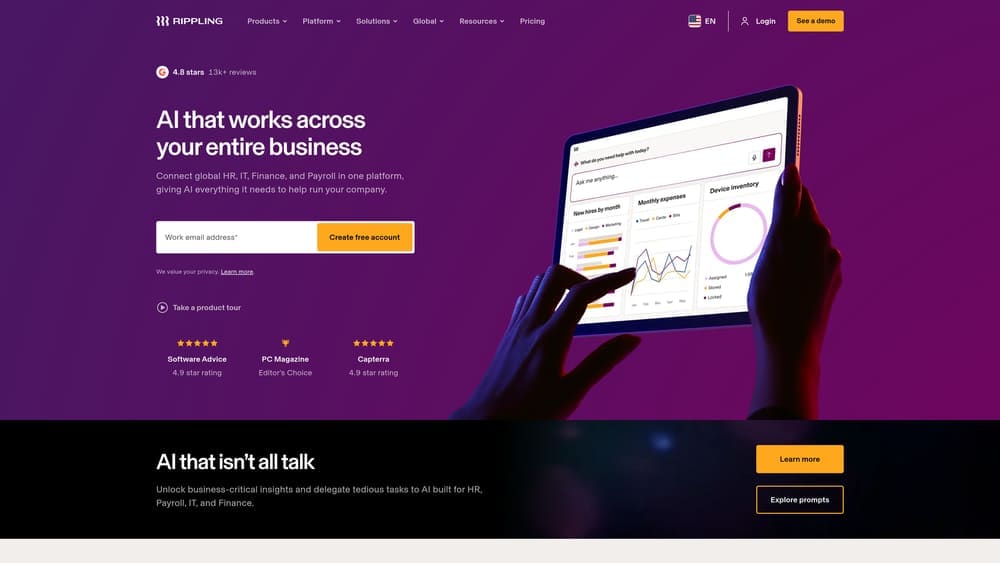
Rippling is a modular HR and IT platform that can operate as a PEO or a standalone payroll provider depending on what your brokerage actually needs at any given stage.
Where This Tool Shines
Rippling’s flexibility is genuinely unusual in this space. Most platforms force you to choose: PEO or payroll. Rippling lets you run both W-2 payroll and 1099 contractor payments through the same interface, and you can layer in the PEO model if and when it makes sense. For a brokerage that’s growing and unsure of its trajectory, that optionality has real value.
The automation capabilities are strong. Onboarding, offboarding, compliance task management, and IT provisioning (device management, app access) are all integrated. For distributed brokerages with remote staff, that last piece is more useful than it might sound.
Key Features
PEO or Standalone Payroll: Same interface either way — you can switch modes without migrating to a new platform.
W-2 and 1099 Payments: Handles both worker types in one system, which is a practical advantage for mixed-workforce brokerages.
Onboarding and Compliance Automation: Reduces manual work for common HR tasks across the employee and contractor lifecycle.
IT Management Integration: Device management and app access controls built in — useful for distributed teams managing sensitive client data.
Modular Pricing: Costs add up as you layer on features. Worth mapping out your actual module needs before comparing against flat-rate competitors.
Best For
Brokerages with a mix of W-2 staff and 1099 agents who want one platform to handle both, and who value automation over white-glove HR support.
Pricing
Core platform starts around $8 per user per month. PEO pricing is quote-based. Total cost depends heavily on which modules you activate.
6. Gusto
Best for: Smaller brokerages that need clean payroll for staff and agents without PEO complexity
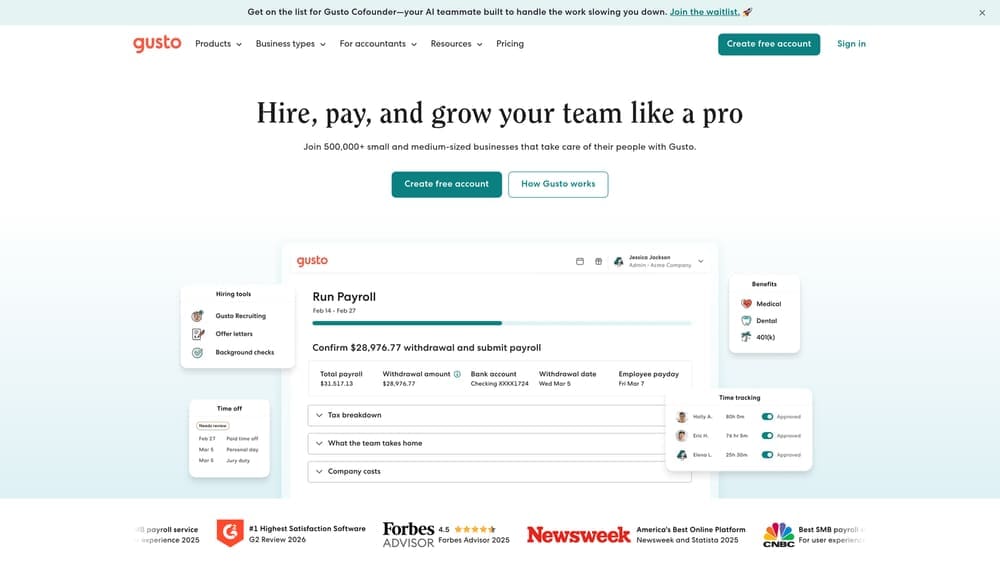
Gusto is a payroll-first platform that handles W-2 employees and 1099 contractors in one place. It’s not a PEO — there’s no co-employment — but for many brokerages, that’s actually fine.
Where This Tool Shines
Gusto is the most practical option for brokerages that primarily need payroll and tax filing handled cleanly without the overhead of a full PEO relationship. The interface is genuinely easy to use, and the combination of W-2 payroll and 1099 contractor management in one platform directly addresses the mixed-workforce reality most brokerages deal with.
The tradeoff is clear: you retain full employer liability. There’s no co-employment pooling for benefits, no shared workers’ comp risk pool. For a brokerage with a small W-2 staff and low workers’ comp exposure (office environment, not field work), that tradeoff may be entirely acceptable.
Key Features
W-2 and 1099 in One Platform: Handles regular payroll and contractor payments without needing separate systems.
Automated Tax Filings: Federal, state, and local tax filings handled automatically — reduces compliance burden significantly for small teams.
Basic HR Features: Offer letters, onboarding checklists, time tracking, and PTO management included.
Health Benefits Add-On: Benefits are available but not through co-employment pooling — you’re buying as a small group, not through a larger risk pool.
No Co-Employment: You keep full employer liability. This is the core difference from a PEO and the main reason to evaluate carefully.
Best For
Brokerages with fewer than 15 W-2 employees where the primary need is clean, affordable payroll and tax filing. Also a strong fit for brokerages that have confirmed a PEO isn’t cost-justified for their current headcount.
Pricing
Simple plan starts at $40/month plus $6 per person per month. Higher tiers with more HR features are available. Transparent and predictable pricing.
7. Paychex Flex
Best for: Brokerages that want to start with payroll and keep the option open to upgrade to full PEO services
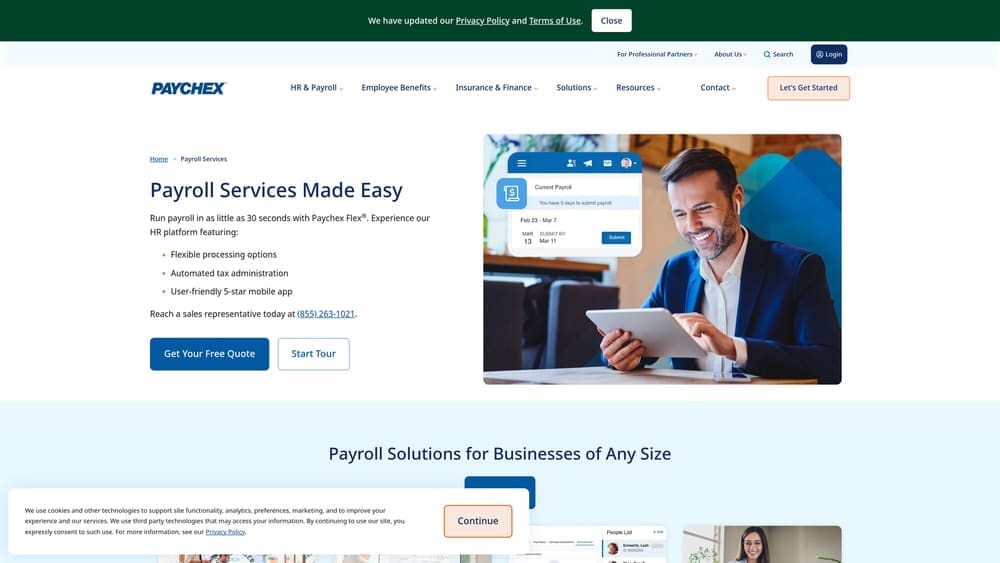
Paychex Flex is a scalable payroll platform with a built-in upgrade path to Paychex PEO — useful for brokerages that aren’t ready for a full PEO commitment but want to stay on a platform that can grow with them.
Where This Tool Shines
The upgrade path is the key differentiator here. If you start on Paychex Flex for payroll and eventually decide a PEO makes sense as your W-2 headcount grows, you can transition to Paychex PEO without migrating your data or learning a new system. That continuity has real operational value.
Paychex also has a strong local rep presence in many markets, which some brokerage owners prefer over purely digital support models. If you want someone you can actually call who knows your account, Paychex tends to deliver that better than most platforms at this price point.
Key Features
W-2 and 1099 Payroll Processing: Handles both worker types, which matters for brokerages with mixed workforces.
PEO Upgrade Path: Transition to Paychex PEO without changing platforms if your needs evolve.
HR Add-Ons: Time and attendance, benefits administration, and compliance support available as add-ons.
Local Rep Support: Many markets have dedicated local representatives — useful for brokerages that prefer a human point of contact.
Pricing Opacity: Exact numbers require a sales conversation. This is a known frustration with Paychex — budget for time spent getting a real quote.
Best For
Brokerages at an inflection point: currently manageable with payroll-only but growing fast enough that a PEO might make sense within the next year or two. Staying on one platform through that transition removes a real operational headache.
Pricing
Quote-based. Varies by headcount and features selected. Requires a sales conversation to get accurate numbers.
8. Insperity
Best for: Brokerages that want a high-touch PEO with dedicated HR specialists, not just software
Insperity is a full-service PEO known for its dedicated HR specialist model. It’s more service-intensive than most competitors and priced accordingly.
Where This Tool Shines
Insperity’s model is built around dedicated HR specialists assigned to each client. This isn’t a call center or a ticketing system — you have a named person who knows your brokerage, your people, and your compliance situation. For brokerage owners who have been burned by impersonal HR software or who are managing complex employment situations, that level of support is genuinely different.
The compliance management is strong, particularly for multi-state situations. Benefits packages are comprehensive, including health, retirement, and ancillary coverage. If you’re trying to use benefits as a recruiting tool to attract W-2 administrative talent in a competitive market, Insperity gives you real leverage.
Key Features
Dedicated HR Specialists: Named HR professionals assigned to your account — not rotational support staff.
Multi-State Compliance Management: Strong handling of wage and hour laws, state-specific employment requirements, and regulatory changes.
Comprehensive Benefits Packages: Health, retirement, and ancillary coverage options that can be used as a recruiting and retention tool.
Performance Management and HR Training: Resources included beyond basic compliance — useful for brokerages building out their management infrastructure.
Minimum Headcount Requirements: Typically better suited for brokerages with 5 or more W-2 employees. Smaller operations may not qualify or may not see the value justify the cost.
Best For
Established brokerages with meaningful W-2 headcount that want the highest level of HR support available in the PEO market. Not the right fit if cost minimization is the primary goal — Insperity sits at the higher end of PEO pricing.
Pricing
Quote-based. Typically structured as a percentage of payroll. Generally on the higher end of the PEO market relative to competitors.
Which Option Actually Fits Your Brokerage
The honest answer is: it depends on your W-2 headcount, not your total agent count.
If your brokerage has fewer than 15 W-2 employees and your main need is clean payroll for staff and 1099 agents, Gusto or Paychex Flex will likely cover you without the cost or complexity of a PEO. The math just doesn’t favor co-employment when your eligible headcount is small and your workers’ comp exposure is low (which is typical for office-based real estate staff).
If you’re growing, adding W-2 staff, or struggling with benefits costs and compliance across multiple states, a PEO starts to make real sense. At that point, the difference between providers matters more than most brokerages realize. Justworks is the most transparent on pricing. TriNet and Insperity offer the deepest HR support. ADP TotalSource brings the most compliance infrastructure. Rippling gives you the most flexibility if your model is still evolving.
One thing that catches brokerages off guard: PEO pricing structures are notoriously difficult to compare across vendors. Percentage-of-payroll models, per-employee fees, and bundled service tiers all make apples-to-apples comparison hard without a dedicated framework.
Before you commit to any provider, run a side-by-side comparison through PEO Metrics. Many businesses unknowingly overpay because of bundled fees, hidden administrative markups, and contracts designed to limit flexibility. PEO Metrics gives you a clear breakdown of pricing, services, and contract terms so you can see exactly what you’re paying for — and whether it’s actually the right fit for your brokerage’s workforce structure.
Don’t auto-renew. Make an informed, confident decision.
Before you sign that PEO renewal, make sure you’re not leaving money on the table.
Many businesses unknowingly overpay because of bundled fees, hidden administrative markups, and contracts designed to limit flexibility. We give you a clear, side-by-side breakdown of pricing, services, and contract terms—so you can see exactly what you’re paying for and choose the option that truly fits your business.
