
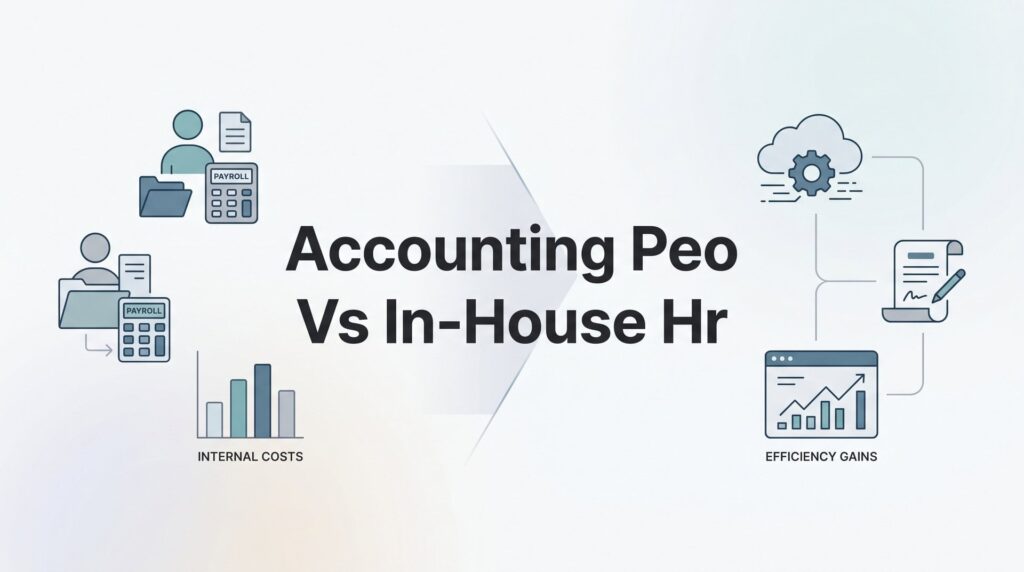
Accounting firms sit in an unusual position when it comes to HR decisions. You’re in the business of managing other companies’ finances, which means your own operational overhead gets scrutinized harder than most. Every dollar spent on HR administration is a dollar that isn’t going toward client work or firm growth.
The PEO vs in-house HR question hits differently for accounting firms than it does for a construction company or a retail chain. Your workforce is highly credentialed, your compliance exposure is layered, and your headcount often fluctuates with busy seasons — tax season in particular. These aren’t minor nuances. They’re the variables that actually determine which model makes sense for your firm.
So when you’re weighing whether to bring HR in-house or hand it off to a PEO, the decision isn’t just about cost. It’s about control, risk, scalability, and whether your HR model can keep pace with how accounting firms grow and operate.
This article walks through the key decision factors as a practical framework built around how accounting firms actually work. If you’re already familiar with how PEOs function at a foundational level, this is where we get into the specifics that actually matter for your situation.
1. Get Clear on What You’re Actually Comparing
The Challenge It Solves
Most PEO vs in-house HR comparisons start from a false premise. “In-house HR” means something very different at a 12-person accounting firm than it does at a 90-person regional practice. And the co-employment structure of a PEO is frequently misunderstood — sometimes in ways that make it sound scarier than it is, and sometimes in ways that oversell what it actually covers.
The Strategy Explained
At smaller firms, “in-house HR” often means someone wearing three hats — the office manager handling payroll, a partner approving PTO, and an outside payroll vendor processing checks. That’s not really an HR function; it’s HR by accident. A PEO replaces that patchwork with a structured system, but it does so through a co-employment arrangement where the PEO becomes the employer of record for payroll and benefits purposes while you retain full control over hiring, firing, and day-to-day management.
That distinction matters for accounting firms specifically. Some partners react negatively to the phrase “co-employer” without fully understanding what it means in practice. It doesn’t affect your client relationships, your firm’s legal identity, or your professional licensing status. It’s primarily a payroll and benefits administration structure. If you want a broader grounding in how these tradeoffs play out across different business types, the PEO vs in-house HR decision framework covers the core factors in detail.
Implementation Steps
1. Write down what your current HR function actually looks like — who handles what, which vendors are involved, and where decisions get made.
2. Map that against what a PEO would take over versus what stays with your firm regardless of which model you choose.
3. Identify any assumptions you’ve been making about co-employment that haven’t been verified — these are worth pressure-testing before they become objections.
Pro Tips
If you have partners who are sensitive to the co-employment concept, address it directly before evaluating providers. The concern is usually about perception, not substance. Getting that conversation out of the way early prevents it from derailing a decision that should be driven by operational and financial factors.
2. Run the Real Cost Comparison — Not Just Salary vs. PEO Fees
The Challenge It Solves
Accounting firms are good at numbers, which makes it ironic that many underestimate what their current HR function actually costs. The problem is that in-house HR costs are rarely consolidated in one budget line. They’re distributed across payroll vendor fees, benefits broker commissions, compliance software subscriptions, office manager time, and the hours partners spend handling HR issues that shouldn’t require their attention.
The Strategy Explained
When you compare a PEO fee against an HR salary, you’re comparing an all-in number against a partial number. The PEO fee typically covers payroll processing, benefits administration, compliance support, and HR technology. Your in-house equivalent needs to include all of those components to be a fair comparison.
For most smaller accounting firms, the fully loaded cost of in-house HR is higher than it appears — sometimes significantly so. The hours a managing partner spends on HR-related decisions have a real cost even if they don’t show up on a vendor invoice. Running a structured ROI analysis of PEO vs internal HR is the most reliable way to surface those hidden costs before you make a commitment.
Implementation Steps
1. Pull together every vendor or service fee related to HR and payroll — payroll processing, benefits broker, compliance tools, background check services, and any HR software subscriptions.
2. Estimate the internal time cost: how many hours per month do partners, managers, or administrative staff spend on HR tasks, and what’s the approximate dollar value of that time?
3. Add a realistic line item for compliance risk — what would a single employment law misstep cost in legal fees or settlement? This isn’t meant to be alarmist, but it belongs in the analysis.
4. Request a detailed PEO quote that breaks out what’s included, then compare line by line against your fully loaded current cost.
Pro Tips
Don’t let a PEO vendor run this analysis for you without verifying their assumptions. They have an incentive to make their fees look favorable. Build your own cost model first, then use it to evaluate what you’re being quoted.
3. Map Your Compliance Exposure Before You Decide
The Challenge It Solves
Accounting firms operate in a more complex compliance environment than most industries. The mistake many firm owners make is assuming a PEO handles all of it — or conversely, that because a PEO doesn’t handle all of it, it’s not worth the investment. Neither is quite right.
The Strategy Explained
A PEO covers employment law compliance: wage and hour rules, ACA reporting, workers’ compensation, FMLA administration, and similar federal and state employment obligations. That’s genuinely useful coverage, and for a firm without dedicated HR expertise, it reduces real risk.
What a PEO doesn’t cover: CPA licensing requirements governed by state boards of accountancy, professional conduct rules, client confidentiality obligations under applicable privacy frameworks, or the firm’s obligations under any engagement-level agreements. Those compliance layers belong to the firm regardless of your HR model.
Some firm owners also worry about whether co-employment creates data handling complexity with respect to client financial information. In practice, a PEO’s access is limited to employee data — payroll, benefits, HR records. Client data stays within your firm’s systems. But if this is a concern at your firm, it’s worth confirming explicitly in the PEO service agreement before you sign.
Implementation Steps
1. List your firm’s compliance obligations in two columns: employment law obligations (where a PEO can help) and professional licensing or client-facing obligations (where the firm retains full responsibility).
2. Identify where your current gaps are — are you confident in your wage and hour compliance? ACA reporting? State-specific leave laws in every state where you have employees?
3. Ask any PEO you’re evaluating to specify exactly what compliance support they provide and what documentation they maintain on your behalf.
Pro Tips
State-specific employment law is where smaller accounting firms tend to be most exposed, especially if you’ve added remote staff in states where you don’t have a physical presence. A PEO’s multi-state compliance infrastructure is one of its more practical benefits for firms in that situation. For a broader look at how professional services firms can structure this, see the guide on workforce compliance strategy using a PEO.
4. Factor In How Tax Season Actually Stresses Your HR Function
The Challenge It Solves
Tax season creates a predictable but real workforce pressure that most HR models aren’t built to handle cleanly. Firms often bring on seasonal staff, extend hours, and compress administrative bandwidth — right at the moment when HR tasks like onboarding, payroll adjustments, and compliance deadlines tend to pile up.
The Strategy Explained
If your HR function is one office manager or a part-time administrator, busy season is when that model breaks down. Onboarding seasonal staff takes time your team doesn’t have. Payroll errors during high-volume periods create downstream problems. And if something goes wrong — a misclassification, a missed compliance filing — the timing couldn’t be worse.
A PEO’s infrastructure handles onboarding, payroll processing, and compliance filings through systems that don’t get overwhelmed by your firm’s busy season. That’s a real operational benefit, not just a theoretical one. Understanding PEO payroll error accountability before you sign helps you know exactly who bears responsibility when processing mistakes occur under pressure.
In-house HR can handle this too, but only if it’s adequately staffed and supported. The question is whether your firm is actually at the headcount where full-time HR staff makes financial sense, or whether you’re trying to manage seasonal spikes with a part-time solution.
Implementation Steps
1. Map last year’s tax season: how many people did you onboard, how many payroll changes occurred, and what HR tasks fell through the cracks or got delayed?
2. Estimate the real cost of those gaps — delayed onboarding, payroll errors, or compliance items that got pushed.
3. Ask any PEO you’re evaluating how their onboarding process works for seasonal hires and what the turnaround time looks like.
Pro Tips
If your firm uses seasonal 1099 contractors rather than W-2 employees for busy season work, a PEO won’t directly solve the onboarding volume issue for those workers. Make sure you’re modeling the right workforce segment when you run this analysis.
5. Evaluate Benefits Buying Power at Your Firm’s Actual Headcount
The Challenge It Solves
Benefits quality is a real recruiting lever for credentialed staff. CPAs and experienced bookkeepers have options. If your benefits package is noticeably weaker than what a larger firm or a corporate employer can offer, you’ll feel it in recruiting and retention — especially for mid-career hires who are making deliberate choices about where to work.
The Strategy Explained
One of the most practical advantages of a PEO for smaller firms is benefits pooling. By aggregating employees across many client companies, a PEO can offer health insurance and other benefits at rates that a 15-person accounting firm couldn’t access independently. The quality of coverage tends to be higher, and the cost to the firm is often lower than going to market directly.
This advantage is most pronounced at smaller headcounts. As firms grow past a certain size — generally somewhere in the range of 75 to 100 employees, though this varies by market and provider — the pooling benefit narrows because the firm’s own risk pool becomes large enough to negotiate more directly. At that point, the benefits argument for a PEO weakens, and the decision becomes more purely about HR administrative efficiency. Reviewing benefit plan transparency issues before committing helps you verify that the coverage you’re being quoted actually delivers what it promises.
Know where your firm sits on that curve before you treat benefits as a decisive factor in either direction.
Implementation Steps
1. Get a current market quote for your benefits package independently — don’t rely solely on your existing broker’s renewal numbers.
2. Request a benefits comparison from any PEO you’re evaluating, including plan quality, not just premium cost.
3. Ask your staff what they actually value in benefits — sometimes the answer surprises you, and it helps you evaluate whether a PEO’s specific offerings are a genuine upgrade.
Pro Tips
Benefits under a PEO are standardized across their client base. If your firm has historically offered something unusual — a specific carrier, a niche plan design, or a generous HSA contribution structure — you may not be able to replicate that exactly within a PEO’s benefits menu. Factor that in before assuming the switch is straightforward.
6. Assess Control and Culture Fit — The Tradeoff Most Firms Overlook
The Challenge It Solves
PEOs standardize HR processes. That’s the source of their efficiency — and the source of their friction with firms that have specific ways of operating. For accounting firms, where partner compensation structures, equity arrangements, and professional culture carry real weight, that standardization can create genuine tension.
The Strategy Explained
Professional services firms tend to have more sensitivity around HR autonomy than, say, a light manufacturing company. Partners care about how HR policies are communicated to staff. Compensation structures at accounting firms can be complex — base salary, origination bonuses, equity tracks — and not all of that maps cleanly onto a PEO’s payroll and HR systems.
It’s also worth considering how your staff will experience the change. If employees are used to a direct relationship with firm leadership on HR matters, shifting to a PEO’s HR portal and support team can feel impersonal. That’s not a reason to avoid a PEO, but it’s a real transition management issue that firms often underestimate.
The HR technology stack a PEO provides is also worth evaluating on its own terms. Some PEO platforms are genuinely better than what a small firm would build independently. Others are dated or clunky. The quality varies significantly by provider.
Implementation Steps
1. Identify the HR processes at your firm that are most customized or partner-sensitive — compensation structures, performance review formats, promotion criteria.
2. Ask each PEO how they handle complex or non-standard compensation arrangements, and get specific answers rather than general assurances.
3. Request a demo of the employee-facing HR portal before you commit — this is what your staff will interact with daily, and it matters more than most firms realize during the evaluation phase.
Pro Tips
If your firm has a strong existing culture around HR and people management, a PEO works best as an administrative layer — not a replacement for how you manage people. The firms that get the most out of PEOs are those that use the PEO for compliance and administration while keeping people management firmly in-house.
7. Know When a PEO Stops Making Sense for Your Firm
The Challenge It Solves
Growth changes the math. The factors that make a PEO valuable at 20 employees — benefits pooling, compliance infrastructure, administrative efficiency — start to shift as firms scale. And the costs of staying in a PEO arrangement past the point where it makes sense are real, even if they’re not always obvious until you’re already past that point.
The Strategy Explained
There are a few clear signals that a PEO may be creating more friction than it removes for an accounting firm. First, if your headcount is large enough that you can access comparable benefits pricing independently, the pooling advantage disappears. Second, if your firm has complex equity or compensation structures that don’t fit the PEO’s systems cleanly, you’re spending time working around the platform rather than benefiting from it. Third, if you’ve hired or developed strong internal HR capacity, you’re paying PEO fees for services you’re partially duplicating. A PEO HR scalability financial model can help you project exactly when that crossover point arrives for your firm’s specific headcount trajectory.
Exit costs are also worth factoring in before you sign. Transitioning out of a PEO involves benefits re-enrollment, system migrations, rebuilding HR infrastructure, and potentially a gap period where your compliance coverage is thinner than usual. These aren’t reasons to avoid a PEO, but they’re reasons to think about your likely 3-5 year trajectory before committing. You can also explore PEO vs EOR structures if your firm has remote or international staff, as those situations sometimes warrant a different model entirely.
Implementation Steps
1. Sketch out your firm’s likely headcount and structure over the next three to five years — are you growing toward a size where in-house HR becomes cost-effective?
2. Ask any PEO you’re evaluating about their contract terms and exit provisions — specifically, what the transition process looks like and what notice period is required.
3. Model the cost of exiting a PEO at your projected future headcount, and factor that into your current decision.
Pro Tips
Firms that sign multi-year PEO contracts without thinking about their exit path sometimes find themselves locked in past the point where the arrangement makes financial sense. Read the contract carefully, and consider whether a shorter initial term with renewal options gives you more flexibility as your firm grows.
The Bottom Line for Accounting Firms
There’s no universal right answer here, and any resource that tells you otherwise is selling something. PEOs work well for accounting firms that are growing, under-resourced on HR, or trying to compete for talent without the overhead of a full HR department. They work less well for larger firms with complex compensation structures, strong existing HR teams, or specific cultural requirements that don’t fit a standardized model.
The decision factors that matter most for accounting firms specifically: your actual headcount and growth trajectory, the real fully-loaded cost of your current HR function, where your compliance gaps are, and how your partners feel about ceding administrative control to an outside organization.
Run a real comparison with actual numbers. That means your current HR costs fully loaded, a realistic PEO quote with line-item detail, and an honest assessment of where your benefits and compliance gaps actually are. Gut feel and vendor pitches aren’t enough to make this call well.
If you’re evaluating PEO providers and want a clearer picture of what you’d actually be paying and what you’d actually be getting, PEO Metrics provides side-by-side comparisons with the kind of pricing and service depth that makes this decision tractable. Many businesses unknowingly overpay because of bundled fees, hidden administrative markups, and contracts designed to limit flexibility. Don’t auto-renew. Make an informed, confident decision.
Before you sign that PEO renewal, make sure you’re not leaving money on the table.
Many businesses unknowingly overpay because of bundled fees, hidden administrative markups, and contracts designed to limit flexibility. We give you a clear, side-by-side breakdown of pricing, services, and contract terms—so you can see exactly what you’re paying for and choose the option that truly fits your business.
