
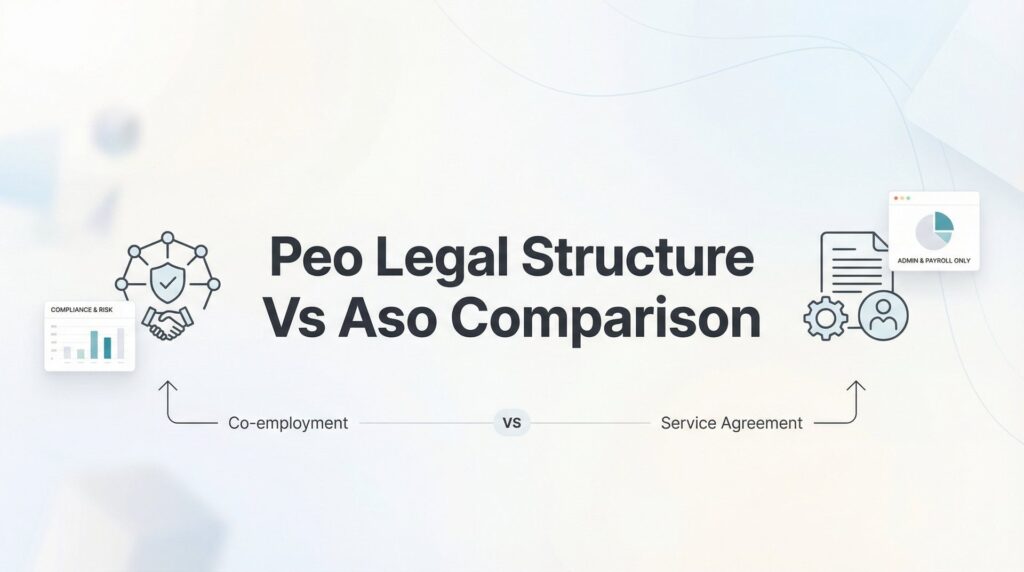
When you’re evaluating outsourced HR solutions, the legal structure difference between a PEO and an ASO isn’t just paperwork—it fundamentally changes who’s responsible for what, how your employees appear on tax filings, and what happens if something goes wrong. A PEO creates a co-employment relationship where the provider becomes the employer of record for tax and benefits purposes. An ASO (Administrative Services Organization) keeps you as the sole employer while outsourcing specific administrative tasks.
This distinction matters more than most vendors will tell you upfront. The right choice depends on your risk tolerance, growth plans, benefits priorities, and how much control you want to retain. Here’s how to evaluate the decision factors that actually matter.
1. Understand the Core Legal Distinction First
What Co-Employment Actually Means
Under a PEO arrangement, the provider becomes a co-employer through a client service agreement. They take on employer of record status for tax purposes. Your employees receive W-2s from the PEO’s EIN, not your company’s EIN.
This isn’t symbolic. It affects unemployment insurance experience ratings, workers’ compensation policies, and regulatory filings. The PEO’s name appears on government documents as the employer. Understanding how a PEO works through the co-employment process helps clarify these distinctions.
How ASO Relationships Stay Cleaner
An ASO keeps you as the sole employer. They provide administrative services under a service agreement, but you remain the employer of record. Your employees receive W-2s from your company’s EIN. You maintain full employer status in every legal sense.
Think of it like hiring an accounting firm versus having them become a co-owner of your business. The ASO handles tasks you delegate, but the legal relationship stays straightforward.
Why This Matters Before Anything Else
Everything else flows from this foundational difference. Benefits access, compliance responsibility, cost structures, and contract flexibility all stem from whether you’re entering a co-employment relationship or a service agreement.
Most companies evaluate features and pricing first, then discover the legal structure implications later. That’s backward. Understand what you’re actually signing up for before you compare anything else.
2. Evaluate Your Benefits Access Requirements
The PEO Benefits Pooling Advantage
PEOs aggregate employees across all client companies to negotiate benefits as a larger group. A company with 25 employees can access rates typically available only to companies with hundreds of employees.
This matters most for health insurance. Small groups face higher per-employee costs and limited plan options. Through a PEO, you’re effectively part of a much larger benefits pool.
The same applies to 401(k) plans, dental coverage, vision insurance, and supplemental benefits. You gain access to enterprise-level options without needing enterprise headcount.
What ASOs Actually Offer
ASOs don’t provide this pooling because they’re not co-employers. They can’t aggregate employees across clients for benefits purposes.
Some ASOs offer benefits broker services. They’ll help you shop for plans and manage enrollment. But you’re negotiating as your own company with your own headcount. The rates reflect your group size, not a pooled arrangement.
If you already have strong benefits through an existing broker or a larger group arrangement, this distinction matters less. Companies exploring PEO for benefits administration outsourcing often find the pooling advantage is the primary draw.
The Decision Test
Ask yourself: Is benefits access a primary driver or a nice-to-have? If your current health insurance costs feel unsustainable or your plan options are limited, the PEO pooling advantage might justify co-employment. If you’re satisfied with your current benefits setup, you’re not giving up much by choosing an ASO.
3. Assess Your Compliance Risk Tolerance
Shared Liability Under Co-Employment
When a PEO becomes your co-employer, they take on certain employer responsibilities. They handle payroll tax filings, unemployment insurance administration, and workers’ compensation coverage as the employer of record.
This creates shared liability. If something goes wrong with payroll tax filings or regulatory compliance in areas they manage, the PEO shares responsibility. They have skin in the game.
For multi-state employers, this matters more. Each state has different payroll tax requirements, unemployment insurance rules, and compliance deadlines. The PEO handles state-specific registrations and filings as the employer of record. Understanding PEO coverage for HR compliance protection helps clarify what’s actually included.
Full Responsibility With ASO Arrangements
An ASO may assist with compliance tasks, but the legal responsibility remains entirely with you. They’re providing services, not sharing employer status.
If your ASO makes a mistake on a payroll tax filing, you’re still the one on the hook with the IRS or state agency. The ASO might have professional liability coverage, but you’re the employer of record who missed the filing.
This doesn’t mean ASOs are riskier—it means the accountability structure is different. You retain full control and full responsibility.
Where Your Comfort Level Sits
Some business owners prefer shared compliance responsibility, especially in complex regulatory environments. Others want to retain full employer status and don’t want a co-employer relationship complicating things.
Neither approach is wrong. It depends on whether you value the shared liability model or prefer to keep employer responsibilities entirely in-house with service provider support.
4. Map Your Control and Flexibility Priorities
PEO Integration and Its Tradeoffs
PEOs operate on integrated platforms. Payroll, benefits, HR administration, and compliance management work together because they’re managing these functions as your co-employer.
This integration creates efficiency but reduces flexibility. You’re working within their systems, their benefits offerings, their compliance approach. If you want to change payroll providers or switch benefits brokers, you can’t—those services are bundled into the co-employment relationship.
You also can’t easily customize. If the PEO’s standard approach doesn’t fit your situation, your options are limited. The integration that makes things efficient also creates dependencies.
ASO Modularity and Independence
ASOs typically offer services à la carte. You might use them for payroll but handle benefits separately. Or use them for HR administration while keeping payroll in-house.
This modularity gives you more control over each function. You can switch providers for specific services without unwinding your entire HR infrastructure. You maintain independence in decision-making.
The tradeoff is less integration. You’re coordinating between different systems and providers. Companies that already have internal HR staff often find this approach works well when using a PEO alongside their internal HR department.
What Matters More to You
If you value simplicity and don’t mind working within an integrated system, the PEO approach makes sense. If you want maximum flexibility to customize, switch providers, or maintain specific arrangements, the ASO model preserves that control.
Companies with strong internal HR capabilities often prefer ASO flexibility. Companies without dedicated HR staff often prefer PEO integration.
5. Compare True Cost Structures
How PEO Pricing Actually Works
PEOs typically charge per-employee-per-month fees or a percentage of payroll. Common ranges run from 2-12% of payroll depending on services, company size, and industry.
This fee usually includes payroll processing, benefits administration, HR support, compliance assistance, and workers’ compensation coverage. It’s bundled pricing.
The challenge is understanding what you’re actually paying for benefits versus administrative services. A detailed breakdown of PEO pricing and cost structure reveals what’s often hidden in bundled fees.
ASO Fee Structures and Hidden Costs
ASOs usually charge flat administrative fees for specific services. You might pay a per-employee-per-month fee for payroll, another fee for HR administration, and separate costs for benefits broker services.
This transparency makes it easier to see what each service costs. But you’re also paying separately for benefits through your own broker or insurance arrangements.
The hidden costs come from coordination. If you’re working with multiple vendors, someone needs to manage those relationships. That’s either your time or someone you’re paying to handle it.
The Real Comparison
To compare accurately, you need to separate benefits costs from administrative fees in both models. What’s the PEO actually charging for services versus passing through for insurance premiums? What would those same benefits cost you directly?
Then compare the administrative fees. Is the PEO’s bundled service fee higher or lower than paying for ASO services separately? Factor in your time cost for coordination.
Many companies find PEOs cost-effective when benefits savings offset higher administrative fees. Running a PEO ROI and cost-benefit analysis helps quantify whether the numbers actually work in your favor.
6. Consider Your Growth Trajectory
Employee Count Thresholds That Matter
Most companies under 50 employees lean toward PEOs for the benefits leverage. The pooled benefits access matters more when you’re competing for talent without enterprise-level offerings.
Companies over 100 employees with established HR infrastructure often find ASOs more practical. You’ve likely built internal HR capabilities, negotiated decent benefits rates, and developed compliance processes. The PEO value proposition at the 100-employee mark requires careful evaluation.
The interesting zone is 50-150 employees. You’re large enough to negotiate reasonable benefits but small enough that pooling still helps. You might have an HR person but not a full team. Either model could work.
Future Events That Change the Equation
If you’re planning to raise capital, some investors prefer cleaner employer relationships without co-employment. If you’re considering acquisition, the PEO relationship adds complexity to due diligence.
If you’re expanding to multiple states rapidly, PEO co-employment can simplify multi-state compliance. If you’re staying in one state, that advantage disappears.
If you’re planning to build out HR infrastructure, you might outgrow a PEO within a few years. If you’re staying lean on administrative staff, the PEO model might make sense indefinitely.
The Transition Pattern
Industry observers note that companies often start with PEOs when small, then evaluate ASO transitions as they grow past 75-150 employees. But many companies stay with PEOs indefinitely because unwinding the benefits arrangements is complicated.
Think about where you’ll be in three years. Does the model you’re choosing today still make sense at that scale? If not, understanding how to leave your PEO before you sign helps you plan for eventual transitions.
7. Run a Scenario-Based Decision Test
Questions That Reveal the Right Fit
Do you have an HR person or team? If no, PEO integration often makes more sense. If yes, ASO flexibility might be more valuable.
Are your current health insurance costs a major pain point? If yes, PEO pooling could deliver significant savings. If no, you’re not giving up much with an ASO.
Do you operate in multiple states? If yes, PEO co-employment simplifies compliance. If no, this advantage is less relevant.
Do you want maximum flexibility to switch providers or customize arrangements? If yes, ASO modularity preserves that control. If no, PEO integration is fine.
Are you planning any major corporate events in the next 2-3 years? If yes, consider how co-employment affects those plans. If no, it matters less.
Red Flags for Each Model
PEO red flags: You’re uncomfortable with co-employment. You want to maintain specific benefits arrangements. You’re planning to be acquired. You have strong internal HR capabilities and don’t need bundled services.
ASO red flags: Your benefits costs are killing you and you need pooling access. You have zero HR infrastructure and need comprehensive support. You’re expanding to multiple states rapidly and want simplified compliance.
The Validation Step
After running through these questions, the right direction usually becomes clear. If you’re still uncertain, that’s a sign you’re in the middle ground where either model could work.
In that case, get specific proposals from both types of providers. Compare actual costs, contract terms, and service levels. Learning how to negotiate your PEO contract ensures you’re comparing apples to apples.
Making the Decision That Fits Your Business
The PEO vs. ASO decision isn’t about which is better—it’s about which legal structure aligns with your specific situation. If you need enterprise benefits access, want shared compliance responsibility, and can accept co-employment, a PEO often makes sense. If you want maximum control, already have strong benefits options, and prefer to own all employer liability, an ASO keeps things cleaner.
Most companies under 50 employees lean toward PEOs for the benefits leverage. Companies over 100 with established HR infrastructure often find ASOs more practical. The middle ground is where the decision gets interesting—and where getting an unbiased comparison matters most.
Before you sign that PEO renewal, make sure you’re not leaving money on the table. Many businesses unknowingly overpay because of bundled fees, hidden administrative markups, and contracts designed to limit flexibility. We give you a clear, side-by-side breakdown of pricing, services, and contract terms—so you can see exactly what you’re paying for and choose the option that truly fits your business.
