
Most advice about employee handbooks is too soft. It treats the handbook like an onboarding nicety, a culture document, or a packet HR sends on day one and files away.
That framing overlooks a critical aspect. For an employer, especially one working with a PEO, the handbook is a risk-control document. It tells employees what rules apply, gives managers a baseline for enforcement, and helps define where company control ends and legal exposure begins. It also matters because many employers still underinvest in it. A 2023 Gusto survey found that 26% of small businesses with fewer than 10 employees had a formal employee handbook, compared with 95% of mid-to-large enterprises with 100+ employees (Gusto survey data cited in verified brief).
For a CFO or owner, the practical question isn't just what is an employee handbook. The better question is whether the current handbook would help or hurt if an employee challenged a termination, disputed a leave decision, or pointed to inconsistent treatment between managers. In a co-employment arrangement, that question gets sharper because the PEO may supply policies, review them, or insist on its own language.
Table of Contents
- The Employee Handbook as a Risk Management Tool
- Essential Policies Every Modern Handbook Needs
- Common Pitfalls That Turn Handbooks into Liabilities
- Best Practices for Drafting and Maintaining Your Handbook
- The PEO Complication Who Really Owns the Handbook
- Aligning Policies Across States With a PEO
- Your Handbook Is a Strategic Decision Not an Afterthought
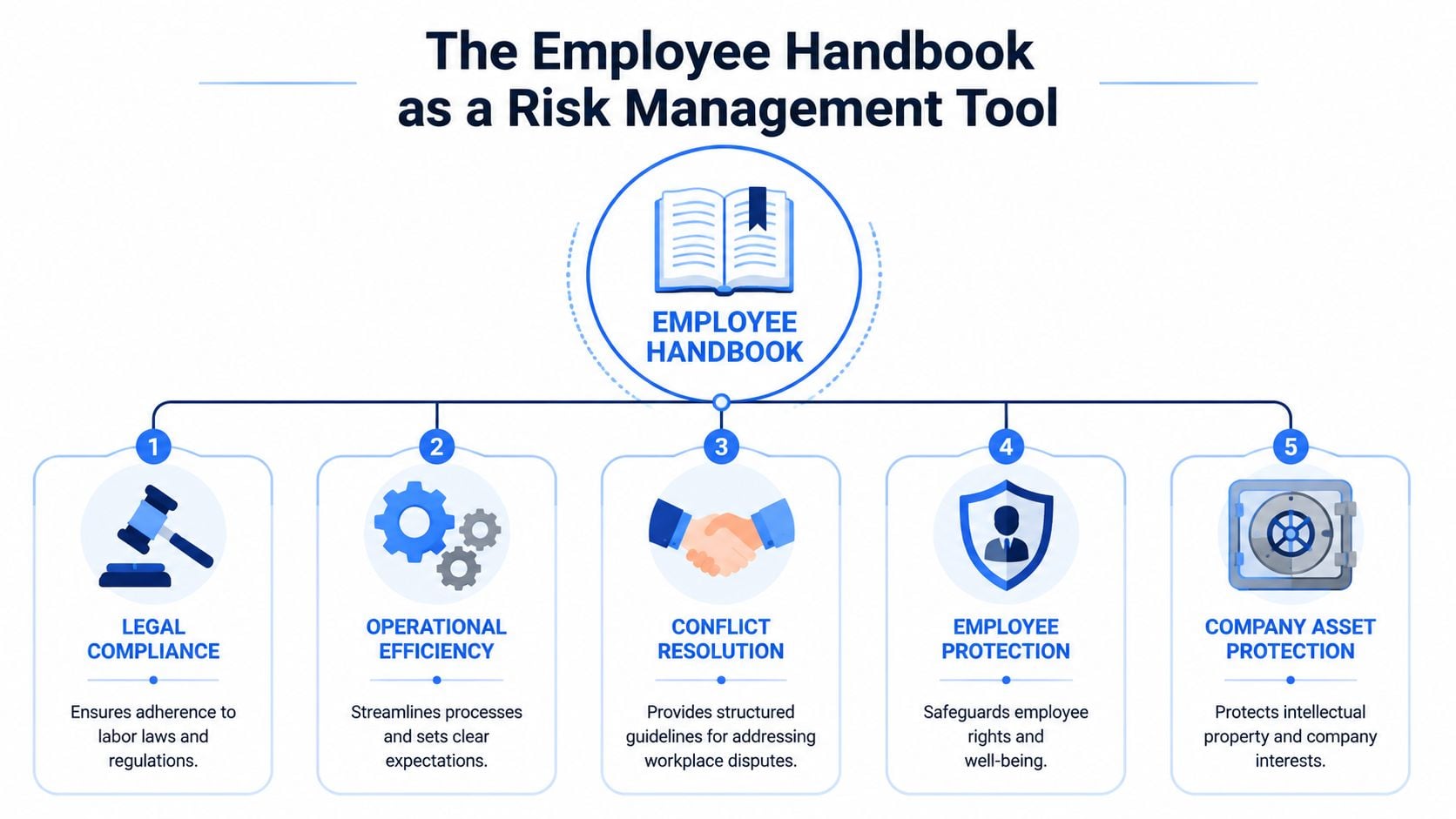
The Employee Handbook as a Risk Management Tool
An employee handbook isn't an employment contract. That's one of the most important things to get right. It is a non-binding document that formalizes policies, procedures, and expectations so employees have a primary reference point for how the workplace operates.
That distinction became especially important with the widespread use of at-will statements, and courts have treated sloppy drafting as a real liability issue. Pitt Law's handbook guidance notes that employers should make clear the handbook isn't an employment agreement. It also highlights the risk of implied contract claims, including the 1995 ruling in Gardner v. Loomis Armstrong, Inc. and damages exceeding $100,000 when a clear disclaimer wasn't in place.
It works like an operating system
In practice, the handbook is the written operating system for the workforce. It sets the standard for attendance, conduct, reporting channels, discipline, and core employment rules. When managers improvise instead of following a written baseline, companies usually create inconsistency first and legal exposure second.
That matters in routine disputes. An unemployment claim, harassment complaint, or termination challenge often turns on basic questions: Was there a written rule? Was the employee told about it? Did managers apply it consistently? A good handbook doesn't win every dispute, but it gives the employer a defensible starting point.
Practical rule: If the company can't show the rule, the acknowledgment, and the enforcement history, the handbook isn't protecting much.
Why CFOs should care
Finance leaders often see handbooks as HR administration. That's too narrow. The handbook affects litigation risk, manager discretion, and compliance discipline. It also helps define which obligations sit with the employer and which are shaped by a PEO relationship.
For employers using outsourced HR support, handbook control should be reviewed with the same care as indemnity language or service commitments. Consequently, employee handbook liability considerations in a PEO relationship become a governance issue, not just a documentation issue.
Essential Policies Every Modern Handbook Needs
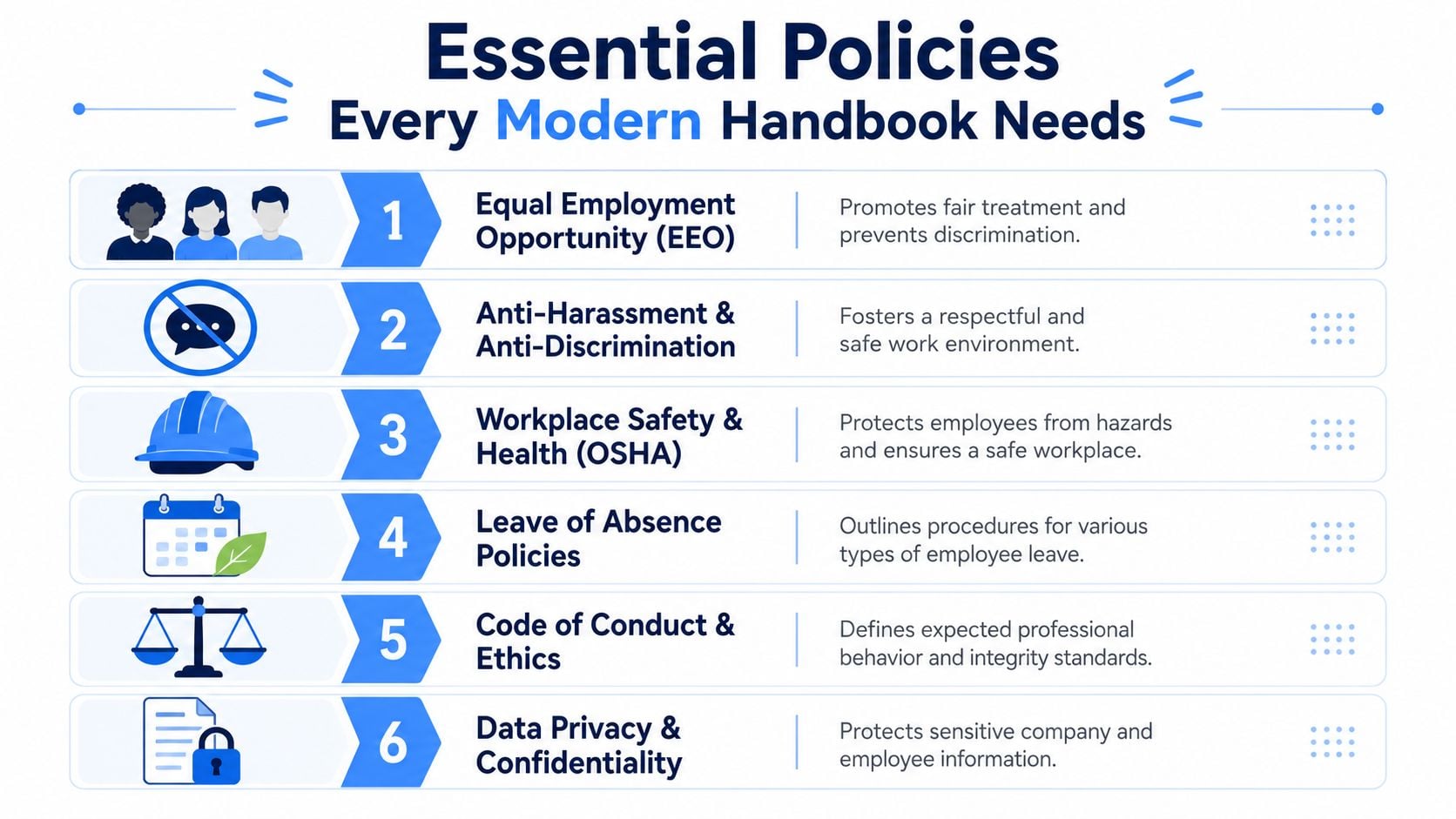
A modern handbook should match how the company operates. Generic templates fail because they often describe a workplace the employer doesn't have. Best-practice guidance describes the handbook as a controlled policy repository covering employment classification, compensation, attendance, technology use, discipline, and termination, along with version control and secure retention of acknowledgments (Mosey handbook template guidance).
The point isn't to make the handbook longer. The point is to make it usable, enforceable, and aligned with payroll, benefits, leave administration, and manager behavior.
Policies that do real work
Some sections are foundational because they anchor later decisions.
- Employment status and at-will language. This tells employees the basic nature of the relationship and helps avoid accidental promises about continued employment.
- Equal employment opportunity and anti-harassment rules. These create a formal standard for conduct, reporting, and response.
- Attendance and timekeeping. These policies matter operationally because supervisors rely on them daily.
- Compensation and benefits overview. This should explain general practices without turning benefits summaries into rigid promises.
- Discipline, complaint, and investigation procedures. These sections shape how managers escalate issues and how employees raise concerns.
- Termination and separation rules. These help define offboarding expectations, return of property, and final administrative steps.
Policies that reflect today's workplace
The handbook also needs current operational content. That usually includes technology use, social media, confidentiality, data privacy, and remote work norms. Verified guidance also notes that recommended handbook content spans acknowledgment-of-receipt procedures, which matters because proving distribution is often as important as the policy text itself.
A useful structure usually includes the following:
| Policy area | Why it matters |
|---|---|
| Employment classification | Helps prevent confusion around exempt, nonexempt, full-time, part-time, and temporary status |
| Attendance and leave | Supports consistent manager decisions and cleaner payroll administration |
| Technology and privacy | Sets rules for device use, acceptable conduct, and handling company information |
| Discipline and reporting | Gives employees and managers a defined path when issues arise |
A handbook should answer the manager's question before the manager creates a new rule on the fly.
For smaller employers that need a more practical baseline before layering in state or PEO-specific requirements, this employee handbook resource for small business is a sensible starting point.
Common Pitfalls That Turn Handbooks into Liabilities
A weak handbook doesn't just fail to help. It can create problems the company didn't have before.
The biggest mistake is writing policy language that sounds absolute, guaranteed, or permanent. Legal guidance warns that a handbook's primary risk is accidental contractual language, which is why employers are told to include a clear at-will statement and have counsel review the document before distribution.
Language that creates promises
The most common drafting traps are easy to miss because they sound reasonable.
- Guaranteed progression language. Statements like “employees will be terminated only after three written warnings” can box the company in.
- Rigid benefit promises. If benefits are described as fixed entitlements rather than subject to plan terms and employer discretion, future changes get harder.
- Probation wording that implies tenure. Some employers use language that suggests employees “become permanent” after an introductory period.
- Inconsistent leave descriptions. If payroll practice says one thing and the handbook says another, the handbook becomes evidence against the employer.
Enforcement failures matter as much as drafting
A clean handbook doesn't help if managers ignore it. A supervisor who excuses attendance issues for one employee and disciplines another under the same written policy weakens the employer's position. The same problem shows up when a manager makes verbal promises that contradict the handbook.
The fastest way to undermine a handbook is to let frontline managers freelance.
That risk becomes more complicated under a PEO because clients often assume the PEO's template solves enforcement. It doesn't. The written policy may be sound, but if the client manager applies it unevenly, exposure still sits with the employer in practical terms. Companies dealing with that split should review PEO policy enforcement and legal risks before assuming the handbook alone is enough.
Best Practices for Drafting and Maintaining Your Handbook
The strongest handbooks aren't static PDFs buried in an onboarding folder. Guidance from the U.S. Chamber recommends digital, searchable handbooks with explicit receipt acknowledgments because they're easier to revise when laws or internal rules change, which reduces the lag between a policy update and employee awareness (U.S. Chamber handbook guidance).
That recommendation fits how companies operate now. A warehouse supervisor, remote engineer, and field sales manager won't all use the same format the same way. Searchability matters.
Build for revision, not just launch
A durable handbook process usually includes:
- Core policy drafting. HR, legal, payroll, and leadership should align on actual practices before language is finalized.
- Manager review. Supervisors need to confirm the policies can be enforced in practice.
- Digital distribution. Employees should be able to access the current version without asking HR for a PDF.
- Acknowledgment capture. Receipt needs to be documented and retained securely.
- Update discipline. Changes should be logged so the company can show which version applied at a given time.
A handbook should also separate company-wide rules from location-specific requirements. That's cleaner than forcing every employee to read every state-specific rule that doesn't apply to them.
Make hybrid and distributed work explicit
Many handbooks still gloss over remote work. That creates confusion around timekeeping, equipment use, reimbursement, attendance expectations, and reporting lines. For employers with cross-border or international context, practical guidance for Irish businesses is useful because it shows how handbook structure can stay practical while still accounting for jurisdiction-specific obligations.
A good maintenance model includes a core handbook plus targeted addenda. That approach is especially useful for companies moving from a single-state footprint to a distributed workforce.
- Keep one core source of truth for universal conduct, reporting, and employment policies.
- Add jurisdiction-specific supplements where leave, wage-hour, or notice rules differ.
- Train managers on the live version, not the version they remember from two years ago.
For employers reworking the document from scratch, this guide on employee handbook purpose is a practical reference point because it keeps the focus on function, not boilerplate.
The PEO Complication Who Really Owns the Handbook
Once a company enters a PEO relationship, the handbook stops being a simple internal HR document. It becomes a control question.
Some PEOs provide a standard handbook. Some review the client's handbook and require certain language. Others use a hybrid model where the PEO owns regulated policy sections and the client owns culture, conduct, and operating rules. Each model has trade-offs.
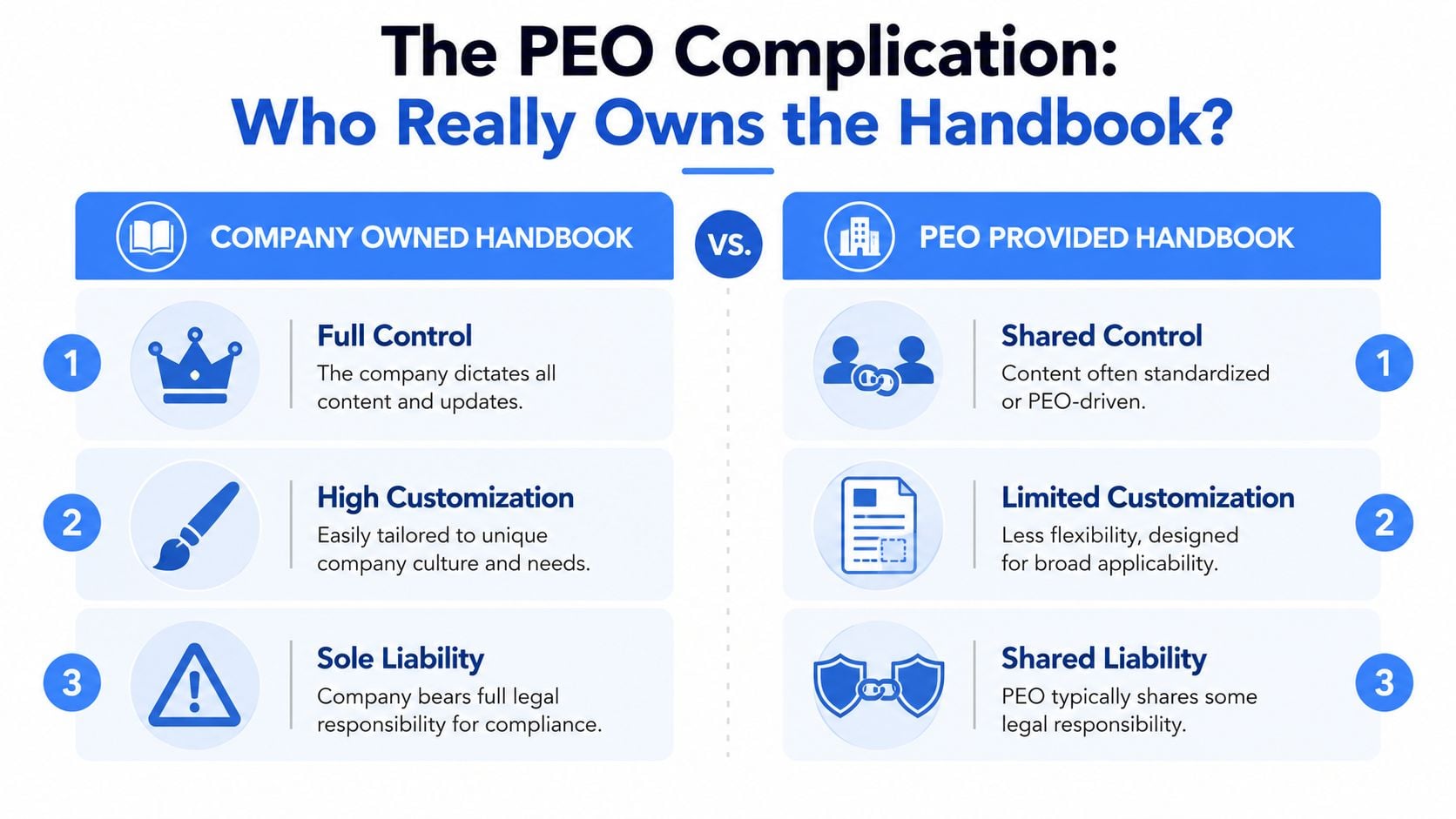
The three common ownership models
| Model | Who writes it | Pros | Cons |
|---|---|---|---|
| PEO-provided | Mostly the PEO | Strong compliance structure, easier updates, cleaner standardization | Limited customization, can feel generic, may not reflect actual manager practice |
| Client-provided with PEO review | Company drafts, PEO reviews | Better cultural fit, more operational accuracy | Review may be narrow, compliance burden stays heavier on client |
| Hybrid model | Shared responsibility | Balances consistency and customization | Requires clear ownership rules or gaps appear fast |
What changes in co-employment
The practical issue isn't whose logo sits on the cover. It's who controls policy language, who updates it, and who answers when a manager acts outside it.
A PEO handbook can reduce drafting burden, but it can also flatten real differences in scheduling, safety rules, commission structures, remote work norms, or disciplinary practice. If the handbook says one thing and the client business operates another way, the document stops being protective.
In a PEO relationship, the handbook is one of the clearest indicators of where control actually sits.
That makes handbook review part of due diligence. Buyers should ask:
- Who owns the master document and who approves revisions
- Which sections are mandatory because the PEO requires them
- How state addenda are handled when the workforce expands
- Who trains managers when policies change
- What happens at termination or offboarding if the client's practice conflicts with the PEO's baseline
For companies comparing providers, handbook ownership belongs alongside pricing, benefits, and service model in the evaluation process. A useful tool for that broader review is the PEO legal responsibility matrix, which helps frame where legal and operational responsibility may be shared, delegated, or retained by the client.
Aligning Policies Across States With a PEO
Multi-state growth is where a handbook stops being an HR formality and becomes a control problem.
A company with employees in California, Texas, and New York is not managing one rule set. It is managing overlapping obligations on leave, wage and hour practices, reimbursements, rest breaks, pay transparency, off-duty conduct, and termination process. A single national policy often fails in one of two ways. It gets so broad that managers cannot apply it consistently, or so cluttered with exceptions that employees stop using it.
Both outcomes carry cost. Vague language weakens enforcement. Overloaded language increases manager error, employee disputes, and the odds that a plaintiff's attorney can point to a policy the company never followed in practice.
Why structure matters more than volume
The better approach is usually a core handbook with state addenda, but only if someone owns the architecture. In a PEO arrangement, that question matters more than many buyers expect.
The PEO may provide baseline language for required policies and distribute the right addendum by work location. That helps. It does not solve for operational fit. If your managers in California handle meal breaks one way, your New York team applies leave rules another way, and the handbook says something else entirely, the risk sits with the employer when a claim lands.
I tell CFOs to look at this as a controls issue, not a formatting issue. The test is simple. Can the company show which policy applied to which employee, on what date, who approved the change, how acknowledgments were collected, and how managers were told to enforce it? If the answer is no, the handbook is not doing its job.
What a PEO can handle, and what stays with the client
A capable PEO can reduce administrative burden in a few specific areas:
- Maintaining state addenda for jurisdictions the provider actively supports
- Distributing updated policies during onboarding and revision cycles
- Standardizing required language for recurring compliance topics
- Tracking acknowledgments if the platform includes document workflow
The client still owns several high-risk decisions:
- How managers apply policy in daily operations
- Whether company-specific rules match the written handbook
- Whether the PEO contract includes handbook maintenance
- Whether location changes, remote hires, and reorganizations trigger policy updates
That division matters in disputes. A PEO may supply the template, but the client usually bears the exposure when supervisors ignore wage rules, apply leave inconsistently, or use outdated disciplinary language in the wrong state.
What to verify before you rely on the PEO's handbook support
During provider review, ask direct questions and get the answers in writing. Which states are covered by default. How often are addenda updated. Who drafts revisions for client-specific policies. Who approves final language. What happens when an employee relocates. How are acknowledgments stored and exported if the relationship ends.
Those details affect cost and liability. A cheaper PEO offering can become expensive fast if handbook updates sit outside the service scope, legal review is limited, or state coverage lags your hiring plan.
PEO Metrics can still be part of that evaluation process, but the mention here does not need another link. The practical point is to compare handbook support alongside pricing, liability allocation, service scope, and implementation controls, rather than treating policy management as an administrative footnote.
Your Handbook Is a Strategic Decision Not an Afterthought
Companies rarely get sued because they lacked a glossy handbook. They get exposed because the handbook they issued did not match how the business operated in practice.
An employee handbook sets the rules for discipline, leave, reporting, pay practices, investigations, and manager discretion. In a PEO arrangement, it also shows who controls policy and who carries the risk when policy is outdated, inconsistent across states, or ignored in practice. That makes it a governance document as much as an HR document.
CFOs should review it with the same discipline used for any other risk document. Read the disclaimers closely. Confirm which policies are controlled by the employer and which are standardized by the PEO. Verify how acknowledgments are captured, whether revisions are versioned, and who is responsible for updates when state law changes or the workforce shifts.
Those details affect cost.
They affect claim exposure, manager training requirements, audit readiness, and how much operational control the company is giving up in a co-employment model. If a provider offers payroll efficiency but leaves handbook ownership vague, the savings can disappear fast once counsel has to clean up inconsistent policy language or defend a preventable dispute.
PEO Metrics can support that review by helping employers compare PEO pricing, contract terms, service models, compliance support, and liability trade-offs. For companies evaluating handbook ownership, co-employment risk, or multi-state policy support as part of a PEO decision, PEO Metrics can be a useful starting point for side-by-side analysis.
