
Most advice on HR outsourcing payroll starts in the wrong place. It treats payroll like a software subscription. Compare monthly fees, scan the feature list, pick the lower quote, move on. That approach works right up until a company hires in a new state, gets hit with a wage notice issue, mishandles a tax registration, or discovers that “included support” means a generic ticket queue.
CFOs and HR directors usually don't need payroll processed more cheaply. They need employment infrastructure that won't break under growth, turnover, audits, or multi-state complexity. The smarter question isn't “What does payroll cost?” It's “Which risks are staying in-house, which risks are shifting to a provider, and what is that shift worth?”
That's why payroll outsourcing has moved into strategic territory. About 69% of organizations report considering outsourcing most or all of their payroll, and about 39% of U.S. companies already outsource some payroll functions, according to Tawzef's HR statistics summary. The market isn't treating payroll as clerical work anymore. Buyers are treating it as a compliance-sensitive operating function.
Table of Contents
- The Flaw in Viewing Payroll Outsourcing as a Simple Purchase
- The Three Models of HR and Payroll Outsourcing Explained
- Quantifying the Real Benefits Beyond a Paycheck
- Decoding Payroll Outsourcing Pricing and Total Cost
- Managing Multi-State Compliance and Employer Liability
- The Decision Framework and PEO Negotiation Strategy
- Making Your Final HR Outsourcing Decision
The Flaw in Viewing Payroll Outsourcing as a Simple Purchase
A payroll decision goes sideways when leadership treats it like buying accounting software. Software helps a team work faster. A payroll partner takes on process, deadlines, compliance tasks, service obligations, and sometimes parts of employer liability. Those are not the same category of purchase.
A 40-person company can run fine on a basic payroll platform while everyone sits in one state and pay practices are straightforward. The same company can hit trouble quickly when it hires a remote manager across state lines, adds a bonus plan, changes workers' compensation classifications, or gets a notice from a tax agency that nobody internally knows how to unwind.
Practical rule: If payroll failure would create legal exposure, employee relations damage, or finance clean-up work, it shouldn't be evaluated on admin fee alone.
The cost lens also misses internal capacity. If HR is spending senior time fixing tax notices, coordinating year-end corrections, chasing data between benefits and payroll systems, and answering avoidable employee pay questions, the company is already paying for a weak operating model. It's just paying in hidden form.
That's why the right frame is risk, capital, and management attention. A payroll-only vendor may be enough. An ASO may make sense. A PEO may be justified. But the choice should follow the company's real exposure, not a reflex to minimize monthly spend. Teams that need a baseline on how the payroll side of a PEO works can review what PEO payroll actually covers.
The Three Models of HR and Payroll Outsourcing Explained
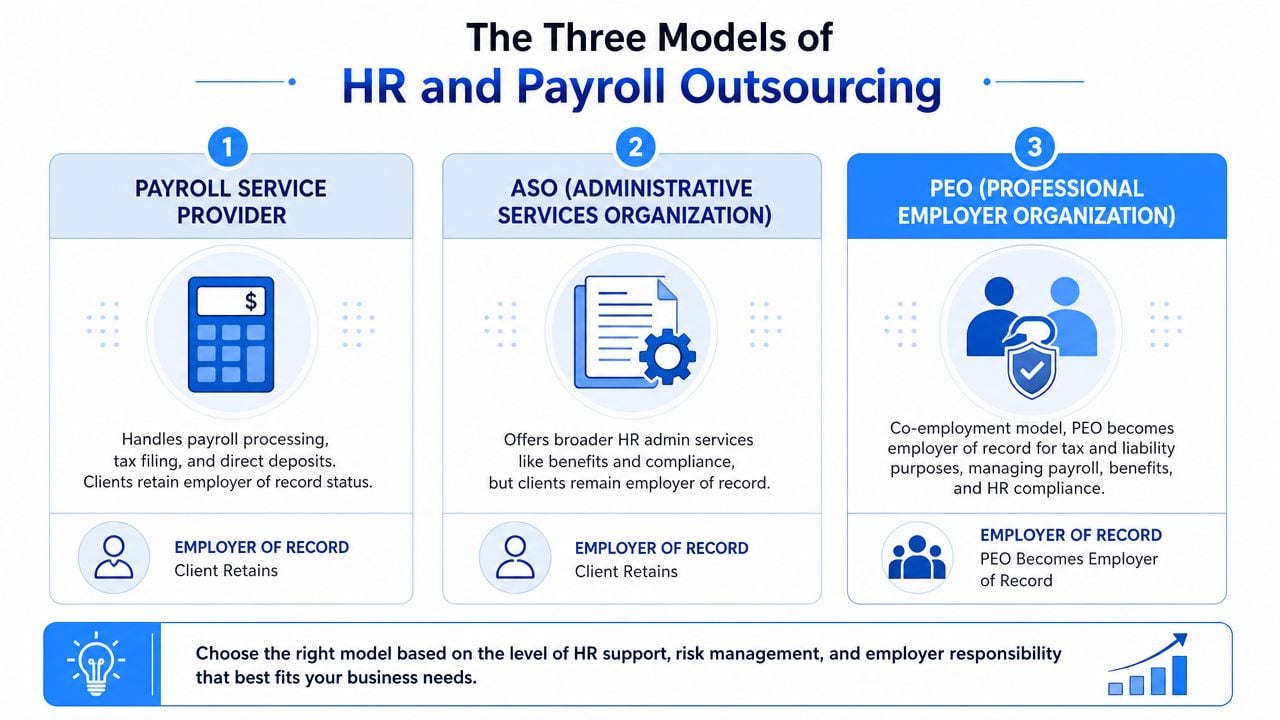
Three models, three very different risk positions
The market lumps very different services under “outsourcing payroll.” That causes bad comparisons. A payroll processor, an ASO (Administrative Services Organization), and a PEO (Professional Employer Organization) can all say they handle payroll. What changes is who does what, who carries which obligations, and how much of the employment infrastructure is being managed.
A simple way to think about it is housing.
A payroll service provider is like renting an unfurnished apartment. The provider handles the basic transaction. The company still manages most of the actual responsibility around it. Payroll runs, taxes may be filed, direct deposits go out. But the employer remains fully responsible for the broader HR and compliance environment.
An ASO is closer to a managed building. The company still owns the core employer responsibilities, but an outside firm helps administer more of the operation. That can include payroll support, benefits administration, reporting, and HR process support. The employer of record position remains with the client.
A PEO is the full-service model. It operates through co-employment for certain administrative and tax purposes, while the client still directs day-to-day work and people decisions. Payroll, benefits, HR support, and compliance administration are integrated under a broader service structure. For many growing employers, that changes the operating burden materially. Companies sorting through these service layers usually benefit from a broader look at human resources outsourcing models.
The mistake isn't choosing the wrong provider. It's choosing the wrong model, then asking that provider to behave like a different one.
Payroll Outsourcing Models At-a-Glance
| Function | Payroll Service Provider | Administrative Services Organization (ASO) | Professional Employer Organization (PEO) |
|---|---|---|---|
| Payroll processing | Core service | Included or coordinated | Included |
| Tax filing | Usually included at the payroll level | Included or supported | Included |
| Employer of record status | Client retains it | Client retains it | Co-employment structure applies for designated functions |
| Benefits administration | Limited or add-on | Often included as admin support | Commonly integrated |
| HR advisory | Usually light | Broader support | Broader support plus integrated service model |
| Compliance support | Basic payroll compliance | More substantial admin guidance | More comprehensive operational support |
| Workers' compensation handling | Typically client-managed | Typically client-managed with support | Often part of the broader PEO structure |
| Best fit | Stable, lower-complexity employers | Employers needing help without co-employment | Employers needing scale, support, and stronger compliance infrastructure |
What works in practice is matching the model to the operating burden.
- Choose payroll-only when the company has internal HR depth, limited state footprint, and strong process discipline.
- Choose an ASO when leadership wants help with administration but wants to retain full employer structure without co-employment.
- Choose a PEO when growth, multi-state hiring, benefits pressure, or limited internal HR capacity make fragmented vendors hard to manage.
What doesn't work is buying the lightest model and expecting high-touch compliance support when a problem lands.
Quantifying the Real Benefits Beyond a Paycheck
The strongest case for HR outsourcing payroll usually isn't “they'll run payroll for us.” The stronger case is that the company gets a cleaner employment operating model. That includes fewer manual touchpoints, less dependency on one internal payroll expert, better coordination between benefits and payroll, and less management time spent on preventable back-office work.
Where the value actually shows up
One value bucket is process compression. When payroll data, onboarding inputs, benefits deductions, and reporting move through disconnected systems, teams spend time reconciling basic information instead of reviewing exceptions. In that environment, tools like AI-powered payslip processing can help standardize inbound payroll documents and reduce manual extraction work, especially during transitions, audits, or due diligence.
Another value bucket is role optimization. An HR manager shouldn't spend a disproportionate share of the week answering payroll correction questions or coordinating year-end paperwork. When outsourcing is structured well, internal HR can focus on performance issues, recruiting support, manager coaching, and employee relations. That's the kind of shift buyers are usually after when they evaluate the broader benefits of HR outsourcing.
What works and what disappoints buyers
The upside isn't automatic. Some outsourcing arrangements effectively reduce friction. Others just move the work to a different inbox.
What tends to work:
- Integrated ownership: Payroll, benefits administration, and compliance support sit close enough together that deductions, eligibility, and reporting don't drift.
- Named support contacts: The company has a real escalation path when a payroll issue affects cash, taxes, or employee trust.
- Strong implementation discipline: Data cleanup happens before go-live, not after the first bad payroll.
What usually disappoints buyers:
- Cheap payroll with expensive leftovers: The provider runs paychecks, but internal HR still handles notices, exceptions, garnishments, and benefits reconciliation.
- Overbought service bundles: The company pays for broad HR support but rarely uses the advisory layer because service is generic.
- Messy handoffs: Sales promises a flawless introduction, but implementation misses earning codes, local tax setup, or deduction mapping.
A good outsourcing arrangement doesn't just produce pay stubs. It removes recurring work from people who shouldn't be doing it.
For finance leaders, that's the key perspective. Evaluate whether the arrangement reduces labor on low-value tasks, narrows compliance exposure, and gives the business more reliable operating capacity.
Decoding Payroll Outsourcing Pricing and Total Cost
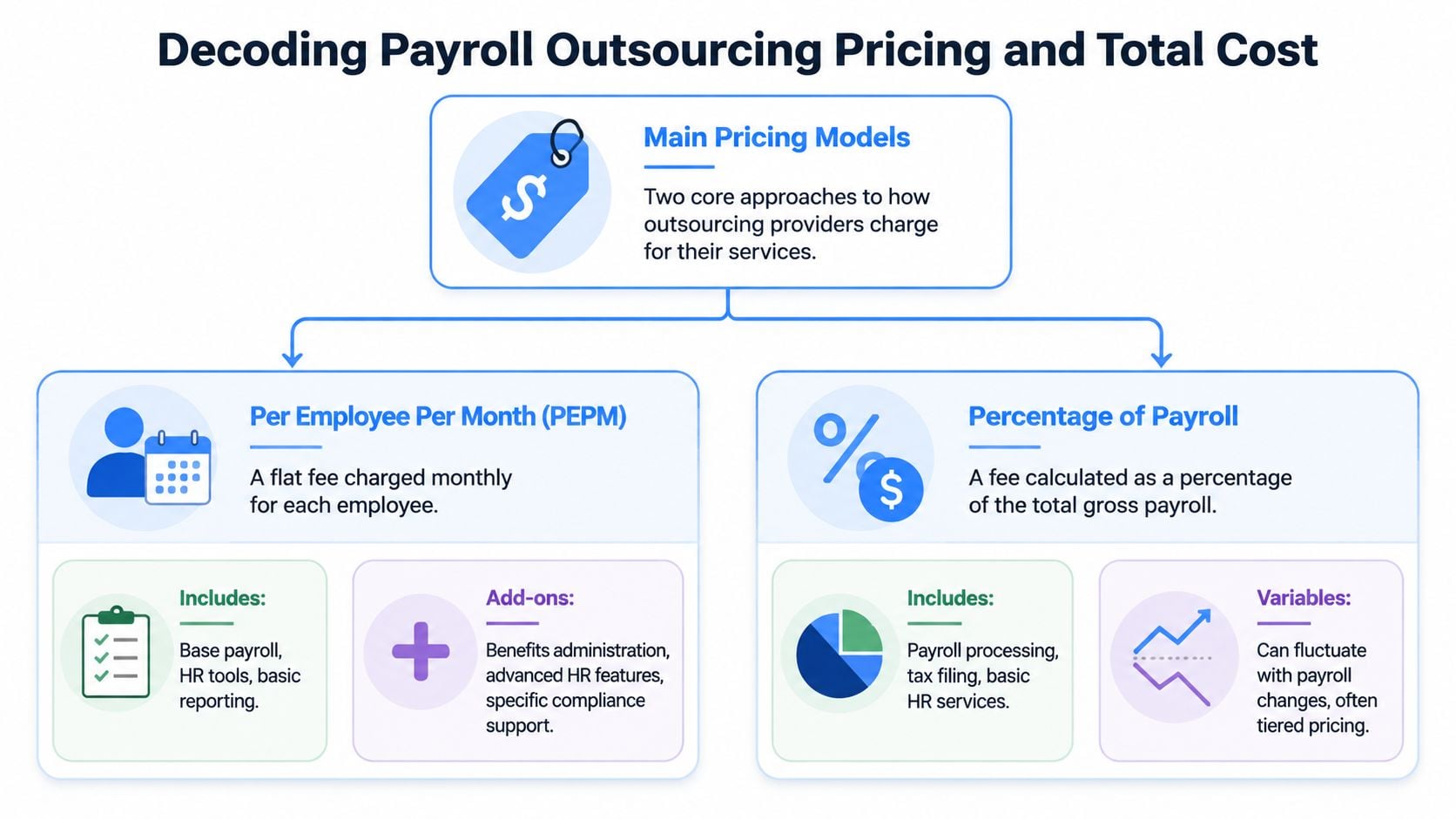
How to read the quote without getting fooled
The cheapest payroll quote often becomes the most expensive operating decision.
Providers know buyers anchor on the headline number, so the proposal usually starts with a simple pricing label such as per employee per month, or PEPM, or a percentage-of-payroll fee. That label tells you very little by itself. The real question is what work stays with the provider, what work comes back to your team, and what fees appear once the account is live.
For small to mid-market employers, PEPM pricing typically ranges from about $50 to $200 depending on service depth, and a company with 50 employees paying $120 PEPM faces roughly $72,000 in annual spend according to HR University's payroll outsourcing cost analysis. A narrow payroll-processing package can sit at one end of that range. A broader arrangement that includes tax filing, benefits administration, and HR support sits at the other.
Payroll-only buyers need a separate benchmark. For a 50-employee firm adding year-end reporting and multi-state support, a realistic budget might be $40 to $60 per employee per month, or about $2,000 to $3,000 per month, according to Paychex's payroll outsourcing overview. That is useful context for payroll services. It is not a proxy for a fully loaded PEO relationship.
A CFO should treat every quote as a cost-allocation model, not a service promise.
A workable total cost lens
The right comparison is total cost over time, not entry price. Normalize each proposal into the same three-year model and force every vendor into the same columns. Include recurring admin fees, setup charges, implementation, year-end processing, off-cycle payrolls, compliance support, notice handling, and any pass-through charges excluded from the headline rate.
One-time fees distort decisions because they disappear in sales conversations and reappear in the contract. Analysts at HR University note that buyers who ignore those fees can materially understate multi-year cost in payroll outsourcing arrangements. The exact percentage matters less than the discipline. Build the model before procurement starts arguing over rate cards.
Use this structure to pressure-test a proposal:
Base fee check
Convert the quote into monthly, annual, and three-year cost. If pricing is tied to payroll, model wage growth, bonus cycles, and hiring plans.Scope audit
Confirm which services are included. Tax filing, year-end forms, garnishments, wage attachments, multi-state registrations, and compliance support are often priced separately.Implementation review
Identify charges for data migration, parallel payroll runs, account setup, onboarding, and training. Ask who fixes historical data errors discovered during setup.Exception pricing
Price out off-cycle runs, reversals, retro adjustments, manual checks, custom reporting, and agency notice responses. These fees hit hardest in messy operating environments.Renewal mechanics
Review annual increases, minimums, true-ups, termination notice periods, and auto-renewal language. A low first-year rate can hide an expensive second contract year.
A short comparison table usually exposes weak quotes faster than a polished proposal deck.
| Cost Area | What to Verify |
|---|---|
| Recurring admin fees | PEPM or percentage basis, and what services are bundled |
| One-time costs | Setup, implementation, onboarding, data migration |
| Payroll exceptions | Off-cycle runs, voids, corrections, special checks |
| Compliance extras | Multi-state setup, notice response, ACA or year-end support |
| Contract drift | Annual increases, true-ups, and renewal language |
Teams that need pricing context before negotiations can review how much a PEO costs across common fee structures.
One more cost line belongs in the model even when it does not appear on the vendor quote. Insurance and worker classification issues often surface once a company expands across states or changes workforce mix. A practical reference point is this guide for Florida business owners and contractors, especially for employers checking exemption status and workers' compensation obligations alongside payroll outsourcing decisions.
Managing Multi-State Compliance and Employer Liability
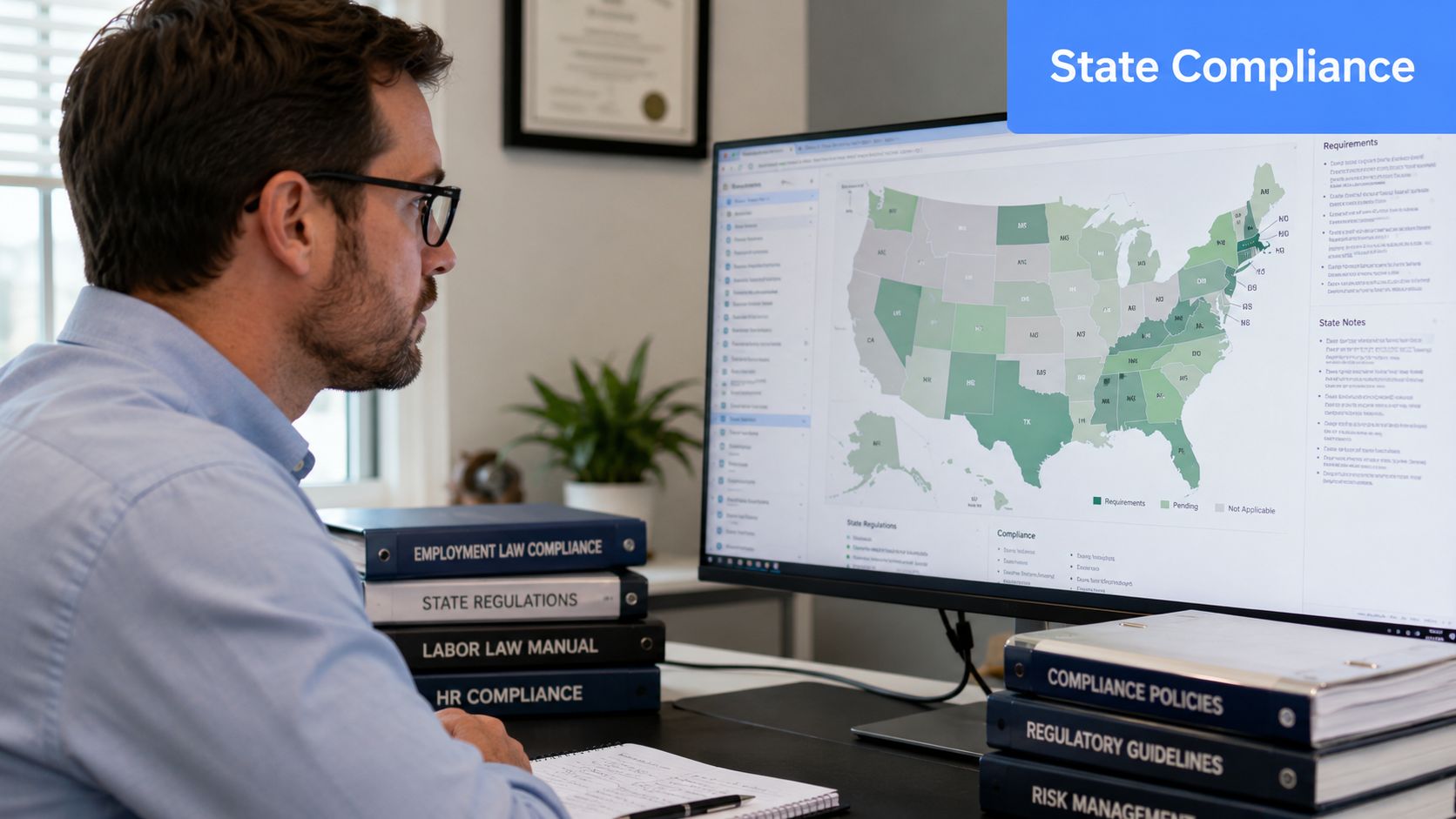
Why the first out-of-state hire changes everything
A company based in Texas can feel operationally simple until it hires one remote employee in California. Suddenly payroll isn't just wage calculation and direct deposit. The company may need new tax registrations, updated wage notice practices, different pay rule handling, local withholding awareness, and a workers' compensation structure that fits the new jurisdiction.
That's where the outsourcing model matters more than the software screen. A payroll processor may help run the check once the setup exists. An ASO may help coordinate the paperwork. A PEO, through its co-employment structure for designated administrative functions, may absorb much more of the setup and ongoing management burden.
For businesses with field staff, contractors, or changing classifications, workers' compensation questions create another layer of risk. A practical reference for that issue is this guide for Florida business owners and contractors, especially for teams sorting out exemption status and state-specific insurance obligations.
What the technology layer actually matters for
The compliance engine is where strong providers separate themselves from polished sales decks. Modern payroll outsourcing platforms embed over 1,000 unique jurisdictional rule sets, and when those rules are correctly applied, gross-to-net error rates fall below 1% compared with 3% to 7% in manual systems, according to Oyster's payroll outsourcing glossary. That same source notes that a single missing local wage withholding rule can trigger penalties that exceed the annual cost of the system itself.
Those numbers matter because multi-state payroll doesn't fail in dramatic ways at first. It fails in small, expensive misses. A locality isn't configured. A withholding rule isn't updated. A tax account is opened late. The payroll itself may still run, but the notices follow later.
Buyers should ask how jurisdictional rules are maintained, versioned, and audited. “We stay current” isn't an answer.
What works is documented compliance architecture, clear account ownership, and a provider that can explain who handles registration, notices, tax amendments, and local rule changes. What doesn't work is assuming that any provider with a self-service dashboard is equally strong at state and local compliance.
The Decision Framework and PEO Negotiation Strategy
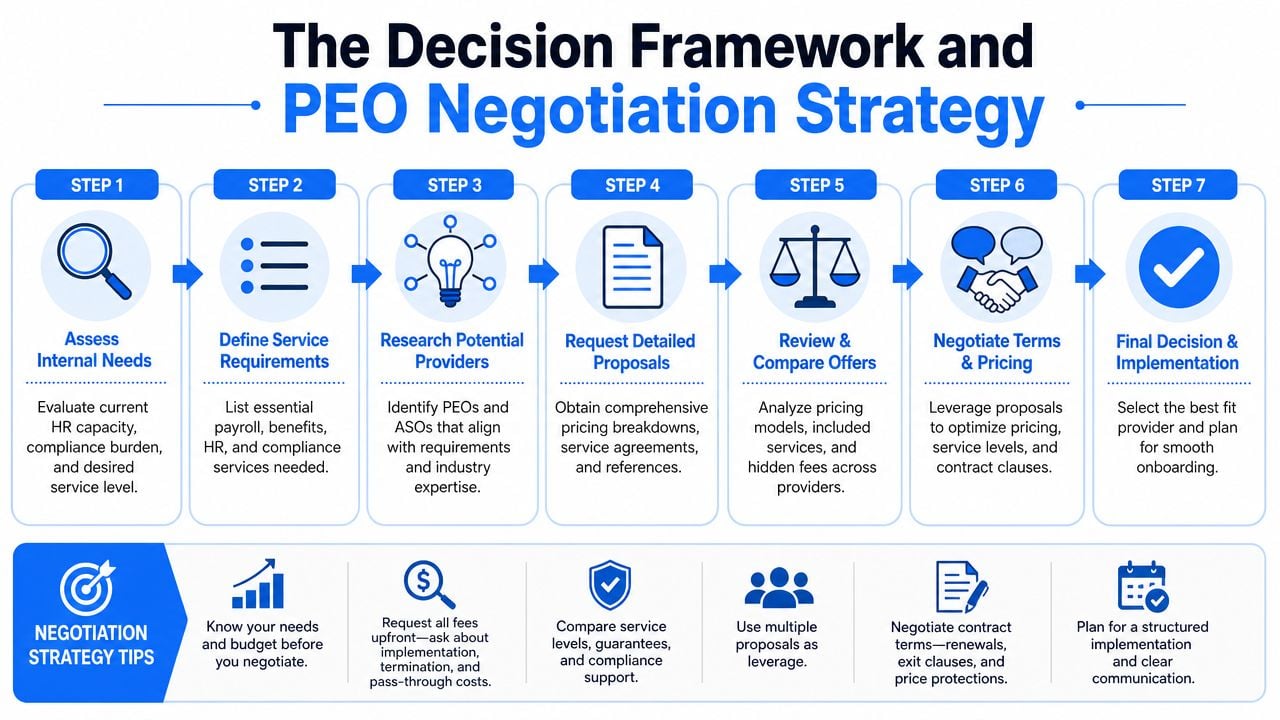
Choosing the right model before negotiating price
A company should settle the model question before it starts haggling over fees. Price pressure can improve a deal. It can't fix a mismatch between business needs and service design.
A workable decision framework starts with four filters:
Internal capability
If payroll and HR operations already run well in-house, payroll-only or an ASO may be enough. If one overloaded HR generalist is holding the process together, a broader model usually makes more sense.Operational complexity
Multi-state hiring, benefits coordination, workers' compensation questions, and frequent employee changes increase the value of integrated support.Risk tolerance
Some leadership teams are comfortable keeping more employer administration in-house. Others want tighter outside support because the downside of errors is too disruptive.Growth pattern
Fast hiring, acquisitions, new state entry, and turnover in finance or HR usually expose process gaps quickly.
A simple internal test helps. If the company had to absorb a payroll manager departure, a tax notice spike, and an out-of-state hiring push in the same quarter, would the current structure hold up? If the answer is no, the cheapest model probably isn't the right one.
The contract terms that deserve real pushback
Once a company chooses a PEO path, negotiation matters more than many buyers realize. There is limited public guidance on how to negotiate PEO fees, and many buyers default to the provider's quote, which leaves them exposed to fee creep and weaker contract protection, as noted in Thomson Reuters' discussion of HR and payroll outsourcing negotiations.
That default is expensive because standard agreements are often provider-friendly in the places that matter most.
Buyers should press on these terms:
Administrative fee protection
Ask for multi-year rate locks or at least clear caps on annual increases.Implementation credits
If the provider wants the business, onboarding concessions are often easier to win than headline fee cuts.Service-level guarantees
Tie critical service commitments to real remedies, not vague account management language.Exit-cost clarity
Require a clear formula for termination fees, data extraction, and transition support.Scope precision
Spell out what's included in notice handling, garnishments, reporting, and multi-state support.Renewal language
Avoid auto-renewal mechanics that make repricing difficult or compress negotiation windows.Dispute handling
Define escalation paths when payroll errors or service failures create business impact. Teams navigating provider friction can sharpen their internal approach with resources on conflict and confrontation in business settings.
Don't negotiate only on price. Negotiate on what happens when the relationship stops performing.
The strongest buyers run a side-by-side matrix with fees, included services, liability language, renewal triggers, and exit terms on one page. That format provides an advantage because it turns soft promises into visible contract differences.
What works is disciplined comparison and narrow, specific asks. What doesn't work is asking a sales rep, “Can you do better?” without tying that request to implementation credits, fee caps, service guarantees, and contract language.
Making Your Final HR Outsourcing Decision
A final decision on HR outsourcing payroll should survive a CFO review, not just a product demo. The critical question is whether the arrangement improves operational efficiency, lowers avoidable risk, and holds up under a bad quarter, a tax notice, or a messy exit.
By this point, the choice should be narrower than "outsource or don't outsource." The better test is fit.
A payroll processor fits when the company wants to keep HR control in-house and mainly needs accurate payroll execution. An ASO fits when leadership wants outside administration but is still prepared to retain more employer responsibility. A PEO fits when the business values broader infrastructure, stronger benefits access, and shared administrative burden enough to accept co-employment and the contract discipline that comes with it.
That is the strategic layer. The economic layer is simpler. Ask whether the provider's full cost is lower than the internal cost of doing the work well, after including management time, compliance exposure, rework, software overlap, and transition friction. Cheap fees can still produce an expensive outcome if the service model creates payroll errors, weak support, or unclear liability when something goes wrong.
The final decision usually comes down to three questions:
- What failure would hurt the business first: payroll errors, compliance gaps, poor employee support, or lack of internal capacity?
- Which responsibilities are moving to the provider, and which remain with the company despite the sales presentation?
- Does the contract still look acceptable at renewal, during a service breakdown, and during termination?
If leadership can answer those questions in plain language, the decision is usually ready for approval. If it cannot, the company is still buying on impression rather than on operating and financial logic.
If the company is comparing PEOs, renegotiating an existing agreement, or trying to pressure-test pricing and contract terms before signing, PEO Metrics helps HR and finance teams evaluate options side by side, identify trade-offs, and negotiate with greater advantage.
