
The most popular advice on CoAdvantage PEO reviews is also the least useful, look at the star rating and move on. That shortcut misses the critical decision, because a PEO is not a software subscription, it's a contract-heavy operating relationship with payroll, benefits, compliance, renewal mechanics, and exit risk all built in. A buyer can like the reviews and still end up overpaying, locked into a bad term, or stuck with a service model that doesn't fit the company's headcount, industries, or state footprint.
For HR directors and CFOs, the right question is simpler and harder: does CoAdvantage fit the business model in front of the spreadsheet? The answer depends on pricing transparency, implementation quality, service consistency, and the clauses that reshape total cost after signature. For a broader comparison framework, the category-level review lens at PEO review criteria and comparison guidance is the right place to anchor the vendor shortlist.
Table of Contents
- Why Most CoAdvantage PEO Reviews Miss the Real Decision
- CoAdvantage at a Glance, History, Footprint, and Market Position
- Pricing, Fees, and the True Cost of a CoAdvantage Engagement
- The CoAdvantage Service Model and Day-to-Day Operations
- Contract Terms That Can Make or Break the Deal
- Service Quality Signals From Public Reviews and What They Actually Mean
- Who CoAdvantage Is Best For and How It Compares to Alternatives
- Negotiation and Benchmarking Playbook for Your CoAdvantage Decision
Why Most CoAdvantage PEO Reviews Miss the Real Decision
A star rating tells a buyer very little about whether a PEO will fit the business. CoAdvantage's 4.3/5.0 G2 rating across 135 reviews is useful as a market signal, but it still does not answer the questions that decide the deal, like what happens at renewal, how implementation fees hit year one, or how exit terms change the total cost of ownership. Review pages are helpful for sentiment. They are poor tools for pricing discipline and contract risk. The public review base does show that CoAdvantage is a real vendor with enough visibility to support serious diligence, not a last-minute name pulled out of a search result G2 review profile.
The right lens is operational, not emotional
A 50-person employer and a 500-person employer do not buy the same PEO, even if both are looking at the same CoAdvantage page. The smaller company usually needs clean payroll, benefits access, and someone who answers the phone. The larger one needs multi-state compliance discipline, transition management, and a contract that does not punish growth or make exit expensive. Good reviews do not tell you whether CoAdvantage's service model fits that profile.
Practical rule: Judge a PEO by what it changes in your monthly operating rhythm, not by how many buyers clicked five stars.
That frame matters because CoAdvantage reviews often mix service praise with feature talk, which makes the vendor sound broadly good without separating day-to-day responsiveness from long-term contract quality. Buyers should separate pricing transparency, service quality, contract risk, and fit. If those four are not aligned, the relationship feels fine at the start and expensive later.
Public reviews also miss the clauses that change the economics after signature. Renewal-rate-lock provisions, termination notice windows, and implementation billing terms matter more than polished testimonials because those terms decide whether your costs stay predictable or drift upward. For a useful benchmark on review patterns across PEOs, see the PEO reviews and comparison data.
The fastest way to cut through the noise is to ask, “What is the true cost of staying, and what is the true cost of leaving?” That is the lens that matters when the sales demo is over.
CoAdvantage at a Glance, History, Footprint, and Market Position
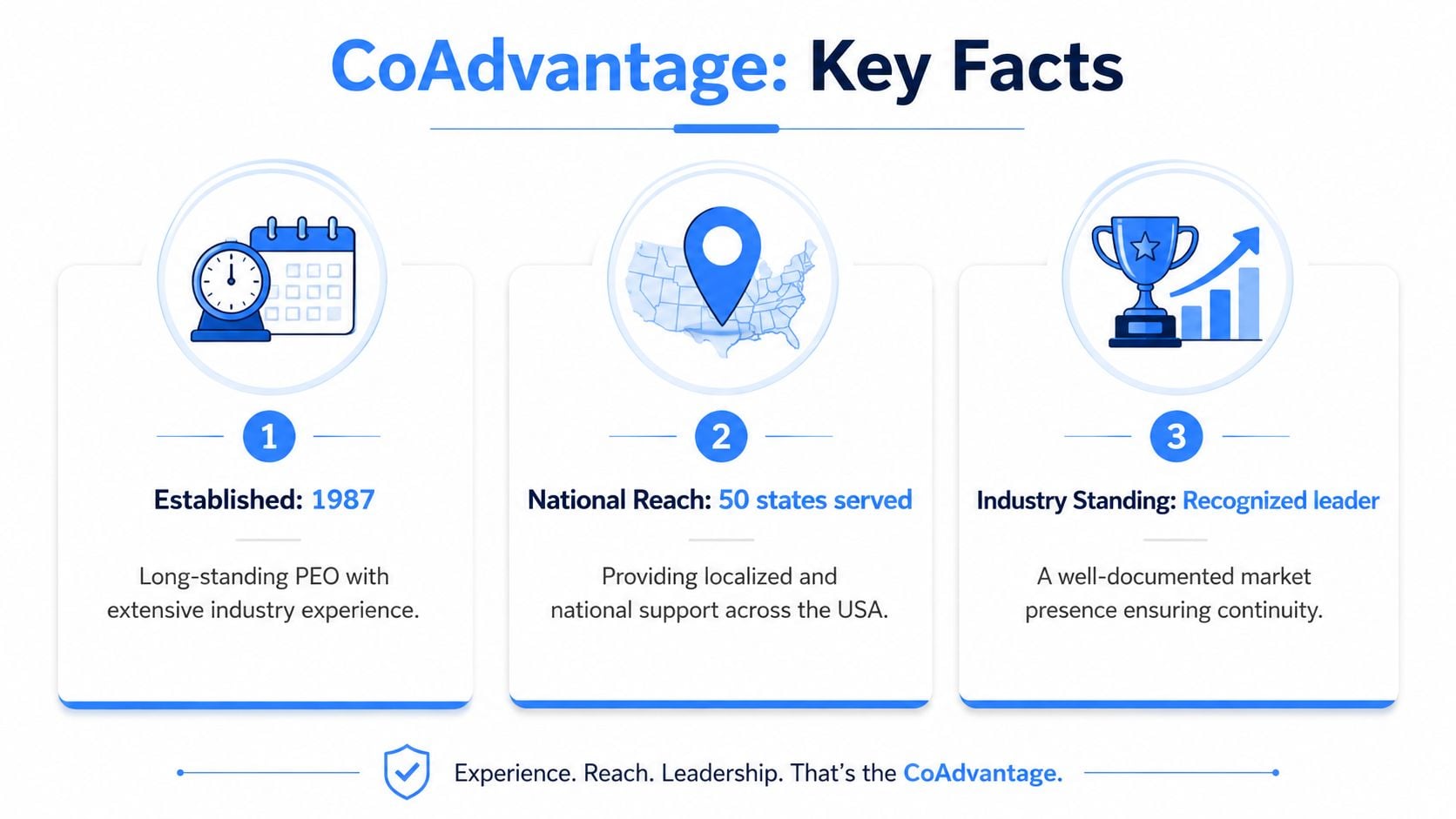
CoAdvantage looks like a mature PEO with staying power, not a short-lived entrant trying to buy attention with marketing. StaffMarket lists a Tampa, Florida headquarters and client retention figures that deserve attention, 85% of clients who could have stayed at least 1 year did stay, 77% stayed at least 2 years, 36% stayed at least 5 years, and 10% stayed at least 10 years StaffMarket profile. That pattern matters because PEO clients rarely remain that long unless onboarding works, the contract is tolerable, and account service does not unravel after implementation.
What retention says about a PEO
Retention is not a vanity metric in this category. It usually shows whether clients got through setup without chaos, whether account management stayed steady, and whether renewal terms were fair enough that switching never became urgent. Long-horizon retention carries extra weight in a service where moving is disruptive and expensive, because it suggests the provider cleared the first hard test and kept the relationship intact through renewal cycles.
The public reputation signals point in the same direction. Glassdoor reviews show 291 company reviews, a 3.7/5 employee rating, and 60% of employees saying they would recommend the company, while the broader profile also notes an overall worker rating of 4.1/5 based on 97 reviews as of February 2, 2026. That mix says CoAdvantage has enough scale to be taken seriously and enough visibility to be evaluated, but it is not so uniformly praised that buyers should assume perfect service delivery.
For buyers, that is a stability signal, not a promise. CoAdvantage has the footprint of a national PEO, enough history to benchmark, and enough retention evidence to earn a place in a serious RFP, which is the right standard for a provider in this market. For a broader comparison set, the PEO company directory and comparison set helps place its position alongside other providers.
Pricing, Fees, and the True Cost of a CoAdvantage Engagement
CFOs get misled by headline pricing all the time, and PEO pricing is one of the easiest places to make that mistake. Third-party advisory estimates place comparable CoAdvantage-style PEO engagements around $120 to $180 per employee per month, with higher costs in service industries that carry more workers' compensation exposure. That range is useful, but only as a starting point, because the quote that matters is the one after implementation charges, benefits load, workers' comp passthroughs, and exit language are all read together.
The point is simple. A low admin fee can still produce a high total cost if the contract buries setup charges, pushes carrier changes into the renewal cycle, or leaves termination costs vague until you try to leave.
What the budget actually needs to include
A clean way to pressure-test any quote is to separate the obvious from the hidden. The obvious line item is the admin fee. The hidden load is where total cost changes.
| Cost Component | Typical Range | What to Ask |
|---|---|---|
| Admin fee | Varies by employee and service scope | What is included, payroll, HR support, compliance, benefits admin? |
| Implementation charge | Often one-time | Is it credited back, waived, or tied to employee count? |
| Benefits load | Depends on plan design | Are carrier costs passed through, and how are renewals handled? |
| Workers' comp premium | Exposure-driven | Is the premium bundled, audited, or subject to true-up? |
| Exit cost | Contract-specific | What notice, penalty, or reimbursement is triggered at termination? |
For accounting teams, the cleanest reference point is the ReceiptsAI expense categories guide. A messy PEO invoice still has to be translated into expense buckets that finance can post, reconcile, and defend.
A simple worked example makes the point. A 120-employee professional services firm in three states might see a visible admin quote that looks manageable, but the annual spend changes once benefits, payroll administration, and risk management are layered in. In that scenario, the question is not whether the quote is cheap. The question is whether each component is clear enough to forecast and reconcile month by month.
Budget rule: If the provider cannot show the full stack of charges in one place, the quote is not transparent enough for approval.
CFOs should also compare the quote against the operating cost of keeping payroll, benefits admin, compliance support, and workers' comp management in house. PEO pricing only looks expensive when the buyer treats the admin fee as the whole bill. Before any signature, use PEO pricing transparency guidance to pressure-test line items, renewal assumptions, and pass-through charges.
The CoAdvantage Service Model and Day-to-Day Operations
A PEO only makes sense when the operational split is clear. CoAdvantage, like any co-employment provider, absorbs the back-office burden for payroll tax filings, workers' comp policy management, benefits administration, and core HR compliance, while the client keeps control of hiring, firing, compensation, performance, and culture. That division matters because buyers often assume they're buying “outsourced HR” when they're really buying a shared-employment structure with defined handoffs. A well-run relationship lowers friction, but only if both sides know exactly where the line sits.
What a normal month looks like
Payroll is usually the easiest place to see whether the model works. The client approves time and pay data, the PEO processes the payroll and filings, and the HR contact handles questions that would otherwise get routed through a patchwork of vendors and internal staff. Benefits changes, like a dependent update or enrollment change, should move through a defined workflow rather than a chain of informal emails.
When a workplace incident happens, the PEO's role becomes visible fast. Workers' compensation claims management, compliance guidance, and risk handling need clear ownership, or the client ends up chasing answers while the clock is ticking. That's why vendor-management discipline matters here, and the structure in best practices for technology vendors is useful even though a PEO is broader than a tech tool.
A buyer should also ask who answers on a bad Tuesday afternoon, not just in the sales cycle. If the provider relies on an assigned HR contact, the follow-up question is whether that person is stable, reachable, and authorized to solve problems without escalation loops.
The responsibilities that stay with the client
The client still owns the hard management calls. That includes hiring decisions, terminations, compensation changes, job design, manager discipline, and company culture. A PEO can advise, and it should, but it can't run the business for the employer.
The cleanest way to think about CoAdvantage is as infrastructure, not leadership. The company should be taking administrative load off the client, not replacing the client's operating judgment. Buyers who get that distinction right usually have a smoother onboarding and fewer ugly surprises after go-live, especially if they map the workflow against how a PEO works step by step.
Contract Terms That Can Make or Break the Deal
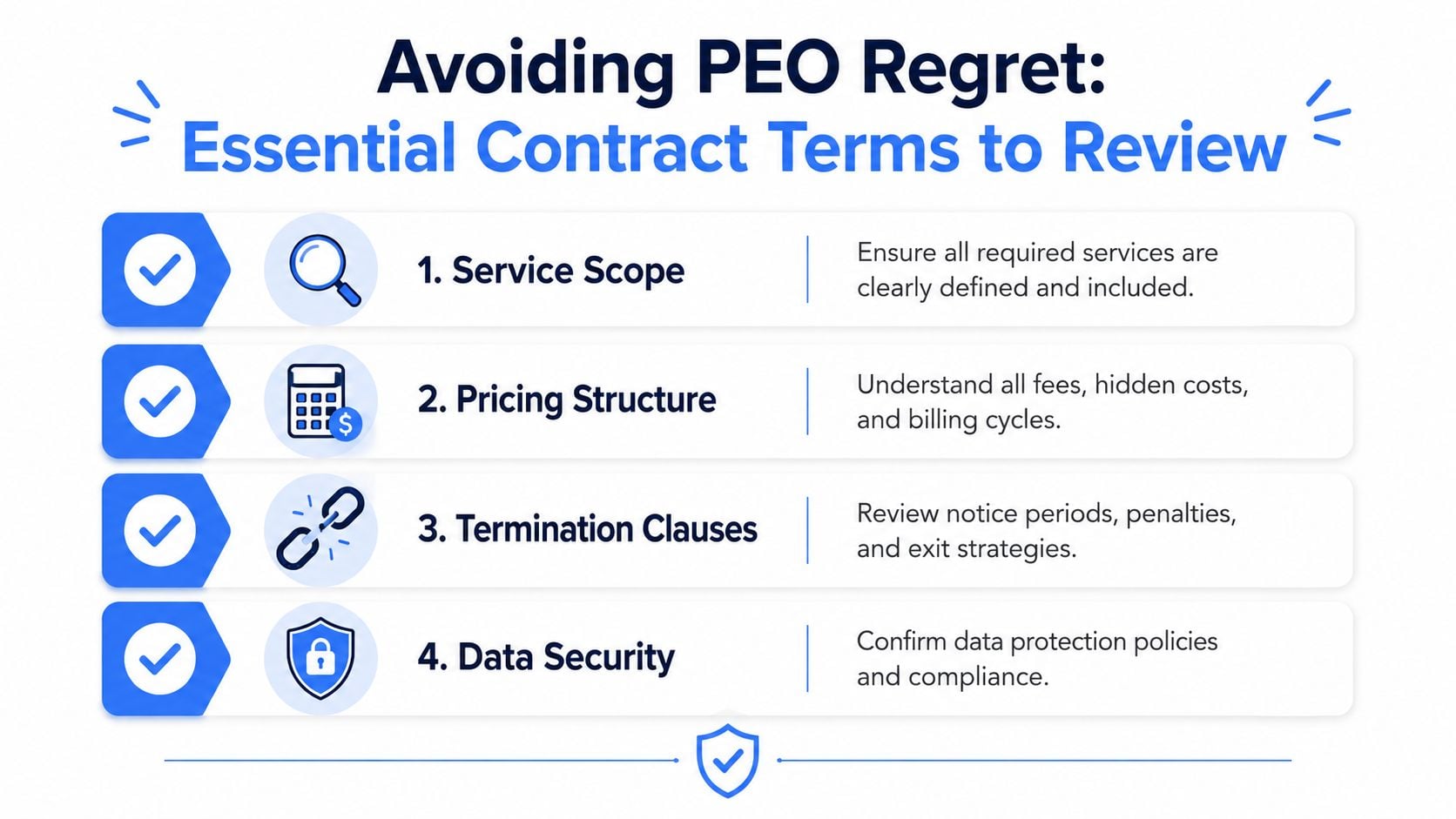
The biggest regrets in PEO deals rarely come from bad service alone. They come from contracts that looked standard at signing and expensive six months later. CoAdvantage, like every serious PEO, needs to be judged on termination notice windows, auto-renewal behavior, rate-lock mechanics, implementation reimbursement, liability allocation, and audit rights, because each one changes the economics of staying.
The clauses that deserve a red pen
Termination language comes first. If the notice window is too short or the exit fee is too aggressive, the provider has more influence than the client does, especially during a bad renewal year. Automatic renewal clauses should be read as hard deadlines, not administrative noise.
Rate-lock provisions need equal attention. Buyers should ask how long the rate is protected, what triggers an increase, and whether changes are tied to payroll growth, claim experience, or contract anniversary. If the escalator formula isn't written in plain language, it's a cost risk.
Implementation reimbursement clauses are another trap. Some agreements shift onboarding expense back to the client if the relationship ends early. That can turn a manageable setup cost into a penalty, which is exactly the kind of item that makes a board ask why legal didn't catch it sooner. The checklist at PEO master service agreement review points is the right lens for this part of diligence.
Ask for the clause that says what happens when the client leaves early, not just the clause that explains onboarding.
What buyers should negotiate
The most reasonable concessions are the ones that reduce breakage risk without blowing up the relationship. A buyer should push for clear service scope, a written fee schedule, and liability language that doesn't leave every operational issue on the client's desk. Audit rights matter too, because billing disputes are easier to solve when the employer can inspect the underlying math.
A short due-diligence checklist helps keep the negotiation focused:
- Termination notice: Confirm the exact window and whether it resets at renewal.
- Fee schedule: Get every recurring and one-time fee in writing.
- Rate increases: Tie every increase to a defined trigger.
- Exit mechanics: Understand reimbursement, data transfer, and final payroll handling.
- Liability wording: Clarify who carries which risk in a claim or compliance issue.
That's the part of the deal most buyers learn too late. A fair contract can make a decent PEO feel like a strong one, and a sloppy contract can make a strong PEO feel expensive.
Service Quality Signals From Public Reviews and What They Actually Mean
Public reviews split into two tracks, buyer experience and employee experience. On the buyer side, CoAdvantage's G2 rating of 4.3 to 4.4 out of 5 across 133 to 135 reviews points to a generally positive service experience, especially around responsive HR support, bundled payroll, benefits, and compliance G2 review profile RFP Wiki comparison page. On the employee side, the signal is more mixed, with Glassdoor at 3.7/5.0 from 291 reviews and 60% recommend, plus Indeed at 4.1/5.0 from 97 reviews Glassdoor reviews StaffMarket profile.
Why the gap matters
That split does not make CoAdvantage a bad choice. It usually means the buyer-facing service layer is stronger than the employer-brand signal behind it, which is common in PEOs where account management can be solid even if internal training or platform depth is not fully visible. Buyers should treat that as a reason to validate implementation, not as a reason to walk away.
The practical read is straightforward. Strong buyer reviews tell the HR team that service may be responsive. Mixed employee sentiment tells the CFO and HR director not to assume consistency without proof. The ultimate test is whether the service team stays disciplined after onboarding, during payroll corrections, escalations, and renewal conversations.
The reference checks that help
A vendor reference should never be a generic happy-customer call. Ask for a client with similar headcount, similar state footprint, and similar risk exposure. Then ask three direct questions, how long implementation took, what happened during the first payroll issue, and whether the service team changed after go-live.
A second question set should go to the implementation lead, not the salesperson. Who owns escalations, what happens when a case is unresolved in one business day, and how are billing disputes tracked? Those answers matter more than polished product language because they show how the provider behaves after the contract is signed. Public reviews point to service that can work well, but the contract, the escalation path, and the billing process tell you whether that experience will hold up under pressure.
Who CoAdvantage Is Best For and How It Compares to Alternatives
CoAdvantage tends to fit employers that want a high-touch service model and a practical back-office solution more than a flashy platform. That usually means businesses in the 50 to 500 employee range, multi-state employers that need payroll and compliance support without building everything in house, and service-heavy companies where workers' comp and risk management matter. Buyers that want deep HR customization, advanced software workflows, or aggressive contract flexibility may want to keep looking.

Where it tends to fit
A regional manufacturer with operations in three states and no internal payroll specialist often gets more value from a service-heavy PEO than from standalone software. So does a professional services firm that wants bundled benefits access without building a full HR department. In both cases, the question is less about brand prestige and more about who can manage the actual work.
A buyer evaluating alternatives should compare CoAdvantage against national PEOs on four dimensions, benefits strength, technology stack, contract flexibility, and industry specialization. That's the comparison that matters because no vendor wins evenly across all four. For teams sorting through options for growing companies, PEO options for growing teams is a useful external benchmark for the broader market.
Where it may not be the right answer
If the business already has strong broker relationships, wants a more modular setup, or expects heavy customization, CoAdvantage may feel too bundled. If the company is international or mostly contractor-based, the fit gets weaker fast. For buyers in that position, an ASO or specialist payroll stack may be the cleaner move.
The test is straightforward. If the company needs dependable HR execution and can live with a more traditional service model, CoAdvantage belongs on the shortlist. If the company wants a highly configurable platform with more self-service control, the shortlist should point elsewhere.
Negotiation and Benchmarking Playbook for Your CoAdvantage Decision
Push for a rate lock in writing, ask for implementation fee credits, and spell out every service commitment in the contract. CoAdvantage buyers should treat the quoted monthly fee as only part of the deal. The true cost shows up in renewal language, exit clauses, and what happens if service levels slip after the paperwork is signed. Use the $120 to $180 per employee per month third-party cost range as the benchmark frame, then force at least two competing PEOs to quote the same scope so you can compare like for like. Put the CFO, HR lead, and the person handling legal review in the same meeting, because PEO terms are connected and they should be negotiated together.
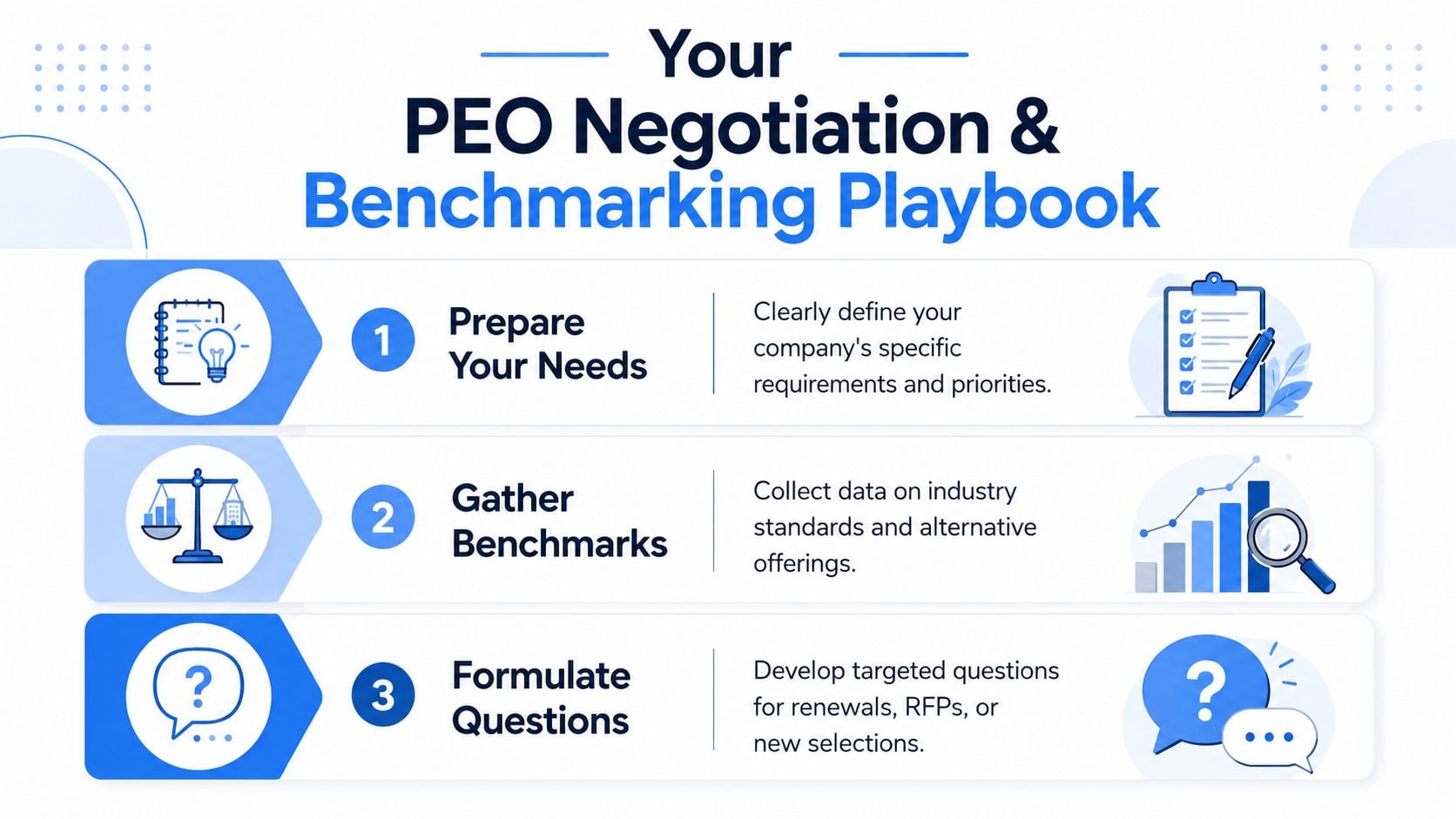
The contract should answer three questions before anyone signs. What pricing stays fixed, what can change at renewal, and what happens if the company leaves early. If CoAdvantage will not hold pricing for a defined term, the buyer should ask for concessions somewhere else, usually onboarding credits, admin fee relief, or a cleaner termination clause. If the renewal language lets fees rise without a clear cap, the apparent savings disappear fast.
Benchmark service terms against the operational burden, not just the sales presentation. Ask how payroll errors are handled, who owns benefits carrier follow-up, and what response time is promised for HR escalations. If those answers stay vague, the relationship will be expensive even if the sticker price looks fair. That is the part many buyers miss.
If the buyer wants outside help, PEO Metrics compares PEO options side by side, flags contract risk, and helps employers pressure-test pricing and service terms before they sign. Use it to test the renewal language, the exit terms, and the scope of service against other offers. That is the work that keeps a polished sales pitch from becoming an expensive surprise.
