
A mid-market HR director can go months thinking OSHA is “handled,” only to discover during a routine audit that a serious injury never made it into the reporting workflow. Operations assumed HR was tracking it. HR assumed the plant manager had called it in. Finance only hears about it when the citation memo lands, and by then the problem isn't paperwork, it's a missed legal duty, a broken process, and a management team that no longer trusts the controls around safety reporting.
That's the part most employers underestimate. Employer responsibilities under OSHA are not a side task for the safety team, and they don't disappear because a company uses a PEO. They sit inside everyday operations, recordkeeping, training, hazard correction, and incident reporting, which means HR, finance, and business leadership all own pieces of the outcome. For a practical overview of how small-business coverage works, the Premiere Education OSHA overview is a helpful starting point, but the primary challenge for a growing employer is turning that legal framework into a workflow people consistently follow.
Table of Contents
- Why OSHA Compliance Matters for Mid-Market Employers
- The Legal Foundation of Employer Duties Under OSHA
- Core OSHA Obligations Every Employer Must Fulfill
- How PEO Co-Employment Affects OSHA Responsibilities
- Enforcement Risks and the True Cost of Non-Compliance
- Your OSHA Compliance Action Plan and Next Steps
Why OSHA Compliance Matters for Mid-Market Employers
A 150-person manufacturer feels OSHA pressure differently than a 15-person office, but the risk pattern is the same. One injury, one late report, or one missing log entry can expose a weak process that had been ignored for months. In a PEO relationship, that gap becomes even easier to miss because everyone assumes someone else owns the follow-through.
The business problem behind a safety problem
OSHA's own employer guidance makes clear that employers must examine workplace conditions, maintain safe tools and equipment, train workers in language they understand, post required notices, and keep injury and illness records. Those obligations aren't limited to one industry or one company size, and they don't go away because the company outsources payroll or benefits administration. The legal duty sits with the employer, even when a PEO is helping with administration. OSHA employer responsibilities
That's why mid-market leaders need to treat OSHA as a cross-functional control system. HR usually owns training records and poster compliance. Operations owns the actual hazard controls and escalation when something breaks. Finance cares because lost workdays, follow-up investigations, and citation defense all create real cost, even before anyone starts measuring morale or turnover.
Practical rule: if a responsibility touches people, premises, or records, it needs a named owner and a back-up owner.
Employers that do well with OSHA don't rely on memory. They use a written escalation path for injuries, a checklist for inspections, and a review cadence that catches misses before an inspector does. Employers that fail usually have policies but no workflow. That's the difference between a binder on a shelf and a compliance system that holds up in a real audit.
For leaders comparing process maturity, the key question isn't whether the company has a safety policy. It's whether the company can prove who reports what, when, and to whom, especially when a PEO is involved. That's the line between risk transfer and risk confusion.
The Legal Foundation of Employer Duties Under OSHA
A mid-market HR director reviewing a PEO agreement during audit season can't assume the arrangement shifts OSHA liability off the company's books. OSHA's employer duties come from the Occupational Safety and Health Act of 1970, which created the federal obligation to furnish a workplace “free from recognized hazards” and to comply with OSHA standards and recordkeeping rules. That language is broad because the duty is broad. In practice, it means the employer has to identify foreseeable risks, correct them with the right controls, and document the work along the way. An infographic titled The Legal Foundation of Employer Duties Under OSHA outlining key workplace safety requirements.
What “free from recognized hazards” means in practice
The legal standard is not met by saying a hazard was obvious or that workers were “trained already.” Employers have to act on known risks with a layered control approach. OSHA's guidance includes engineering controls, administrative controls, and PPE when hazards can't be eliminated, plus mandatory employee training on recognition and avoidance of unsafe conditions. OSHA training and control guidance
That structure forces a real order of operations. If ventilation can remove a hazard, PPE alone usually is not enough. If a ladder process is unsafe, a warning memo will not fix it. Employers often fail when they confuse awareness with control, especially in facilities where supervisors assume a toolbox talk is the same thing as hazard abatement.
The law also treats training as a comprehension issue, not just a delivery issue. OSHA says training must be given in a language and vocabulary workers can understand. In multi-language or contractor-heavy workplaces, that is part of compliance, not an optional extra.
Why the rules became more specific over time
The modern reporting framework became more demanding as OSHA refined its rules, including a 2014 update that required direct reporting of severe incidents. That change matters because it shows how OSHA moved from general expectations to specific reporting timetables and documentation duties. The employer role is now procedural as much as it is protective.
The legal question is straightforward. Did the company have the controls, the records, the notices, and the reporting path in place before the incident happened. OSHA does not ask whether a company meant well after an incident. It looks at whether the worksite was managed in a way that reduced foreseeable harm.
For employers using a PEO, that distinction matters even more. Administrative support can help with payroll, posters, and parts of recordkeeping, but it does not erase the employer's duty to oversee safety, handoffs, and escalation. HR and finance leaders should also look closely at joint employment enforcement risks in PEO relationships, because co-employment language does not remove the need to know which obligations stay with the company and which tasks are only being assisted by the vendor.
Core OSHA Obligations Every Employer Must Fulfill
Compliance gets real when it turns into deadlines, forms, inspections, and training records. The companies that stay out of trouble usually don't try to “do OSHA” once a year. They build operating habits around a few fixed requirements and audit those habits regularly.
Hazard control and employee training
OSHA expects employers to control hazards using engineering controls, administrative controls, and PPE when elimination isn't possible. That means the employer has to look at the job, the equipment, and the process, not just hand out gloves and hope for the best. A worksite with recurring ladder incidents, for example, needs a process review, not just a reminder email. For a practical legal perspective on ladder risks in construction, the article on what construction workers should know about ladder is a useful reminder of how often simple equipment use turns into serious exposure.
Training has to match the work and the workforce. If a supervisor can't explain a hazard in terms workers understand, the training hasn't landed. That failure shows up later as preventable injury, not just a documentation gap.
Recordkeeping and incident reporting
Employers with more than 10 employees that are not in partially exempt industries generally must maintain injury and illness logs using Forms 300, 300A, and 301. They also need access to exposure and medical records for workers or their representatives. That means a real reporting workflow, not a folder of unsigned PDFs, has to exist inside the company.
The reporting deadlines are unforgiving. A workplace fatality must be reported within 8 hours, while an in-patient hospitalization, amputation, or loss of an eye must be reported within 24 hours. The common failure point is simple, someone sees the event, but no one knows who must make the OSHA call.
Posting, notices, and anti-retaliation
Employers also have to post required notices and avoid retaliation against workers who raise safety concerns or use their OSHA rights. That's where a lot of mid-market companies slip. They think of OSHA as a safety checklist, then miss the employee-relations part of compliance. A worker who reports a hazard shouldn't be treated like a disruption.
| Obligation | Trigger or Threshold | Timeline | Common Failure Point |
|---|---|---|---|
| Hazard assessment and control | Any recognized workplace hazard | Ongoing | PPE used as the only control |
| Employee training | Workers exposed to hazards | Before exposure and as needed | Training delivered, but not understood |
| Injury and illness logs | Employers over 10 employees in covered industries | Ongoing recordkeeping | Missing or inconsistent log entries |
| Fatality reporting | Workplace fatality | Within 8 hours | No clear escalation owner |
| Severe incident reporting | In-patient hospitalization, amputation, or eye loss | Within 24 hours | Operations assumes HR reported it |
| Posting and notices | Required by OSHA | Ongoing | Poster missing or outdated |
| Anti-retaliation protection | Employee reports hazard or injury | Immediate | Supervisor disciplines the reporter |
A safe-looking workplace can still be noncompliant if the records are wrong. OSHA audits often start there, not at the machine itself.
For teams reviewing internal process against vendor support, the employee responsibilities OSHA article is a useful companion because employer compliance works best when workers know their reporting role too. The company's obligation doesn't shrink when employees forget their part. It gets harder.
How PEO Co-Employment Affects OSHA Responsibilities
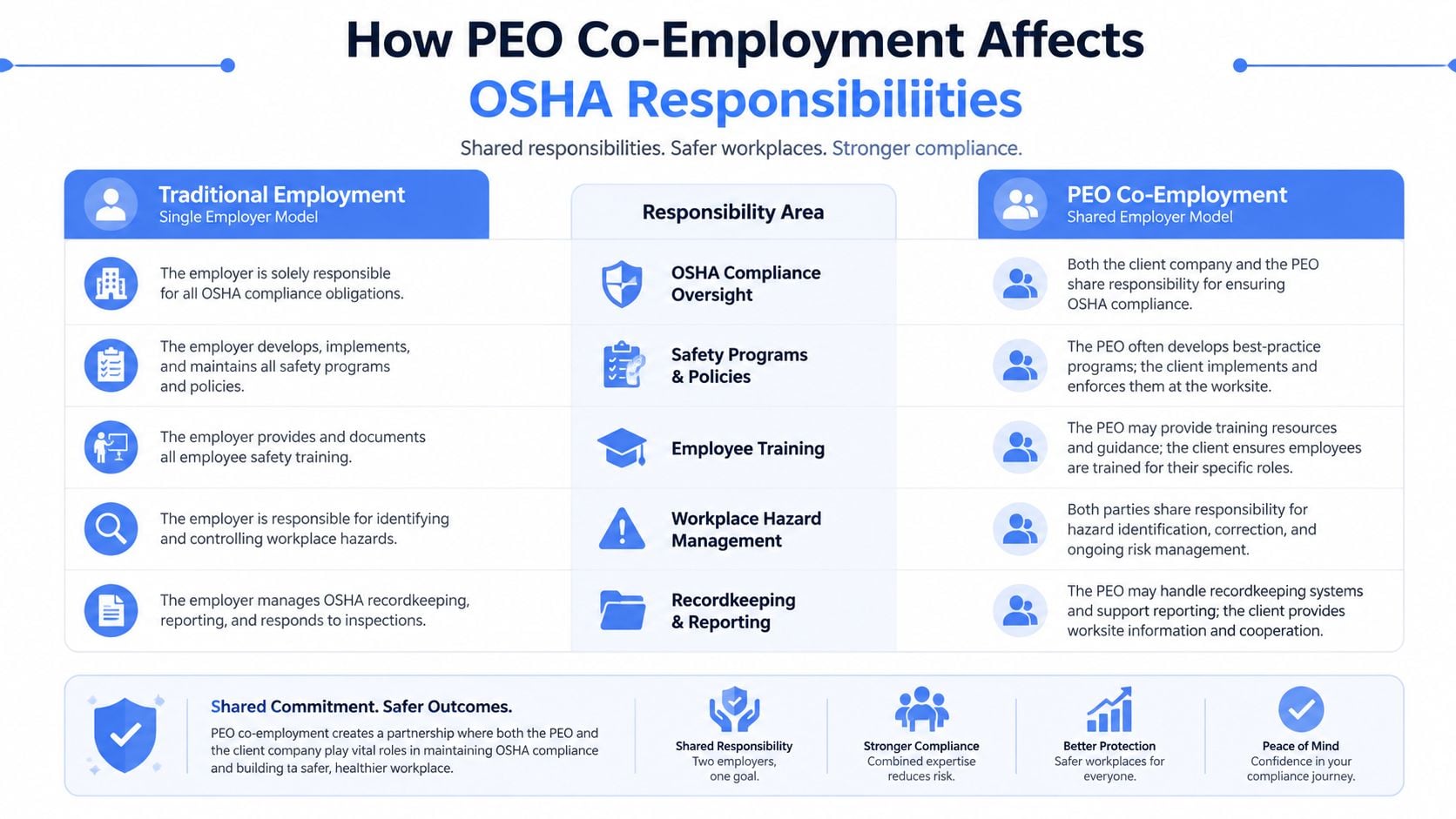
PEO relationships can simplify administration, but they can also blur accountability if the contract isn't clear. That's the trap. Co-employment changes who helps execute tasks, not who remains legally accountable for the workplace.
Shared work, retained liability
A PEO can help with recordkeeping, training administration, policy templates, and benefits-related coordination. It may also help the employer keep calendars, forms, and onboarding materials organized. But the worksite employer still controls the actual work environment, and that means it still owns hazard correction and safe operations.
That split matters during incidents. If a worker is hospitalized, someone has to decide who makes the report, who documents the event, and who follows up on abatement. If those steps live only in a service agreement and not in an actual workflow, the company is exposed the moment an incident happens outside business hours or when a manager is traveling.
The shared employer doctrine explained resource is helpful for leaders who need a cleaner mental model, but the operating takeaway is simple. A PEO can support compliance, but it can't absorb the employer's duty to provide a safe workplace.
Questions that expose weak contracts
The best PEO evaluations ask specific questions, not broad ones. Who receives injury notifications first. Who files the OSHA report. Who maintains the 300, 300A, and 301 logs. Who trains managers on escalation. Who owns follow-up if the report is late. If the contract is vague on those points, the company doesn't have a compliance solution, it has an assumption.
Multi-state employers face another wrinkle. State rules can differ, and distributed teams create more handoffs, more supervisors, and more chances for a delayed report. That's where PEO support can be useful, but only if the employer still verifies state-by-state requirements and keeps its own internal escalation map current.
For employers renewing a PEO agreement, the right standard isn't “Does the PEO handle OSHA?” The right question is “What exactly does the PEO do, what do managers still own, and how is that documented?” If those answers aren't clear, the company is carrying the risk whether the contract says so or not.
Enforcement Risks and the True Cost of Non-Compliance
An OSHA inspection rarely starts out of nowhere. Complaints, fatalities, serious injuries, and targeted high-hazard programs can all trigger a visit. If a company already has weak reporting habits, one incident can expand into a broader look at how safety decisions, recordkeeping, and escalation work.
Why underreporting makes the risk worse
OSHA's 2023 Work-Related Injury and Illness Summary shows that, as of May 31, 2024, 385,488 establishments submitted Form 300A data covering 1,538,299 injuries and illnesses, plus 18,506,116 days away from work and 22,409,900 days of job transfer or restriction.
Those totals matter because they show how much reporting, follow-up, and internal coordination injury and illness cases can require across employers. The broader labor market reported 2.8 million nonfatal workplace injuries and illnesses in 2022, up 7.5% from 2021.
The enforcement problem gets worse when companies underreport. A 2017 to 2023 hospital-based study in Illinois found 7,578 non-fatal occupational injuries and illnesses and 160 fatalities that were not reported to OSHA, with only 39.7% of non-fatal injuries and 25.1% of non-fatal illnesses reported.
What citations really cost
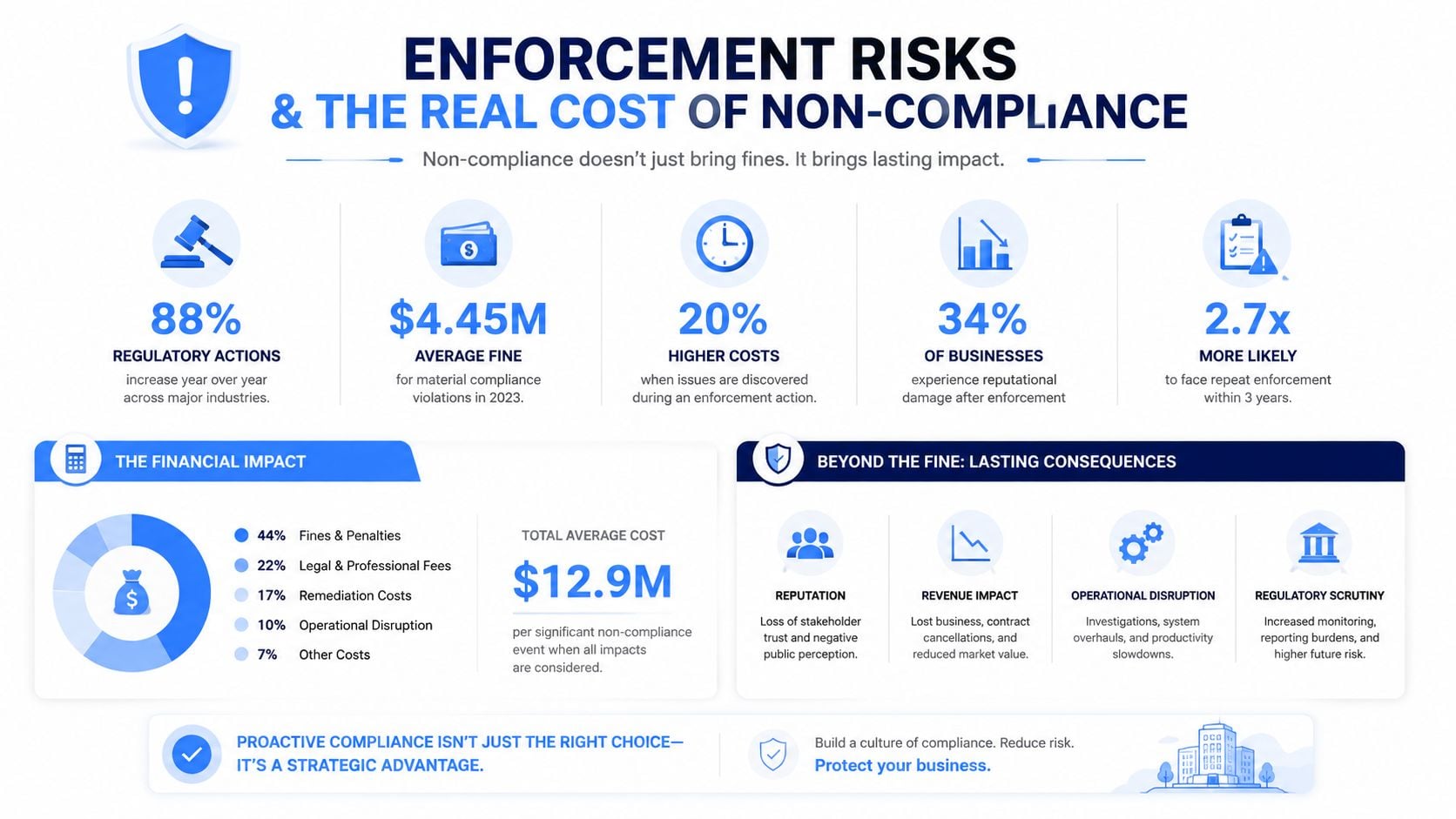
Citations are not just a fine line on a spreadsheet. They can require abatement work, follow-up inspections, document production, and management time that was never budgeted. A serious citation can also create a repeat issue if the employer fixes the symptom but not the process.
The expensive mistake isn't always the violation itself. It's the second failure, when the company can't prove the correction stuck.
For employers in construction or other exposed environments, a separate hazard like asbestos can compound the exposure because remediation, documentation, and worker communication all have to line up. The article on asbestos management risks and strategies is a good example of how one environmental issue can quickly become an OSHA and operations problem at the same time.
The internal review on PEO audit penalty case review matters for finance leaders because the full cost of non-compliance is not limited to citations. It also includes management distraction, internal cleanup, insurance questions, and the reputational damage that can make recruiting harder the next time the company needs a supervisor who understands safety.
Your OSHA Compliance Action Plan and Next Steps
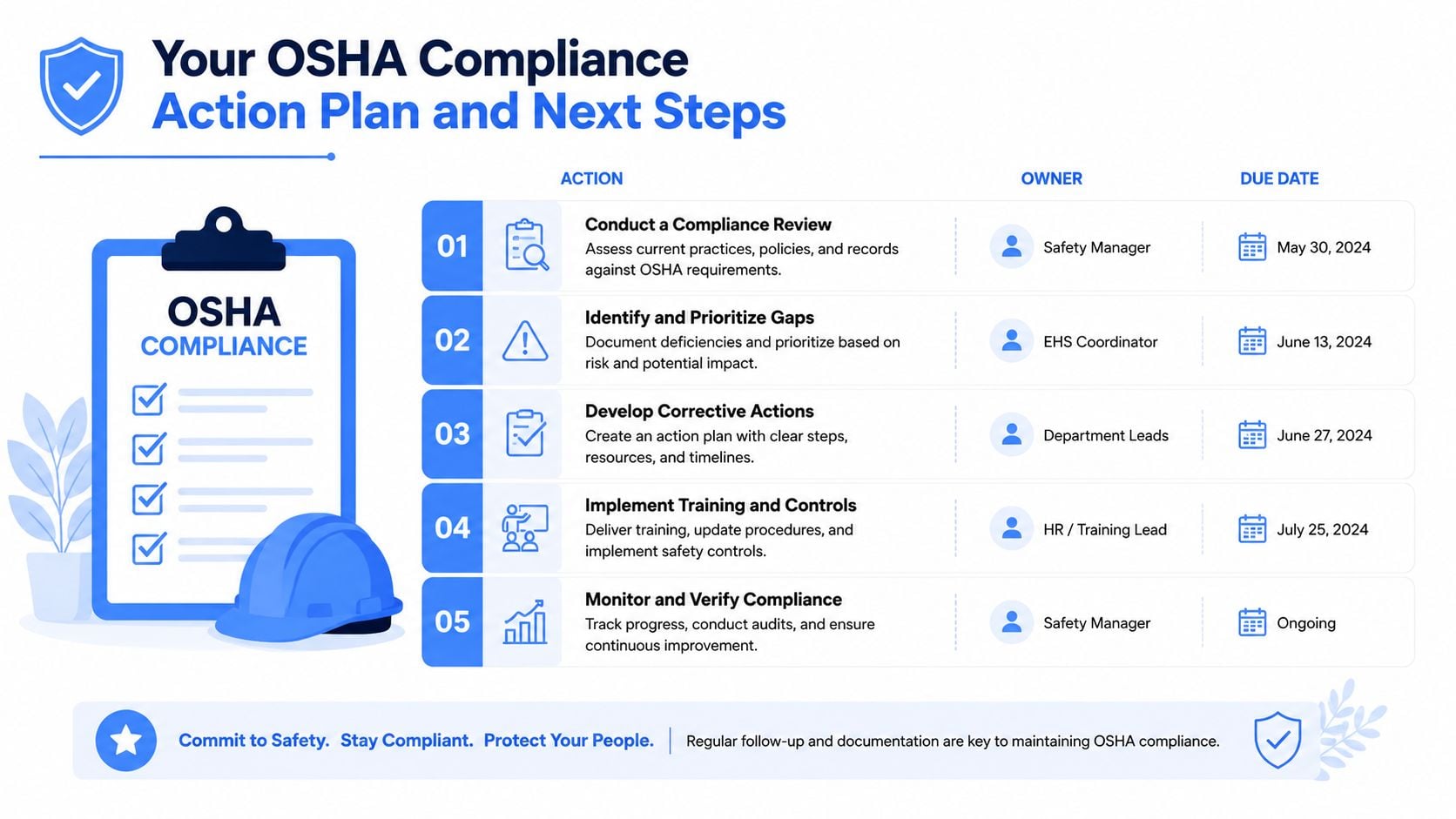
The fastest way to reduce OSHA exposure is to stop treating compliance as a single project. It needs owners, deadlines, and evidence. That's true whether the company runs safety in-house or through a PEO relationship.
A practical sequence that holds up
Verify incident escalation today. HR, operations, and plant leadership should know who reports a fatality within 8 hours and a severe incident within 24 hours. If that answer isn't immediate, the process is already too slow.
Audit the logs and postings this week. Confirm the company's OSHA poster is current, and check whether Forms 300, 300A, and 301 are complete where required. Missing records usually point to a missing workflow.
Review training records within 30 days. Training should match the hazards workers face and be understandable in the language they use at work. If supervisors can't explain the hazard controls, retraining is overdue.
Test your hazard reporting path. A worker should be able to report a hazard without having to guess which manager owns it. That path should work on a night shift, not just during business hours.
Clarify the PEO contract before renewal. PEO HR compliance services matter most when the agreement spells out who handles reporting, recordkeeping, training support, and escalation. If the contract is vague, the employer should tighten the language before the next incident forces the issue.
For HR and finance leaders, the next move is simple. Assign an owner to each OSHA duty, test the workflow with a real incident scenario, and confirm the PEO isn't being used as a substitute for management accountability. The companies that do this well don't just avoid citations. They build a compliance system they can defend when it matters.
If the goal is to tighten OSHA ownership in a PEO environment, PEO Metrics can help compare what's included in different provider models and where the employer still carries the risk. Visit PEO Metrics to review PEO options, compare contract terms, and pressure-test the compliance support before the next audit or renewal.
