
A supervisor at a midsize plant notices a machine guard hanging loose near the end of second shift. The line keeps moving. An employee sees it too, assumes maintenance already knows, and says nothing. The next morning, another worker reaches into the machine during a jam and narrowly avoids a life-changing injury. By lunch, HR is pulling training records, operations is reconstructing the timeline, and the company’s safety contacts are trying to determine who had to report what, and when.
That kind of near-miss creates more than safety risk. It exposes reporting gaps, weak documentation, and confusion about whether the employer, the PEO, the site manager, or the employee owned the next step. For HR directors and CFOs, employee responsibilities under OSHA belong in the same conversation as claims cost, audit readiness, and contract risk. A handbook that clearly assigns safety duties is part of that control structure, which is why many teams revisit basics like what belongs in an employee handbook after an incident.
Table of Contents
- Introduction
- Understanding OSHA Core Concepts
- Employee Rights and Duties Under OSHA
- Reporting Hazards Training and PPE Use
- Recordkeeping and Reporting Requirements
- Whistleblower Protections and Safe Work Refusal
- Common Misconceptions with Examples
- Actionable Compliance Checklist
Introduction
The most expensive OSHA problem often starts as a very ordinary employee choice. Someone sees a hazard, thinks someone else has it covered, and keeps working. In a stand-alone employer, that’s already risky. In a PEO arrangement, it can trigger a second layer of confusion because payroll, workers’ compensation administration, safety support, and site supervision may sit with different parties.
For companies with 10 to 2,000 employees, that split matters. A missed hazard report can become a claims dispute, a recordkeeping problem, or a finger-pointing exercise during an audit. Employers carry the legal burden to provide a safe workplace, but employees still have operational duties that affect whether incidents are caught early or allowed to escalate.
The practical question for HR and finance leaders isn’t whether employees have OSHA duties. They do. The key question is whether those duties are written, trained, documented, and mapped to the right party inside the co-employment structure.
Understanding OSHA Core Concepts
The shared model
OSHA works a lot like a team sport. Management sets the game plan, provides equipment, and trains the players. Employees still have to run the play correctly.
Under the OSH Act, employees must comply with applicable safety and health standards and follow workplace safety rules, even though OSHA cites employers rather than employees for violations. OSHA also ties employee conduct to basic actions such as reading the OSHA poster, following lawful safety rules, and using prescribed protective equipment, as summarized in the National Safety Council summary of employee rights and responsibilities.
A useful visual for HR training looks like this:
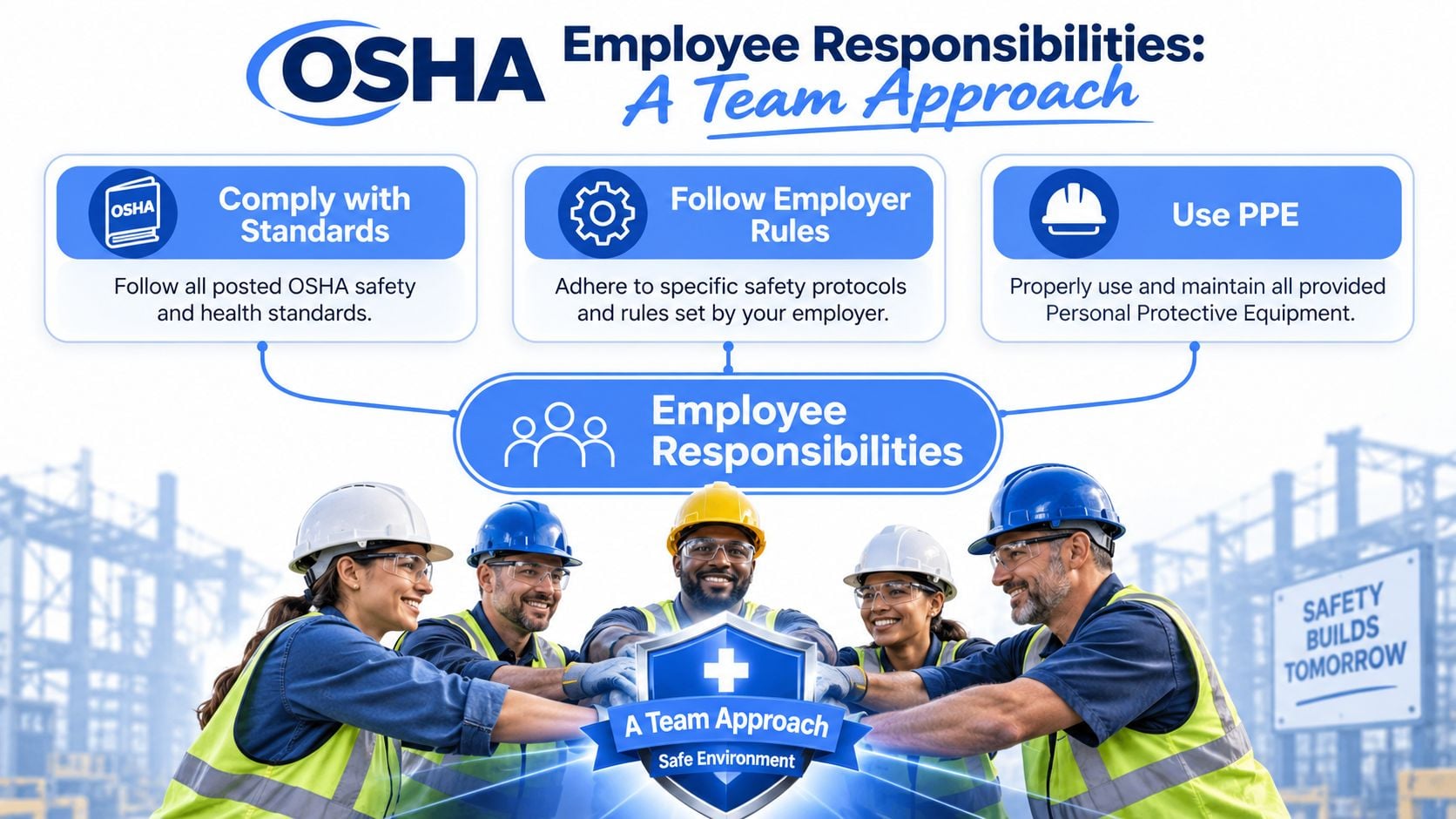
When leaders discuss employee responsibilities OSHA rules with managers, three duties belong at the center:
- Comply with standards: Employees need to follow posted rules and trained procedures.
- Follow employer rules: Site-specific safety instructions count, not just the federal standard.
- Use PPE: Hard hats, gloves, eye protection, hearing protection, and other assigned gear only work if workers wear and maintain them.
Practical rule: If a company can’t show what it told employees to do, it will struggle to prove that workers failed to follow it.
Companies that want a broader employer-side checklist can pair this with a review of OSHA requirements for employers.
Why co-employment changes the stakes
In a PEO relationship, the worksite employer still controls the floor. The supervisor sees the missing guard. The employee hears the machine making a new sound. The plant manager decides whether production pauses. But the PEO may support workers’ compensation administration, policy templates, or training delivery.
That means the core concept isn’t just “employees must follow rules.” It’s “employees must know which rule applies, who receives the report, and how that report gets documented.” If that handoff is vague, the safety system breaks at the exact moment it matters.
Employee Rights and Duties Under OSHA
A supervisor gets a text at 7:10 a.m. An employee saw a frayed extension cord near a wet production area before the line started. In a standard single-employer setup, the question is simple: who takes the report and who fixes it? In a PEO co-employment arrangement, the answer has two layers. The worksite employer controls the floor and the immediate response. The PEO may support policy wording, training records, or claim administration. Employee duties still start at the same place, but the reporting path has to be clear enough that no one loses an hour figuring out where the message belongs.
What employees must do
OSHA states that workers have responsibilities as well as rights. Employees are expected to follow the employer’s safety and health rules, use required protective equipment, report hazardous conditions, and report work-related injuries to the employer. OSHA also tells employees to read the OSHA poster posted at the workplace because it explains key protections and how to raise concerns through the agency. See OSHA’s Workers page for the agency’s summary of worker rights and responsibilities.
That list sounds basic. In practice, it works like a relay race. The employer sets the rule, the employee carries it out, the supervisor receives the report, and HR or the PEO may document what happened for training, claims, or recordkeeping. If one handoff fails, the company can end up with a preventable injury, a disputed claim, or missing documentation.
The OSHA poster matters for that reason. It is not wall decoration. It is a notice that tells employees what they can expect, what they should report, and where they can go if the normal chain breaks down.
A simple example makes the duty line clearer. A shipping employee notices that a dock plate is unstable before unloading begins. The employee’s role is not to diagnose the mechanical cause or decide whether the condition meets a citation threshold. The employee’s role is to stop, report, and follow site instructions. The worksite employer decides how to secure the area. The PEO may later help confirm whether training records, workers’ compensation reporting, or policy language match what happened.
Why HR and finance should care
For HR, employee duties shape three things: what must be taught, what must be documented, and what conduct can be disciplined fairly. If workers are told to report hazards “promptly” but no one defines who receives the report, HR will have a hard time enforcing the rule consistently.
For finance leaders, the issue is measurable in dollars and days. A late injury report can complicate a claim. An undocumented hazard complaint can make it harder to defend a workers’ compensation position or show that the employer responded on time. In a co-employment model, those costs can spill across the service relationship, especially if the PEO is supporting claims administration or loss-control review. That is one reason many teams track how safety execution affects claims and pricing through a PEO safety program’s effect on loss ratio.
A useful legal overview for managers reviewing claim-handling expectations appears in Scher, Bassett & Hames claim guidance. The practical lesson is straightforward. Employees do not carry the full OSHA compliance burden, but they do control the first few minutes after a hazard or injury appears. Those first few minutes often determine whether the event stays small, becomes recordable, or turns into a disputed claim.
Reporting Hazards Training and PPE Use
The reporting process should be boring, fast, and easy to repeat. If employees need to guess whether to call HR, the PEO, operations, security, or a help desk, they’ll delay. Delay is what turns a correctable issue into a reportable event.
A practical reporting flow
The cleanest workflow has four stages:
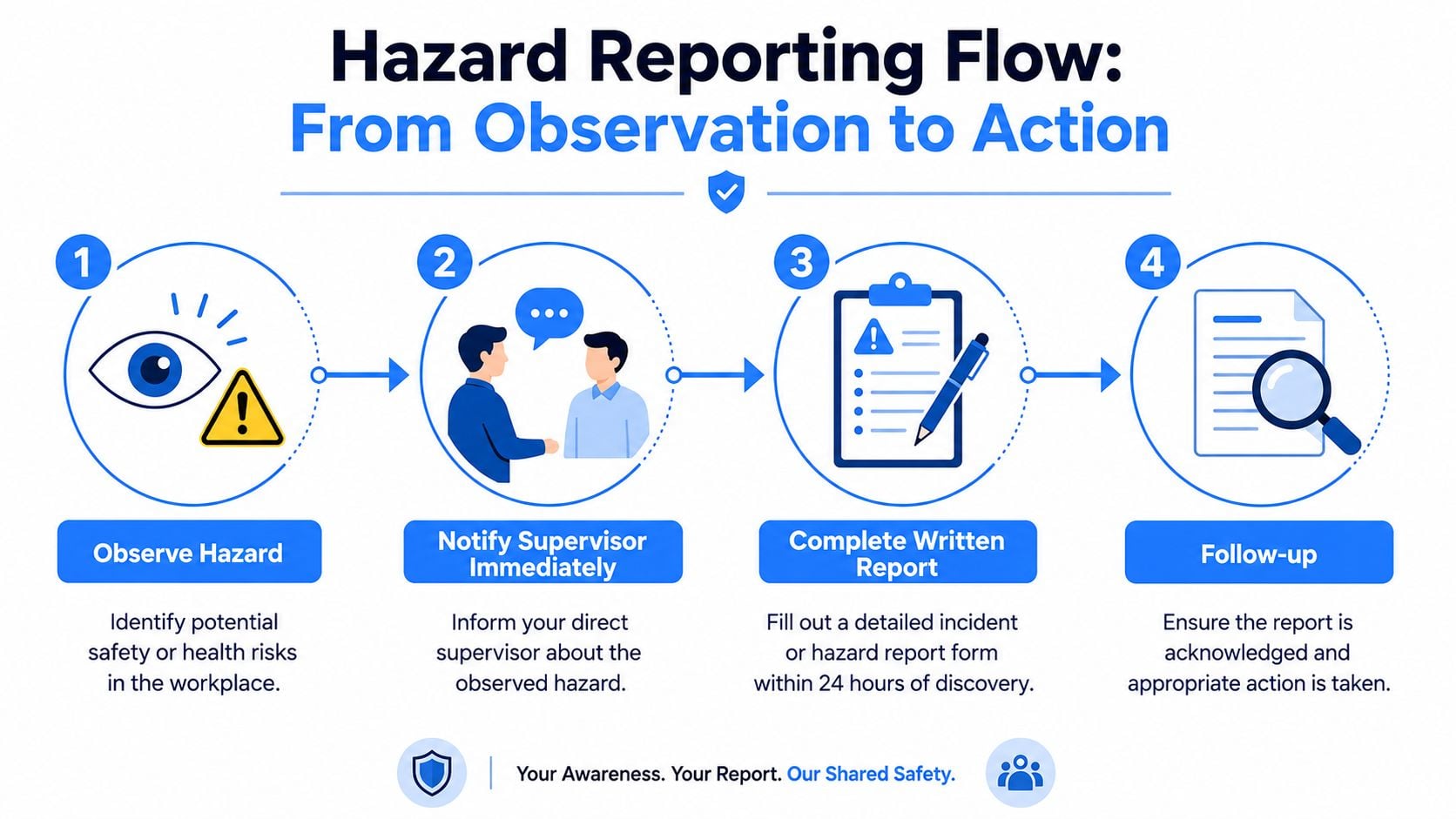
Observe the hazard.
The employee notices a missing guard, chemical leak, blocked exit, damaged cord, or failed PPE.Notify the supervisor immediately.
Immediate verbal notice works for speed. It shouldn’t be the last step.Complete the written report within 24 hours of discovery.
That internal deadline isn’t an OSHA citation rule for employees. It’s a practical control that gives the employer enough time to assess the issue, preserve facts, and meet any downstream obligations.Follow up.
Someone should confirm that the report was received and routed.
A simple internal incident log might include:
| Field | Example entry |
|---|---|
| Date observed | 06/17 |
| Time observed | 2:15 p.m. |
| Location | Line 3 press area |
| Hazard | Left-side machine guard loose |
| Immediate action | Line paused, supervisor notified |
| Written report submitted | 3:05 p.m. |
| Follow-up owner | Maintenance manager |
Teams reviewing claim trends often pair this workflow with broader workers’ comp and safety governance analysis, especially in co-employment settings where reporting duties affect loss outcomes. One example is PEO safety program impact on loss ratio.
PPE use is an employee duty too
PPE creates a common misunderstanding. Employers must provide required protection and train employees on its use. Employees still have to wear it, inspect obvious problems, and report damage or poor fit.
That matters because OSHA’s employer framework requires training workers in a language and vocabulary they can understand and expects employers to address recognized hazards, as outlined in OSHA’s discussion of employer responsibilities under the General Duty Clause and related requirements. On the chemical side, employers also need a written hazard communication program with labels, safety data sheets, and training, and failures in that area can lead to penalties of up to $13,494 per violation according to SiteDocs’ summary of hazard communication requirements.
For employees, the practical script is simple:
- If PPE is missing: Stop and ask for it.
- If PPE is damaged: Report it and request replacement.
- If PPE doesn’t fit: Escalate before starting the task.
Recordkeeping and Reporting Requirements
A forklift clips a pallet. An employee goes to urgent care, then is admitted to the hospital that night. The site supervisor hears about it at 7:00 p.m. The PEO payroll contact finds out the next morning. HR assumes operations already called OSHA. Operations assumes the PEO handled it. That is how a reporting clock runs out.
Recordkeeping under OSHA works like a chain of custody. The injury happens once, but the notice, the forms, and the reporting timeline pass through several hands. In a co-employment arrangement, that handoff matters in real-dollar terms because a late report can create a citation on top of the injury itself.
OSHA incident reporting timelines
OSHA requires employers to report a work-related fatality within 8 hours. Employers must report a work-related inpatient hospitalization, amputation, or loss of an eye within 24 hours, according to OSHA’s severe injury reporting requirements. Employees are not the party that reports to OSHA in most cases, but their duty is still practical and immediate. They need to tell the employer fast, give accurate facts, and correct misunderstandings while details are still fresh.
Here is the table many HR and finance leaders use to train supervisors and staffing contacts on who needs to act first.
OSHA Incident Reporting Timelines
| Incident Type | Employee Action | Employer Deadline |
|---|---|---|
| Fatality | Report immediately to supervisor or employer | 8 hours |
| In-patient hospitalization | Report immediately and cooperate with fact gathering | 24 hours |
| Amputation | Report immediately and preserve details | 24 hours |
| Loss of an eye | Report immediately and confirm event details | 24 hours |
The practical risk is simple. If the employee tells only a coworker, or tells the worksite manager but not the intake channel the employer uses, the legal deadline does not pause. In a PEO structure, one party may supervise the day-to-day work while another party handles HR administration, workers’ compensation coordination, or OSHA logs. That split does not remove the need for one clear reporting path.
Forms 300, 300A, and 301 in a co-employment setup
The next layer is recordkeeping. OSHA’s recordkeeping forms and requirements overview explains the role of Forms 300, 300A, and 301. A useful way to explain them internally is this:
- Form 300 is the running log.
- Form 301 is the incident file for the individual case.
- Form 300A is the annual summary.
Confusion usually starts with ownership. The worksite employer may know the facts first because it controls the floor, the equipment, and the supervisor. The PEO may hold parts of the HR file, injury intake workflow, or policy administration. If both sides keep partial records without a single owner, you can end up with duplicate entries, missing entries, or mismatched dates.
For HR and finance leaders, this is less about paperwork style and more about control design. Decide who receives the first notice, who confirms OSHA-reportable status, who completes each form, and who retains the final record set. If your organization is reviewing retention periods across the co-employment relationship, align this workflow with broader PEO record retention legal requirements.
A short scenario makes the point. An employee reports an injury to the onsite lead before leaving for treatment. The lead texts a regional manager but does not open the formal incident report. The PEO later receives a claim notice and starts its own file. Now there are two timelines and no single source of truth. During an OSHA inquiry, the first question is often basic: who knew, and at what time?
That is why many companies use one intake form, one escalation rule, and one designated record owner even when responsibilities are shared. If facts are disputed after an incident, employers sometimes also need independent fact development through corporate private investigations to sort out witness timelines, reporting gaps, or conflicting accounts before regulators or carriers rely on an incomplete version of events.
Whistleblower Protections and Safe Work Refusal
Employees are more likely to report hazards when they know the law protects them from retaliation. That protection exists, but the process is narrower and faster than many managers think.
The retaliation deadline matters
Under Section 11(c), an employee who believes the employer punished or discriminated against them for exercising OSHA rights must contact OSHA within 30 days of learning of the alleged discrimination, according to the Ohio State summary of OSHA workplace rights. Miss that window, and the claim may be lost on timing alone.
That means HR should train supervisors on two points:
- Protected actions matter: Reporting hazards, requesting an inspection, or raising safety concerns can trigger anti-retaliation protections.
- Documentation matters just as much: If discipline follows a safety complaint, the employer needs a clean, well-documented business reason and a consistent timeline.
When an employer needs fact development around alleged retaliation, witness statements, or internal misconduct, outside support sometimes becomes part of the process. That’s where resources such as corporate private investigations can be relevant, particularly when the dispute overlaps with broader workplace misconduct issues.
A simple refusal decision tree
The right to refuse work is real, but narrow. The same OSHA rights summary states that refusal is protected only when an OSHA standard is violated and a real danger exists.
A practical decision tree looks like this:
Is there a specific safety condition the employee can identify?
“This feels unsafe” isn’t enough by itself.Does the condition appear to violate an OSHA rule or a required safety practice?
If not, the refusal case becomes harder.Does the condition create a real and apparent danger of death or serious harm?
Minor discomfort or routine disagreement won’t qualify.Is there a reasonable alternative, such as correction, reassignment, or a short pause while the hazard is addressed?
If there is, refusal may not be protected.
Joint-employment arrangements raise extra risk because the supervisor giving the order may not be the party handling formal HR response. That’s one reason many organizations map safety authority alongside broader DOL joint employment enforcement risks.
If a company wants employees to raise safety concerns early, supervisors can’t treat every pause, question, or escalation like insubordination.
Common Misconceptions with Examples
Confusion usually starts at handoff points. In a standard employer model, an employee reports a problem and one chain of command handles the rest. In a PEO arrangement, the same event can touch the site supervisor, the client HR team, the PEO HR contact, the workers’ compensation carrier, and the person responsible for the OSHA log. If employees and managers treat OSHA duties like informal common sense, those handoffs break.
Three mistakes that show up in training
Misconception one: Employees can refuse any task they personally think is unsafe.
Training needs a narrower rule. An employee should identify the specific condition, explain what makes it dangerous, and raise it through the employer’s reporting path. In a PEO structure, that path matters because the supervisor giving the assignment may work for the client company, while the HR team documenting the event may sit with the PEO. If the concern never gets documented clearly, the company is left arguing about memory instead of facts.
Misconception two: A verbal heads-up is always enough.
A verbal report starts the response. It rarely closes the recordkeeping gap.
Here is the common failure point. An employee tells a floor supervisor about a chemical splash, the supervisor rinses the area and sends the worker back, and no one sends a written note to HR or the PEO contact. Two days later, symptoms worsen and treatment is needed. Now the employer group has to reconstruct who knew what, when they knew it, and whether the incident should have gone into the OSHA record or a claim file. In a PEO model, that delay can keep the PEO’s risk manager or claims contact out of the loop at the exact moment timing matters.
Misconception three: PPE discipline is optional if the work is short.
Short tasks still carry full rules. Five minutes at a saw without eye protection creates the same exposure problem as a longer task if an injury happens.
This matters even more in co-employment because PPE responsibility is often split on paper. The client may control the site and daily supervision. The PEO may support training, policy templates, or claims administration. If employees hear mixed messages, they often assume the shorter task gets a pass. It does not. Clear assignment of who provides PPE, who trains on it, and who documents violations prevents that confusion.
A coaching script HR can use
Supervisors need language that works in real time and survives a later audit. A simple script is:
“Stop the task. Describe the hazard. Tell me what equipment, condition, or exposure is involved. Then send the report through the required channel before the end of the shift so HR and our PEO contact can document it correctly.”
A written responsibility matrix helps because it works like a routing map. It shows who receives the first employee report, who decides whether medical treatment is needed, who enters the case into the incident system, and who handles OSHA log and carrier notice deadlines. For a PEO client, that map can reduce expensive delays, especially when an incident starts as a supervisor conversation and later becomes a recordkeeping, claims, or liability issue. PEO Metrics is one example of a firm that helps employers compare PEO structures and contract terms, including how compliance support and responsibility allocation are handled in practice.
Actionable Compliance Checklist
The strongest safety programs reduce ambiguity. Everyone knows what belongs to the employee, what belongs to the supervisor, and what belongs to the employer or PEO.
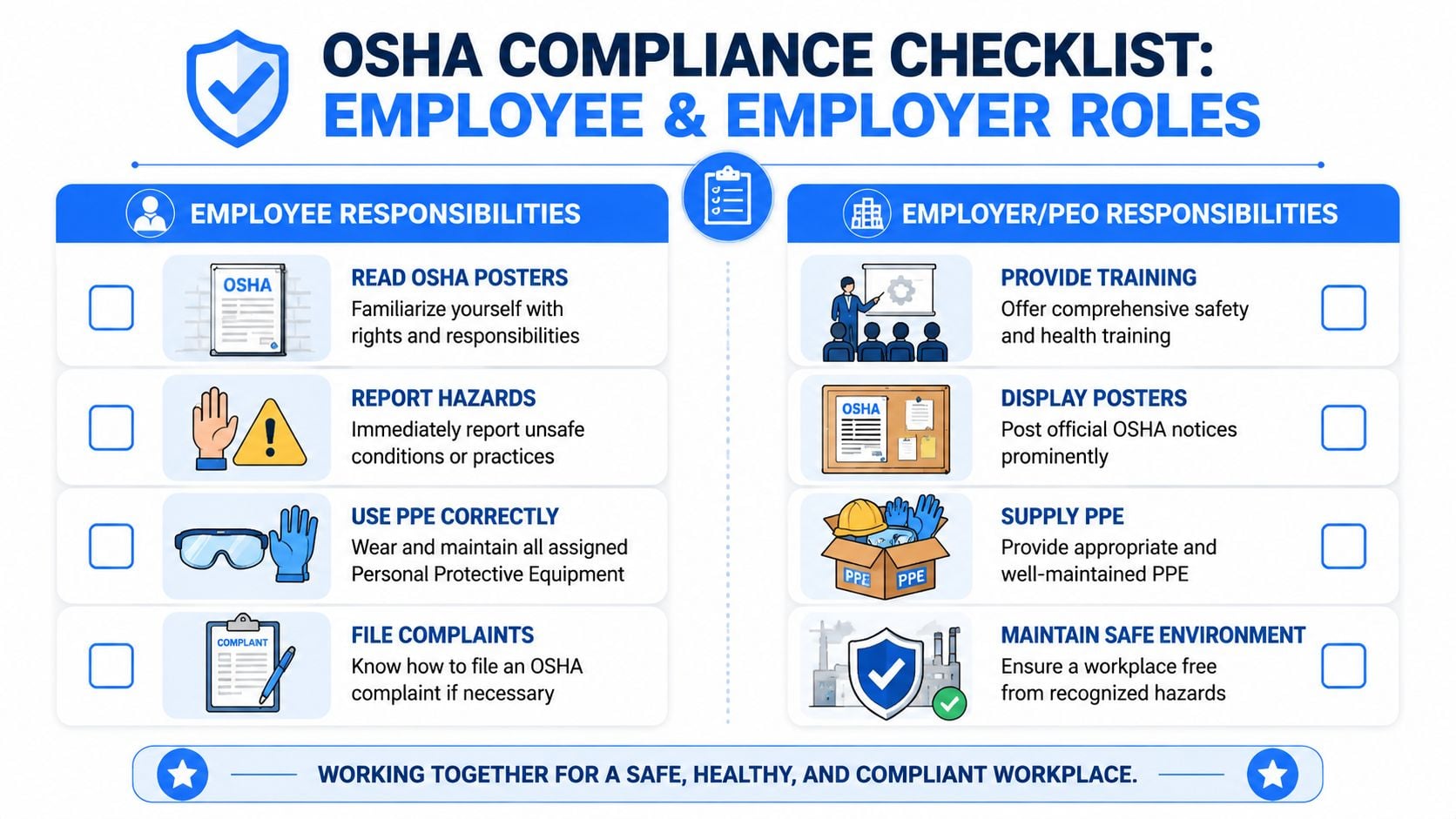
Use this as a short audit list during onboarding, site reviews, and PEO renewal meetings:
- Employees should read posted notices: The OSHA poster isn’t decorative. It sets baseline rights and duties.
- Employees should report hazards fast: Immediate notice first, written follow-up on the company’s internal timeline.
- Employees should use PPE correctly: If equipment is damaged, missing, or ill-fitting, report it before starting the task.
- Employees should raise retaliation concerns quickly: Section 11(c) complaints have a 30-day filing window, as noted earlier.
- Employers and PEO partners should train clearly: Rules must be understandable and tied to actual job tasks.
- Employers should maintain reporting discipline: Fatalities carry an 8-hour OSHA notice deadline. In-patient hospitalizations, amputations, and eye-loss events carry a 24-hour deadline.
- HR should keep forms and routing simple: One intake method beats five competing ones.
For companies reviewing policy language, supervisor training, or PEO contract terms, the cleanest next step is usually a responsibility map that assigns each safety action to one owner, one backup, and one reporting path.
Companies that want an outside view on how a PEO agreement handles safety support, reporting workflows, recordkeeping roles, and contract risk can review options with PEO Metrics. The value is in clarifying who owns what before the next incident tests the process.
