
The most popular advice about PEO professional development is also the least useful: choose the provider with the largest training library. A catalog of courses proves only that content exists. It doesn't prove that employees will complete it, managers will reinforce it, or the business will retain more capable people.
A serious evaluation asks a harder question: what changes after employees use the PEO's development offering? The answer should connect training to role expectations, performance conversations, compliance obligations, manager behavior, skills application, and retention. PEOs have become significant employment infrastructure, serving 4.5 million worksite employees across more than 208,000 primarily small and mid-size businesses in 2022, according to NAPEO's industry footprint data. Their scale makes the quality of that infrastructure worth examining closely.
For HR directors, CFOs, and owners at companies with 10 to 2,000 employees, the practical distinction is simple. A library offers access. A development system creates accountability, relevance, manager involvement, and evidence of skills gained.
Table of Contents
- Why Most PEO Training Libraries Miss the Mark
- Common Types of PEO Professional Development Programs
- Comparing PEO Service Models for Training Delivery
- Questions to Ask When Evaluating PEO Training Offerings
- Cost Structures and Contract Terms That Affect Training Value
- Measuring ROI on PEO-Provided Professional Development
- Negotiating Better Professional Development Terms in Your PEO Contract
Why Most PEO Training Libraries Miss the Mark
A PEO sales presentation often follows a familiar script. The representative opens an LMS, searches a polished catalog, displays courses on communication, harassment prevention, cybersecurity, and leadership, then moves to payroll and benefits pricing. The catalog looks substantial, but the demonstration rarely shows what happens after an employee enrolls.
Course volume is not a workforce strategy. A company can give employees access to hundreds of courses and still have no clear answer to basic operating questions. Which roles need development first? Which managers are expected to coach employees afterward? How does a completed course affect a performance review, promotion decision, safety process, or succession plan?
Access is not adoption
A self-service library shifts much of the work to the employer. HR must identify needs, assign content, remind employees, interpret reports, and persuade managers to make time for learning. Without that operating rhythm, optional training competes with customer deadlines and daily production.
The same problem appears when a PEO bundles compliance modules with broader development content. Required training may receive attention because it has a deadline, while voluntary leadership or technical courses remain unused. A provider that cannot show completion by role, manager, location, or course type is offering a content repository, not a measurable development program.
Buyers should also distinguish content aggregation from advisory support. Third-party libraries can be useful, especially for standard topics, but the PEO needs to explain how it curates courses, removes outdated material, and aligns recommendations with the employer's workforce. A manager of frontline teams needs a different path from an accounting supervisor, even if both can technically access the same catalog.
Development must connect to the employment system
Employees report stronger development-related workplace conditions at PEO client companies than at non-PEO firms. The cited survey found that employees at client companies were more likely to say their employer provided good training and development opportunities by 4 percentage points, reported good HR policies and practices by 5 percentage points, and said the employer did a good job designing jobs by 4 percentage points. The same survey reported 5 percentage points higher engagement and 8 percentage points stronger intent to stay until retirement among employees at PEO client companies, as documented in NAPEO's white paper.
Those findings don't mean every PEO training library produces those outcomes. They do show why buyers should inspect the broader HR operating model rather than judge training by course count. A strong provider can help connect development to job design, HR practices, and manager routines.
Practical rule: If the PEO can't show how training appears in manager workflows, performance discussions, or compliance assignments, treat the library as an unproven benefit.
Companies building a manager capability plan can also use professional development programs for managers as a useful comparison point. The relevant standard isn't whether the PEO has a management category. It's whether supervisors receive structured practice, feedback, and follow-through.
The same diligence should cover broader operating risks. PEO service fragmentation risks matter because training can become disconnected when payroll, HR advice, benefits administration, compliance, and learning tools sit in separate service silos. A buyer should ask who owns the development plan and who is accountable when the employee doesn't progress.
Common Types of PEO Professional Development Programs
PEO offerings usually fall into several recognizable categories. Each can be valuable, but each solves a different problem and carries a predictable failure mode.
Compliance and safety training
This category commonly includes harassment prevention, workplace conduct, safety orientation, incident reporting, and policy acknowledgments. It serves the entire workforce, with assignments often shaped by role, location, or exposure to particular workplace risks.
Its strength is consistency. A PEO can provide a central assignment process and preserve completion records. Its weakness is that completion can become the end point. Watching a module doesn't establish that a supervisor can respond correctly to a complaint or that a warehouse employee can apply a safety procedure under pressure.
Soft skills and general libraries
Communication, feedback, conflict management, time management, customer service, and presentation courses can support broad employee development. These libraries work best when managers select a small number of relevant courses and discuss application during regular one-to-ones.
They underdeliver when the PEO presents a large catalog without role-based pathways. Employees may browse by interest rather than business need, while HR receives activity data without evidence that behavior changed.
Technical learning partnerships
Some PEOs provide access to external platforms such as LinkedIn Learning or Coursera, or offer partnerships covering software, data, finance, sales, and other technical subjects. This model can give employees useful depth beyond standard HR content.
The trade-off is control. The employer should verify whether the PEO controls assignments, receives usable reporting, and can connect learning to job architecture. A technically strong course still has limited value if the employee's manager can't see progress or create opportunities to apply the skill.
Leadership and manager enablement
Manager programs may include coaching, delegation, difficult conversations, performance feedback, and employment-law basics. This is often the highest-impact category because supervisors translate policy and development into daily behavior.
The red flag is a one-time webinar presented as a leadership system. Stronger programs include a sequence of learning, manager tools, advisor support, and a way to review whether supervisors used the practices.
Onboarding and role readiness
Onboarding content may include policy training, benefits orientation, systems access, role expectations, and early manager check-ins. It can reduce administrative friction when assignments trigger automatically from the HR platform.
Automation alone won't create effective onboarding. Buyers evaluating digital workflows may find the discussion of how to improve onboarding with AI useful, particularly when considering personalization, task sequencing, and timely support. The PEO should explain which elements are automated and which require human guidance.
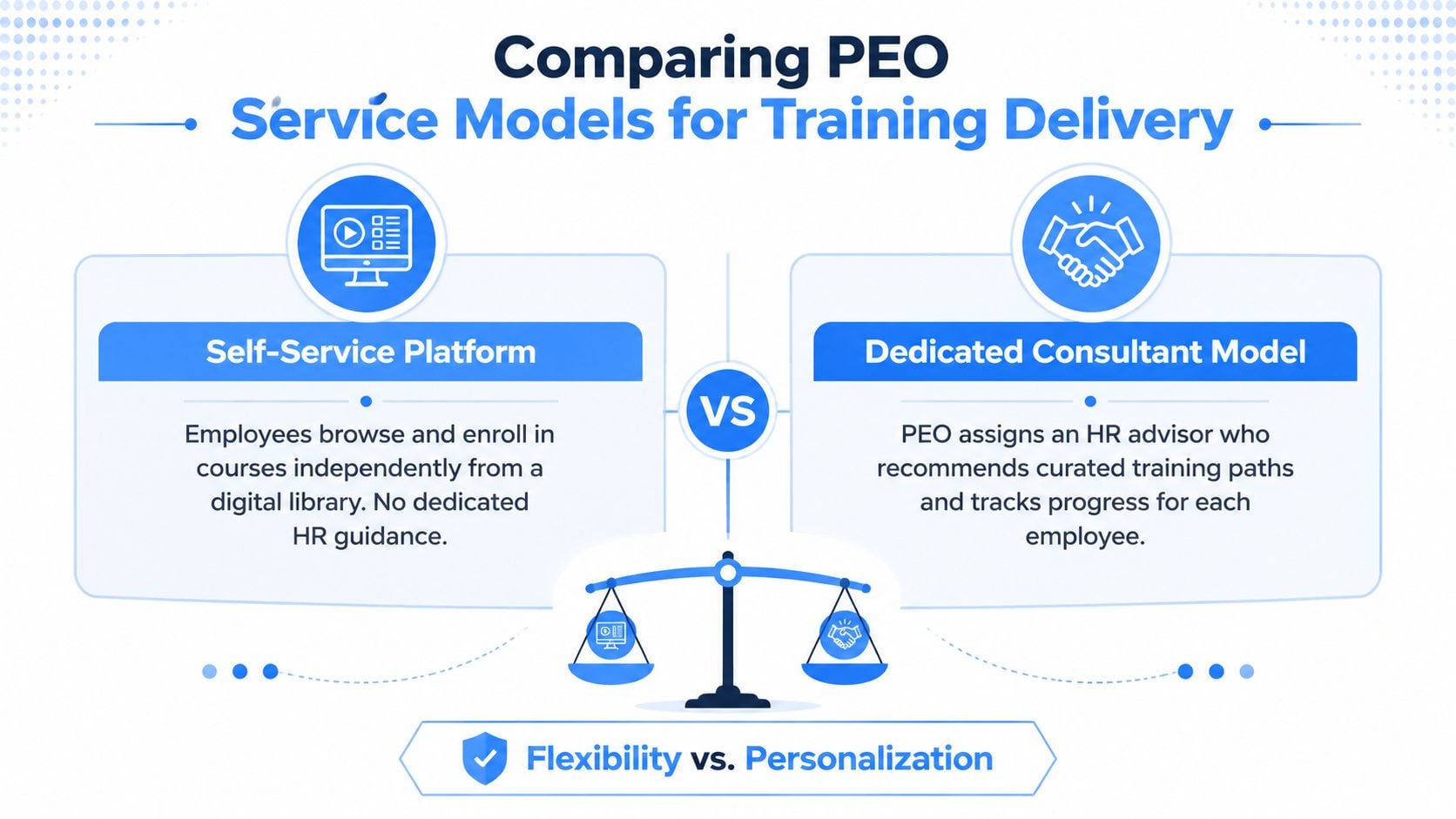
Comparing PEO Service Models for Training Delivery
Three delivery models appear most often, and they place very different demands on the employer.
| Service model | What the employer receives | Where it fits | Main risk |
|---|---|---|---|
| Self-service LMS | A digital catalog, enrollment tools, and completion records | Companies with engaged managers and internal HR capacity | Employees browse without a clear development plan |
| Advisor-guided development | HR consultant recommendations, curated paths, and review support | Growing companies that need structure but lack specialist capacity | Quality depends on advisor expertise and account coverage |
| Compliance-integrated training | Assignments linked to location, role, policy, or compliance events | Multi-state employers managing changing obligations | Required learning can crowd out career development |
Self-service platforms
Self-service is flexible and easy to scale. Employees can select courses when they need them, and the employer avoids scheduling every session. That model can work for a mature HR team with defined competencies, active managers, and a culture that protects learning time.
It struggles in smaller companies where HR is already managing payroll, recruiting, employee relations, and benefits. The platform may be affordable within the bundle, but the hidden cost is internal administration.
Advisor-guided development
An advisor-guided model adds interpretation. The PEO's HR professional might review a performance concern, recommend a manager pathway, or help an employer assign content to a new team leader. The value comes from judgment, not the mere presence of an LMS.
The buyer should ask how often the advisor engages, how many clients the advisor supports, and whether recommendations are documented. A promise of “strategic HR support” means little if the assigned contact mainly handles reactive questions.
Compliance-integrated delivery
This model links training to workforce events. A worker who moves into a supervisory role might receive new assignments. An employee changing work locations might receive jurisdiction-specific content. This approach is particularly useful for employers expanding across states because it reduces reliance on manual reminders.
It still needs a development layer. Compliance assignments protect the employer from administrative gaps, but they don't automatically build leadership, technical, or career skills.
A review of the underlying PEO software can clarify whether the training tools connect to the wider HR platform or operate as a separate add-on. That distinction affects reporting, employee records, and the amount of manual work required from HR.
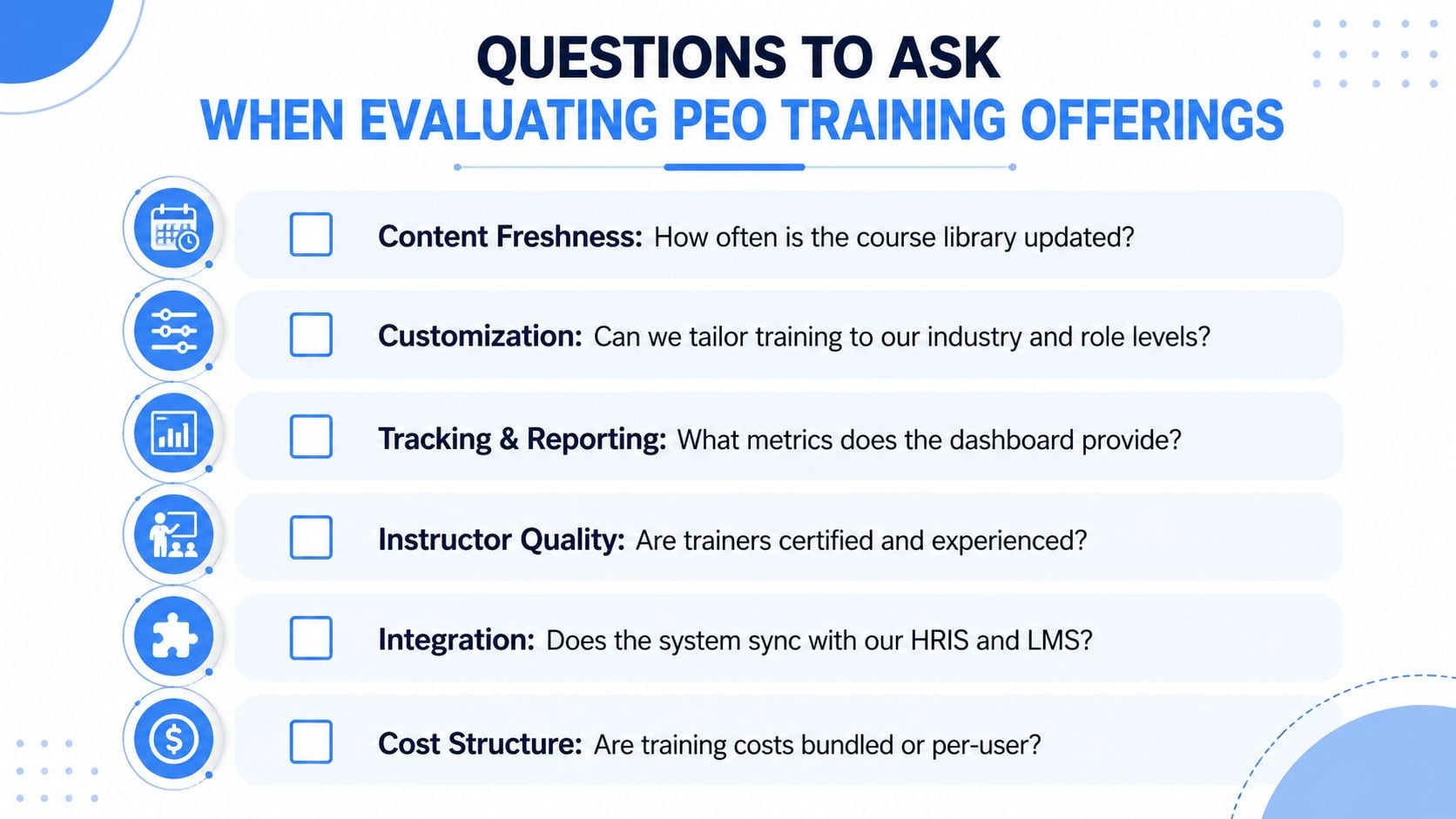
Questions to Ask When Evaluating PEO Training Offerings
A PEO demo should test operational proof, not presentation quality. The following questions expose whether the provider can support development after implementation.
Ask about content and relevance
How often is the library updated? A strong answer identifies a review process, update ownership, and how the PEO handles changes to policies or compliance requirements. “The vendor maintains it” is incomplete unless the PEO explains how customers are notified and how old assignments are managed.
Can the employer tailor learning by role, location, seniority, or policy? Useful customization includes role-based pathways and company-specific materials. A red flag is a platform that allows employees to browse but gives HR no control over required sequences.
Can the PEO demonstrate a development path for a real role? Request a concrete example, such as a first-line supervisor moving from onboarding to feedback, scheduling, performance management, and employee-relations training. The provider should be able to show the assignment logic, manager involvement, and reporting output.
Test reporting and manager use
What does the dashboard show beyond completion? Completion is a starting measure. Buyers should request visibility into enrollment, overdue assignments, time spent, assessment results where available, repeat participation, and progress by team or location.
Can managers see and discuss development activity? A strong system gives supervisors usable information without exposing inappropriate employee data. It should help a manager prepare for a development conversation, not merely display a green completion checkmark.
Does training connect to performance reviews? The PEO should explain whether development goals, recommended courses, and manager notes can appear in the performance process. If the LMS and performance tools don't connect, ask who will maintain the bridge.
Check multi-state and contractual execution
How does the provider handle state-specific requirements? Remote and multi-state employers need to know whether assignments change when employees work in different jurisdictions, how updates are communicated, and who verifies coverage. Buyers should ask specifically about harassment training, safety, recordkeeping, and policy acknowledgments rather than accepting “multi-state compliance” as a general assurance.
Who owns the training records if the relationship ends? The contract should address export format, timing, historical records, and access during transition. If the PEO cannot answer, the employer may face avoidable friction during a provider change.
What evidence supports the development promise? Ask for anonymized reporting examples, sample manager dashboards, implementation milestones, and references from employers with a similar workforce. A provider that offers only a catalog tour hasn't demonstrated outcomes.
The best questions to ask PEO providers can help structure the broader vendor conversation. Training questions shouldn't sit apart from questions about service ownership, implementation, data access, and accountability.
Cost Structures and Contract Terms That Affect Training Value
Training can appear free because the PEO includes basic content in the administrative fee. That doesn't make it costless. The employer still pays through the overall relationship and contributes internal time for selection, communication, completion follow-up, and evaluation.
A careful review separates included access from included service. One provider may include a basic compliance library but charge for leadership cohorts, custom content, live instruction, or a dedicated training consultant. Another may include the LMS while billing separately for implementation, integrations, advanced reporting, or additional users.
Pricing questions that expose the real cost
Ask whether pricing is based on employees, active users, assigned users, or the entire worksite population. Confirm how seasonal staff, new hires, contractors, and acquired teams are treated. Per-user pricing can become difficult to forecast when headcount changes or when the employer wants to assign learning broadly.
Request a written schedule for:
- Implementation fees: Confirm whether LMS setup, data mapping, configuration, and administrator training are included.
- Custom development: Identify charges for company policies, branded content, role-specific paths, or translations.
- Live delivery: Clarify rates for instructors, workshops, office hours, and manager coaching.
- Reporting and integrations: Ask whether HRIS or LMS connections carry separate fees.
- Renewals: Check whether the PEO can remove courses, reduce advisor access, or change licensing without a service adjustment.
Contract protections matter more than catalog promises
A renewal clause that permits the provider to reduce training scope without notice can undermine a development plan. The agreement should define the included service, reporting cadence, support access, data ownership, and notice requirements for material changes.
The exit section deserves equal attention. Training records should be exportable in a usable format, and the employer should retain access long enough to document compliance and continue employee development during transition. Buyers reviewing the broader economics of a PEO should also examine the PEO membership fee alongside training charges, because a low apparent training cost may sit inside a higher overall administrative structure.
Measuring ROI on PEO-Provided Professional Development
A training program earns credibility when the employer can connect activity to business results. That doesn't require pretending every outcome came from one course. It requires a disciplined measurement chain that starts with participation and moves toward application, manager observation, and workforce outcomes.
Use a layered scorecard
The first layer measures delivery. Track assignment, enrollment, completion, overdue status, assessment results where available, and participation by department, role, manager, and location. These measures reveal whether the PEO is administering the service as promised.
The second layer measures application. Managers can document whether a supervisor used a feedback framework, whether a new hire followed the required safety process, or whether an employee applied a technical skill in a real project. Short manager check-ins are often more useful than a satisfaction survey because they test behavior rather than opinion.
The third layer measures workforce results. Compare turnover patterns, internal movement, time to role readiness, manager feedback, and compliance incidents against the business's own baseline. The comparison should be defined before launch, and HR should avoid claiming causation when other changes occurred at the same time.
PEO client research offers a relevant benchmark for the retention discussion. Industry research reports 12% lower employee turnover among PEO clients than comparable non-clients, while earlier analyses in the same summary reported 10% to 14% lower turnover, according to NAPEO's economic data release. That evidence supports the business case for examining retention, but it doesn't prove that a particular PEO's training library caused the difference.
Put reporting in the operating calendar
Require the PEO to provide a recurring report with completion by team, overdue assignments, manager participation, and any available assessment or skills data. HR should review it with business leaders rather than storing it in an unused dashboard.
For a deeper financial framework, the guide on how to calculate ROI on training can help employers connect development costs with productivity, retention, and risk-related outcomes. The PEO ROI calculator guide can support the wider comparison by placing training value alongside administrative fees, benefits economics, and service quality.
A practical scorecard might ask four questions each quarter:
- Did employees participate?
- Did managers reinforce the learning?
- Did employees apply the skill?
- Did the business see a credible change in retention, readiness, productivity, or risk?
If the PEO can report only the first answer, the employer has evidence of activity, not return.
Negotiating Better Professional Development Terms in Your PEO Contract
Professional development shouldn't remain a verbal promise from the sales team. Buyers should attach the service to specific deliverables, named responsibilities, reporting expectations, and transition rights.
Request a written training schedule that identifies included content, assignment support, manager resources, advisor involvement, and reporting. If the provider offers a dedicated consultant, define access expectations, escalation routes, and what happens when the assigned advisor changes. If the employer relies on an LMS, request rate protection and written limits on user, integration, and custom-content charges.
Useful negotiation positions include:
- Quarterly reporting: Require reports showing completion, overdue assignments, participation by team, and manager-level visibility.
- Development planning: Ask for curated paths for priority roles, not just unrestricted catalog access.
- Compliance updates: Define how the PEO communicates changes and updates jurisdiction-specific assignments.
- Data portability: Secure export rights for completion records, assignments, assessment results, and employee development history.
- Renewal protection: Require notice before material reductions in training scope, advisor support, or reporting.
- Service remedies: Tie repeated reporting failures or unavailable contracted services to a defined remediation process.
A buyer doesn't need to demand an unrealistic guarantee that training will eliminate turnover. A stronger position is to negotiate verifiable inputs and outputs, then review them consistently. The provider should be willing to document what it will deliver, how the employer will measure it, and how unresolved service failures will be handled.
PEO Metrics evaluates providers side by side across pricing, benefits, contract terms, service quality, compliance support, industry fit, and professional development features, including training platform and LMS access. For companies comparing providers or renegotiating an existing agreement, PEO Metrics can help identify training-related trade-offs alongside fee increases, implementation costs, exit terms, and other contract risks.
