

Food service employers deal with a level of HR complexity that most general-purpose platforms weren’t built to handle: high turnover, tipped-wage compliance across different state and local rules, seasonal staffing that swings with patio season or holiday catering bookings, and workers’ comp classifications that carry real risk in kitchens. A PEO can absorb a lot of that burden, but the providers below vary widely in how well they actually understand restaurant and hospitality operations. This list focuses on PEOs with a documented presence in food service and hospitality, plus one independent resource for comparing proposals before you commit to a service agreement.
Quick comparison
- PEO Metrics: best for operators comparing multiple PEO proposals; pricing is quote-based for the PEOs themselves; the one thing it does differently is give you an independent, side-by-side read on competing offers rather than selling its own PEO service.
- TriNet: best for regionally concentrated restaurant groups; quote-based; the one thing it does differently is offer a long-standing industry-vertical HR plan structure built around hospitality.
- Insperity: best for multi-location brands wanting hands-on consulting; quote-based; the one thing it does differently is pair PEO services with a dedicated HR business performance consultant.
- Justworks: best for owner-operators who want predictable costs; quote-based; the one thing it does differently is a flat per-employee pricing model instead of percentage-of-payroll fees.
- ADP TotalSource: best for multi-state chains needing strong payroll infrastructure; quote-based; the one thing it does differently is run on ADP’s own payroll and tax reporting engine.
- Paychex PEO: best for small independent restaurants already using Paychex; quote-based; the one thing it does differently is serve a very wide range of business sizes on one platform.
- G&A Partners: best for regional hospitality operators; quote-based; the one thing it does differently is dedicated HR consultants focused on risk management for restaurant-type operations.
- Engage PEO: best for seasonal food service employers; quote-based; the one thing it does differently is pay-as-you-go workers’ comp billing.
- Vensure HR: best for larger operations willing to vet a specific affiliate; quote-based; the one thing it does differently is scale through a network of affiliated PEO brands.
1. PEO Metrics
PEO Metrics is an independent comparison service, not a PEO. It’s built for food service employers who already have one or more PEO proposals in hand and need a clear-eyed way to evaluate them against each other rather than taking a single sales rep’s word for what’s competitive.
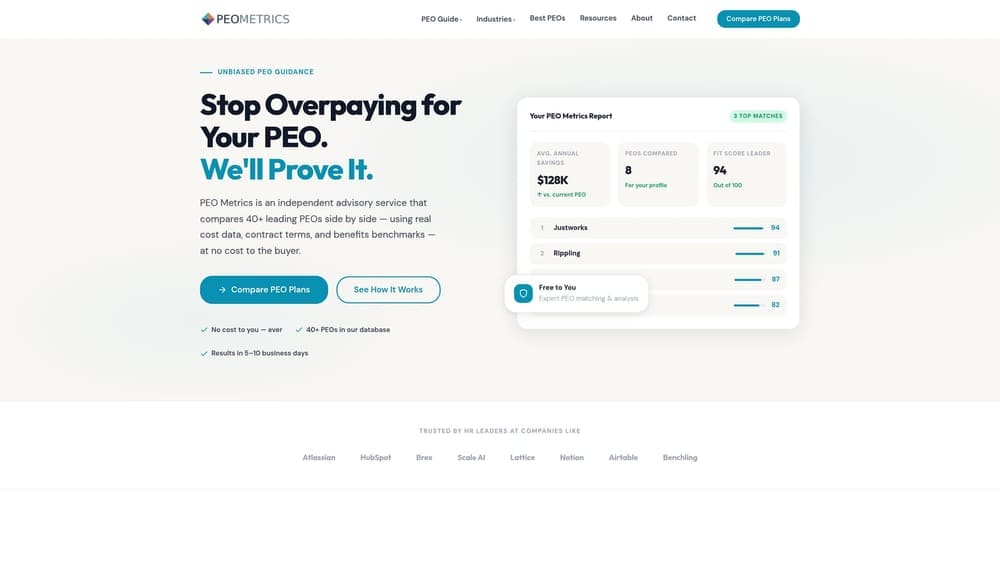
What sets it apart from every other entry on this list is that it doesn’t sell PEO services at all. Its job is to sit on your side of the table while you weigh pricing structures, workers’ comp handling, and contract language across multiple vendors.
- Lays out pricing and fee structures from different PEO proposals side by side so you can see where markups or bundled costs are hiding
- Walks through how each provider’s workers’ comp program applies to food service risk classifications, which matters given how differently kitchen and front-of-house roles get rated
- Reviews contract terms, including exit and termination provisions, before you sign anything
There’s no meaningful setup on the food service employer’s side beyond gathering the proposals you want reviewed; PEO Metrics does the comparison work. It doesn’t integrate with payroll or HR systems because it isn’t managing your workforce day to day. The obvious limitation is that it’s a step before the PEO relationship, not a replacement for it: you still need to vet your final chosen provider directly, check state licensing, and confirm current terms with them before signing. Pricing for the comparison service itself is available on the website.
Best for: Food service employers who want an outside read on competing PEO proposals before signing.
2. TriNet
TriNet is a national PEO that has historically built HR plans around specific industries, including hospitality-oriented service packages layered on top of standard payroll and benefits administration. That vertical structure is the main reason restaurant groups end up on TriNet’s shortlist in the first place.
Its features run through the usual PEO stack, tuned toward operators who want an industry frame rather than a generic HR package.
- Offers plan options built around specific industries rather than a one-size-fits-all HR bundle
- Handles payroll processing and tax administration so you’re not running that in-house
- Gives employees access to a benefits marketplace that can look more like what larger employers offer
- Administers workers’ compensation coverage as part of the bundled service
TriNet integrates with common accounting and time-tracking platforms through its own system, which keeps day-to-day administration inside one login for most HR teams. Setup involves TriNet’s standard onboarding process, typically run by whoever owns HR internally with TriNet’s implementation team handling the technical side.
The tradeoff is geography. TriNet’s structure tends to serve regionally concentrated operators better than businesses spread across many states with different minimum wage and tip credit rules, since compliance support can feel less tailored once you’re managing locations in a dozen different jurisdictions. Confirm TriNet’s current industry-vertical offerings directly, since program names and inclusions shift over time. Pricing is quote-based.
Best for: Single-state or regionally focused restaurant groups wanting an industry-tailored HR plan.
3. Insperity
Insperity is built around a consultant-led model: instead of just processing payroll and administering benefits, it assigns dedicated HR business performance consultants to accounts. For a multi-location food service brand juggling several general managers and inconsistent HR practices across sites, that kind of hands-on support can matter more than the software itself.
The features reflect that consulting emphasis as much as the administrative basics.
- Assigns a dedicated consultant who works on HR strategy, not just transaction processing
- Provides access to a broad employee benefits marketplace
- Handles payroll and compliance administration across locations
- Includes performance management tools for tracking staff across multiple sites
Insperity integrates with common payroll and accounting systems, though the current list is worth confirming directly since integration partners change. Day-to-day, the consultant relationship means less burden falls on an internal generalist, but it also means Insperity’s service model and minimum group size expectations are built with larger accounts in mind. Confirm current minimum employee counts directly, as these shift and can price out very small independent restaurants. Pricing is quote-based.
Best for: Multi-location food service brands wanting hands-on HR consulting alongside PEO services.
4. Justworks
Justworks takes a different approach to pricing than most PEOs on this list: instead of a percentage of payroll, it charges a flat monthly fee per employee. For an owner-operator trying to budget against thin restaurant margins, that predictability is often the deciding factor.
What it offers
- Charges flat per-employee pricing tiers instead of variable percentage-based fees
- Runs payroll and benefits through a self-service digital platform
- Supports compliance across multiple states as you add locations
- Connects with time tracking tools to help manage hourly, shift-based staff
Who runs it and who it isn’t for
Justworks integrates with QuickBooks, Xero, and various time-tracking apps, and it’s designed to be managed largely by whoever handles HR or ownership duties internally, since the platform is self-service by design. Setup is generally lighter than full-service consultant-led PEOs.
That self-service design is also the limitation: Justworks offers less dedicated account management than some of the full-service PEOs on this list, which may not suit operators who want a consultant walking them through wage and hour questions specific to tipped employees. Pricing is quote-based, though the flat-fee structure means cost scales primarily with headcount rather than payroll volume.
Best for: Owner-operators who want predictable flat-fee pricing and a self-service platform.
5. ADP TotalSource
ADP TotalSource is ADP’s PEO offering, and its main selling point is straightforward: it’s built directly on ADP’s own payroll and tax infrastructure. For a multi-state food service chain juggling different tip credit rules and wage reporting requirements across jurisdictions, that depth of payroll engineering can matter more than any other single feature.
- Processes payroll on ADP’s established infrastructure rather than a third-party platform
- Handles tax filing and compliance reporting across multiple states
- Provides HR administration and benefits access as part of the PEO bundle
- Manages workers’ compensation programs alongside payroll
Integrations run through ADP’s broader payroll and tax ecosystem, which is one of the more established networks in the industry. Setup and account management tend to follow ADP’s standard implementation process, usually handled jointly by an internal HR lead and an assigned ADP team.
The tradeoff is scale and pace. Implementation timelines and contract terms tend to favor mid-size and larger employers over single-location operators, so a small independent restaurant might find the onboarding process heavier than necessary for its size. Pricing is quote-based.
Best for: Multi-state food service chains that want PEO services tied to ADP’s payroll and tax systems.
6. Paychex PEO
Paychex PEO serves a genuinely wide range of business sizes, from a single independent restaurant to a regional chain with several locations, all built on Paychex’s existing payroll technology. That range is the main reason it shows up on so many restaurant shortlists: it doesn’t require you to be a certain size to get in the door.
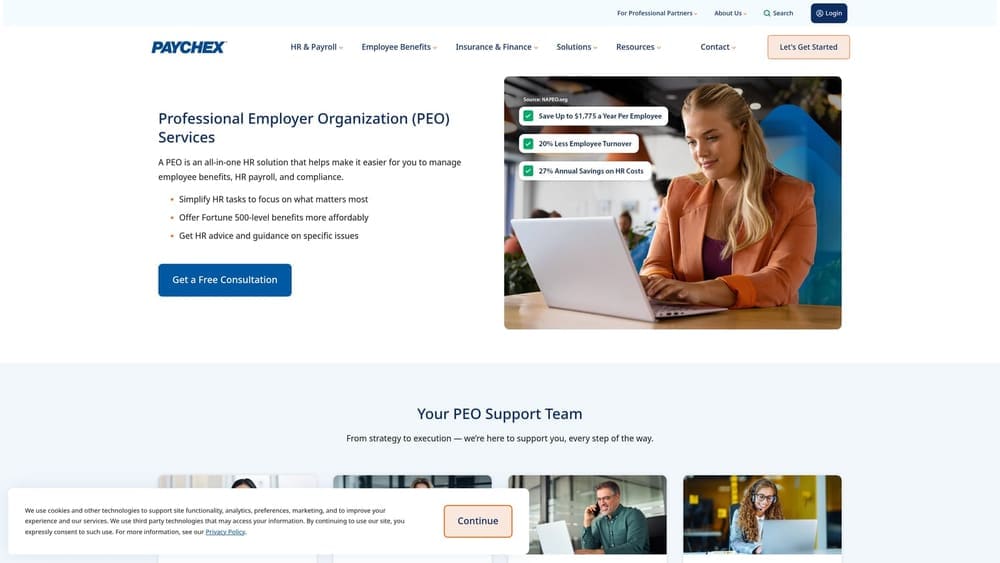
- Runs payroll on the Paychex platform many small businesses already use
- Provides HR administration and compliance support alongside payroll
- Offers employee benefits options comparable to larger employer plans
- Gives access to workers’ compensation programs
Paychex Flex handles payroll and time-tracking integration, which keeps the technical side relatively familiar if you’ve used Paychex before switching to the PEO model. Day-to-day account management is typically handled by a regional Paychex team paired with your internal HR or ownership contact.
That regional structure is also the catch: service quality can vary by regional team, so it’s worth requesting current client references, ideally from other food service operators, before signing. Pricing is quote-based.
Best for: Small independent restaurants that already use or want Paychex’s payroll technology.
7. G&A Partners
G&A Partners is a regional PEO with a client base that includes hospitality and food service employers, and it leans into dedicated HR consultants for compliance and risk management rather than a purely self-service model.
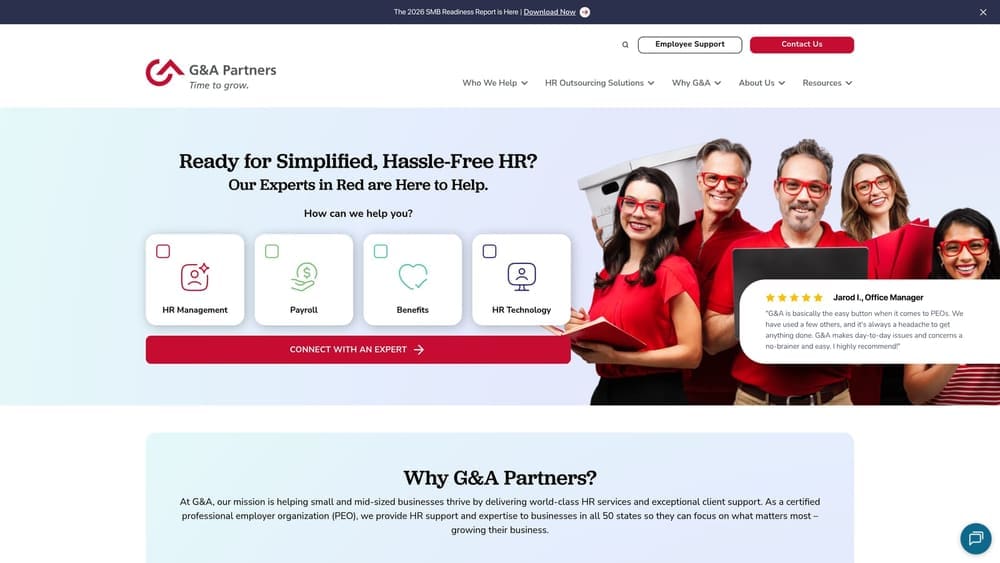
Its distinguishing feature is the concentration of hospitality clients paired with hands-on risk management support, which matters for operations dealing with kitchen safety, workers’ comp claims, and regional wage variation.
- Assigns dedicated HR consultants familiar with hospitality client needs
- Administers payroll and benefits alongside HR support
- Supports risk management and safety program development for restaurant operations
- Provides compliance guidance tuned to regional wage rules
G&A Partners uses standard payroll and accounting integrations, though the current list should be confirmed directly since it can change. Day-to-day, the consultant model means an internal HR lead works closely with an assigned G&A representative rather than managing everything independently.
The limitation is footprint. G&A Partners has a smaller national presence than the largest PEOs on this list, so multi-state coverage needs to be confirmed before signing, particularly if your locations span states outside its core service area. Confirm its current state footprint directly, since PEO service areas shift periodically. Pricing is quote-based.
Best for: Regional restaurant and hospitality operators concentrated in G&A Partners’ core service states.
8. Engage PEO
Engage PEO targets small and mid-size employers, including restaurant and hospitality clients, and its standout feature addresses a real pain point in food service: cash flow around workers’ comp premiums during seasonal staffing swings.
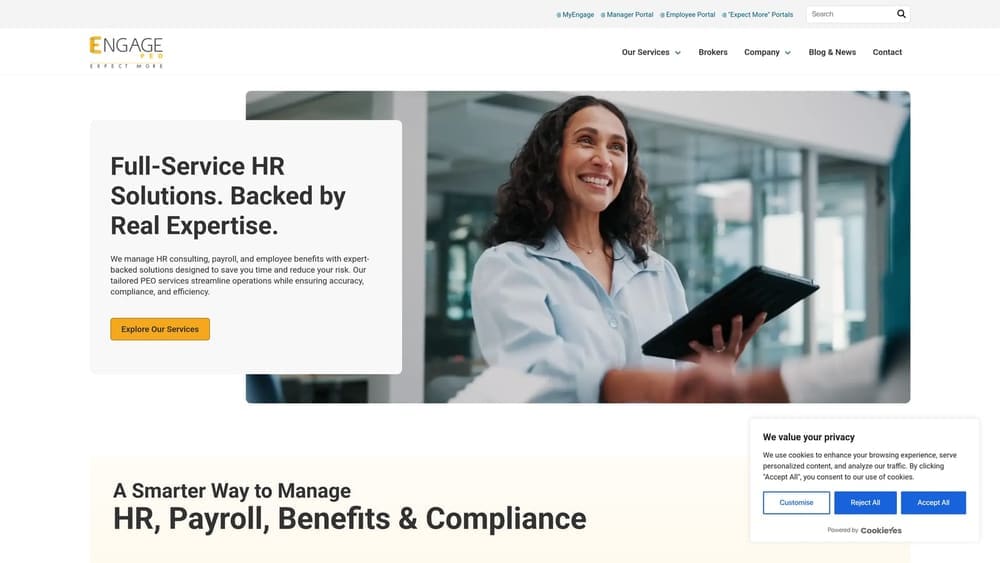
Instead of a fixed annual premium based on estimated payroll, Engage offers pay-as-you-go workers’ comp billing, which adjusts as your actual payroll rises and falls with the season.
- Bills workers’ comp premiums based on actual payroll rather than annual estimates
- Administers HR and payroll services as part of the PEO relationship
- Runs a consultative onboarding process rather than a purely self-service setup
- Provides benefits administration alongside payroll and HR support
Engage integrates with standard payroll and time-tracking systems, though the current list is worth confirming directly with the vendor. An internal HR or ownership contact typically works with an assigned Engage representative through onboarding and ongoing service.
Engage’s smaller brand recognition compared to ADP or Paychex means state availability and claims handling should be verified directly before signing, particularly if you operate across multiple states. Pricing is quote-based.
Best for: Small and mid-size food service employers with seasonal staffing patterns wanting flexible workers’ comp billing.
9. Vensure HR
Vensure HR is one of the larger privately held PEOs by worksite employee count, but it operates differently than most entries on this list: it works through a network of affiliated PEO brands rather than a single unified service under one name.
That network structure is both its scale advantage and the thing you need to vet most carefully before signing.
- Operates a large worksite employee base spread across affiliated brands
- Administers payroll, benefits, and HR across a broad industry mix including hospitality
- Provides access to workers’ compensation programs
- Serves a wide range of industries, giving it breadth of experience with different risk profiles
Integrations vary by which affiliated brand ends up managing your account, so this is something to confirm directly with whichever specific provider you’re assigned rather than assuming it matches Vensure’s parent-level marketing. Day-to-day account management similarly depends on the affiliate, not a single centralized Vensure team.
That’s the core limitation: because service is delivered through separate affiliated entities, contract terms and service quality can vary meaningfully depending on which affiliate you’re placed with. A larger food service operation with the bandwidth to vet a specific affiliate thoroughly, rather than taking the parent brand’s reputation at face value, is better positioned to use Vensure well. Pricing is quote-based.
Best for: Larger food service operations comfortable vetting a specific affiliate within a multi-brand PEO network.
Matching the shortlist to your operation
If you’re running a single location and margins are tight, flat-fee simplicity from a provider like Justworks removes a lot of guesswork from monthly budgeting. If you’re managing locations across state lines, prioritize providers with genuinely strong payroll infrastructure and tip credit handling, which is where ADP TotalSource’s payroll depth or TriNet’s industry-vertical plans tend to matter most. Seasonal or high-turnover operations should weigh Engage PEO’s pay-as-you-go workers’ comp billing against the flexibility they actually need.
None of these providers are interchangeable once you look past the marketing pages, and the fine print on contract terms, exit clauses, and workers’ comp experience modifiers varies enough between them that it’s worth running any shortlist through an independent comparison before you sign.
Before you sign that PEO renewal, make sure you’re not leaving money on the table. Many businesses unknowingly overpay because of bundled fees, hidden administrative markups, and contracts designed to limit flexibility. We give you a clear, side-by-side breakdown of pricing, services, and contract terms, so you can see exactly what you’re paying for and choose the option that truly fits your business.
