

If you run HR or own a retail business, a generic PEO ranking usually misses what you actually worry about: seasonal hiring spikes, turnover, stores in more than one state, and workers’ comp that changes between a cashier and a stockroom lead. This list is for small and mid-sized retail employers. It pairs one comparison service with PEOs that publicly serve smaller employers, and it weighs workers’ comp handling, multi-state payroll and compliance support, benefits access for part-time and hourly staff, technology, and pricing transparency.
A quick framing note: a PEO enters a co-employment relationship with you, sharing HR, payroll, benefits, and risk functions. That differs from an ASO (you stay the sole employer), an EOR (typically used to employ workers in places where you have no entity), and payroll-only software. CPEO is an IRS-certified status, and not every PEO holds it. Vendor details below are described as of 2026 and should be confirmed on each official site before you rely on them. For more background, see [LINK CHECK: related editorial articles].
Quick Comparison of the Retail PEO Options
- PEO Metrics: best for retailers shortlisting PEOs; pricing on the website; compares multiple PEOs on like-for-like terms before you sign anything.
- Insperity: best for multi-location retailers without in-house HR; quote-based; an assigned HR representative.
- TriNet: best for mid-sized retailers building a benefits menu for hourly talent; quote-based; industry-tailored plan packages.
- Justworks: best for small boutiques and few-location shops; pricing on the website; published per-employee pricing.
- ADP TotalSource: best for multi-state retailers wanting timekeeping tied to payroll; quote-based; time and attendance connected to the PEO.
- Paychex PEO: best for existing Paychex payroll clients; quote-based; a bundle built on an established payroll platform.
- Oasis Outsourcing: best for regional retailers needing workers’ comp and compliance help; quote-based; adjustable service tiers.
- Vensure Employer Services: best for smaller retailers with stockroom or warehouse roles; quote-based; experience across a broad mix of industries, including higher-risk comp classes.
1. PEO Metrics
PEO Metrics is not a PEO. It is a comparison and consulting service that helps businesses evaluate PEO providers side by side, using provider metrics and pricing analysis. It’s built for the shortlisting stage, when you have several quotes in hand and no clean way to compare them.
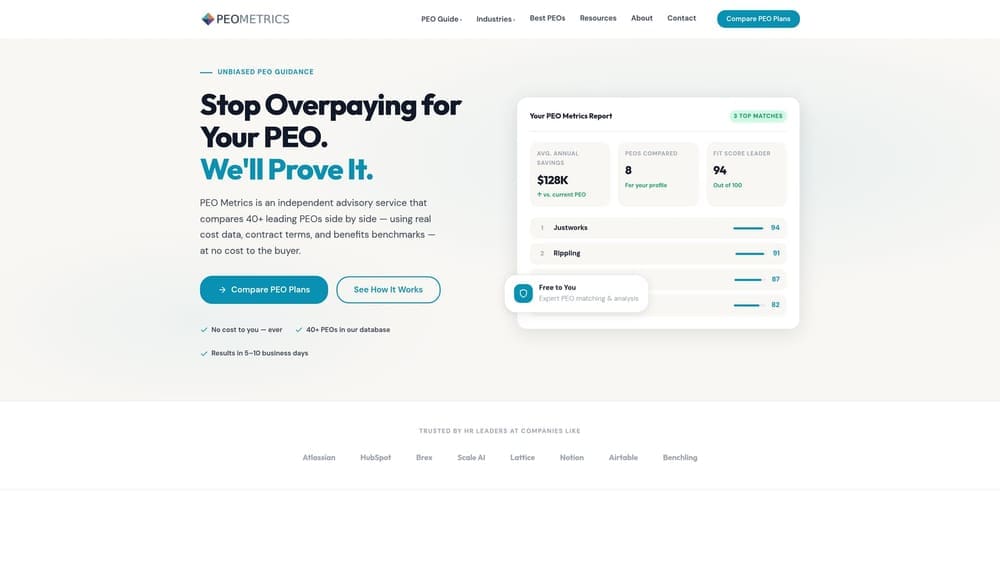
Its most useful contribution for retail is consistency. PEO quotes often differ in the workers’ comp basis, the fee structure, and the benefits assumptions, so a lower number on one proposal may not mean a lower cost. Putting quotes on like-for-like terms before a contract is signed is the specific job this service does, and none of the other tools here do it.
- Side-by-side PEO comparisons, so you can see providers against the same criteria rather than in separate sales decks.
- Pricing analysis that helps you look past headline administrative fees to what you would actually pay.
- Detailed provider metrics to check fit on things like service model and support.
- Consultative guidance when a quote or contract term is unclear.
Integrations don’t apply, since it’s an advisory service. Setup is simply sharing your headcount, locations, and current costs, and an owner or HR lead can run the process without IT involvement.
The limits are plain. It does not provide payroll, benefits, or co-employment, so you still need to choose and contract with a PEO. PEO Metrics may also receive vendor placement fees, which you should weigh when judging any recommendation. Pricing is listed on the website.
Best for: Retailers at the shortlisting stage who want quotes compared on consistent terms.
2. Insperity
Insperity is a national PEO known for a service model that assigns a dedicated HR representative to each client. It is aimed at employers that want a person to call rather than a portal to navigate.
For retail, that hands-on model matters most when you have several locations and no HR department. Store managers regularly hit questions about scheduling disputes, terminations, leave, and discipline, and a named representative can shorten the path to an answer. That assigned-rep approach is the main distinction from the more software-led options on this list.
What you get
- A dedicated HR representative who handles employee relations questions so managers don’t improvise.
- Payroll and benefits administration under one provider, reducing the number of vendors you manage.
- Workers’ comp and risk support, relevant when roles range from sales floor to receiving.
- Employee onboarding tools that help when you bring in seasonal staff in volume.
Fit and limits
Integrations should be verified on the official site, particularly for your point-of-sale, scheduling, or time-tracking tools. Pricing is quote-based, and what moves it typically includes headcount, benefits selections, and your workers’ comp profile. Confirm minimums and whether a very small shop is a good fit, since a single-store owner with a handful of employees may find a lighter service more suitable.
Best for: Multi-location retailers without in-house HR staff.
3. TriNet
TriNet is a publicly traded PEO that offers packages tailored by industry, along with a range of benefits options. For a retailer, the draw is a structured plan menu rather than a single standard bundle.
Benefits are a recruiting tool in retail, where hourly candidates compare your offer against the shop down the street. A PEO that offers multiple plan tiers lets you build something for full-time staff while thinking separately about part-timers. The industry-tailored packaging is what sets TriNet apart here, since it starts from assumptions about your type of business rather than a blank slate.
- Industry-specific packages that give you a starting configuration instead of building from scratch.
- Benefits plan options so you can offer choices to different employee groups.
- Payroll and compliance support to cover multi-jurisdiction rules as your footprint grows.
- An HR technology platform where employees and managers handle routine tasks themselves.
Verify integrations on the official site, especially for timekeeping and scheduling. Pricing is quote-based, and the number depends on headcount, plan choices, and risk profile. Confirm the minimum employee requirement before investing time, because a very small store may fall below it. Day-to-day, an HR lead or office manager usually administers the platform.
Best for: Mid-sized retailers wanting a structured benefits menu to attract hourly talent.
4. Justworks
Justworks is a software-first PEO that publishes its per-employee pricing, which is uncommon in a market where most quotes arrive only after a sales call. That transparency makes it easy to model costs before you speak to anyone.
The limitation to check first: confirm how it handles large hourly workforces and higher-risk workers’ comp classes. A boutique with a few salespeople is a different risk than a store with heavy stockroom activity, and published pricing may not capture that difference. Ask directly about eligibility for your class codes.
- Published pricing tiers, so you can estimate per-employee cost without waiting on a quote.
- An employee mobile app that lets staff view pay and benefits without asking a manager.
- Payroll and benefits in one system, which suits a lean back office.
- Compliance support that covers filings you’d otherwise track yourself.
Setup is generally lighter than at service-heavy providers, and the owner or an office manager can run it. Verify integrations on the official site. Pricing is listed on the website, and it moves with headcount and the plan tier you select, so confirm current rates there.
Best for: Small boutiques and few-location shops with limited HR staff.
5. ADP TotalSource
ADP TotalSource is ADP’s PEO offering, and it is separate from ADP’s payroll-only products. Make sure any proposal you receive is specifically for the PEO, because the co-employment relationship and the liability structure differ from ordinary payroll service.
What it does distinctively is connect timekeeping to payroll inside the PEO. For retailers with shifting schedules, overtime rules that vary by state, and hourly staff across several locations, clean hours data flowing into payroll cuts down on correction work. That tie between time and pay is the clearest differentiator on this list.
- PEO co-employment that shifts employer-side HR and compliance duties to a shared model.
- Payroll infrastructure built for multi-state and multi-location pay runs.
- Time and attendance tools that feed hours directly into payroll.
- Benefits administration so enrollment and billing sit with one provider.
It works within the ADP ecosystem, so check the official site for how it connects to your other systems. Pricing is quote-based, shaped by headcount, benefits, and state mix. Verify eligibility minimums and onboarding timelines, especially if you need to be live before a holiday hiring wave. Implementation usually involves both an HR lead and whoever manages store scheduling.
Best for: Multi-state retailers wanting timekeeping connected to payroll.
6. Paychex PEO
Paychex PEO is the co-employment service from Paychex, distinct from its payroll products. It packages payroll, HR, retirement services, and benefits access on a platform many small employers already know.
The strongest case is a business already running payroll with Paychex. Moving into a PEO inside the same relationship can mean less data migration and a familiar interface, which matters when you’re short on time. For a retailer starting from nothing, the advantage is smaller, and you should compare it directly against the others.
- Bundled payroll and HR support under a single provider.
- Retirement services, which help you offer a 401(k) to staff who stay beyond the first year.
- Benefits access for eligible employees.
- Compliance support for employment filings and rules.
Integrations run through the Paychex ecosystem, so verify what connects on the official site. Pricing is quote-based, and headcount, benefit selections, and state drive it. The key question for retail is benefits eligibility for part-time employees and whether the PEO is available in every state where you operate. Ask for both in writing.
Best for: Existing Paychex payroll clients moving into co-employment.
7. Oasis Outsourcing
Oasis Outsourcing is a Florida-founded PEO that serves multiple states and offers its services in tiers. The structure lets you buy a level of support that matches how much HR work you want to hand off.
That flexibility is its difference from more standardized bundles. A regional retailer with a capable store manager network might want help mainly on workers’ comp and compliance, while another might want the full range. Customizable tiers let you pay for the first without being pushed into the second.
- Customizable service tiers so you scale support up or down.
- Workers’ comp support to help manage claims and coverage across roles.
- Payroll and benefits administration in the same package.
- Compliance help for the employment rules your locations face.
Verify integrations on the official site. Pricing is quote-based, and tier selection, headcount, and workers’ comp exposure shape the figure. Confirm geographic coverage and size fit early, since a PEO that operates in some states and not others can leave a gap for a growing chain. Ask who your day-to-day contact will be and how claims are handled.
Best for: Regional retailers needing workers’ comp and compliance help.
8. Vensure Employer Services
Vensure Employer Services provides PEO and HR outsourcing to small and mid-sized businesses across many industries. Its breadth includes employers with higher-risk workers’ comp classes, which is relevant if your retail operation includes stockroom, warehouse, or delivery roles.
That experience with a wide industry mix is its distinguishing point. Many retailers discover the comp class question only when a quote comes back higher than expected, because a few warehouse-type positions change the risk picture. A provider used to those classes may be a better match than one built mainly around office-based clients.
- PEO and HR outsourcing options, so you can choose a service scope that fits.
- Payroll and benefits administration to consolidate vendors.
- Workers’ comp support for roles with physical demands.
- Compliance services across the states you employ in.
The main caution is that the service model can vary by affiliated brand, so confirm which entity you’d contract with and what it covers. Verify state coverage and integrations on the official site. Pricing is quote-based, with headcount, benefits, and comp classification as the main drivers. Smaller retailers should ask how the provider handles classification of mixed roles.
Best for: Smaller retailers with stockroom or warehouse roles raising comp class questions.
Matching a Retail PEO to Your Situation
Three situations stand out. A small single-store shop with a few employees will likely find Justworks the easiest to price and run, since you can see the rates up front. A multi-state chain should look hard at ADP TotalSource for timekeeping tied to payroll and at Insperity for hands-on HR support. A seasonal-heavy retailer should focus on onboarding speed, workers’ comp handling, and benefits eligibility rules for part-timers, which makes TriNet, Oasis, and Vensure worth testing. If you already run payroll with Paychex, start there, but still compare it against at least two others.
Whichever you choose, get every quote on identical terms: the same headcount, the same states, the same workers’ comp assumptions, and the same benefits. Ask about minimum employee rules and contract exit terms before signing. Confirm every vendor detail directly with the provider, since prices, state coverage, and eligibility change. PEO Metrics may receive vendor placement fees, so treat our guidance as one input and verify the rest yourself.
Before you sign that PEO renewal, make sure you’re not leaving money on the table.
Many businesses unknowingly overpay because of bundled fees, hidden administrative markups, and contracts designed to limit flexibility. We give you a clear, side-by-side breakdown of pricing, services, and contract terms, so you can see exactly what you’re paying for and choose the option that truly fits your business.
