

If you run a small, grant-funded organization, a PEO decision turns on mechanics that most “best PEO” lists skip: how co-employment interacts with your unemployment reimbursement election, whether your staff can keep a 403(b), and whether the vendor can work with restricted funding and program-level budgets. These providers were chosen for nonprofit-relevant fit, benefits and retirement options, compliance support, pricing transparency, and service model, using vendor sources as of 2026. Most are general-market PEOs, not nonprofit specialists, so treat each entry as a starting point for verification.
Quick Comparison of Nonprofit PEO Options
- PEO Metrics: nonprofits still choosing a PEO; pricing on request via the website; compares several PEOs side by side instead of selling one.
- Justworks: small nonprofits with no HR staff; pricing published on its site (verify current rates); the most self-service platform of the group.
- TriNet: mid-sized nonprofits; quote-based; packages services by industry.
- Insperity: lean leadership teams wanting hands-on help; quote-based; an assigned HR representative is central to its model.
- ADP TotalSource: nonprofits already on ADP or spread across states; quote-based; built on ADP’s payroll platform.
- Paychex PEO: nonprofits already using Paychex payroll; quote-based; lets you start with payroll and move toward PEO or HR outsourcing in one vendor.
- Engage PEO: smaller nonprofits wanting a mid-market alternative; quote-based; smaller-scale PEO with an HR-services emphasis.
1. PEO Metrics
PEO Metrics is our own service, and it is different in kind from everything else here: it is a comparison and consulting service, not a PEO. It does not run payroll, administer benefits, or enter a co-employment relationship with your staff. A PEO shares employer responsibilities with you under co-employment. A CPEO is a PEO certified by the IRS. An ASO handles administration without co-employment. PEO Metrics sits outside all three and helps you evaluate them.
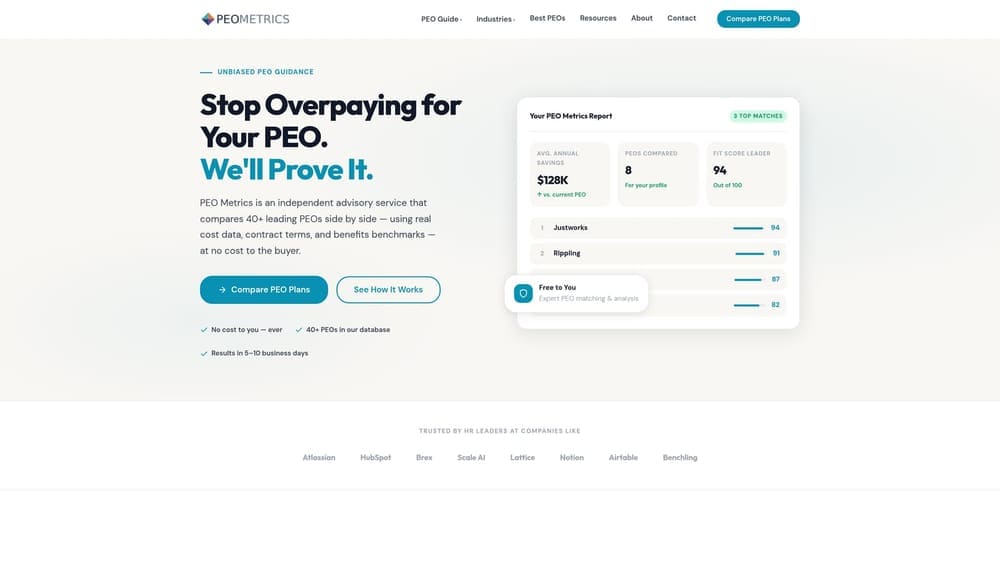
Its distinctive strength is that quotes from several PEOs land in one place, with detailed metrics and pricing analysis, rather than a single vendor presenting its own proposal as the market. For a nonprofit, that matters because bundled fees and administrative markups are hard to see in separate proposals, and grant budgets leave little room for surprises.
- Side-by-side provider comparison, so you can weigh service scope against cost in one view.
- Pricing analysis that helps you spot bundled fees and markups before you sign.
- Data-driven provider metrics that put each vendor on the same footing.
- Consultative guidance on shortlisting, including which questions to press on nonprofit-specific terms.
There is nothing to integrate, because it is not a software platform. Setup is a conversation, and whoever owns the PEO decision at your organization runs it.
The limits are plain. It delivers no payroll, benefits, or HR services itself, so it is useful only if you are actually weighing a PEO. And PEO Metrics may receive vendor placement fees, which you should factor into how you use any recommendation. Pricing details are on the website.
Best for: Nonprofits still deciding which PEOs to shortlist and wanting quotes pressure-tested.
2. Justworks
Justworks is a PEO built for small and growing employers, and its main appeal for a small nonprofit is that it is easy to understand and to use. Where many PEOs make you request a quote to learn anything, Justworks has historically posted its pricing publicly. Check the current per-employee rates on its site as of 2026, since they change.
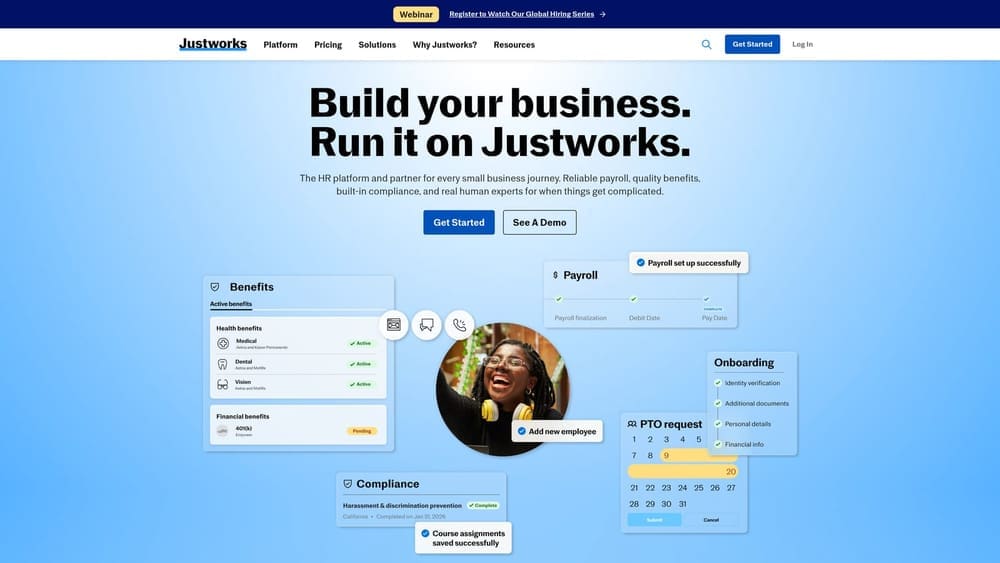
That self-service design suits an executive director who is also acting as HR lead and does not have time for a lengthy implementation. Employees handle much of their own onboarding, benefits enrollment, and time-off requests through the platform.
- Payroll that runs through the same platform as benefits, reducing separate tools for a tiny team.
- Benefits administration, so staff enroll and manage coverage themselves.
- Compliance support to help a team without legal or HR expertise stay on top of employer obligations.
- Workers’ comp coverage included as part of the PEO arrangement.
- HR support for everyday questions.
Accounting and time-tracking integrations exist, but confirm the current list on the vendor site against the tools you use, especially if your finance team tracks grants in a specific system.
The limits: a larger or more complex organization wanting a dedicated advisor may find the model too light, and the plan notes that nonprofit unemployment handling should be verified directly. Ask how it treats a reimbursement election, and whether 403(b) access is available, before you commit. Neither is something this article can confirm for you.
Best for: Small nonprofits with no in-house HR that want a transparent, easy-to-use platform.
3. TriNet
TriNet is a large PEO covering payroll, benefits, HR compliance, and risk services. What sets it apart on this list is that it packages its offering by industry, which can mean a service bundle shaped around sector-specific needs instead of one generic plan. Whether it has a nonprofit-oriented package is something to confirm with the vendor as of 2026, not something to assume.
The trade-off starts with budgeting. Pricing is quote-based, so you will not get a number until you go through a sales process, and minimums and fit vary. For a nonprofit building a grant budget or an annual operating plan, that delays the comparison work.
What You Get
- Payroll and benefits administration under one contract.
- HR compliance support to help interpret employment rules across the states where you hire.
- Risk and workers’ comp support, useful where program staff face field-based or client-facing work.
- Industry-specific offerings, which is the feature to probe for nonprofit relevance.
What to Verify
Integrations are not listed in our notes, so ask which accounting and HR systems connect. Ask specifically how TriNet handles a nonprofit’s unemployment reimbursement election, since a PEO that reports under its own state unemployment account can complicate that election depending on the state. Ask which retirement plans it supports and whether a 403(b) is among them.
It is likely a better fit for mid-sized organizations than for a team of a handful of people, where a quote-based, larger-vendor process can feel heavy. Pricing is quote-based and typically moves with headcount and the benefits you select.
Best for: Mid-sized nonprofits wanting a PEO that packages services by industry.
4. Insperity
Where Justworks leans on self-service, Insperity leans on people. Its model pairs each client with an assigned HR representative, alongside payroll, benefits, and risk and compliance services, plus HR consulting. For a nonprofit whose leadership team is two or three people wearing many hats, having a named person to call about a performance issue, a policy question, or a difficult termination is the core of the pitch.
That advisor-led design is its standout feature versus the rest of this list. It tends to matter most when your HR needs are less about processing and more about judgment, such as handbook drafting, manager coaching, and employee relations.
- An assigned HR representative who learns your organization instead of routing you to a ticket queue.
- Payroll and benefits administration within the same relationship.
- Risk and compliance services that support policy and regulatory questions.
- HR consulting for work that goes beyond transactions.
Integrations are not specified in our notes, so verify what connects to your accounting and grant-tracking tools. Setup generally involves an onboarding process with the vendor team, and day-to-day ownership usually sits with an operations or finance lead working with the representative.
The cost question deserves attention. A service-heavy model may cost more than a technology-led option, and pricing is quote-based, so you will not see a number up front. Also verify any minimum employee requirement as of 2026, since a very small organization may fall below it. As with every provider here, confirm how the PEO interacts with your unemployment reimbursement election and whether your staff can keep a 403(b).
Best for: Nonprofits with small leadership teams that want hands-on HR guidance.
5. ADP TotalSource
If your payroll already runs through ADP, ADP TotalSource is the PEO worth pricing first. It is ADP’s co-employment offering, built on the company’s payroll and workforce platform, with benefits, workers’ comp, and HR support layered on. The distinctive advantage is continuity: moving from ADP payroll to an ADP-run PEO can mean fewer system changes than switching to an unrelated vendor.
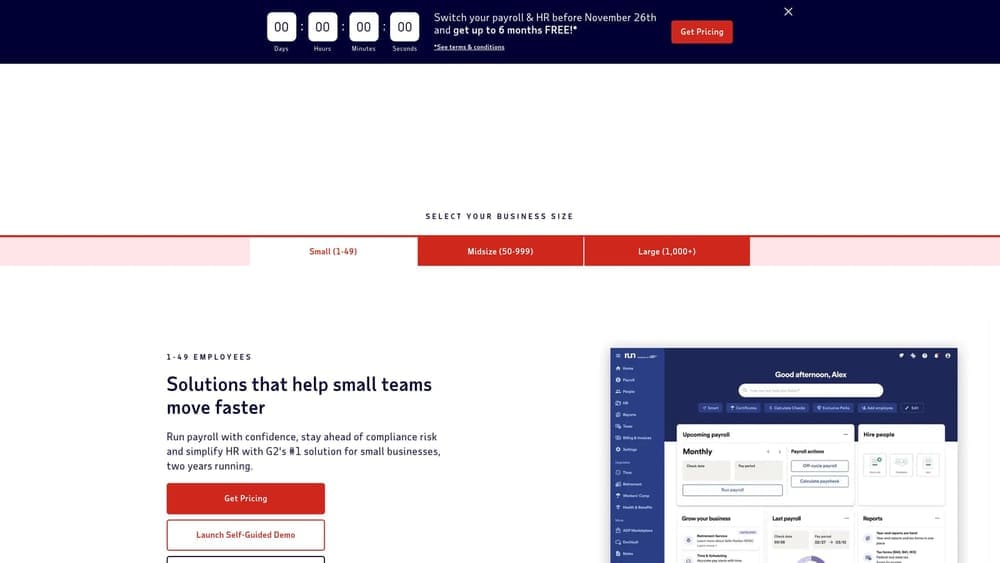
It also suits organizations with employees in several states, where a large platform’s multi-state payroll and compliance footprint is more relevant than a boutique’s attention.
- A payroll platform that handles multi-state tax filings, helpful for organizations with remote or regional staff.
- Benefits offerings your employees can enroll in through the PEO.
- Workers’ comp coverage handled within the arrangement.
- HR support for routine employment questions.
- Retirement options, where the one to confirm is 403(b) availability, since many PEO retirement programs center on 401(k) plans.
Integrations include other ADP products; third-party connections should be verified on the vendor site. Implementation is typically a managed process, and an HR or finance lead will be the main contact afterward.
The limits are scale and opacity. Pricing is quote-based, and a very small nonprofit may find the size of the organization and sales process out of proportion to its needs. Eligibility should be verified as of 2026. If you are not already an ADP customer, the platform advantage largely disappears, and you are comparing on service and price like everyone else.
Best for: Established nonprofits already on ADP or operating in several states.
6. Paychex PEO
Paychex offers a PEO and HR outsourcing option as part of a broader suite that includes payroll and retirement services. Its distinctive angle is the on-ramp: an organization can begin with payroll and later move into PEO or HR outsourcing without changing vendors, which suits a nonprofit that is not ready to hand over co-employment yet.
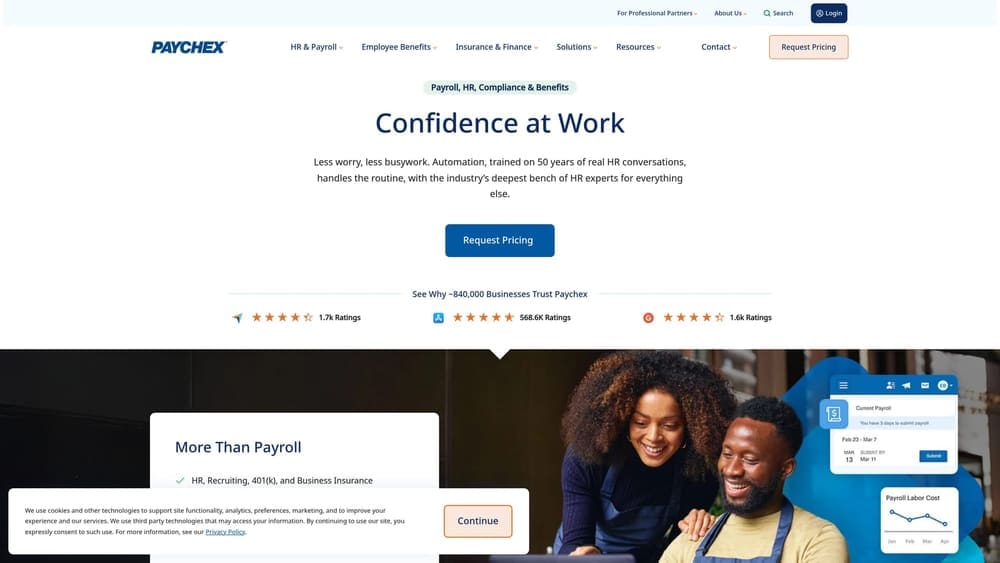
That flexibility has a cost in clarity. Paychex sells several service tiers, and not all of them are the same thing. Some HR outsourcing arrangements are administrative services without co-employment, so a like-for-like comparison against a true PEO is harder. Before you compare quotes, confirm in writing which product is a true PEO and which is something else.
- Payroll that can serve as the foundation if you are starting small.
- Benefits administration, either bundled or added as your needs grow.
- HR outsourcing for organizations that want support without full co-employment.
- Retirement services, where you should ask directly whether 403(b) plans are supported.
- Compliance support for employment-law questions.
Integrations center on other Paychex products; check third-party connections on the vendor site. Setup effort will depend on whether you are adding services to an existing payroll relationship or starting fresh, and an operations or finance lead will usually own it day to day.
Pricing is quote-based, so expect a sales conversation. It is a weaker fit if you want one clean, single-product comparison, or a vendor with a clearly nonprofit-specific program. Ask about the latter directly as of 2026.
Best for: Nonprofits already using Paychex payroll that want a path to broader HR support.
7. Engage PEO
Engage PEO serves small and mid-sized employers with payroll, benefits, compliance, workers’ comp, and HR support. Its positioning is smaller-scale with an emphasis on HR services, which may appeal to a nonprofit that finds the national names impersonal. Verify that positioning on the vendor site as of 2026.
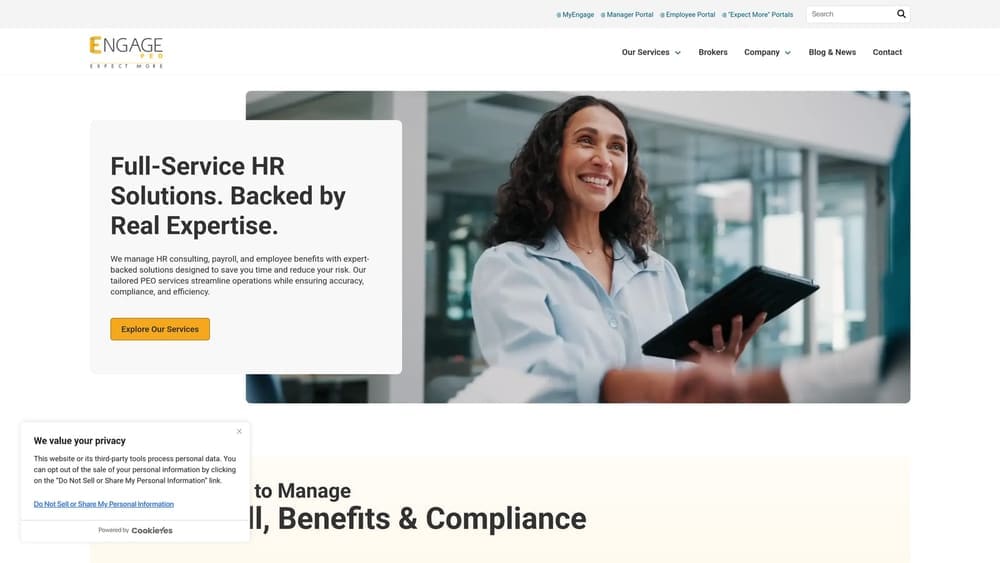
A caveat comes first: nonprofit relevance is not confirmed in our research, and nonprofit experience is unverified. Treat this entry as a candidate to qualify, not a recommendation. Ask for references from other 501(c)(3) clients and ask how it has handled unemployment reimbursement elections in your state.
Features
- Payroll and benefits administration in one arrangement.
- Compliance support for a team without in-house employment-law expertise.
- Workers’ comp coverage, where you should confirm how nonprofit class codes are treated.
- HR support aimed at day-to-day employee questions.
Limits and Pricing
A smaller footprint may mean fewer carrier options in some states, which can affect the benefits menu your staff sees. Integrations are not specified, so verify them against your accounting and grant-tracking tools. Pricing is quote-based, and it generally moves with headcount and benefit choices, so request a written proposal and compare it against the larger vendors.
It makes the most sense as a comparison point: if a mid-market PEO matches the national names on nonprofit mechanics and costs less, that is worth knowing. If it cannot answer the nonprofit questions clearly, move on.
Best for: Smaller nonprofits comparing a mid-market PEO against the national names, if nonprofit fit is confirmed.
Matching a Provider to Your Nonprofit and Running the Checks
For a small nonprofit without HR staff, start with Justworks. If you want a hands-on advisor, Insperity is the closest match. A group already on a payroll platform should price ADP TotalSource or Paychex first. If you are still comparing, PEO Metrics can put quotes side by side.
Whatever you shortlist, ask each provider:
- How does joining affect our unemployment reimbursement election in our state?
- Can staff keep or join a 403(b)?
- Which workers’ comp classes apply to our roles?
- What are the contract exit and renewal terms?
This article is informational and not legal, tax, or benefits advice. Confirm details with each vendor, the IRS, and your state workforce agency. PEO Metrics may receive vendor placement fees.
Before you sign that PEO renewal, make sure you’re not leaving money on the table. Many businesses unknowingly overpay because of bundled fees, hidden administrative markups, and contracts designed to limit flexibility. We give you a clear, side-by-side breakdown of pricing, services, and contract terms, so you can see exactly what you’re paying for and choose the option that truly fits your business. Don’t auto-renew. Make an informed, confident decision.
