
A lot of wage and hour problems start the same way. Payroll has been running for years, managers approve time in different ways, someone works after hours from a phone, and leadership assumes the process is basically sound because no one has raised a major issue.
Then a complaint lands. Sometimes it comes from an employee. Sometimes it comes from a former employee. Sometimes it arrives as an agency inquiry that pulls finance, HR, operations, and legal into the same room for months. At that point, wage and hour compliance stops being an HR back-office topic and becomes a cash-flow, documentation, and contract-risk problem.
For employers evaluating a PEO, that distinction matters. A strong PEO relationship can reduce exposure. A weak one can leave the employer paying enterprise fees for small-business controls. The right question isn't whether a provider “handles compliance.” The right question is how that provider helps prevent underpayment, document decisions, and respond when regulators or plaintiffs' counsel start asking for records.
Table of Contents
- Why Wage and Hour Compliance Is a Top Priority in 2026
- The Core Pillars of Wage and Hour Law
- A Practical Wage and Hour Compliance Checklist
- Common Audit Triggers and How to Respond
- Navigating Multi-State Wage and Hour Complexities
- How a PEO Mitigates Your Wage and Hour Risk
- From Compliance Burden to Business Confidence
Why Wage and Hour Compliance Is a Top Priority in 2026
The finance risk in wage and hour compliance is easy to underestimate because the problem usually grows unnoticed. One employee misses some overtime. A location manager rounds time inconsistently. A bonus isn't included in overtime calculations. Then the same error repeats across payroll cycles, departments, or states.
That turns a payroll process issue into a balance-sheet issue. In fiscal year 2025, the U.S. Department of Labor's Wage and Hour Division recovered more than $259 million in back wages for nearly 176,957 employees, with an average recovery of $1,465 per worker, according to the agency's Wage and Hour Division enforcement data. For a CFO, the takeaway is straightforward. Wage and hour compliance isn't a filing obligation. It's an ongoing operational control function.
A second point gets missed in boardroom conversations. Even when the direct wage exposure looks manageable, the internal cost of an investigation is rarely small. Payroll data has to be pulled. Time records have to be reconciled. Job descriptions get compared against actual duties. Leadership loses time to document production, interviews, remediation, and contract review with vendors.
Practical rule: If a company can't explain exactly how hours are captured, approved, exported to payroll, and audited, it doesn't have a wage and hour compliance program. It has a payroll habit.
For employers with hourly teams, distributed operations, or rapid hiring, “we've always done it this way” is one of the most expensive management assumptions in the business. It usually means key decisions were made years ago and never re-tested against current pay practices, remote work patterns, or state-specific rules.
That creates a procurement issue as much as a legal one. Buyers comparing payroll vendors, ASOs, and PEOs should evaluate whether a provider supports monitoring of labor law changes, audit readiness, and escalation workflows. A useful benchmark is whether the provider has a documented labor law update monitoring process instead of relying on ad hoc client alerts.
Employers that want a concrete view of private-claim exposure often review examples of wage dispute settlement amounts California to understand how payroll errors can turn into significant claims once penalties, attorney involvement, and multiple employees are involved.
The Core Pillars of Wage and Hour Law
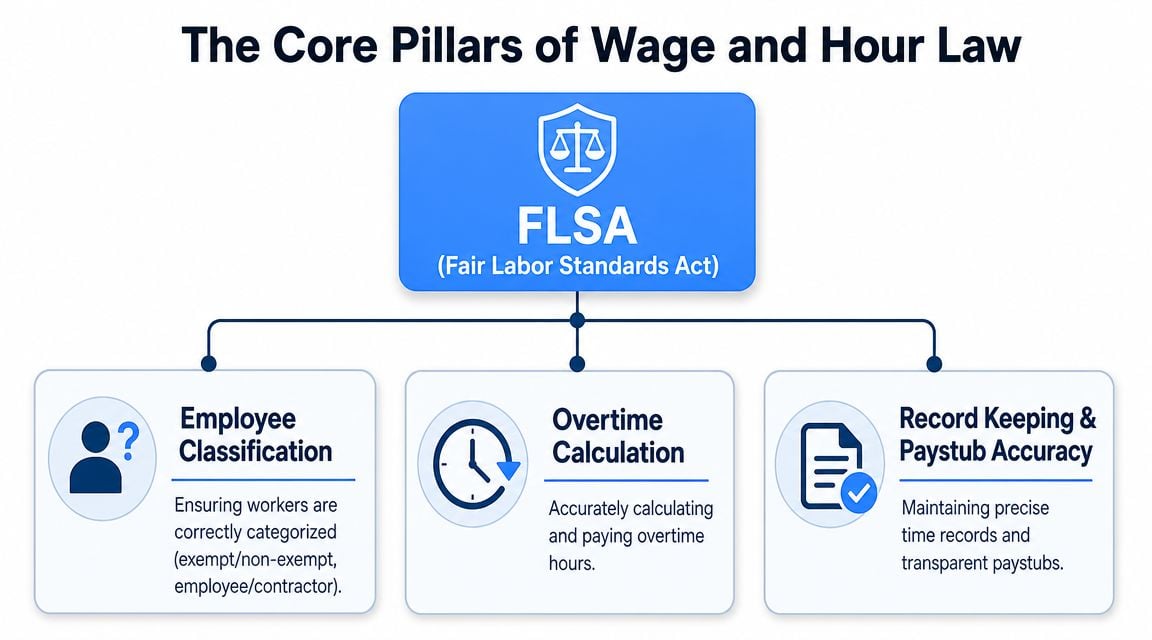
Most wage and hour compliance failures sit in three places: classification, overtime calculation, and recordkeeping. Finance leaders don't need a law-school treatment of each one. They need to know where mistakes start, how they spread, and what systems have to prove when someone challenges pay practices.
Classification errors usually start in operations
A job title doesn't control whether someone is exempt from overtime. Neither does paying a salary by itself. Classification depends on the legal tests that apply to the role and the duties the person performs day to day.
That gap between paper and practice is where employers get into trouble. A company might label a working supervisor as exempt because the role sounds managerial, while the employee spends most of the week performing the same production work as the team. Once that happens across several locations, the error becomes systemic.
A good control isn't just an HR file review. It's a process that compares job descriptions, manager expectations, compensation design, and real work performed. That's one reason buyers often review PEO joint employment liability explained before deciding how much they can rely on a provider's compliance guidance versus their own internal accountability.
Overtime mistakes are often built into payroll logic
The next pillar is overtime. Under the FLSA, overtime must be calculated using the regular rate, and that rate includes non-discretionary bonuses and commissions, not just base hourly wages, as the U.S. Department of Labor explains in its FLSA handy reference guide.
That sounds technical until payroll runs. Then it becomes very practical.
If a company pays attendance bonuses, shift premiums, or production incentives, and payroll calculates overtime from base rate only, the underpayment repeats automatically every cycle. The same issue appears when employees work in multiple jobs or locations and hours aren't combined correctly for weekly overtime purposes.
A useful way to think about this is in table form:
| Pillar | What employers often assume | What actually creates risk |
|---|---|---|
| Classification | Salary equals exempt | Duties and legal tests control |
| Overtime | Base hourly rate is enough | Regular rate must include required variable pay |
| Hours aggregation | Each location stands alone | Weekly hours may need to be combined across roles or sites |
Payroll software doesn't make an employer compliant on its own. It only applies the rules it was configured to apply.
Records decide who wins factual disputes
The third pillar is recordkeeping. In this aspect, many defensible employers lose their advantage. They may have intended to pay correctly, but they can't show exactly when work started, when it ended, whether meal periods were captured, or whether after-hours work was approved and paid.
Records matter because wage claims often become disputes about facts. Did the employee answer messages after clock-out? Did a manager ask people to prep before the shift? Did travel time or location transfers get counted? Without reliable records, the employer has a harder time proving its side.
A Practical Wage and Hour Compliance Checklist
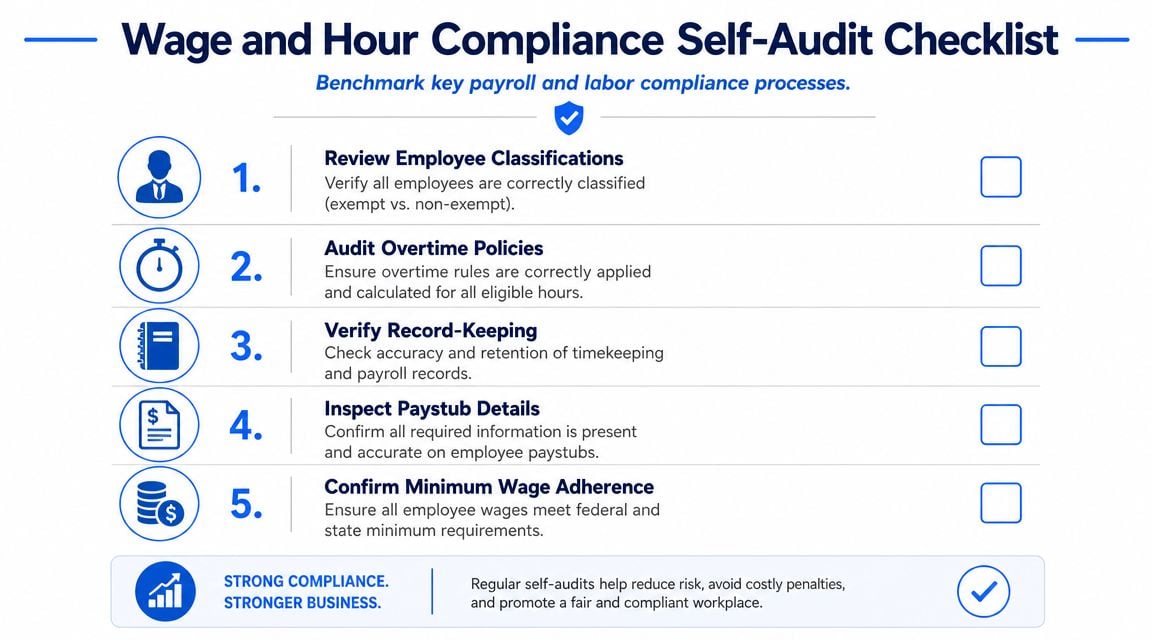
Most companies don't need a broad “compliance initiative.” They need a disciplined review of a few operating controls that drive most wage and hour exposure. The fastest way to start is to treat it like a self-audit and assign owners across HR, payroll, operations, and finance.
What to review this quarter
Use this checklist as a working review, not a policy exercise.
- Re-test exempt classifications: Compare written job descriptions with actual duties performed in the field. Focus on roles that have evolved because of growth, turnover, or lean staffing.
- Audit time capture outside scheduled shifts: The FLSA requires accurate records of all hours worked, and weak controls that miss off-the-clock work, including after-hours email or remote work, can lead to back-pay exposure, as discussed in this practical guide to wage and hour compliance.
- Check regular-rate inputs inside payroll: Review whether bonuses, commissions, and shift differentials feed correctly into overtime calculations.
- Review manager practices, not just policies: A clean handbook doesn't help if frontline managers ask employees to start work early, finish tasks after clock-out, or skip recording travel between sites.
- Inspect paystub accuracy and retention: Make sure records are complete, stored consistently, and easy to produce if a claim or audit arises.
For hospitality and service businesses, one extra review point matters. Teams often confuse tips, service charges, and mandatory fees, then build payroll treatment on the wrong assumption. A practical primer on comparing service charge and tip models can help operations and payroll leaders frame the issue before they set policy.
What strong controls look like
A good wage and hour compliance checklist doesn't stop at “review this.” It asks whether the company can prove consistent execution.
Look for these signs of strength:
| Control area | Weak version | Strong version |
|---|---|---|
| Timekeeping | Managers edit time without clear support | Edits are logged, reviewed, and traceable |
| Remote work | Policy is informal | After-hours work rules are documented and enforced |
| Payroll review | Exceptions are fixed case by case | Exception reports are reviewed on a schedule |
| Classification | Reviewed only at hire | Re-tested when duties or org structure change |
The best checklist item is the one that produces evidence. If a control can't be documented, it becomes much harder to rely on when a claim surfaces.
Many employers ultimately discover whether their PEO or payroll provider is really helping. A provider that offers policy templates but no audit trail, no exception reporting, and no implementation discipline may reduce admin work without reducing legal risk.
Common Audit Triggers and How to Respond
Employers often assume wage audits are random. They aren't. Regulators and plaintiffs' attorneys usually follow patterns, and some business models attract more scrutiny than others.
Where regulators tend to focus
Historical enforcement data shows that compliance risk isn't uniform. A summary of Department of Labor data reported that sectors with the most back-wage cases included food services (5,417), construction (3,063), retail (2,856), healthcare (1,370), and agriculture (1,125), and also noted back-wage recoveries of $149,957,029 for 125,301 employees in fiscal year 2024 and $156,152,548 for 135,067 employees in fiscal year 2023, according to this WorldatWork analysis of DOL enforcement trends.
That aligns with what tends to create audit triggers in practice:
- Complaint-driven reviews: A single employee complaint can lead regulators to request broader records than the original issue suggests.
- Recurring payroll anomalies: Repeated edits, rounded time, or inconsistent overtime patterns can expose weak controls.
- High-risk operating models: Multi-location hourly teams, variable compensation, tipped workforces, and staffing volatility all create more opportunities for error.
- Turnover in the same role group: Departing employees often compare notes. If several people leave with the same pay concern, the issue rarely stays isolated.
For buyers assessing vendor support, examples of PEO audit penalty case review can be useful because they force a practical question: what happens when records are requested and errors are found?
What to do when the notice arrives
The worst response to a wage and hour audit is improvisation. A better response is procedural and calm.
- Scope the request. Identify which entities, locations, employee groups, and time periods are covered. Finance should know exactly what data will be produced before anything goes out.
- Run an internal exposure analysis. Reconstruct hours, pay rules, classifications, and exception handling. Don't assume the alleged issue is narrow.
- Fix current practices while preserving records. If an issue appears credible, stop the ongoing error, document the remediation steps, and centralize communications.
A common mistake is treating the agency request like a records exercise only. It isn't. It's also a systems test. Regulators often learn as much from inconsistent explanations and fragmented records as they do from the underlying pay data.
A fast response matters less than an organized one. Producing incomplete data early often creates more work later.
Navigating Multi-State Wage and Hour Complexities
Federal law is only the floor for many employers. Once a company operates in more than one state, wage and hour compliance turns into a rules-engine problem with legal consequences. Finance may see one payroll file. Operations may see one workforce. Regulators see separate obligations layered by jurisdiction.
Why one payroll policy often fails in practice
State agencies often remind employers that when federal, state, or local laws conflict, the employer must follow the stricter standard, as reflected in Maryland wage guidance. That sounds simple until the company has remote workers, satellite sites, or managers transferring employees across locations.
A policy that works in one state can fail immediately in another. Break rules, paystub requirements, wage notice obligations, local minimum pay rules, and treatment of certain categories of work don't line up neatly. Even when payroll software can technically handle different rules, someone still has to configure them correctly, maintain updates, and train managers not to override the process on the ground.
Consider a common growth pattern. A company starts in one state with a small HR team and an outside payroll provider. Then it hires sales staff in another state, opens an operations site in a third, and allows hybrid work from several others. The original payroll workflow often survives longer than it should. That's when compliance drift starts.
What buyers should test in a PEO review
Multi-state employers should be wary of broad promises like “we support all states.” Support isn't the same as control.
A better review includes questions like these:
- Jurisdiction setup: How does the provider determine which state and local rules apply when an employee moves, travels, or works remotely?
- Policy enforcement: Can the system reflect different time and pay rules by state, location, or employee group?
- Update ownership: Who monitors legal changes and who is responsible for applying them in the payroll and timekeeping workflow?
- Escalation path: When operations wants an exception, who approves it and how is it documented?
Employers with distributed teams often compare those answers against a provider's approach to multi-state payroll compliance under PEO arrangements. The key issue isn't whether the vendor has a national footprint. It's whether the operating model can keep up with conflicting rules.
How a PEO Mitigates Your Wage and Hour Risk
A PEO can reduce wage and hour compliance risk, but only if the buyer understands what risk transfer is real and what remains with the employer. Too many evaluations stop at software demos and benefits pricing. The harder question is whether the provider changes the control environment in a meaningful way.
What a good PEO actually changes
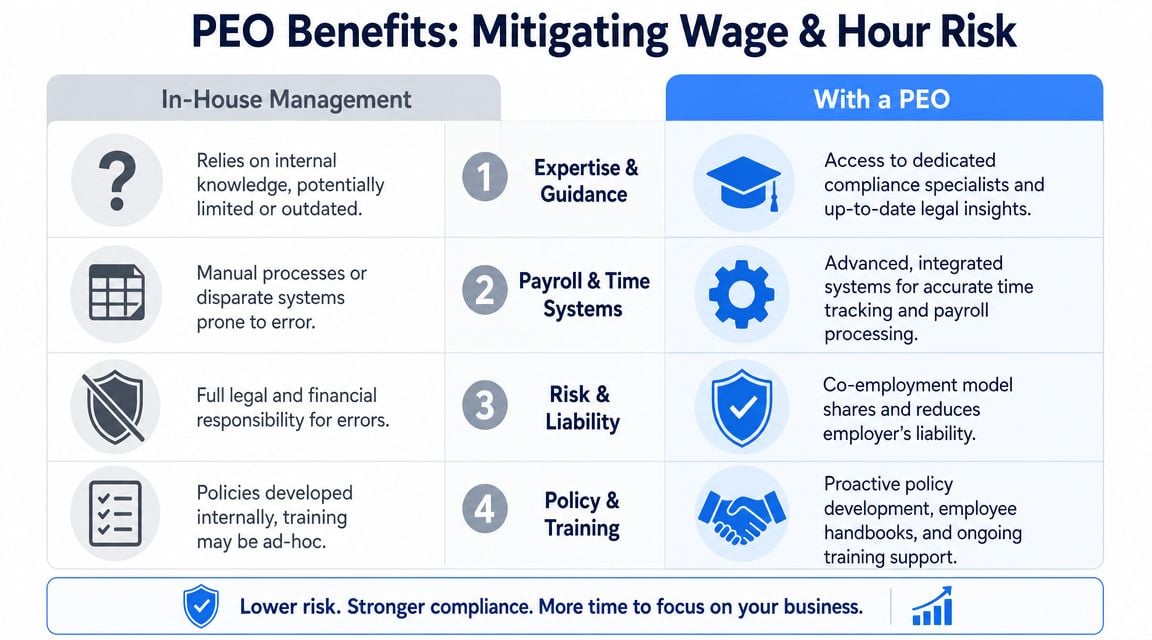
At its best, a PEO improves wage and hour compliance in four concrete ways.
First, it centralizes payroll, timekeeping, and employee data so the company isn't stitching together reports from multiple systems. That matters when overtime rules, edits, and approvals need to be traced.
Second, it adds implementation discipline. A capable provider won't just onboard employees. It will force decisions on classification, earnings codes, manager permissions, and approval workflows before bad habits scale.
Third, it gives the employer access to specialists who see recurring failure points across clients. That can be useful for job classifications, handbook language, state-specific workflows, and issue escalation.
Fourth, it can strengthen response readiness when a claim appears. Some providers help organize records, explain system logic, and coordinate the initial compliance response. Others leave the employer largely on its own. That difference should be visible in the contract and service model, not just in a sales presentation.
A PEO doesn't eliminate all liability. Employers still control hiring decisions, manager behavior, scheduling, and daily practices that often create wage claims. That's why risk managers often look at wage and hour exposure alongside broader employment practices liability policies, especially when internal supervision is uneven across locations.
Questions worth asking before signing
The best procurement conversations on wage and hour compliance are specific. These questions usually expose the difference between generic support and real risk management:
- Implementation review: What is the provider's process for auditing FLSA classifications during onboarding?
- Payroll logic: How are bonuses, commissions, and shift differentials handled in regular-rate overtime calculations?
- Timekeeping controls: Can managers edit punches freely, or are changes logged with reason codes and approvals?
- Multi-state enforcement: How does the platform apply state-specific rules when employees transfer or work remotely?
- Claims support: If a wage claim arrives, what records does the provider supply, how quickly, and who owns the response steps?
- Contract language: What does the agreement say about compliance support, indemnification, and dispute handling?
A useful companion review is PEO wage claim defense responsibility. Buyers should know, in plain terms, who does what when a wage dispute turns formal.
The value of a PEO isn't that it says the word compliance. The value is whether its systems, people, and contract terms reduce the chance of a preventable payroll error becoming an expensive dispute.
From Compliance Burden to Business Confidence
Wage and hour compliance is one of those subjects that looks narrow until a company has to defend it. Then every weakness shows up at once. Timekeeping gaps, outdated classifications, inconsistent manager practices, weak records, and vague vendor responsibilities all converge in the same file request.
That is why the issue belongs in finance, HR, and procurement at the same time. Strong employers treat wage and hour compliance as an operating discipline. They test classifications, audit payroll logic, verify time capture, and pressure-test vendor commitments before a problem appears.
For companies using or evaluating a PEO, that mindset changes the buying process. Instead of asking whether the provider “does compliance,” the better question is whether the provider makes the business more defensible. Can it support cleaner setup, better records, more reliable payroll calculations, and faster response when a claim arises?
That is the return. Fewer surprises. Better documentation. More confidence in expansion, hiring, and payroll operations.
Companies comparing or renegotiating a PEO can use PEO Metrics to benchmark providers, compare contract terms, and identify which options offer stronger compliance support, better service trade-offs, and fewer costly surprises.
