
The wrong way to choose a PEO is to start with the demo.
Good sales teams know how to make payroll tools, benefits portals, and HR support look interchangeable. The harder part, and the part that determines whether the relationship works after month six, is underneath the presentation. Buyers need to examine fee structure, renewal terms, implementation ownership, claims support, compliance scope, and who picks up the phone when an employee or manager has a real problem.
That is the lens for this guide. It is not just a roundup of recognizable names. It is a practical look at how to break apart a PEO offer the way an experienced buyer would, including where pricing gets fuzzy, where contracts shift risk back to the employer, and where service models fit one company well but create friction for another.
The market is large and established, as noted earlier from IBISWorld's industry outlook. That makes provider differences more important, not less. A mature category usually brings more polished marketing, more packaged bundles, and more ways to hide the true cost inside admin fees, benefits markups, or contract language.
A polished demo will not tell a CFO how renewals are handled. It will not tell an HR leader whether employee relations support is strategic, transactional, or routed through a general queue. It will not tell an owner whether the provider is built for a straightforward payroll and benefits handoff or a multi-state operation with frequent exceptions.
If you need a quick refresher on how the co-employment model works before comparing vendors, start with this explanation of what a professional employer organization (PEO) is.
Table of Contents
- 1. ADP TotalSource
- 2. TriNet
- 3. Insperity
- 4. Justworks
- 5. Paychex PEO
- 6. Rippling PEO
- 7. Engage PEO
- Top 7 PEOs: Side-by-Side Comparison
- Final Thoughts
1. ADP TotalSource
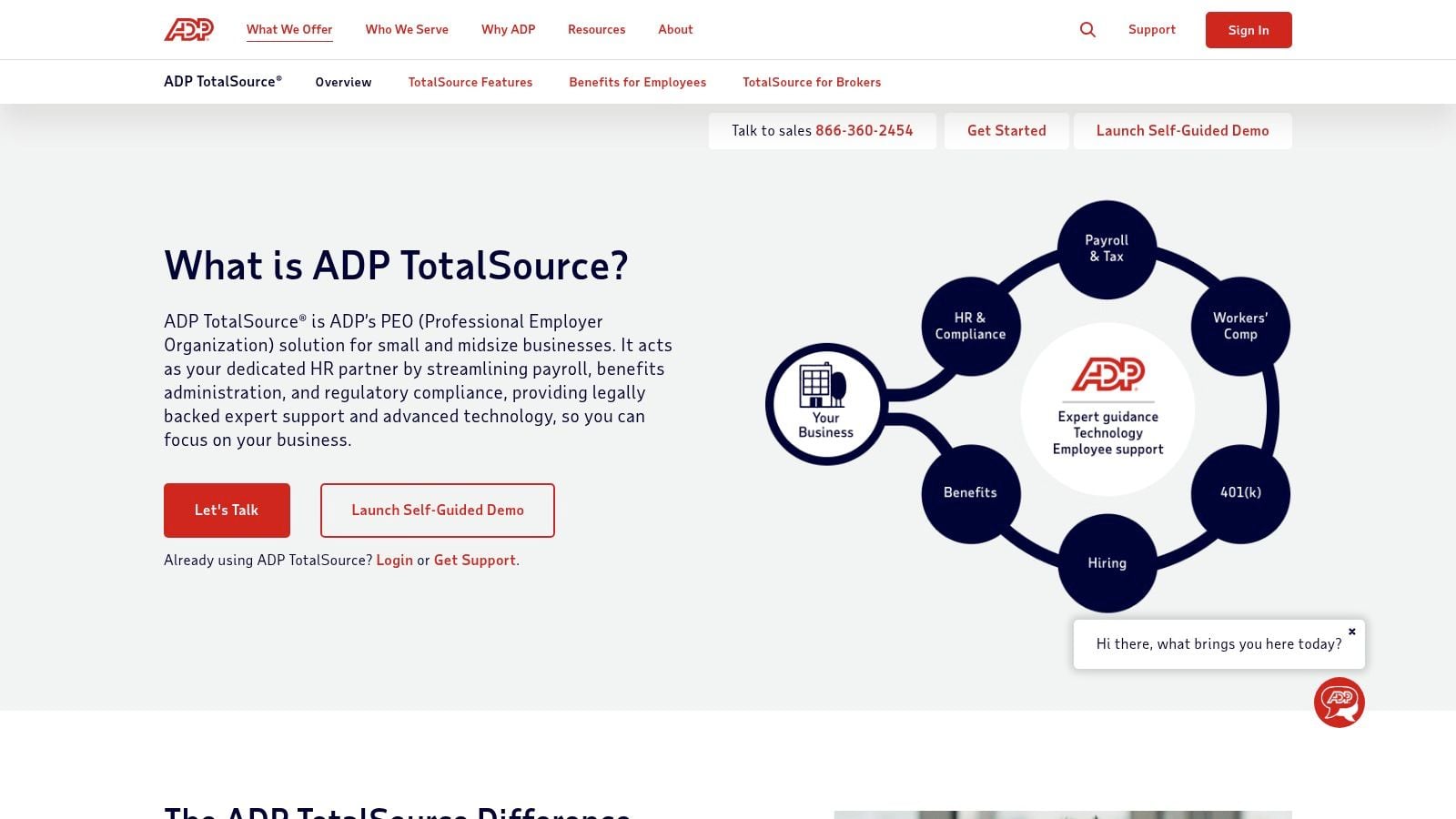
ADP TotalSource is one of the safest picks for companies that want a large, established PEO with national reach. It tends to make the most sense for employers with multi-state employees, a real compliance burden, and leadership that values operational stability over startup-style flexibility.
ADP's scale is the point. For a buyer trying to centralize payroll, benefits administration, workers' compensation, and HR support under one roof, that scale can translate into broader process coverage and less improvisation. That's often a plus for companies that have already outgrown a lightweight payroll vendor and don't want to stitch together multiple consultants and systems.
Where ADP TotalSource fits best
ADP is usually strongest when the problem is complexity, not just admin volume. A company with employees in several states, formal leave needs, ACA tracking, and ongoing manager issues will often value the maturity of the platform and support structure more than a cleaner interface.
It also helps that ADP TotalSource is a CPEO. For buyers still sorting out the basics, this overview of what a professional employer organization is is useful before getting deep into provider comparisons.
Practical rule: If the company's biggest risk is inconsistent compliance across locations, a larger PEO often beats a cheaper one.
What to press on in sales conversations
The downside is predictable. ADP doesn't publish pricing, so buyers have to work from proposals, not a simple posted fee. That makes comparison harder, especially if another provider is quoting a clean per-employee structure while ADP bundles services more broadly.
Very small employers can also find the operating model a bit heavy. The processes are documented and structured, which finance teams may like, but smaller teams sometimes want more customization than a large provider is willing to offer quickly.
A strong ADP evaluation usually comes down to three questions:
- Service ownership: Ask who handles benefits issues, employee relations guidance, payroll exceptions, and workers' comp coordination day to day.
- Implementation detail: Ask for a written implementation path, including data migration responsibilities and payroll cutover timing.
- Renewal protections: Ask how annual pricing changes, carrier changes, and service adjustments are handled at renewal.
2. TriNet
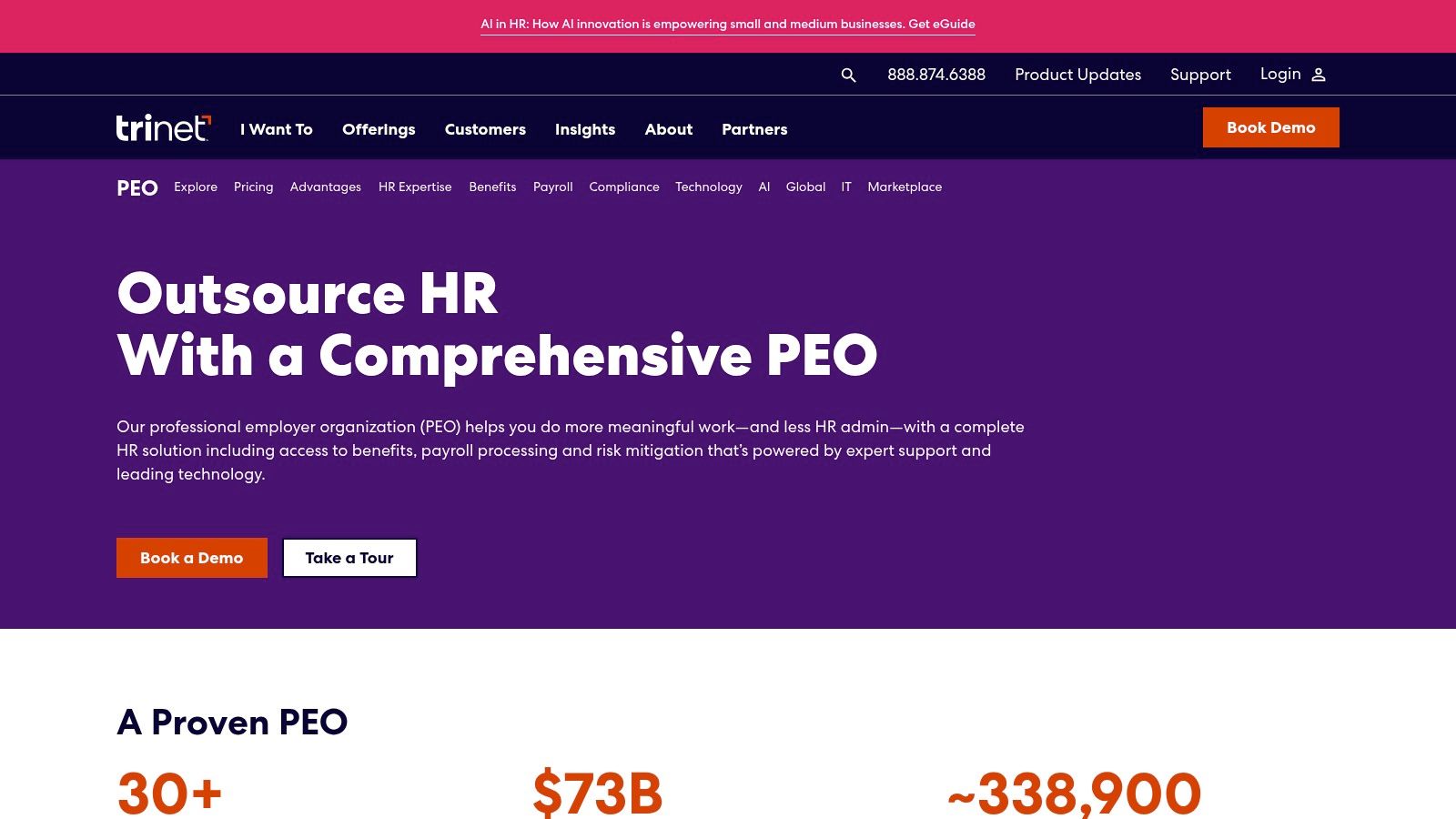
TriNet usually makes the shortlist for a different reason than ADP. The pitch is less about scale and more about fit. If you run a company in biotech, financial services, professional services, or another sector with specific policy, hiring, or benefits pressures, that framing can be useful. It gives buyers a way to test whether the provider actually understands the operating issues behind the HR work, not just the paperwork itself.
That matters because many executives overestimate what "industry specialization" means in a PEO sale. In practice, the key question is whether TriNet's service model, benefit design, and risk guidance match how your workforce operates. A startup with remote employees in multiple states has different needs than a nonprofit with grant-funded headcount or a regulated employer with tighter documentation requirements.
Why TriNet gets serious consideration
TriNet is often attractive to companies that want more context in the conversation. Sales and implementation teams tend to frame the discussion around industry norms, which can help buyers ask better questions about leave policies, exempt versus nonexempt classifications, hiring across states, and benefit competitiveness.
That is more useful than a generic vendor demo, but only if you know how to test the claims. A practical guide to the pros and cons of using a PEO helps separate category-level benefits from provider-specific strengths.
TriNet can also appeal to leadership teams that want a national provider without getting pushed into a completely standardized conversation. For the right buyer, that has value.
What to examine before you buy
The risk is simple. Vertical messaging can sound more customized than the actual delivery model.
Ask who will handle employee relations questions day to day. Ask how state-specific compliance issues get escalated. Ask whether your account team has worked with companies that share your labor model, not just your industry label. A software company with contractors, commissioned employees, and multi-state hiring creates a very different support load than a software company with one office and a straightforward salaried workforce.
Pricing also needs a harder look than TriNet's positioning may suggest. Public pricing is limited, so buyers need to compare total cost, contract terms, and what is excluded from the base proposal. That means reviewing benefit plan assumptions, implementation fees, renewal language, and any service boundaries around HR guidance or risk support.
Industry expertise only matters if the service team can resolve the real issue sitting in your inbox.
TriNet is often a strong option for employers that want more than generic payroll and HR administration. It is less compelling when the workforce is straightforward and the main goal is a cleaner price-to-service ratio. In those cases, specialization can be nice to have, but it may not justify a higher-cost or more layered operating model.
3. Insperity
Insperity usually enters the conversation when a company wants a PEO that can handle more operational complexity without feeling like a stripped-down small-business tool. The appeal is straightforward. Payroll, tax administration, benefits, workers' compensation, HR support, and risk services sit under one provider, which can reduce coordination work for an already stretched finance or HR team.
That said, breadth is not the same as fit.
Insperity tends to make more sense for employers that want a more structured service model and are willing to pay for it. Smaller companies can still be good candidates, but buyers should test whether they need that level of support or would be better served by a lighter arrangement. If that question is still open internally, it helps to compare a PEO vs. HRO service model before getting too far into vendor demos.
What Insperity does well
Insperity is often strongest with leadership teams that want one provider to cover the administrative core and give them access to HR guidance without piecing together multiple vendors. That matters when the internal team is lean, hiring is active, or compliance questions are showing up often enough to interrupt normal work.
It also tends to work well for buyers who value process. The company has an established implementation motion, a large support infrastructure, and a sales process that usually reflects a more mature operating model. For some employers, that translates into fewer handoffs and clearer ownership once the account is live.
For teams building a budget model before proposals come in, this breakdown of how much a PEO costs is useful because it frames the key inputs. Fee structure, benefit elections, payroll size, and service scope all affect the number.
The cost question to pin down early
Insperity's main challenge in a buying process is quote interpretation. Public pricing is limited, and two employers of similar size can receive proposals that look similar at first glance but behave very differently over a contract term.
Buyers should slow down here. The key comparison is not monthly admin fee versus monthly admin fee. It is total annual cost, pricing basis, contract flexibility, and how much service you receive before issues move into an extra-fee or out-of-scope category.
That is why the contract matters as much as the demo. SelectSoftware Reviews' buyer guide for PEOs highlights terms that many buyers skip on the first pass, including renewal language, implementation charges, and liability provisions.
- Clarify the fee basis: Ask whether the quote is built on headcount, payroll, benefits enrollment, or a mixed formula.
- Get renewal terms in writing: Verbal explanations are not enough if annual increases or repricing triggers are broad.
- Review exit mechanics early: Confirm data access, benefit transition support, notice requirements, and any termination fees before signing.
Insperity is a credible option for companies that want a more structured PEO relationship and can justify the added cost with real operating needs. It is less attractive for buyers who mainly want basic payroll, benefits access, and cleaner administration at the lowest workable price.
4. Justworks
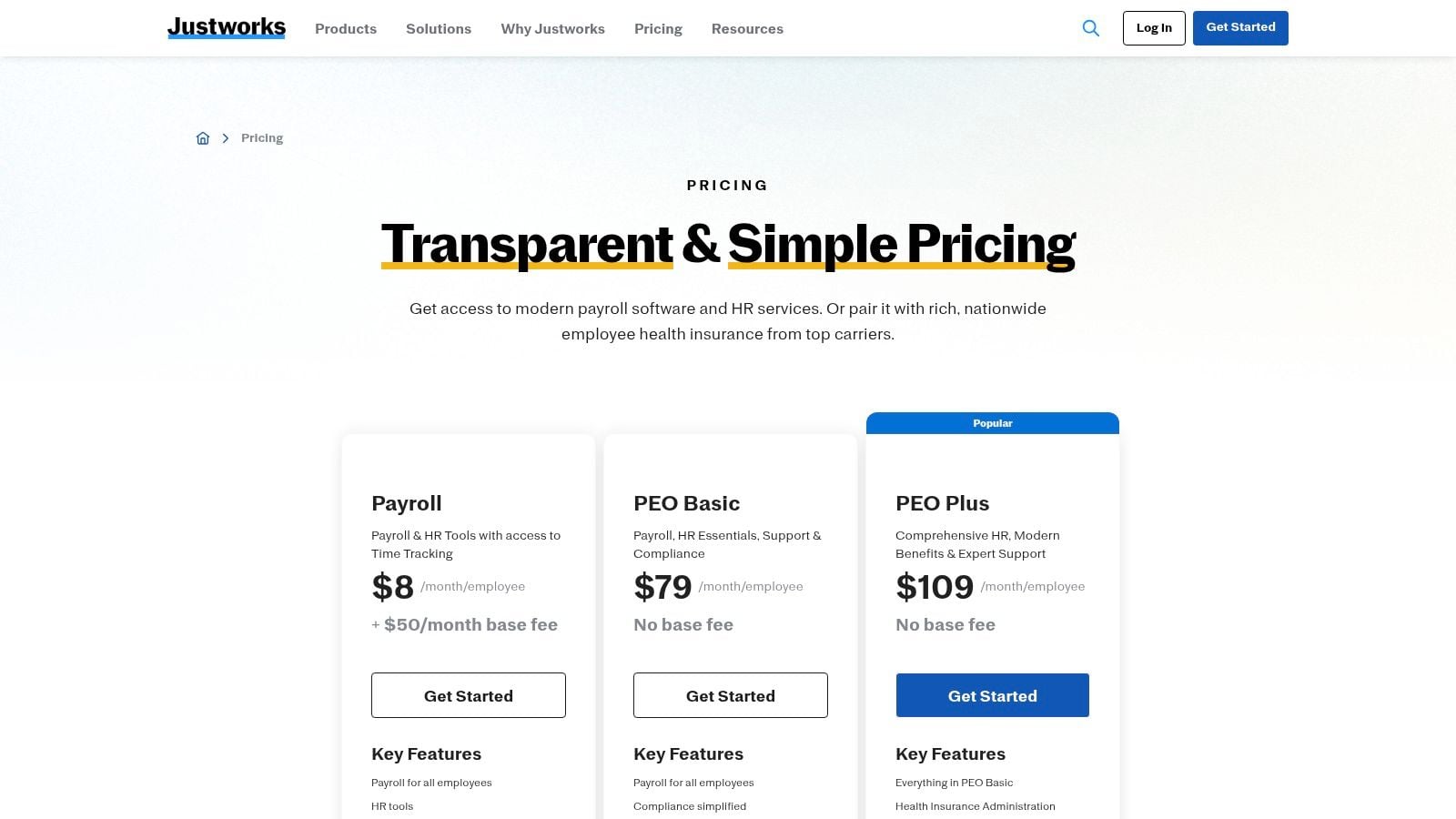
Justworks pricing earns attention for one simple reason. It publishes pricing. In a category where many providers push buyers into a quote process before revealing much of anything, that transparency is a real advantage.
The company is also one of the few major options in this group where a buyer can start with a rough economic model quickly. The brief specifically notes transparent structures starting at $8 per employee per month plus base fees among top providers like ADP, Rippling, and Deel, with Justworks also cited in negotiation context in the verified data. That doesn't make every Justworks proposal cheap, but it does make initial screening faster.
Why Justworks gets shortlisted so often
Justworks tends to fit smaller and mid-sized employers that care about ease of use, cleaner onboarding, and fewer pricing surprises in the early sales cycle. For a buyer without a large internal HR or procurement team, that simplicity saves time.
That's also consistent with adoption patterns. Almost two-thirds of PEO clients are in the 10 to 49 employee band, as noted earlier, and Justworks often appeals to companies in that range that want a straightforward operating model. This guide to the pros and cons of using a PEO is useful for deciding whether that model is even the right fit before comparing platforms.
Where the simple story gets more complicated
Published pricing doesn't eliminate trade-offs. It only removes one layer of uncertainty. Buyers still need to understand the benefits setup, support model, and what happens as the workforce becomes more complex.
A company with highly specific benefits expectations, unusual payroll scenarios, or a broad multi-state compliance burden may find that a simple frontend buying experience doesn't always translate into the best long-term fit. Justworks can be excellent for speed and clarity, but the best professional employer organization for a growing employer isn't always the one with the easiest initial quote.
Buyer note: Transparent pricing is valuable, but contract language and benefits design still decide whether the deal holds up after year one.
5. Paychex PEO
Paychex PEO is usually not the pick for a buyer chasing the newest HR tech. It is often the pick for a company that wants a familiar payroll base, broad service coverage, and one vendor accountable for payroll, HR, tax administration, and benefits support.
That distinction matters. Paychex tends to appeal to operators who care less about product polish and more about execution during payroll runs, onboarding, compliance handoffs, and support escalations.
Best use case for Paychex PEO
Paychex is a practical option for employers already in the Paychex universe, or for teams that want a more traditional service model with named contacts and established processes. If the company is graduating from payroll outsourcing into co-employment, that continuity can reduce implementation risk.
It can also fit buyers that prefer operational stability over feature breadth. Some executives do not need a platform that tries to do everything. They need payroll to run correctly, HR questions answered quickly, and employee administration handled by a team that has done it at scale for years.
That said, familiarity should not be mistaken for simplicity.
A buyer still needs to test whether the PEO layer improves operations or just bundles more services into the same relationship. This comparison of PEO vs HRO is useful if the company is still deciding whether co-employment is the right model in the first place.
What to verify before signing
The main issue is not just opaque pricing. It is how Paychex defines scope once the deal is active. Buyers should ask what is included in the base fee, what triggers extra charges, and which service requests are handled by a dedicated contact versus a general support queue.
The transition path deserves close review too. If the company already uses Paychex payroll and plans to add the PEO, ask what changes in setup, approvals, reporting, benefits administration, and tax handling. If leadership may exit the PEO later, get a clear answer on how records, historical payroll data, and benefit-related responsibilities transfer back.
Experienced buyers use this stage to separate a decent proposal from a durable one. A platform can look integrated in a demo and still create friction during implementation or renewal if responsibilities are vague.
A disciplined Paychex review should focus on:
- Service ownership: Confirm who handles payroll issues, HR guidance, benefits questions, risk management, and escalation points after go-live.
- Workflow changes: Ask what administrators and employees will do differently inside Paychex Flex once the PEO arrangement starts.
- Contract mechanics: Review renewal terms, termination notice windows, and any pricing adjustments tied to headcount, benefits elections, or state expansion.
- Exit process: Ask how employee records, tax history, and benefits administration are handed off if the company leaves the PEO.
Paychex can be a strong fit for buyers who value a known operating model and want fewer moving parts across payroll and HR. The mistake is assuming that brand familiarity answers the harder questions. It does not. The real evaluation is whether the contract, service model, and transition rules hold up once the sales process is over.
6. Rippling PEO
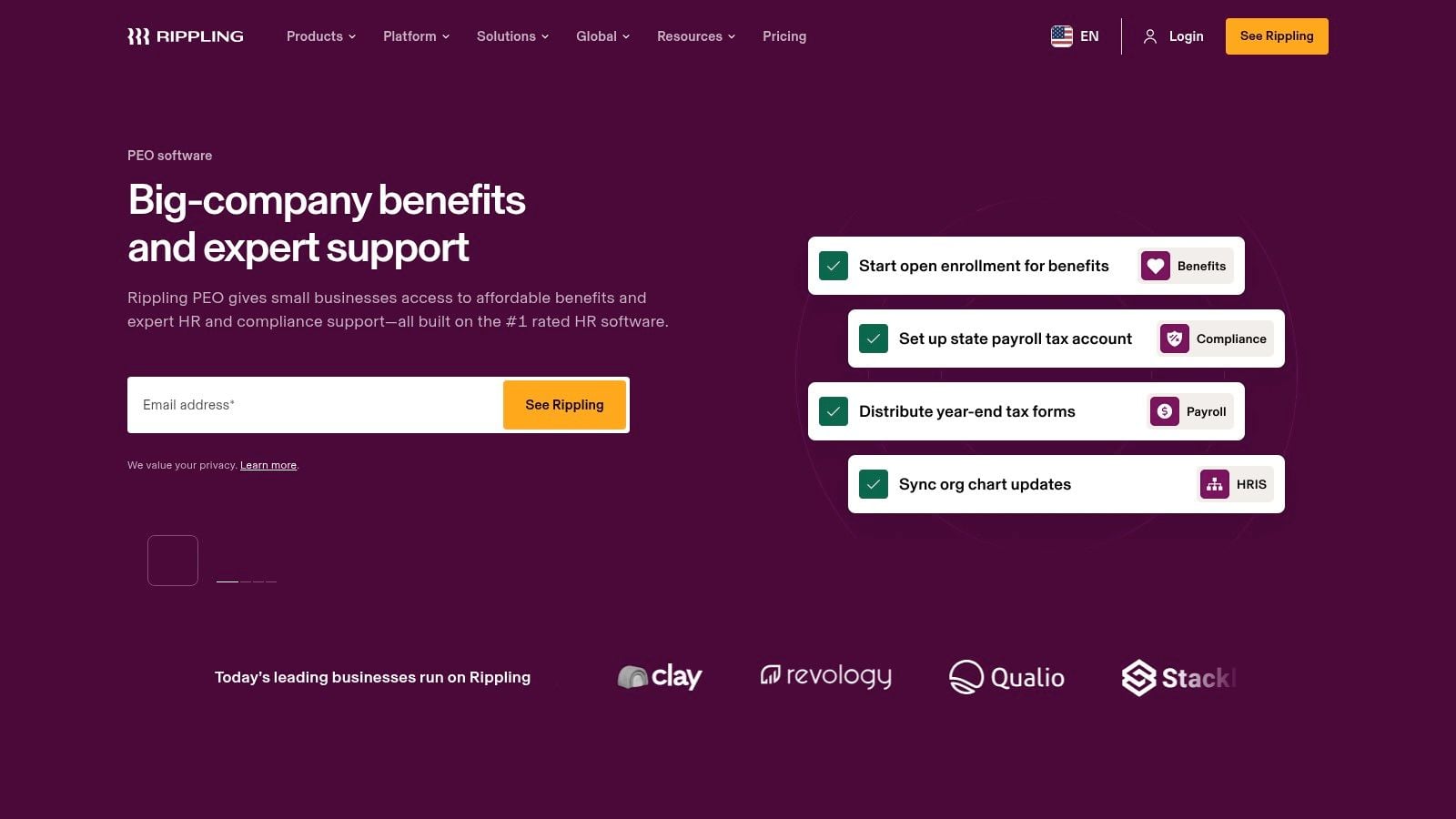
Rippling PEO gets attention for its software, and for once the attention is justified. The primary differentiator is not a prettier HR dashboard. It is the fact that payroll, HR, benefits, time tracking, and device and app provisioning can sit in the same operating system. For a company hiring across states, shipping laptops, assigning software, and onboarding quickly, that can remove a surprising amount of administrative drag.
That said, Rippling is not automatically the best fit just because the platform looks modern. Buyers need to separate the software value from the PEO value. Those are related, but they are not the same purchase.
Rippling's real advantage
Rippling makes the strongest case with companies that care about infrastructure design, not just outsourced HR help. If leadership expects headcount growth, more systems, and more process complexity over the next two years, a unified platform can matter more than a slightly lower base PEO quote. Keeping employee data, payroll actions, permissions, and onboarding tasks tied together reduces handoffs and lowers the odds that one team is working from stale information.
This is also one of the few PEO options where the product architecture itself should be part of the buying decision. A buyer comparing Rippling to a more service-heavy PEO should ask a blunt question: are we paying for better HR support, better systems, or both? Rippling often wins on systems.
The trade-off behind the platform
The risk is that buyers overvalue the demo and under-scrutinize the commercial terms. Rippling's PEO pricing is not public, and total cost can change materially once additional modules, benefit elections, implementation scope, and service needs are added. A proposal that looks competitive at first glance can become difficult to benchmark if one vendor bundles more functions into the platform and another keeps them separate.
Service model clarity matters too. Rippling can be a strong operational fit, but executives should still pin down who owns benefits issues, compliance guidance, payroll corrections, and escalation support after the contract is signed. Technology can reduce work. It does not replace accountability.
Buyers should also verify structural and compliance details directly rather than assuming the sales process covered them. Ask which entities are involved, how responsibilities are allocated, and what changes if the company later decides to move from the PEO arrangement to Rippling's non-PEO products. That is where experienced buyers read between the lines of the pitch.
Rippling usually fits best when the company values system control, automation, and cross-functional workflow design enough to pay for it.
Rippling can be a smart choice for a tech-enabled, multi-state employer that wants one platform to carry more of the operating load. It is less persuasive for a buyer whose main objective is straightforward HR outsourcing at the lowest practical cost.
7. Engage PEO
Engage PEO deserves more attention than it usually gets because its service model is distinct. The attorney-led HR consulting angle is not a cosmetic difference. For employers with real employee relations risk, policy issues, investigations, or multi-state complexity, that support structure can matter a lot.
Most PEO comparisons flatten the category into payroll, benefits, and compliance bullets. That misses the practical difference between a provider that can answer routine HR questions and one that is built to support more sensitive employment issues with greater depth.
Where Engage PEO earns attention
Engage PEO is a serious option for employers that expect to deal with recurring policy interpretation, manager conduct issues, leave questions, or a complicated regulatory environment. In those situations, service quality often matters more than a marginal pricing difference.
That logic lines up with the broader business case for PEOs. Organizations using PEO services demonstrate a 27% return in cost savings alone, according to NAPEO industry research data. Savings are part of the story, but risk reduction and operational support are often what make the relationship work.
What buyers should weigh against the service depth
The likely trade-off is cost and transparency. Higher-touch compliance support usually doesn't come with entry-level pricing, and public pricing detail is limited. Buyers should expect to work harder to evaluate total value.
There's also a fit question. A company with a simple workforce and limited compliance complexity may not need this level of service. But an employer dealing with difficult employee relations issues, multi-state obligations, or leadership that wants stronger guardrails may see the value quickly.
A strong Engage PEO evaluation should focus on service examples, escalation ownership, and contract terms. That's where the differentiation lives.
Top 7 PEOs: Side-by-Side Comparison
| Provider | Implementation complexity | Resource requirements | Expected outcomes | Ideal use cases | Key advantages |
|---|---|---|---|---|---|
| ADP TotalSource | High, enterprise onboarding and multi‑state setup | Significant, dedicated HR resources, budget for large-group benefits | Scalable benefits purchasing, strong compliance and risk management | Multi‑state employers seeking a single large‑scale provider | Enterprise-grade benefits, deep compliance and risk resources |
| TriNet | Moderate–High, industry-specific configuration | Moderate, vertical program setup and ongoing HR coordination | Tailored HR and compliance for regulated industries | Companies in life sciences, finance, nonprofits or other regulated sectors | Industry vertical expertise, mature compliance and benefits |
| Insperity | Moderate–High, full-service integration | Moderate, integration of payroll, risk/safety, benefits | Comprehensive HR services with established compliance support | Employers wanting national PEO with long track record | Proven CPEO history, broad benefits access and resources |
| Justworks | Low, fast onboarding and simple setup | Low–Moderate, SMB-focused resources, transparent fees | Quick implementation, predictable pricing, user‑friendly UX | Small to mid-sized businesses seeking straightforward PEO services | Transparent pricing, strong usability, 24/7 support |
| Paychex PEO | Moderate, integration with Paychex payroll systems | Moderate, adoption of Paychex Flex and client support team | Unified payroll+PEO operations with scalable add‑ons | Organizations preferring a single vendor for payroll and PEO | Integrated Paychex tech, dedicated client support team |
| Rippling PEO | Moderate, tech-heavy integration across HR and IT | Moderate–High, modular purchases and IT/HR alignment | Tight HR/IT/finance integration and modular scalability | Tech-enabled, distributed teams needing unified systems | Unified platform, extensive integrations, ability to toggle PEO/non‑PEO |
| Engage PEO | Moderate, attorney-led consulting model | Moderate–High, legal-centric HR support and higher-touch services | High‑touch compliance, reduced legal and regulatory risk | Employers with complex employee relations or heavy compliance exposure | Attorney-led HR consulting, CPEO certification, multi‑state guidance |
Final Thoughts
Choosing the best professional employer organization is usually less about rank and more about fit under real operating conditions. Buyers get into trouble when they compare brochure language instead of the terms that change cost, risk, and day-to-day workload. Pricing formula, benefits competitiveness, service ownership, renewal language, and exit restrictions matter more than a long feature list.
That is also why broad PEO rankings have limits. A provider can work well for a 25-person company with straightforward payroll and basic HR needs, then become a poor fit for a multi-state employer dealing with leave administration, manager coaching, and recurring compliance questions. Another may offer strong benefits but lock the client into contract terms that erase the value.
The category deserves serious attention. As noted earlier, PEO use is still concentrated among smaller employers, which means many companies evaluating the model are making this decision for the first time. At the same time, Guardian's summary of industry research points to a credible business case. Businesses that use PEOs often report better growth, lower turnover, and stronger survivability than non-users, according to Guardian's summary of PEO trends. Those outcomes are possible. They are not automatic.
A disciplined buying process usually comes down to three checks.
First, model total cost over the full contract term. Monthly admin fees are only one line item. Implementation charges, benefit rate changes, payroll processing fees, year-two increases, off-cycle payroll costs, and termination provisions often decide whether the deal still works after six or twelve months.
Second, pin down who owns what after go-live. Ask specific questions. Who fixes payroll mistakes. Who handles benefits escalations. Who advises managers on employee relations issues. Who responds to multi-state compliance questions, and how fast. Sales teams tend to describe service in general terms. Executives should force that discussion into named roles, response times, and support scope.
Third, test the provider against your actual workforce. Marketing copy tends to assume a clean W-2 population with predictable schedules and low HR friction. Many employers do not look like that. Variable compensation, remote hiring, leave complexity, high turnover, field supervisors, and regulated job categories expose the difference between a workable PEO and an expensive mismatch.
Renewal strategy matters too. Incumbents often count on inertia. Buyers who prepare a credible alternative can often negotiate better pricing, implementation concessions, tighter renewal terms, or stronger service commitments. The strongest negotiating position usually comes before the renewal window closes, not after.
For companies that want a structured comparison before signing or renewing, PEO Metrics is one option to consider. The firm focuses on side-by-side review of pricing, benefits, contract terms, service model, compliance support, and fit. That is often where the key decision gets made.
