

PEO pricing for schools and private education involves unique cost drivers that generic breakdowns miss, including seasonal payroll cycles, mixed workforce structures, and education-specific compliance requirements around credentialing and background checks. This guide helps private schools and independent education organizations accurately evaluate PEO quotes, understand what’s driving their specific costs, and benchmark proposals against realistic industry expectations.
Most advice about an employee leasing company starts with a neat definition and a list of benefits. That's backwards. Buyers rarely get…
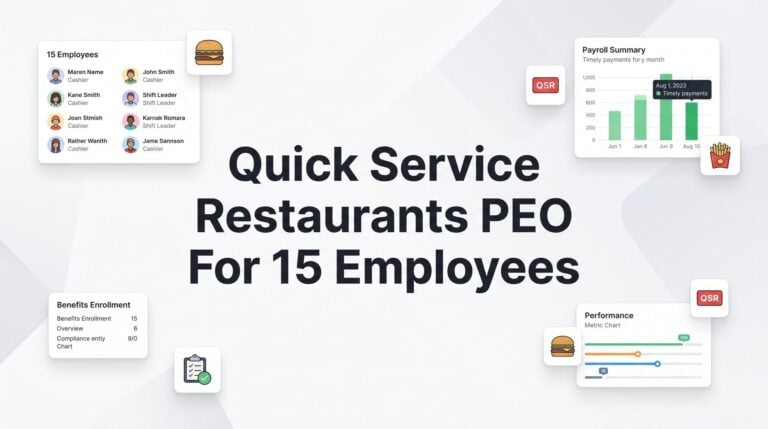
Quick service restaurants with 15 employees face unique HR challenges — from tipped wage compliance to high turnover — that most generic PEO tools overlook. This guide identifies the best PEO comparison tools specifically suited to QSR operators at the 15-employee level, helping you evaluate providers side by side before committing to per-head pricing that directly impacts your bottom line.
PEO compliance support for quick service restaurants goes well beyond standard handbook templates, addressing the specific risks QSR operators face daily—tipped employee regulations, minor labor laws, split shift rules, and multi-jurisdiction wage requirements. This guide breaks down what that support actually covers inside fast food and fast casual operations, and where it meaningfully reduces exposure versus where gaps still exist.
Quick service restaurant operators competing for hourly workers can access affordable health insurance, retirement plans, and other competitive benefits through a PEO without building an internal HR infrastructure. This guide explains what a PEO actually delivers for QSR employee benefits, including how cost pooling works, what the administrative burden looks like in practice, and whether it makes financial sense for operators managing high turnover and variable-hour teams.
Switching hotels and hospitality businesses to a PEO requires careful sequencing to avoid payroll disruptions, workers’ comp gaps, and benefit lapses across a complex, mixed workforce of tipped, seasonal, and salaried employees. This guide covers the actual execution steps — in the right order — so your transition protects operations instead of threatening them.
Switching gyms and fitness studios to a PEO can streamline payroll, benefits, and compliance across mixed workforce types — but the transition requires careful planning to avoid disrupting pay cycles, confusing staff, or signing contracts that don’t account for the seasonal and variable nature of fitness business operations.
A lot of finance teams reach the same point at renewal or during a growth stretch. Two proposals are on the table.…

Franchise groups face a more complex PEO pricing structure than single-location businesses, with fees that compound across entities, co-employment complications, and contract terms that vary based on how your network is structured. This guide breaks down exactly what drives franchise groups PEO pricing and cost structure so you can evaluate proposals clearly before signing.

Franchise owners using a PEO with 5 employees face a unique challenge—enough HR exposure to need protection, but too small for most solutions to pencil out. This guide covers seven practical strategies tailored to single-location franchise operators, addressing co-employment dynamics, franchisor agreement conflicts, and how to choose a PEO that actually makes financial sense at this headcount.

Franchise groups face unique risks when signing PEO contracts because standard agreements are built for single-employer operations, not multi-location networks with semi-autonomous franchisees operating across multiple states. This guide breaks down the specific franchise groups PEO contract terms to scrutinize before signing — from co-employment liability allocation and multi-state compliance gaps to pricing structures that quietly shift as your system grows or changes.

Franchise owners managing 25 employees face a critical HR inflection point where a PEO can handle multi-location complexity, compliance, and workers’ comp exposure — but only if chosen and used strategically. This guide covers seven practical strategies for evaluating PEO fit, negotiating terms, avoiding hidden costs, and knowing when a PEO may not be the right move for your franchise model.