
Switching call centers to a PEO requires careful planning around timing, data migration, and choosing a provider that understands high-volume hourly hiring, shift complexity, and multi-state compliance. This step-by-step guide walks call center operators through the full transition process, from evaluating PEO fit to going live without disrupting payroll or benefits for a large, fast-moving workforce.
Most advice on HR outsourcing near me starts with the wrong filter. It assumes the closest provider is the safest choice. That…
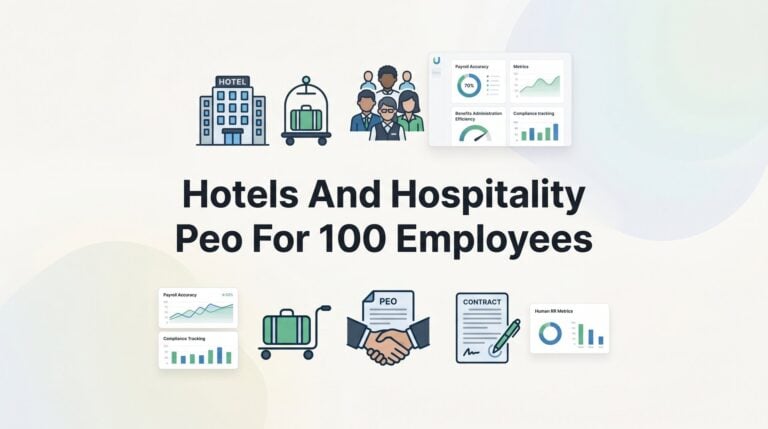
Hospitality operators at 100 employees face compounding HR challenges — high turnover, seasonal staffing, workers’ comp exposure, and complex compliance — that a well-structured PEO can meaningfully address. This guide outlines seven targeted strategies for hotels and hospitality businesses using a Hotels and Hospitality PEO for 100 Employees to reduce operational drag without overpaying for services built for a different scale.
PEO pricing for gyms and fitness studios is shaped by industry-specific factors — mixed employee classifications, elevated liability exposure, and seasonal headcount swings — that generic cost estimates rarely account for. This guide breaks down exactly what drives PEO costs for fitness businesses and how to evaluate quotes accurately to avoid overpaying.
At 15 employees, gyms and fitness studios face a unique HR challenge — managing trainers, part-time staff, high workers’ comp risk, and competitive benefits without a dedicated HR team. This guide covers seven practical ways a PEO helps fitness studio owners at this headcount solve industry-specific problems, from workers’ comp classification to instructor benefits that actually attract talent.
Switching childcare and daycare centers to a PEO can reduce workers’ comp costs, simplify compliance, and improve benefits access—but the transition requires careful timing and a provider experienced with childcare licensing requirements to avoid payroll disruptions or regulatory gaps.
Switching nonprofit organizations to a PEO requires careful planning around grant-funded payroll, restricted budget cycles, and board approval processes that for-profit transitions simply don’t face. This step-by-step guide covers exactly what to audit, how to time the transition around fiscal and grant cycles, and how to protect employee benefits throughout the switch.
Most advice about employee handbooks is too soft. It treats the handbook like an onboarding nicety, a culture document, or a packet…
A PEO can solve real operational headaches for 15-employee restaurants — from tip compliance and workers’ comp exposure to competitive benefits — but only if you understand which services actually fit your staffing mix and cost structure.
Restaurants with around 50 employees face a unique combination of HR pressures — from tipped wage compliance to high turnover — that a PEO can help manage more effectively at this specific headcount. This guide covers seven practical strategies for getting measurable value from a restaurants PEO for 50 employees, including how to structure benefits, control workers’ comp costs, and streamline payroll without overpaying for services you don’t need.
PEO pricing for quick service restaurants is shaped by factors most providers don’t design for — high turnover, tip credit calculations, kitchen workers’ comp classifications, and fluctuating headcount that can quietly inflate your costs. This breakdown explains what’s actually driving your PEO invoice so QSR operators can evaluate contracts with a clearer picture of true cost.
Switching schools and private education businesses to a PEO requires more than a standard payroll migration — academic calendars, credentialed staff, seasonal headcount changes, and enrollment-driven budgets create unique compliance and operational risks that generic transition guides ignore. This step-by-step resource walks education operators through a structured PEO switch designed specifically for private schools, tutoring centers, and learning enrichment businesses.