
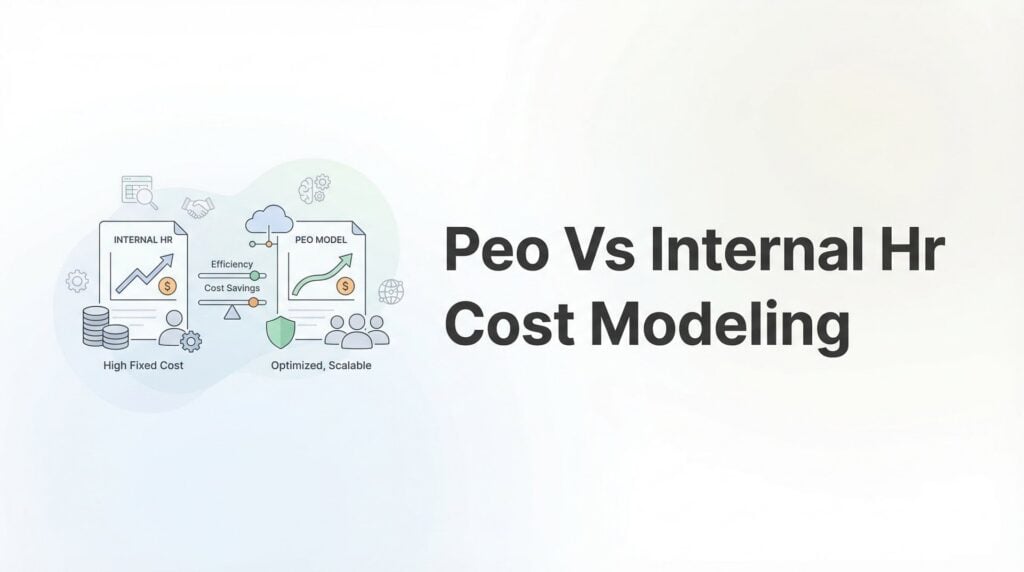
Most PEO vs internal HR cost comparisons fail before they start. Business owners grab a PEO quote, compare it to their HR manager’s salary, and call it a day. That’s like comparing your mortgage payment to your rent without factoring in property taxes, maintenance, insurance, and the water heater that will inevitably die.
The real cost of internal HR hides in dozens of line items you’re probably not tracking—and PEO costs include services you might be paying for separately without realizing it.
This guide walks through seven practical cost modeling strategies that surface the true numbers on both sides. No theoretical frameworks or MBA-speak—just the actual categories and calculations that reveal whether a PEO makes financial sense for your specific situation.
Whether you’re a 15-person company wondering if you’ve outgrown DIY HR or a 200-person operation questioning if your HR department is cost-effective, these modeling approaches will give you defensible numbers for the decision.
1. Map Your Fully-Loaded Internal HR Costs
The Challenge It Solves
When business owners think about internal HR costs, they typically count salaries and maybe benefits for HR staff. That’s roughly 40% of the actual spend. The rest hides in software subscriptions, outside counsel fees, recruiting costs, and the hours your operations manager spends dealing with employee complaints instead of running operations.
Without a complete picture, you’re comparing a fraction of your real HR spend against a fully-loaded PEO quote. The decision looks expensive when it might actually save money.
The Strategy Explained
Spend 30 days tracking every HR-related expense and time commitment across your organization. This isn’t about precision to the penny—it’s about surfacing costs you didn’t realize were HR costs.
Start with the obvious: HR salaries, payroll taxes, benefits for HR staff. Then expand into software (HRIS, payroll platform, ATS, benefits administration, time tracking). Add professional services: employment attorney retainers, workers comp broker fees, benefits consultant costs, background check services.
The sneaky category is time spent by non-HR staff. Your office manager who processes new hire paperwork. Your controller who reconciles payroll. Your CEO who handles performance issues. Track it for one month and annualize it.
Implementation Steps
1. Pull your P&L and flag every line item with any HR component—payroll processing fees, recruiting ads, background checks, HR software, legal fees for employment matters, workers comp audits, employee training programs.
2. Survey department heads to estimate monthly hours spent on HR tasks by non-HR staff, then multiply by their hourly cost (salary + benefits + payroll taxes divided by 2,080 hours).
3. Add one-time costs from the past year and divide by 12 for monthly average—settlement payments, recruiting agency fees, compliance penalties, emergency legal consultations, HR system implementation costs.
4. Create a spreadsheet with 12 categories: Direct HR salaries and benefits, Payroll processing and tax filing, Benefits administration and broker fees, Recruiting and onboarding costs, Compliance and legal, HR technology, Training and development, Workers compensation insurance and claims management, Employee relations and conflict resolution, Performance management, Time and attendance tracking, Risk management and safety programs.
Pro Tips
Most companies discover their real HR cost per employee is 1.5 to 2 times what they initially estimated. The biggest surprises typically come from leadership time spent on HR issues and the cumulative cost of point solutions that each seemed cheap individually. Don’t skip the time tracking step—it’s where the hidden costs live. For a deeper dive into tracking these expenses, explore our HR infrastructure cost analysis framework.
2. Unbundle PEO Pricing for Accurate Comparison
The Challenge It Solves
PEO quotes come as a bundled per-employee-per-month rate that looks simple but obscures what you’re actually buying. When you see “$150 PEPM,” you can’t tell how much is payroll processing versus benefits administration versus compliance support. This makes it impossible to compare against your current setup where you’re buying those services separately.
You need to know which PEO services replace existing vendor relationships and which ones are new capabilities you’re not currently paying for.
The Strategy Explained
Request an itemized quote that breaks down the PEPM rate into component services. Reputable PEOs will provide this—if they won’t, that’s a red flag. You want to see separate line items for payroll processing, tax filing, benefits administration, workers comp, HR support, compliance assistance, and technology platform access.
Once you have the breakdown, map each PEO component against your current costs. If you’re paying $8 PEPM for payroll processing now and the PEO’s payroll component is $12 PEPM, that’s a $4 increase for that specific service. But if their benefits administration is $15 PEPM and you’re currently paying a broker $25 PEPM, that’s a $10 savings.
Understanding the full PEO pricing and cost structure helps you identify where value is bundled versus where you’re overpaying.
Implementation Steps
1. When requesting PEO quotes, specifically ask for an itemized breakdown of the PEPM rate showing the cost allocation across payroll, benefits, workers comp, HR support, compliance, and technology—many PEOs will provide this if asked, even if they don’t volunteer it upfront.
2. Create a comparison matrix with three columns: Current Vendor/Cost, PEO Component/Cost, and Net Change—list every service the PEO includes and match it against what you’re paying now.
3. Separate the analysis into “replacement services” (things you’re already paying for) and “new services” (capabilities the PEO offers that you don’t currently have)—this shows you the true cost increase for added functionality versus cost changes for equivalent services.
4. Flag any services in the PEO bundle that you genuinely won’t use—if you have no remote employees and the PEO includes multi-state payroll tax filing, that’s not value for you, and you should negotiate or look for a more tailored solution.
Pro Tips
The benefits administration component is usually where PEOs deliver the most value relative to cost. If you’re currently managing benefits enrollment manually or paying a broker significant fees, the PEO’s technology platform and included administration often represents a meaningful upgrade at lower cost. Don’t dismiss the entire PEO quote because the payroll processing component costs more than your current provider—look at the total package.
3. Calculate Benefits Purchasing Power Differential
The Challenge It Solves
Small and mid-sized companies pay significantly higher benefits premiums than large employers. A 30-person company might pay 20-40% more for equivalent health coverage than a 500-person company. PEOs aggregate thousands of employees into master policies, giving small businesses access to large-group pricing.
But quantifying this advantage requires actual premium comparisons, not theoretical savings percentages. You need to model what your team would pay under PEO master policies versus what you’re paying now or what you’d pay as a standalone small group.
The Strategy Explained
Get census-level benefits quotes from the PEO’s carrier partners using your actual employee demographics. Compare these premiums against your current benefits costs or recent renewal quotes. The difference is your benefits purchasing power savings—or sometimes the cost of upgrading to better coverage.
This calculation matters most for health insurance, but also applies to dental, vision, life, and disability coverage. Don’t accept generic “you’ll save 15-25%” claims. Run the numbers with your specific employee population.
Factor in plan design differences. If the PEO’s plans have lower deductibles or better networks, you’re getting more value even if premiums are similar. If their plans are worse, the lower premium might not offset the reduced coverage. Learn more about how PEOs can lower health insurance costs for companies your size.
Implementation Steps
1. Provide your employee census data to the PEO (ages, zip codes, coverage tiers, current plan enrollment) and request specific premium quotes for their available health plans—not estimated ranges, but actual rates based on your population.
2. Compare the PEO’s quoted premiums against your current renewal rates for equivalent coverage levels—if your current plan has a $1,500 deductible and 80/20 coinsurance, find the closest PEO plan match and compare total premium cost (employer + employee contributions).
3. Calculate the annual difference by multiplying the monthly per-employee premium difference by your covered employee count and by 12 months—this is your benefits purchasing power impact, positive or negative.
4. Adjust for plan design differences by estimating the value of better or worse coverage—if the PEO plan has a $500 lower deductible, that’s worth roughly $500 per year per enrolled employee in reduced out-of-pocket exposure, which offsets higher premiums.
Pro Tips
Benefits savings are often largest for companies with 10-75 employees. Below 10, you’re likely on individual market plans already. Above 75, your group buying power improves and the PEO advantage shrinks. If your workforce is young and healthy, you might not see significant savings. If you have older employees or dependents with chronic conditions, the PEO’s larger risk pool can deliver substantial premium reductions.
4. Quantify Compliance Risk in Dollar Terms
The Challenge It Solves
Compliance risk feels abstract until it costs you money. Business owners know they should worry about wage and hour violations, misclassified employees, ADA accommodation failures, and FMLA administration errors—but these risks are hard to compare against the concrete cost of a PEO.
The challenge is converting “we might get sued” into a number you can plug into a cost model. Without that, compliance risk gets ignored in the financial analysis even though it’s often the most expensive category over a multi-year period.
The Strategy Explained
Use probability-weighted cost projections to estimate your annual compliance risk exposure. This isn’t about predicting whether you’ll get sued—it’s about calculating the expected value of potential compliance failures based on realistic probabilities and costs.
Start with the most common violations for companies your size: wage and hour claims, workers comp misclassification, unemployment claim errors, benefits compliance failures. Research the typical settlement or penalty costs for each violation type. Then estimate the annual probability of each occurring given your current HR capabilities.
Multiply probability by cost to get expected annual value. Add these up across violation types. That’s your baseline compliance risk cost. Then model how that number changes with a PEO handling compliance for you. Understanding PEO HR compliance protection helps you see what actually gets covered.
Implementation Steps
1. List the five most common compliance risks for your company size and industry—for most businesses this includes wage and hour violations, employee misclassification, benefits administration errors, workers comp claim disputes, and unemployment claim mishandling.
2. Research typical costs for each violation type including legal fees, settlements, penalties, and back wages—wage and hour claims average $5,000-$50,000 depending on employee count and violation severity, misclassification penalties can reach $25,000+ per employee, benefits compliance failures (COBRA, ERISA) range from $10,000-$100,000.
3. Estimate annual probability of each violation occurring with your current HR setup—be realistic, not optimistic: if you’re manually tracking FMLA and have no employment attorney on retainer, your probability of an FMLA administration error is higher than if you have dedicated HR staff and legal support.
4. Calculate expected annual cost by multiplying each violation’s cost by its probability, then sum across all categories—this gives you a probability-weighted annual compliance risk number you can compare against PEO cost.
Pro Tips
Companies with 15-50 employees typically have the highest compliance risk relative to their HR resources. You’re subject to most major employment laws but don’t have dedicated compliance expertise. If your expected annual compliance cost exceeds $10,000 and a PEO reduces that risk by 70-80%, that’s real savings even before considering other PEO benefits. Don’t assume perfect compliance with your current setup—most companies have violations they don’t know about yet.
5. Model the Scalability Cost Curve
The Challenge It Solves
A cost comparison that looks good today might flip in 18 months if you’re growing. Internal HR costs scale in steps—you’re fine with one person until you hit 40 employees, then you need to hire a second. PEO costs scale linearly—each new employee adds the same PEPM cost.
If you’re comparing costs at your current headcount without projecting growth, you’re missing a critical variable. The right choice at 25 employees might be the wrong choice at 75 employees.
The Strategy Explained
Project your headcount growth over the next three years using conservative, moderate, and aggressive scenarios. Then model how internal HR costs and PEO costs change under each growth path.
For internal HR, identify the headcount thresholds where you’d need to add staff, upgrade systems, or hire specialized roles. A company growing from 30 to 60 employees will likely need to add an HR generalist. A company growing from 60 to 120 might need to split benefits administration and employee relations into separate roles.
For PEO costs, multiply your projected headcount by the PEPM rate, adjusting for any volume discounts the PEO offers at higher employee counts. Some PEOs reduce rates at 50, 100, or 150+ employees. Companies experiencing rapid expansion should explore PEO solutions for growing companies to understand how costs shift at scale.
Compare the total cost curves. Where do they intersect? At what headcount does one option become clearly more cost-effective?
Implementation Steps
1. Create three-year headcount projections using conservative (10% annual growth), moderate (25% annual growth), and aggressive (50% annual growth) scenarios—this gives you a range of possible futures to model against.
2. For internal HR, identify the headcount thresholds where you’d need to add staff or capabilities—typically this happens at 40-50 employees (first dedicated HR person), 75-100 employees (second HR person or specialized benefits admin), and 150+ employees (HR manager plus generalist or multi-person team).
3. Calculate total internal HR costs at each growth milestone including new salaries, additional software licenses, expanded benefits broker fees, and increased compliance support—don’t forget that HR technology often has per-employee pricing that increases with headcount.
4. Model PEO costs at the same headcount milestones by multiplying projected employees by PEPM rate, adjusting for any volume discounts—ask the PEO about pricing tiers and whether rates decrease at 50, 100, or 150+ employees.
Pro Tips
The break-even point often shifts around 75-100 employees. Below that, PEOs frequently cost less than building equivalent internal HR capability. Above 100, internal HR can become more cost-effective if you’re willing to invest in staff and systems. But this varies by industry, geography, and complexity. If you’re planning significant growth, model the full three-year cost trajectory—the decision that saves money in year one might cost you in year three.
6. Factor in Opportunity Cost
The Challenge It Solves
Every hour you spend managing HR administration is an hour you’re not spending on revenue-generating activities, strategic planning, or operational improvements. For small business owners and leadership teams, this opportunity cost is real but rarely quantified.
When the CEO is handling employee complaints, processing payroll, and researching benefits options, that’s high-cost labor doing low-value work. The question isn’t whether HR tasks need to get done—it’s whether the business is better off with leadership doing them or delegating them to a PEO.
The Strategy Explained
Calculate the total hours per month that owners and senior leaders spend on HR tasks, then multiply by their effective hourly cost. This gives you the current opportunity cost of internal HR management. Compare that against the PEO’s cost to handle the same tasks.
The calculation isn’t just about salary—it’s about the value of that time redirected to higher-impact work. If your CEO is worth $150/hour in strategic work but spends 10 hours per month on HR administration, that’s $1,500 per month in opportunity cost, or $18,000 annually.
This matters most for companies where leadership is directly involved in HR because they don’t have dedicated staff. It matters less if you already have an HR team handling everything. Our PEO ROI calculator guide walks through how to quantify these opportunity costs step by step.
Implementation Steps
1. Track leadership time spent on HR tasks for one month including payroll processing, benefits questions, employee relations issues, compliance research, recruiting, onboarding, and policy development—use a simple time log or calendar review to capture actual hours, not estimates.
2. Calculate the effective hourly cost for each person by taking their total compensation (salary + benefits + payroll taxes) and dividing by 2,080 hours, then multiply their monthly HR hours by this rate to get current opportunity cost.
3. Identify which HR tasks the PEO would eliminate from leadership’s plate versus which ones would remain—most PEOs handle payroll, benefits admin, and compliance, but you’ll still be involved in hiring decisions, performance management, and company culture work.
4. Calculate the net opportunity cost savings by taking the hours the PEO would save, multiplying by the hourly cost, and annualizing—this is the value of redirected leadership time that should be factored into your cost comparison.
Pro Tips
Opportunity cost is highest for founder-led companies under 50 employees where the CEO is still deep in operational details. If you’re spending 15+ hours per month on HR tasks and your time is worth $100+/hour, that’s $18,000+ in annual opportunity cost. A PEO that costs $30,000 but saves you those 15 hours might actually be net positive when you factor in what you can accomplish with the recovered time. Don’t ignore this category just because it’s harder to measure than direct costs.
7. Build Transition and Exit Cost Scenarios
The Challenge It Solves
PEO relationships aren’t free to start or free to end. Onboarding requires data migration, employee communication, system training, and benefits re-enrollment. Exiting requires finding replacement vendors, migrating data back out, and potentially re-establishing benefit plans mid-year.
If you only compare ongoing monthly costs, you’re missing the one-time expenses that affect your true break-even timeline. A PEO that saves you $2,000 per month looks great until you factor in $15,000 in implementation costs—now you need eight months just to break even.
The Strategy Explained
Model the complete financial lifecycle: one-time implementation costs, ongoing monthly costs, and potential exit costs if the relationship doesn’t work out. This gives you a realistic break-even timeline and helps you understand the commitment you’re making.
Implementation costs include PEO setup fees, data migration, employee enrollment meetings, and the internal time required to transition. Some PEOs charge explicit setup fees ($5,000-$15,000), while others roll costs into the first few months of service. Review our PEO onboarding implementation guide to understand what a realistic timeline looks like.
Exit costs include finding replacement vendors, data extraction, benefits plan re-establishment, and potential gaps in coverage during transition. If you leave mid-year, you might face benefits re-enrollment outside of open enrollment or lose negotiated rates.
Implementation Steps
1. Request detailed implementation timelines and costs from PEO finalists including setup fees, data migration costs, required employee meetings, training sessions, and the estimated internal hours needed from your team during transition.
2. Calculate total implementation cost by adding PEO fees plus the value of your internal time commitment—if implementation requires 40 hours from your HR manager and 20 hours from leadership, multiply those hours by their respective hourly costs and add to explicit PEO fees.
3. Model your break-even timeline by dividing total implementation costs by monthly savings—if implementation costs $12,000 and you save $2,000/month with the PEO, your break-even is six months, meaning you need to stay with the PEO for at least six months to see positive ROI.
4. Research exit scenarios by asking the PEO about contract terms, cancellation policies, data portability, and typical exit timelines—understand whether you can leave at year-end with 60 days notice or if you’re locked into multi-year terms with penalties. If you’re concerned about flexibility, our PEO exit and cancellation guide covers what to negotiate upfront.
Pro Tips
Most PEO implementations take 45-90 days and require significant internal effort even with a smooth process. If your break-even timeline is longer than 12 months, think carefully about your commitment level and confidence in the relationship. The companies that regret PEO decisions most often are those who didn’t model exit costs and found themselves trapped in a relationship that wasn’t working. Ask about data ownership and portability upfront—you want to know you can leave cleanly if needed.
Making the Call With Real Numbers
Accurate cost modeling isn’t about finding a winner—it’s about making a decision you can defend with real numbers.
Start with strategy one: spend a month actually tracking where HR costs hide in your organization. Most business owners are genuinely surprised by what they find. From there, request itemized PEO quotes (not bundled pricing) and work through the benefits differential calculation. These three steps alone will give you better data than most companies ever gather.
The modeling strategies in this guide work whether you ultimately choose a PEO or decide to build out internal HR. What matters is that your decision is based on complete information, not the incomplete comparison that leads so many companies to regret their choice six months later.
The break-even analysis from strategy seven is particularly important. If you’re looking at a 3-4 month payback period, the decision is straightforward. If you’re looking at 18+ months to break even, you need high confidence in the relationship and your growth trajectory. There’s no universal right answer—just the right answer for your specific situation based on complete cost data.
Don’t skip the opportunity cost calculation just because it feels squishy. For many small business owners, the value of recovered time is the most significant benefit of a PEO relationship, even if it’s harder to measure than direct cost savings.
Before you sign that PEO renewal, make sure you’re not leaving money on the table. Many businesses unknowingly overpay because of bundled fees, hidden administrative markups, and contracts designed to limit flexibility. We give you a clear, side-by-side breakdown of pricing, services, and contract terms—so you can see exactly what you’re paying for and choose the option that truly fits your business. Don’t auto-renew. Make an informed, confident decision.
