
Running HR across multiple locations isn’t just a bigger version of running HR in one place. It’s a fundamentally different operational problem. You’re managing payroll across multiple tax jurisdictions, tracking compliance in states that each have their own wage and hour rules, and trying to keep benefits enrollment consistent for employees who may never set foot in the same office.
The decision most multi-location operators eventually face: do you build the in-house infrastructure to handle this, or outsource it to a PEO? Both paths are legitimate. Both have real tools behind them. And the right answer depends heavily on your headcount, how many states you’re operating in, and what your HR team actually looks like today.
This list covers the platforms, PEO services, and HR systems that matter most for multi-location service businesses — whether you’re evaluating PEOs, building in-house, or still figuring out which direction makes more sense. Tools are selected based on multi-state capability, compliance depth, and practical fit for distributed workforces.
1. PEO Metrics
Best for: Multi-location businesses comparing PEO providers before signing anything
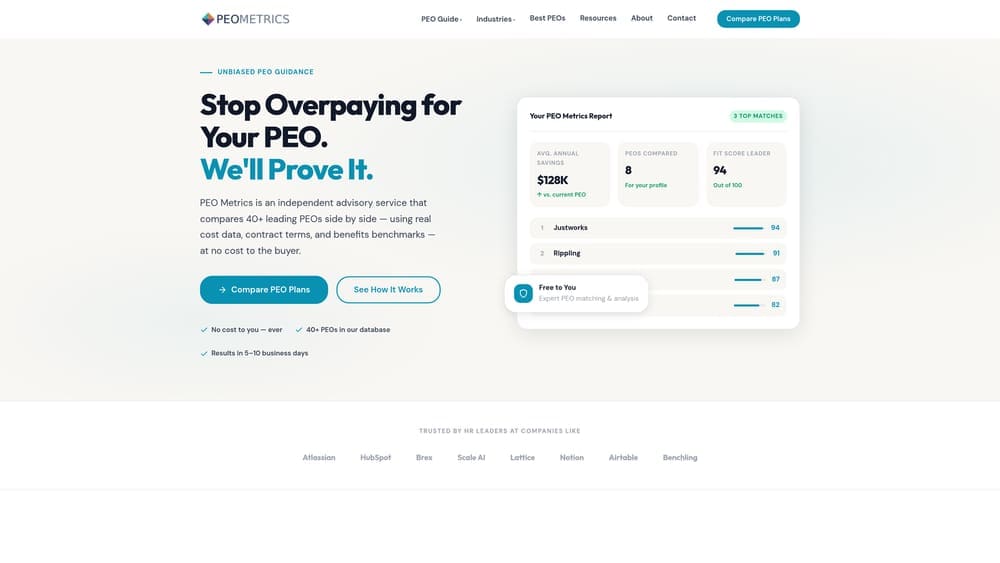
PEO Metrics is a PEO comparison platform that helps businesses evaluate, compare, and select PEO providers side-by-side — with pricing data and unbiased guidance before any contract is signed.
Where This Tool Shines
Most businesses that end up overpaying for a PEO do so because they evaluated one or two options without a clear framework for comparison. For multi-location businesses, this problem is worse — your location footprint and state mix directly affect what you should be paying, and most PEO sales processes aren’t designed to surface that clearly.
PEO Metrics is the only tool on this list that helps you decide between paths rather than committing you to one. It’s particularly useful if you’re not sure what a PEO should cost for your specific headcount and state footprint, or if you’ve received quotes that seem inconsistent and don’t know why.
Key Features
Side-by-side provider comparisons: Compares PEO providers on pricing, service levels, and contract terms in one view rather than managing separate sales conversations.
Pricing transparency: Surfaces what businesses with similar profiles are actually paying — useful for benchmarking quotes you’ve already received.
Unbiased guidance: Not affiliated with any single PEO provider, which matters when most comparison resources are lead-gen tools for the providers themselves.
Contract and service level analysis: Highlights differences in terms, flexibility, and administrative structures that are easy to miss during a standard sales process.
Pre-commitment evaluation: Designed to be used before signing — not after you’ve already locked in and noticed the fees don’t match what you expected.
Best For
Multi-location service businesses actively evaluating PEO providers, businesses that have received quotes but aren’t sure if they’re being priced fairly, and operators who want to understand the full cost picture before committing to a co-employment arrangement.
Pricing
Contact for details. Given the cost exposure involved in a multi-year PEO contract, the comparison process typically pays for itself quickly.
2. Rippling
Best for: In-house HR teams that need multi-state payroll automation and centralized workforce management
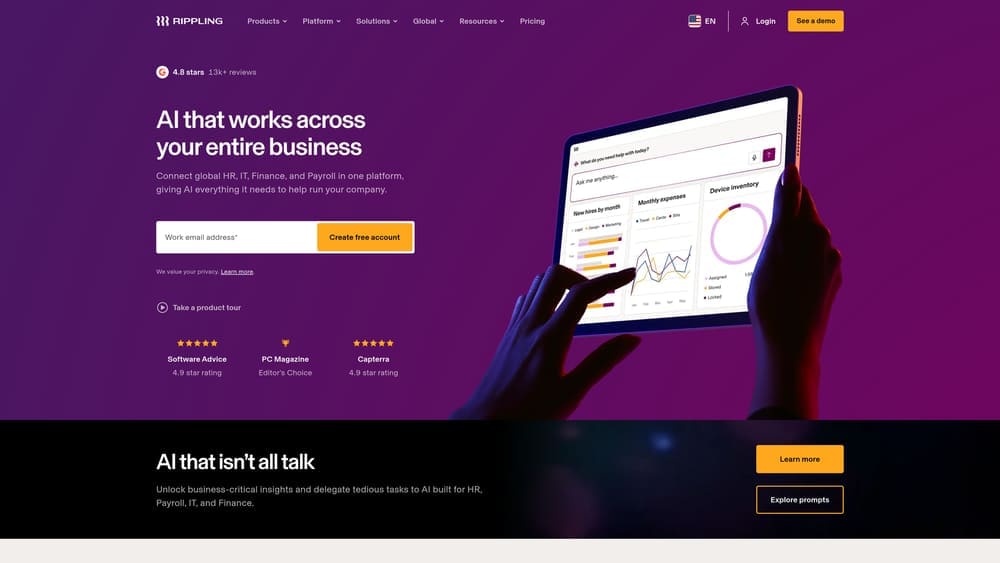
Rippling is a workforce management platform that unifies HR, payroll, IT, and benefits in one system — with strong multi-state payroll automation built in.
Where This Tool Shines
Rippling is built for businesses that want to stay in-house but need the infrastructure to manage complexity at scale. Multi-state payroll is handled automatically, including tax filings and compliance updates — which removes one of the more painful administrative burdens for distributed teams.
The IT management layer is genuinely useful for multi-location service businesses where onboarding and offboarding employees across sites creates device and access management headaches. It’s a more complete operational platform than most HR tools, which matters when your HR team is managing multiple locations without a lot of redundancy.
Key Features
Automated multi-state payroll: Handles tax compliance, filings, and registration across states without manual intervention.
Unified HR and IT management: Manages employee records, devices, and access permissions in one system — useful for distributed teams.
Modular pricing structure: Pay for the modules you actually need rather than a bundled suite with features you won’t use.
Onboarding workflows: Configurable onboarding processes for distributed teams, with e-signature and document management built in.
No co-employment: Business retains full employer status — no PEO structure, no shared liability arrangement.
Best For
Multi-location businesses that have decided to keep HR in-house and want a single platform to manage payroll, HR, and IT across locations. Works well for businesses with a dedicated HR or operations lead who can configure and manage the system.
Pricing
Starts around $8/employee/month for the base platform; modular add-ons are priced separately and can add up depending on which features you need.
3. Justworks
Best for: Smaller multi-location businesses that want PEO services with predictable, flat-rate pricing
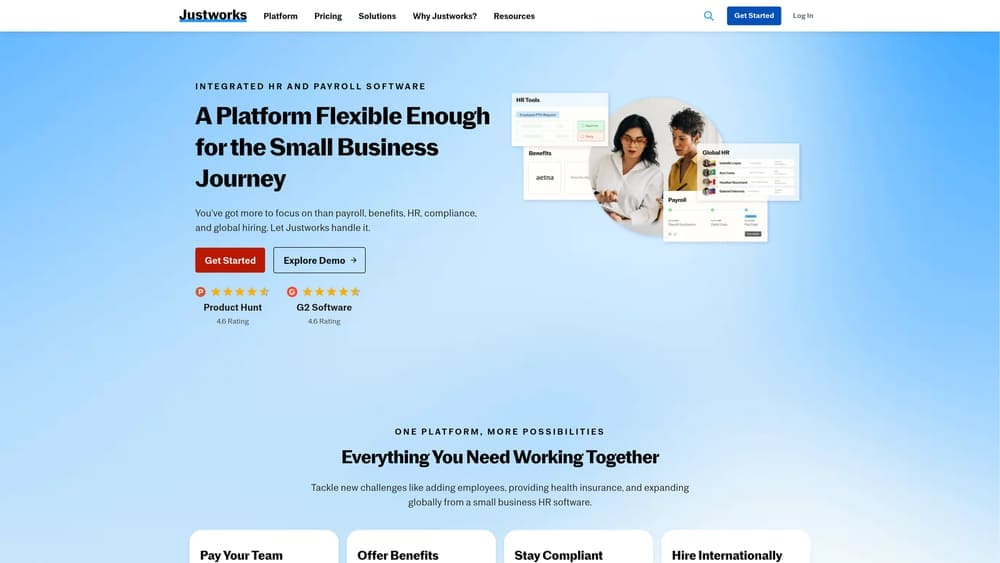
Justworks is a PEO with a transparent flat-rate pricing model that makes it easier for multi-location businesses to budget HR costs without percentage-of-payroll surprises.
Where This Tool Shines
Most PEOs price as a percentage of payroll, which makes budgeting difficult and creates a perverse incentive where your HR costs rise automatically as you give raises. Justworks charges a flat per-employee-per-month fee, which is unusual in this market and genuinely useful for multi-location businesses trying to model costs across sites.
The multi-state compliance handling and access to group health benefits through PEO pooling are standard PEO advantages — but the pricing transparency makes Justworks easier to evaluate honestly against in-house alternatives.
Key Features
Flat per-employee pricing: Predictable monthly cost that doesn’t fluctuate with payroll amounts — a meaningful differentiator in the PEO market.
Multi-state payroll and compliance: Handles payroll tax filings, registrations, and compliance updates across states under the PEO’s EIN.
Group benefits access: Employees across all your locations get access to competitive health benefits through the PEO’s pooled purchasing.
Clean admin interface: More accessible than legacy PEO platforms — easier for non-HR managers to navigate at individual locations.
Co-employment model: Full PEO structure with shared employer responsibilities and compliance coverage.
Best For
Multi-location service businesses under 150–200 employees that want the compliance and benefits advantages of a PEO without percentage-of-payroll pricing. Less suited for larger organizations or those needing deep industry-specific HR expertise.
Pricing
Starts around $59/employee/month for the Basic plan; higher tiers with expanded features are available at additional cost.
4. ADP TotalSource
Best for: Businesses that have decided on a PEO and need broad multi-state compliance infrastructure
ADP TotalSource is ADP’s full-service PEO offering, built for businesses that need deep multi-state compliance coverage backed by one of the largest HR infrastructure networks in the country.
Where This Tool Shines
ADP’s scale is the main argument here. Multi-location service businesses operating across many states benefit from a PEO that has deep compliance infrastructure in all of them — not just the major markets. ADP TotalSource brings that coverage along with access to ADP’s benefits purchasing network, which can be meaningful for businesses whose headcount at any single location is too small to qualify for competitive group rates independently.
The integration with ADP’s broader payroll and HR ecosystem is a practical advantage if you’re already using ADP tools elsewhere in the business — it reduces the friction of managing multiple platforms across locations.
Key Features
Deep multi-state compliance infrastructure: Strong coverage across states, including less common jurisdictions that smaller PEOs may handle inconsistently.
Full-service co-employment model: Comprehensive PEO structure covering payroll, benefits, compliance, and HR administration.
ADP benefits network access: Group purchasing leverage from ADP’s large client base, with a broad range of benefit options.
Dedicated HR support: Assigned HR support included with the service, not just platform access.
Ecosystem integration: Connects with ADP’s broader suite of payroll and workforce management tools.
Best For
Mid-sized multi-location businesses that have already decided on a PEO and prioritize compliance depth and scale over pricing transparency. Better for businesses comfortable navigating a larger enterprise vendor relationship.
Pricing
Custom quote required — pricing is not publicly listed. Get competing quotes before engaging; this is exactly the kind of situation where a comparison tool like PEO Metrics helps you benchmark what you’re being offered.
5. Paychex PEO
Best for: Multi-location businesses that want a human HR contact, not just a platform
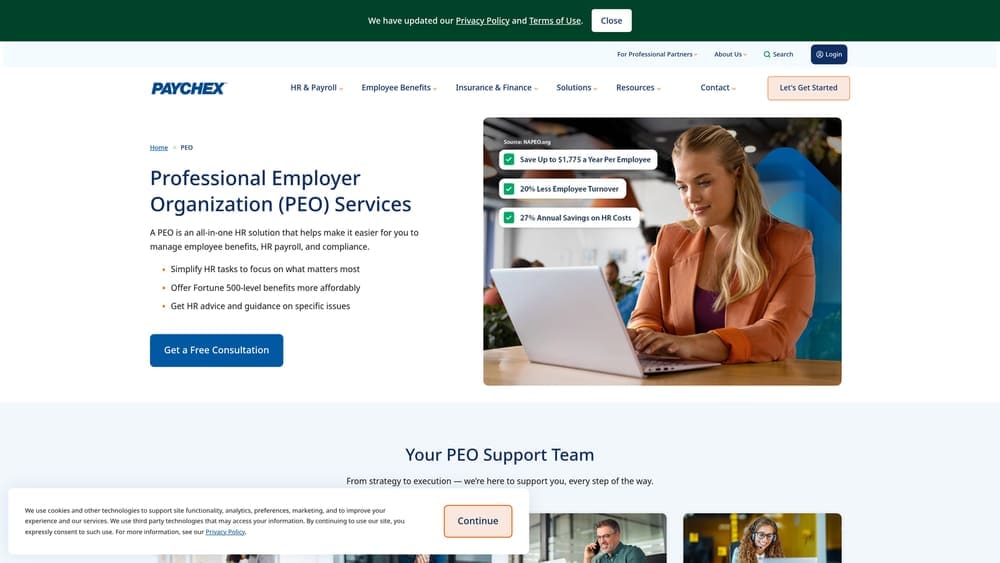
Paychex PEO pairs co-employment benefits with a dedicated HR generalist model — giving multi-location businesses a real person to call rather than a support ticket queue.
Where This Tool Shines
For multi-location service businesses where site managers handle day-to-day HR questions without a dedicated HR person on-site, having a named HR generalist who knows your account is practically useful. Paychex’s model emphasizes this human touchpoint more than most PEOs, which tend to push toward self-service platforms as they scale.
The workers’ comp and risk management support is worth noting specifically for field service businesses — HVAC, cleaning, trades, and similar industries where workers’ comp classifications vary by state and job type. Having that handled through a PEO with risk management expertise reduces the administrative overhead of managing separate policies per state.
Key Features
Dedicated HR generalist per account: A named contact who knows your business — not a generic support line.
Multi-state payroll and tax compliance: Standard PEO payroll handling across jurisdictions under the co-employment structure.
Workers’ comp and risk management: Integrated workers’ comp program with risk management support — relevant for service businesses with field employees.
Benefits administration: Group purchasing access with health, dental, vision, and ancillary benefit options.
Service-first model: Stronger on human support depth than on platform sophistication compared to newer PEO entrants.
Best For
Multi-location service businesses in trades, field services, or other industries where workers’ comp complexity and the need for accessible HR support matter more than having the most polished software interface.
Pricing
Custom quote required — pricing not publicly listed. The service-heavy model typically reflects in the pricing, so compare carefully against alternatives before committing.
6. TriNet
Best for: Professional or technical service businesses that want industry-specific PEO expertise
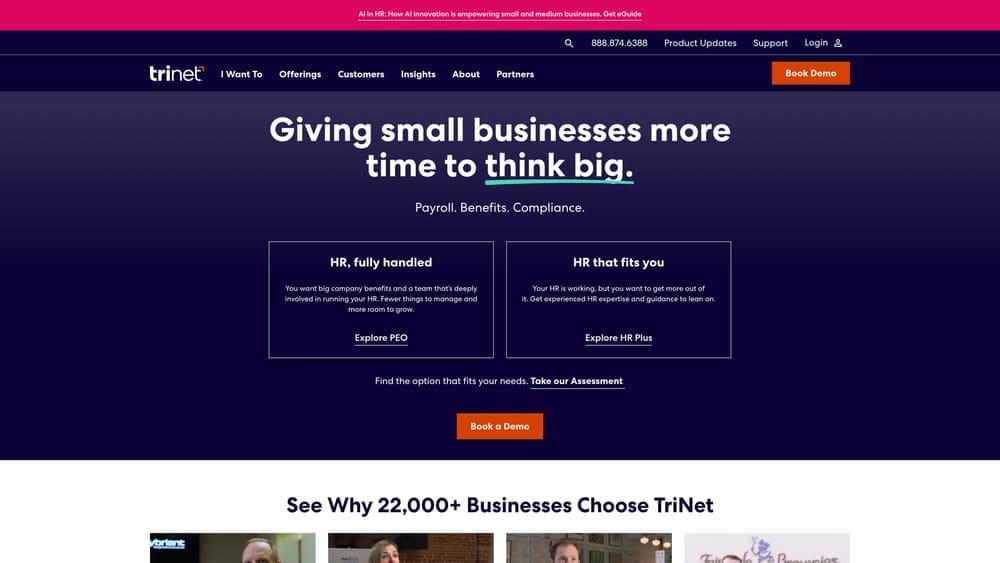
TriNet is a PEO that organizes its HR services around industry verticals — useful for multi-location service businesses in professional, technical, or specialized fields where generic HR packages don’t fit well.
Where This Tool Shines
Most PEOs offer a single HR package that works reasonably well across industries but isn’t optimized for any of them. TriNet’s vertical approach means the HR frameworks, compliance guidance, and benefits structures are designed with your industry’s specific workforce profile in mind. For a multi-location IT services firm or professional services company, this can mean more relevant support than a generalist PEO provides.
The multi-state compliance and benefits access are standard PEO advantages here. What differentiates TriNet is the depth of industry-specific knowledge — which matters most when your HR questions aren’t generic.
Key Features
Industry-specific HR packages: Vertically organized service model rather than a one-size-fits-all approach — relevant for specialized service businesses.
Competitive benefits access: Group purchasing leverage with benefit options appropriate to professional workforce profiles.
Dedicated HR support: Industry-knowledgeable HR support included — not just generalist guidance.
Co-employment structure: Full PEO arrangement with shared employer responsibilities.
Best For
Multi-location businesses in professional services, technology services, healthcare services, or other specialized verticals where industry-specific compliance knowledge and workforce norms matter. Less differentiated for businesses in general labor or commodity service industries.
Pricing
Custom quote required — pricing not publicly listed. TriNet’s vertical specialization typically positions it above the lowest-cost PEO options in the market.
7. Gusto
Best for: Smaller in-house teams managing multi-state payroll without enterprise-level complexity
Gusto is a payroll and HR platform for in-house teams — not a PEO. It handles multi-state payroll, benefits, and HR administration for smaller service businesses that want to stay in-house without building a heavy HR stack.
Where This Tool Shines
Gusto fits the gap between “we’re using spreadsheets and a basic payroll service” and “we need a full HRIS and dedicated HR infrastructure.” For a service business operating in two or three states with a small HR team, Gusto handles the multi-state payroll complexity without requiring enterprise software or enterprise pricing.
The interface is genuinely accessible for non-HR managers — which matters for multi-location businesses where site managers may need to handle basic HR tasks without a dedicated HR person on-site. Benefits administration, onboarding documents, and payroll are all in one place without requiring significant training to use.
Key Features
Multi-state payroll with automated tax filings: Handles state tax registrations, filings, and compliance updates across jurisdictions automatically.
Benefits administration: Health, dental, vision, and 401(k) administration built into the platform — not a separate integration.
Onboarding and document management: Employee onboarding workflows with e-signature and document storage.
Accessible interface: Designed for small business owners and non-HR managers, not just HR professionals.
No co-employment: Business retains full employer status — all compliance responsibility stays with the business, not shared with a PEO.
Best For
Smaller multi-location service businesses (typically under 100 employees) that have decided to keep HR in-house and are operating in a manageable number of states. Not well-suited for businesses with complex workers’ comp needs or heavy compliance requirements across many jurisdictions.
Pricing
Starts at $46/month base plus $6/employee/month on the Simple plan; higher tiers with expanded HR features are available at additional cost.
8. BambooHR
Best for: In-house HR teams that need a centralized system of record across multiple locations
BambooHR is an HRIS platform for in-house HR teams that centralizes employee records, onboarding, and reporting across multiple locations — the organizational backbone for distributed workforces building their own HR infrastructure.
Where This Tool Shines
Multi-location businesses that have built or are building an in-house HR function often hit a point where managing employee data across locations in spreadsheets or disconnected systems becomes a real operational problem. BambooHR solves the data centralization problem cleanly — one system of record for all locations, with reporting that actually surfaces what’s happening across the distributed workforce.
It doesn’t process payroll natively, which means it’s typically paired with a payroll provider rather than replacing one. That’s a real consideration for how you build your in-house stack. But for the HR data, onboarding, and people management layer, it’s one of the more polished tools available for mid-sized businesses.
Key Features
Centralized employee records: Single system of record for all locations — eliminates the fragmentation that comes with managing HR data in multiple places.
Onboarding workflows: Configurable onboarding processes with e-signature, document management, and task tracking across locations.
Reporting and analytics: Cross-location reporting on headcount, turnover, compensation, and other workforce metrics.
Performance management and time tracking: Optional modules for reviews, goal tracking, and time and attendance.
Payroll integrations: Connects with most major payroll providers — does not process payroll natively.
Best For
Multi-location businesses with a dedicated HR team that wants a strong HRIS backbone without switching payroll providers. Works well as part of an in-house HR stack alongside a separate payroll platform like Gusto, Rippling, or a traditional payroll service.
Pricing
Custom quote required — pricing is based on headcount. Generally positioned in the mid-market range; worth comparing against the all-in-one platforms if you’re building a new stack from scratch.
9. Insperity
Best for: Mid-market businesses that want high-touch PEO service and strong benefits access
Insperity is a full-service PEO positioned for mid-market businesses that want dedicated HR specialists, comprehensive benefits access, and a service model built around human support — not just software.
Where This Tool Shines
Insperity’s main differentiator is service depth. Where some PEOs have moved toward platform-first models with support as a secondary feature, Insperity maintains a dedicated HR specialist model that gives businesses a knowledgeable point of contact for complex HR situations. For multi-location businesses where HR questions are genuinely complicated — multi-state leave management, workers’ comp disputes, benefits issues across sites — this matters.
The benefits purchasing leverage is also worth noting. Insperity’s size gives it strong group purchasing power, which can be meaningful for mid-market businesses whose employee count is spread across locations and may not qualify for the most competitive rates independently.
Key Features
Dedicated HR specialists per account: High-touch service model with named specialists who know your business — not a rotating support queue.
Comprehensive benefits package: Strong group purchasing leverage with a broad range of health, dental, vision, and ancillary benefit options.
Multi-state payroll and compliance: Full co-employment PEO structure handling payroll, tax filings, and compliance across jurisdictions.
Mid-market positioning: Service model designed for businesses in the 50–300 employee range — not optimized for micro-businesses or very large enterprises.
Best For
Multi-location service businesses in the 50–300 employee range that want a full-service PEO with strong human support and don’t mind paying for it. Not the right fit for businesses primarily shopping on price or those under 50 employees where the cost structure may not pencil out.
Pricing
Custom quote required — generally positioned at the higher end of PEO pricing, reflecting the service depth and specialist model. Compare quotes carefully before committing.
Choosing the Right Fit for Your Situation
The tools above split into two categories: PEO services that absorb your multi-state compliance complexity through co-employment, and in-house HR platforms that give your team the infrastructure to manage it directly. The right choice depends on where you are operationally.
If you’re still deciding between a PEO and building in-house, start with PEO Metrics — it’s the only tool here that helps you evaluate the decision itself rather than committing you to one path. Particularly useful if you’ve received PEO quotes that seem inconsistent or you’re not sure what your specific location footprint should actually cost.
If you’ve decided on a PEO and need broad multi-state coverage, ADP TotalSource and Insperity are the strongest options for mid-market businesses. Justworks is worth a close look if you’re under 150 employees and want pricing you can actually model. Paychex PEO fits best when human support access at the site level matters more than platform sophistication. TriNet makes the most sense for professional or technical service verticals.
If you’re staying in-house, Rippling handles the most complexity in one platform. Gusto is the simpler option for smaller teams in fewer states. BambooHR pairs well with either as the people data and onboarding layer.
One thing to be careful about regardless of which direction you go: PEO contracts are often structured in ways that make it easy to overpay and difficult to switch. Before you sign or renew anything, make sure you’re comparing options with real pricing data in hand. Don’t auto-renew. Make an informed, confident decision.
Before you sign that PEO renewal, make sure you’re not leaving money on the table.
Many businesses unknowingly overpay because of bundled fees, hidden administrative markups, and contracts designed to limit flexibility. We give you a clear, side-by-side breakdown of pricing, services, and contract terms—so you can see exactly what you’re paying for and choose the option that truly fits your business.
