Side-by-side comparisons between PEOs and in-house HR, ASOs, payroll providers, and staffing agencies.
Car wash operators face a genuine choice between PEOs and payroll companies, and the wrong decision can quietly drive up workers’ comp costs, compliance risk, and turnover in an industry defined by physical hazards and high employee churn. This guide breaks down the real functional differences between the two options specifically for car wash businesses, so operators can match the right solution to their actual risk profile and staffing challenges.
Kitchen hood cleaning companies face unique HR challenges — rooftop crews, hazardous chemicals, and complex workers’ comp classifications — that make the PEO vs. in-house HR decision a genuine operational and risk question, not a generic small business choice. This guide walks through the real factors that should drive your decision, including geographic footprint, crew size, compliance exposure, and growth stage.
Backflow testing business owners weighing a Backflow Testing PEO vs Payroll Company will find this guide breaks down 9 practical tools and resources to make an informed decision. It covers key differences in workers’ comp classifications, compliance exposure, and liability protection that matter specifically to trade businesses with field technicians working across job sites.
Backflow testing company owners weighing Backflow Testing PEO vs In-House HR will find a practical breakdown of seven critical factors—including workers’ comp management, multi-jurisdiction payroll, licensing compliance, and growth trajectory—to help determine which HR approach best fits their trade business’s size, risk exposure, and operational demands.
Grease trap pumping businesses face unique HR challenges spanning DOT, EPA, and OSHA compliance that generic solutions often miss. This guide provides seven targeted strategies for evaluating Grease Trap Pumping PEO vs In-House HR, covering real cost comparisons, trade-specific compliance risks, and the operational scenarios where each model succeeds or falls short for small pumping operations.
Restoration companies face unique HR challenges—hazardous worksites, 24/7 crew deployments, and volatile headcount—that make the Restoration PEO vs In-House HR decision far from straightforward. This guide delivers seven practical decision frameworks tailored specifically to restoration business owners, helping them evaluate workforce size, risk exposure, multi-state operations, and cost trade-offs to choose the HR model that actually fits how their business runs.
Water damage restoration companies face unique HR challenges—rapid storm hiring, multi-state compliance, and high workers’ comp exposure—that make the Water Damage Restoration PEO vs In-House HR decision critically important. This guide provides seven decision strategies tailored to restoration industry realities, including seasonal workforce volatility, employee classification complexities, and cross-state regulatory compliance, helping owners with 10-150 employees determine which HR model b…
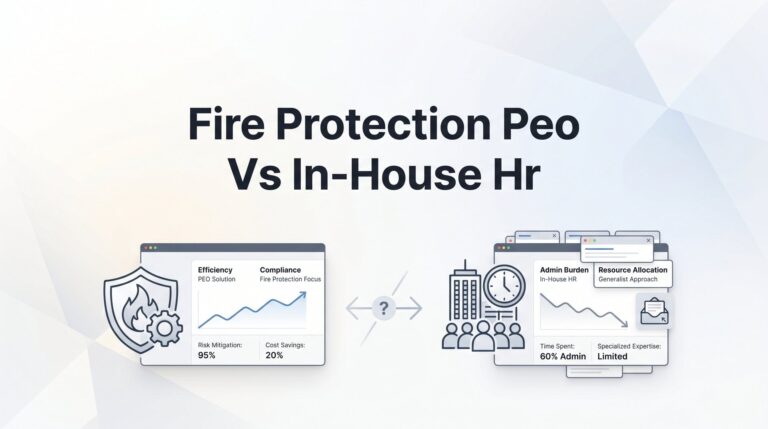
Fire protection companies face unique HR challenges—from OSHA compliance and workers’ comp classifications to managing certified technicians across multiple job sites—making the Fire Protection PEO vs In-House HR decision operationally critical. This guide outlines seven industry-specific decision strategies based on your claims history, workforce mix, geographic footprint, and growth trajectory to help you choose the right HR approach for your business.
Commercial cleaning operators face a critical choice between outsourcing HR through a PEO or managing it in-house, with direct impact on margins and risk exposure. This guide examines 7 decision factors specific to the cleaning industry—including workers’ comp costs, high-turnover onboarding, and multi-site compliance—to help operators make an informed Commercial Cleaning PEO vs In-House HR decision based on their operational realities.
Janitorial companies face unique HR challenges—high turnover, multi-site scheduling, and elevated workers’ comp risks—that make the Janitorial PEO vs In-House HR decision far more complex than for typical businesses. This guide provides seven concrete decision strategies tailored specifically to cleaning operations, helping owners from small residential crews to large commercial janitorial companies determine which HR model best fits their operational realities and cost structure.
