
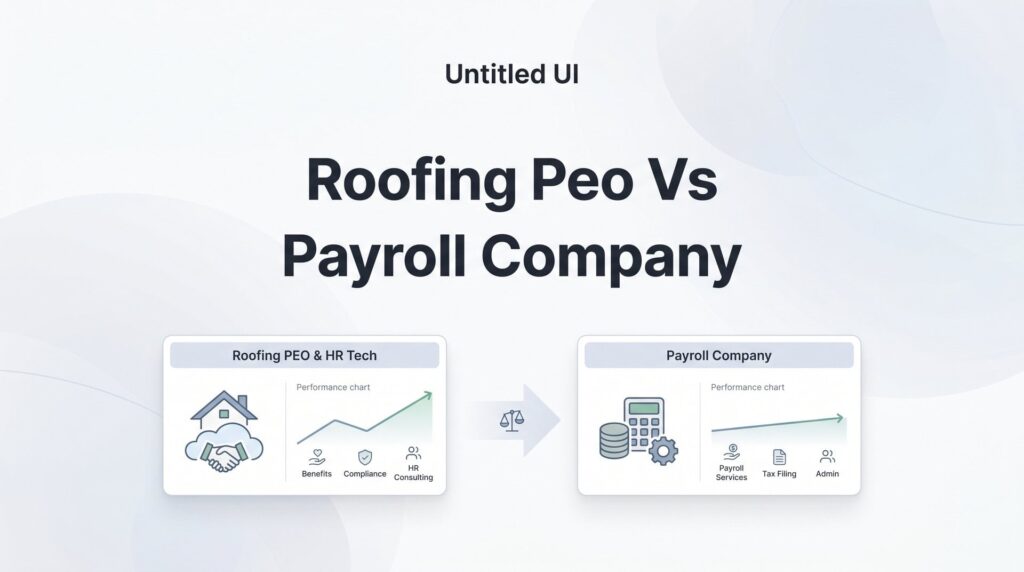
Roofing-specific PEO context. For roofing contractors, the PEO vs payroll-only decision is shaped by workers\' comp pool dynamics, industry-specific compliance, and the operational support needed for a roofing workforce. Payroll-only providers don't address roofing's biggest exposure: OSHA fall protection, workers' comp mod rate management, heat illness prevention, or aggressive return-to-work programs. The exposure gap is massive.
Looking for the full Roofing PEO guide? See our PEO for Roofing Contractors pillar page covering the complete industry profile — pain points, recommended PEOs, PEO economics, when each model wins, and a decision framework specific to roofing.
Top Roofing HR & Compliance Pain Points
- OSHA fall protection is non-negotiable. Falls from heights are construction's top fatality category. OSHA 1926.501 requires 100% fall protection above 6 feet on residential roofs. Citations carry $16K–$161K per violation; willful violations expose individuals to criminal liability.
- Workers' comp mod rates can be brutal. Roofing carries the highest workers' comp class-code rates in construction (NCCI 5551). Standalone mods can exceed 1.50, doubling premium vs the base rate. PEO blended pools deliver some of the largest premium savings in any industry.
- Heat illness prevention regulations. California, Washington, Oregon, and several other states require formal heat-illness prevention plans with water-rest-shade requirements. Citations are common during summer enforcement sweeps.
- Seasonal labor with high turnover. Residential roofing has significant seasonal swings and turnover. Onboarding cycles per year can exceed total headcount. PEO onboarding workflows save 8–15 hours per hire.
- 1099 vs W-2 classification scrutiny. Residential roofing has been a state DOL enforcement target for misclassification. State penalties of $5K–$50K per worker plus back-wage exposure.
PEO vs Payroll-Only for roofing contractors
When payroll-only works: Rarely. Even single-owner roofers benefit from PEO workers' comp pooling. The only case payroll-only works: an owner-operator with no employees and existing standalone coverage.
When PEO wins: Almost universally. Roofing carries the highest workers' comp class-code rates in construction — PEO pool dynamics deliver the largest dollar savings of any industry we work with.
For the full PEO vs payroll company comparison — feature matrices, cost math, and decision frameworks — see our PEO vs payroll company guide.
Recommended PEOs for roofing contractors
- CoAdvantage: roofing-specific construction pool; aggressive RTW programs critical for high-mod roofers; fall-protection safety consulting
- Insperity: roofing vertical with mod-rate optimization service; multi-state operational depth for commercial roofers
- ADP TotalSource: enterprise-tier commercial roofing operators with federal work
- Paychex Employer Services: mid-market roofing with accounting platform integrations
Roofing PEO — Common Questions
How much workers' comp savings can a roofing contractor expect from a PEO?
Does a PEO help with OSHA fall protection compliance?
What's the workers' comp class code for roofing under a PEO?
How do PEOs handle the seasonal labor swings in residential roofing?
Is a PEO worth it for a roofer with a really good safety record (mod under 0.85)?
Get a Free Roofing PEO Comparison
We score 40+ PEOs against your specific roofing profile — mod rate, multi-state operations, compliance load. Free, delivered in 5–10 business days.
Get My Free Comparison