
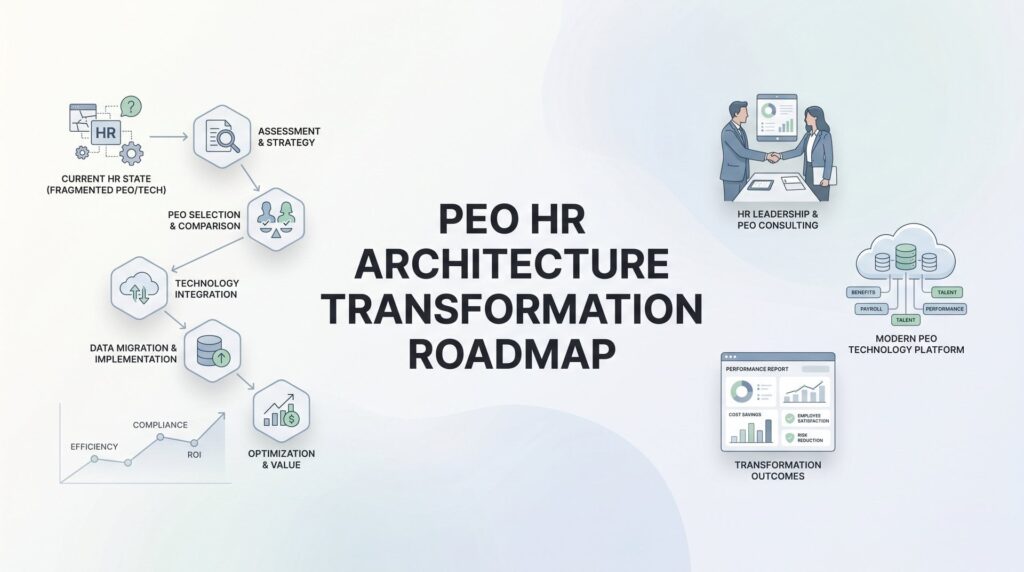
Most businesses don’t wake up one morning and decide to transform their HR architecture. What actually happens is messier: you’re drowning in compliance headaches, your payroll person just quit, benefits renewal came in significantly higher than last year, and someone mentions a PEO. Or maybe you’re already on a PEO and realize you never actually restructured how your internal HR team operates around it — so you’re paying for overlapping work, unclear ownership, and a tech stack that doesn’t talk to itself.
Either way, this isn’t about drawing org charts on a whiteboard. It’s about making concrete decisions: what stays in-house, what shifts to the PEO, where your existing tools fit (or don’t), and how to sequence the transition so nothing falls through the cracks.
This guide walks you through the actual steps — from auditing what you have today to stabilizing the new structure after go-live. It assumes you already understand what a PEO is and how co-employment works. If you need that foundation first, start there before coming back here. This is for business owners and HR leaders who are past the “should we do this?” question and into the “how do we actually do this right?” phase.
The companies that get the most value from a PEO aren’t the ones who signed the best contract. They’re the ones who deliberately redesigned their internal operations around the PEO model instead of just bolting it onto whatever they had before. That’s what this roadmap is for.
Step 1: Map Every HR Function You Currently Own
You can’t decide what to hand off if you don’t know what you’re holding. Before anything else, build a complete inventory of every HR-related function in your business. Not just the obvious ones — all of them.
The full list typically includes: payroll processing, payroll tax filing, benefits administration, benefits strategy, compliance tracking, workers comp management, onboarding (paperwork and experience), offboarding, HRIS maintenance, recruiting support, performance management, employee relations, leave management, and HR reporting. Some businesses also have training coordination, immigration support, or multi-state compliance sitting somewhere in the mix.
For each function, document three things:
Who owns it: Is it an internal staff member, an outsourced vendor, a software tool running on autopilot, or honestly nobody? The “nobody” ones matter most — those are your live compliance risks.
How much time it takes: Get a rough monthly hour estimate. This doesn’t need to be a time-motion study. Ask the person doing the work. “About how many hours a month do you spend on benefits questions?” is a useful question. “I’m going to track your keystrokes” is not.
What it actually costs: Salary allocation, vendor fees, software licenses. If your HR generalist spends 40% of their time on payroll-adjacent work, that’s 40% of their fully-loaded cost sitting in that function. Using cost accounting methods to compare internal HR vs PEO expenses can help you quantify this accurately.
While you’re doing this, flag pain points and failure modes explicitly. Which functions are fragile because one person holds all the institutional knowledge? Which are already broken and everyone just works around the problem? Which are costing more than they should given the output?
Here’s what most businesses find when they do this honestly: three or four tools doing overlapping work, at least one critical compliance task that lives in someone’s head rather than a documented process, and a handful of functions that nobody owns clearly — they just happen because someone eventually notices they need to happen.
This inventory is your decision-making baseline for everything that follows. Don’t skip it or rush it. A half-built inventory leads to a half-built transformation, and you’ll spend the next two years fixing the gaps you left.
One practical approach: build a simple spreadsheet with columns for function name, current owner, monthly hours, estimated monthly cost, pain points, and a notes column. It doesn’t need to be beautiful. It needs to be complete and honest.
Step 2: Define What Moves to the PEO and What Stays Internal
Now you have a full picture of what you own. The next decision is what to keep and what to hand off. This is where most PEO transitions get sloppy — people assume the PEO handles everything HR-related, sign the contract, and then spend months figuring out who actually owns what.
Use your inventory to sort every function into three buckets: PEO-managed, internally-managed, and shared/hybrid. The criteria that actually matter for this sort:
Is it a commodity function or a strategic one? Payroll tax filing is a commodity — it needs to be done accurately and on time, but it doesn’t require deep knowledge of your business. Workforce planning requires understanding your growth trajectory, your talent gaps, and your culture. Commodity functions are strong PEO candidates. Strategic functions usually aren’t.
Does the PEO’s execution quality exceed what you can do internally? For most companies under 150 employees, the answer is yes for compliance-heavy work. A PEO with dedicated compliance teams and legal resources will generally outperform an HR generalist who’s also handling recruiting and employee relations simultaneously.
Does moving it reduce real risk or just shift it? The PEO takes on employer-of-record liability in a co-employment structure, but you don’t fully transfer all risk. Understanding legal obligations you still own as a PEO client is essential before assuming a function is “handled.”
For most companies under 150 employees, the typical split looks like this: payroll processing, tax compliance, benefits administration, and workers comp management usually move to the PEO. Recruiting, performance management, culture initiatives, internal communications, and strategic HR planning usually stay internal. That’s a reasonable starting framework, but your specific situation will shift things.
The hybrid zone is where most problems hide. Benefits strategy versus benefits administration is a classic example — the PEO administers the plan, but who decides what plans to offer, how to communicate them, and how to handle edge cases? Compliance monitoring versus compliance response is another: the PEO may flag a regulatory change, but who decides how your business responds? Onboarding paperwork versus onboarding experience is a third: the PEO handles I-9s and system setup, but who makes sure new hires actually feel welcomed and prepared?
Don’t leave these hybrid zones vague. Document ownership explicitly. Building a clear PEO legal responsibility matrix works well here — covering who is Responsible, Accountable, Consulted, and Informed for each function. Vague shared ownership is operationally worse than wrong ownership, because nobody escalates when things go sideways. At least if the wrong person owns something, they’ll notice when it breaks.
Step 3: Audit Your Tech Stack for Redundancy and Integration Gaps
HR tech sprawl is real. Most businesses that have been operating for a few years have accumulated tools that made sense individually but create a fragmented mess collectively. Before you finalize your PEO selection or go-live plan, you need a clear picture of what you’re running and what happens to each tool in the new model.
List every HR-related tool you’re paying for: HRIS, ATS, payroll software, time tracking, benefits platforms, LMS, performance management tools, survey tools, document management. Include anything that touches employee data, even if it’s a module inside a broader system like your accounting software. If you’re weighing whether to keep your existing tools or let the PEO replace them, a detailed PEO vs HR software stack comparison can clarify the tradeoffs.
For each tool, determine which of three categories it falls into:
Replaced by the PEO: The PEO’s platform covers this function entirely, and you can sunset the existing tool. This is where you recapture cost — but only if you actually cancel the licenses.
Needs to integrate with the PEO’s platform: You’re keeping the tool, but it needs to exchange data with the PEO’s system. This requires actual integration work — not a handshake agreement that “it should be compatible.”
Remains standalone: The tool operates independently and doesn’t need to connect to the PEO’s platform at all.
The integration questions that matter most: Does your ATS feed new hire data into the PEO’s onboarding workflow, or will someone be re-entering data manually? Can the PEO’s payroll system accept time data from your existing time-tracking tool, or are you looking at a manual export process? If you sunset your current HRIS, what happens to historical employee records, and who owns the migration?
Flag your hard dependencies before you finalize anything. If your accounting team pulls payroll data from your current system to generate GL entries, that workflow needs to be rebuilt before you cut over. If your managers use a specific tool for performance reviews and it doesn’t connect to the PEO’s system, you have a decision to make about whether to migrate or maintain two systems.
The cost reality check here is important: many businesses keep paying for tools the PEO makes redundant simply because nobody ran a license-by-license review. Do that review. Cancel what’s genuinely duplicative. That cost recovery often offsets a meaningful portion of the PEO’s administrative fee.
Step 4: Restructure Internal HR Roles Around the New Model
This is the step most companies skip. It’s also the primary reason PEO relationships underperform.
If you don’t redefine what your internal HR team does after the PEO takes over transactional work, one of two things happens: they duplicate PEO work (you’re paying twice for the same output), or they’re left in an ambiguous role where their former responsibilities have evaporated but nobody has defined what they’re supposed to be doing instead. Neither scenario ends well.
Start with honest job description rewrites. Your HR generalist who spent the majority of their time answering benefits questions, processing payroll corrections, and chasing down compliance paperwork now has a fundamentally different job. The question is: what should that job be?
The answer for most businesses is a shift toward strategic work the PEO doesn’t cover: manager coaching and development, retention strategy, workforce planning, internal communications, culture initiatives, employee experience design, and HR analytics. A practical guide on using a PEO alongside your internal HR department can help you define these boundaries clearly.
Be honest about the headcount math. If the PEO genuinely replaces the work of a full-time HR administrator, that’s a real business decision that needs to be addressed directly. Don’t restructure roles as a backdoor layoff — it erodes trust and usually surfaces in ways that create more problems than it solves. If a role is being eliminated, say so clearly and handle it with the same care you’d want applied to any workforce reduction.
Designate a clear PEO relationship owner internally. This person manages the day-to-day interface with the PEO, escalates issues when the standard service channel isn’t moving fast enough, tracks service quality over time, and serves as the internal point of contact when employees have questions about PEO-managed services. This role is often underestimated. A PEO relationship without a dedicated internal owner tends to drift — service issues go unaddressed, integration problems compound, and the business ends up with a vendor relationship that nobody is actually managing.
The internal HR team that thrives post-PEO is smaller, more strategic, and more directly connected to business outcomes. Getting there requires intentional redesign, not just waiting for the new structure to emerge on its own.
Step 5: Build the Migration Sequence and Timeline
Don’t move everything at once. A phased migration is not timidity — it’s risk management. HR functions are too operationally critical to treat as a bulk cutover event.
The sequencing that tends to work: payroll and tax filing typically move first, because they carry the highest compliance stakes and the most visible failure modes. If payroll breaks, you know immediately. Benefits administration usually follows, ideally timed with open enrollment so you’re not mid-year with split administration. Workers comp transitions next, aligned with policy renewal to avoid coverage gaps — understanding the workers comp policy term structure helps you time this correctly. Ancillary services — training platforms, supplemental HR support, additional compliance monitoring — come last once the core infrastructure is stable.
Align your timeline with natural business cycles wherever possible. Benefits migration syncs with open enrollment. Payroll migration targets a quarter boundary to simplify tax reconciliation. Workers comp migration aligns with policy renewal dates. Forcing a migration outside these natural windows creates unnecessary complexity and administrative cleanup.
Build parallel-run periods for critical functions. Run payroll through both your existing system and the PEO’s system for at least one full cycle before cutting over completely. Yes, this creates extra work. It also catches data discrepancies, integration failures, and configuration errors before they affect actual employees. The cost of running parallel for a month is significantly lower than the cost of correcting a payroll error after the fact.
Create a rollback plan for each phase. If the PEO’s payroll processing fails in week two, what’s your fallback and how quickly can you execute it? If benefits enrollment data doesn’t transfer cleanly, how do you handle employee coverage during the gap? A comprehensive PEO transition guide can help you anticipate these scenarios. These aren’t pessimistic questions — they’re responsible ones. Having a rollback plan also tends to sharpen the PEO’s implementation team, because they know you’re not just hoping for the best.
Set realistic expectations on timeline. A full HR architecture transformation typically takes three to six months from decision to stable state. Some PEO sales teams will suggest thirty days. That timeline might be achievable for a very small company with simple HR needs and no legacy systems. For most businesses doing this seriously, it’s not realistic — and rushing it creates the kind of gaps that take years to fully resolve.
Step 6: Establish Governance and Ongoing Performance Tracking
Going live isn’t the finish line. It’s the start of the actual operating model. The businesses that get lasting value from a PEO are the ones that treat the relationship as something to actively manage, not a set-and-forget decision.
Define upfront how you’ll measure whether the new architecture is working. Not just whether the PEO delivered what they promised, but whether the overall HR function improved for your business and your employees. These are related but not the same question.
Metrics worth tracking:
Payroll error rate: How often are corrections needed? What’s the trend over time?
Time-to-resolution on employee issues: When an employee has a benefits question or a payroll discrepancy, how long does it take to resolve? This is a proxy for service quality that employees actually experience.
Compliance incident frequency: Are you seeing fewer compliance gaps, late filings, or regulatory notices than before the PEO?
Total HR cost per employee: This should be calculated to include the PEO fee, retained internal HR costs, and any remaining vendor costs. Knowing how to calculate PEO operational efficiency savings gives you a true cost picture, not just a comparison of the PEO invoice to what you paid before.
Employee satisfaction with HR services: A simple periodic pulse survey. Are employees getting answers when they need them? Is the benefits enrollment process clear? This catches service degradation before it becomes a retention issue.
Set a structured review cadence. Monthly operational reviews for the first six months — these should be working sessions, not status updates. Once things stabilize, quarterly reviews are typically sufficient. Annual strategic reviews should assess whether the current PEO structure still fits your business given headcount changes, geographic expansion, or shifts in your workforce composition.
Get named contacts at the PEO, not just a support line. Know who to call when the standard service channel isn’t moving fast enough. Reviewing the details of your PEO service agreement ensures you understand exactly what service levels you’re entitled to. Build that relationship before you need it urgently.
Revisit the architecture annually. Your business will change — new states, headcount growth, acquisitions, workforce model shifts. The HR architecture that made sense at 50 employees may not be the right structure at 150. Build in a deliberate annual review rather than waiting for something to break before you reassess.
Before You Start: A Working Checklist
Transforming your HR architecture around a PEO isn’t a one-time project. It’s a structural decision that shapes how your business handles people operations for years. The companies that do it well are the ones that approach it deliberately — not as a vendor procurement exercise, but as an operating model redesign.
Before you move forward, make sure you have these in place:
Complete HR function inventory: Every function documented with current ownership, monthly time, and cost. The “nobody owns this” gaps identified.
Clear PEO vs. internal ownership matrix: No ambiguous shared zones. Every function has an explicit owner, especially in the hybrid areas.
Tech stack audit completed: Redundant tools identified for sunsetting, integration requirements documented, hard dependencies flagged before go-live.
Internal HR roles rewritten: Job descriptions reflect the post-PEO reality. Strategic capacity is defined, not assumed. Headcount decisions addressed directly if applicable.
Phased migration timeline built: Sequenced by risk and aligned with business cycles. Parallel-run periods and rollback plans included for critical functions.
Governance framework in place: Measurable KPIs defined, review cadence set, named PEO contacts established, and annual architecture review scheduled.
If you’re still in the process of evaluating which PEO can actually support this kind of transformation, pricing alone won’t tell you what you need to know. Service depth, integration readiness, implementation support, and contract flexibility matter as much as the administrative fee — sometimes more. Many businesses overpay not because they chose the wrong PEO, but because they renewed without ever examining whether the structure still fit.
